
Appointment as an Auditor


1 Overview of the audit process
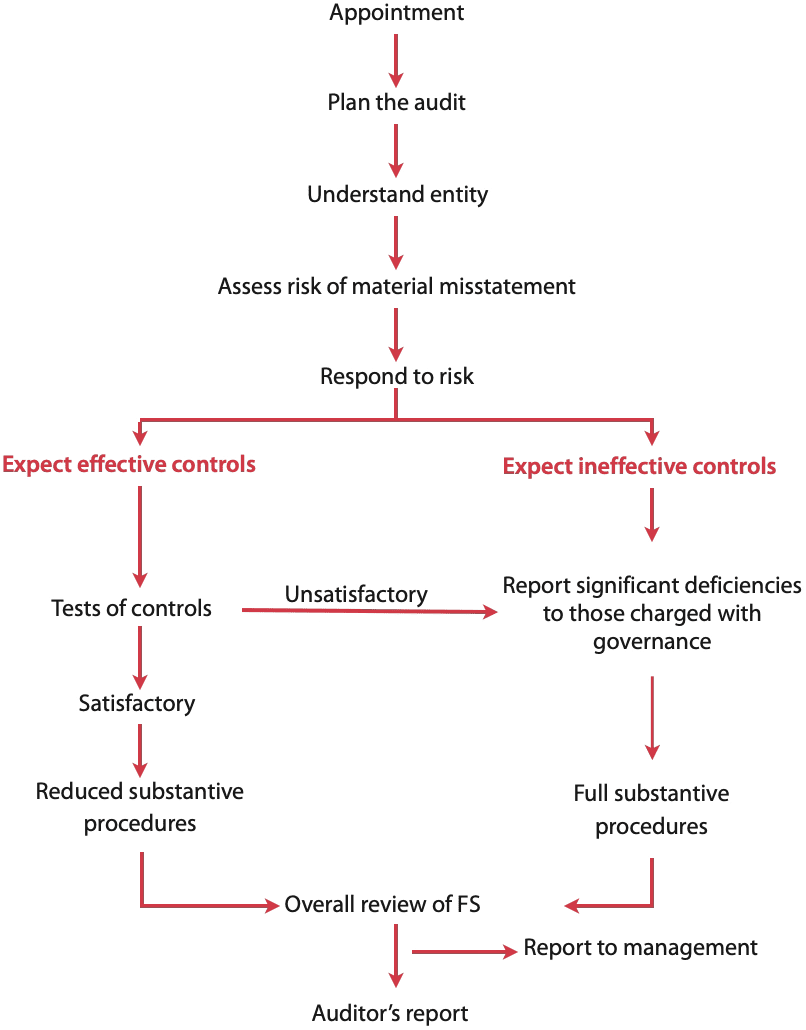
This is an important and useful diagram and it sets out the stages or approach to an audit.
2 Marketing professional services
The ACCA 's Code of Ethics and Conduct states that professional accountants can inform the public about their services using advertising and other form of promotion, subject to the general requirement that the medium shall not reflect adversely on the professional accountant, ACCA or the accountancy profession.
It is recognised that there can be a conflict between some of the ethical principles, for example, a self-interest threat and complying with the principle of professional behaviour.
The professional accountant in public practice must be honest and truthful and must not:
Make exaggerated claims for services, experience etc or be misleading in other ways.
Make disparaging references or unsubstantiated comparisons to the work of another.
Bring the ACCA, the accountancy profession or other accountants into disrepute.
If fees are mentioned, promotional material must state the basis of charging and great care has to be taken that readers are not mislead about the services offered and the fees that will be charged. It is possible to compare fees with those of other firms provided the comparison is not misleading.
If commissions are paid or received (for example, by recommending software package), full disclosure of the commercial arrangement must be made.
3 Tendering for professional services
Often, to obtain new work, accountants will be asked to submit a tender in competition with other firms. Before submitting a tender, contact must be made with the existing or previous accountant (see section 5, below) to see if there are any reasons why the appointment should not be accepted.
The fees quoted can can be whatever the accountant thinks appropriate, but there can be threats to compliance with the fundamental principles. For example, if the fee were so low that it would be difficult to carry out the work to the required standard of competence and due care. The IESBA states that:
Auditors should perform high quality audits irrespective of the audit fee charged.
Adequate time must be planned and spent to enable the audit to be performed in accordance with the technical and professional standards.
Audit personnel with appropriate expertise and experience should be assigned to the work.
Two-way communication between the auditors and those charged with governance (TCWG) to mitigate the threats that can arise from fee pressure.
There is no set format for a tender document, but a little thought will show that something like the following would be usual for a tender for audit work:
A brief introduction to the accountancy firm.
Areas of expertise and specialisms.
A reiteration of the requirements of the client (to confirm understanding) and suggestions for other work that might be needed.
An outline of the proposed audit approach. For example:
Planning.
Assessment of the system of internal controls.
Testing internal control and reporting on control weaknesses (interim audit timing might be suggested).
Possible use of internal audit for some aspects of the audit.
Timing of the final audit and suggested dates for auditor’s report signature.
Work do be done at the final audit stage (eg attend inventory counts at certain branches etc).
Planned use of computer assisted audit techniques.
An outline of the firm's system of quality management to ensure that a ‘good’ audit will be performed.
Key partner’s and manager’s name. Details of audit team composition.
Fee and the basis of its calculation. Invoicing arrangements and terms of payment.
Any other services (that are not prohibited) that the firm may provide (eg corporate financial advice).
4 Before you say ‘yes’ (and continuance decisions)
It is, of course, flattering to be asked to be the auditor of a company. Now only does it feed one’s ego, it also promises more income for the firm. However, auditors must exercise great caution: they must be confident that they can carry out the work profitably, ethically, competently, incurring an acceptable level of risk and avoiding damage to their reputation.
The following need to be investigated:
Are they professionally qualified to act? Is it legal and ethical for them to do so? For example, they shouldn’t accept an appointment if the fees exceed the 15% limit for public interest companies, unless there are adequate safeguards. Are there issues of familiarity or self-review?
Do they have adequate resources in terms of staff, time and expertise? Can the new work be carried out when the client wants without adversely affecting existing clients? If the potential audit client acts in a specialist area of business and the auditors have no prior experience of that, it would be very unwise for them to accept the appointment.
Investigate the client, its management and directors. Many firms of auditors have access to databases which, for example, will allow them to search on directors’ names to see if any of the directors have been banned from being directors of companies because of their past behaviour. They may discover that it is too risky to become the auditor of a company if they have no trust in the honesty of the directors. The audit fee is often modest, why risk your reputation by undertaking an audit where the directors may be fraudulent?
Consider the nature of the industry or business. If there is a risk of criminal involvement or money laundering it might be better to stay clear.
Money laundering regulations (covered in a later chapter) require auditors to ‘know their client’: ownership, commercial rationale, sources of funds etc.
Communicate with present auditors. There is a professional requirement to do this and it is essential to find out why the old auditors are retiring or being removed.
Consider politically exposed persons. These are people who have or who have had positions of political influence. For example, politicians, senior military personnel, senior civil servants. Unfortunately, there is a history of many of these individuals having profited from corruption and they might still have influence that permits the misuse of public funds, the improper awarding of contracts and large-scale money laundering.
The potential client’s credit-rating.
Preconditions for the audit: will the financial reporting framework used be acceptable and do management understand and accept their responsibilities for preparing the financial statements and for supplying the auditors with all the information they require?
5 Communication with existing auditors
If the auditor is approached by new audit client, if it’s a new business and this is the first audit there will be no previous auditors to communicate with and new auditors must make their own decision.
If it is not a new business and there is an existing auditor then the new auditor must ask the client for permission to contact the old auditor. If permission is not given, the appointment should be declined. Why would permission not given? Is a client trying to conceal something? Why else would they not allow a new auditor to communicate with the existing auditor?
Assuming permission is given the new auditor will write to the old auditor for information. The old auditor can’t simply send that information to the new auditor because that is confidential, and the old auditor has to ask the client for permission in turn. If that permission is not given the new auditor should decline the appointment because again the client is trying to stop communication between the old and new auditors.
If the old auditor provides information then the new auditor is more fully equipped to make their accept or reject decision. If the existing auditor decides not to provide information the new auditor should try to persuade the old auditor to provide it, but otherwise might have to rely on information as been found in other ways.
6 The engagement letter
Upon appointment, auditors should send an engagement letter to their new client.
Engagement letters are often regarded as rather dull documents, sent once and then forgotten. However, they are of crucial importance because they set out the contractual relationship between the auditor and the client. If the engagement letter is not sent out it’s very difficult for an auditor subsequently to complaint that the client hasn’t done what was expected, or it might be difficult for the auditor to defend the firm against a claim that the auditor has not done what was expected. Engagement letters:
Define the auditor’s responsibilities
Provide written evidence of the auditor’s acceptance of the appointment.
Should be sent to the board of directors or audit committee prior to the first audit.
Identify any reports to be produced in addition to the auditor's report. For example, for banking or insurance clients who may come under additional scrutiny.
Should be updated for all changes. For example, if the auditor begins to undertake tax work for the client.
7 Typical contents of an engagement letter
Description of the objective of an audit: to obtain reasonable assurance whether the financial statements are free from material misstatement and issue an auditor's report that include an audit opinion.
Defining responsibilities: management’s are to prepare the financial statements and to set up a system of internal control. It is the auditor’s responsibility to audit the financial statements.
Reference to the applicable financial reporting framework. For example, national legislation (eg companies act) and/or IFRS.
Emphasis that audits depend on sampling that there are no guarantees. The audit looks for only material misstatements. It will examine records on a test basis that can only give a reasonable assurance.
The auditors will state that they expect unrestricted access to the company’s records and they expect full explanations for any queries they might have.
They will state that the auditor’s report is a matter between them and the addressees of the report (the members of company) and that it should not be relied upon by other parties.
There will be certain matters about planning the audit, such as arranging the interim audit and final audit, attending inventory counts, organising external confirmation of receivables, and liaison with the internal audit department.
Almost certainly there will be something about fees. They should be estimated but subject to the proviso that if more work needs to be done, it will be done and additional fees will be required.
Description of the expected relationship between the external auditor and internal audit; how the work of internal audit might be reviewed and then relied on by the external auditors.