
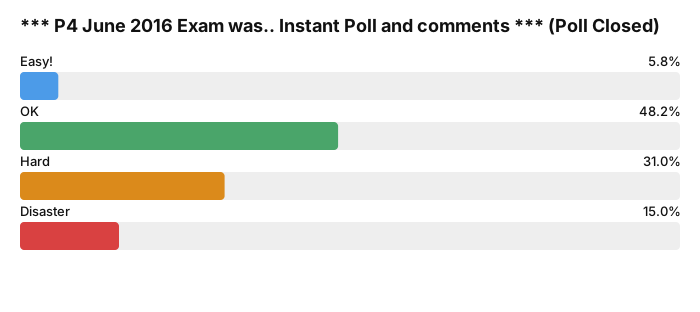
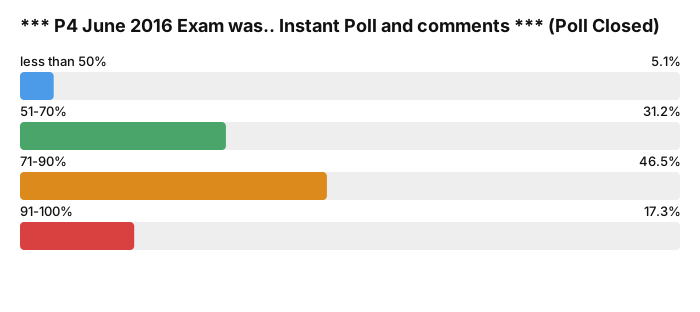
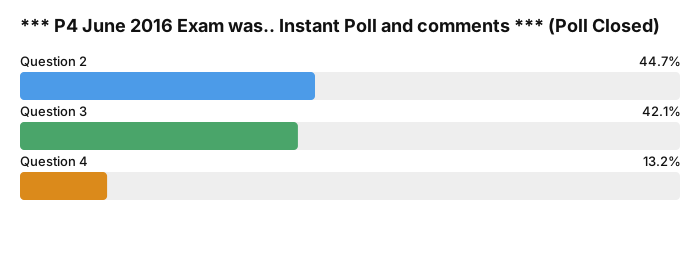
Please vote in our Instant Polls about the P4 June 2016 Exam.
ACCA Forums
 Former user10y ago#61Former user10y ago#62
@nkmile64 said: Did anyone manage the VaR question? It asked the confidence interval for the final outcome not to be negative, which means we first had to find the probability of the outcome being between 0 and the mean of 6.5. With a std. deviation of 1.3, the std. variable is z = (x-m)/s =(0-6.5)/1.3 = 5 However, the Tables provided in the exam stop at std. variable 3!. Does anyone have a solution for this?You did the same as I did in the exam... the $6.5m NPV was for the whole project life, so didn't need to times that by the 7 years, just needed to do the square root of 7 x 1.3^2 and divide $6.5m by the answer to give the number of standard deviations (approx 3.44) 6.5/3.44= 1.89 in the table - which is 0.4706. Add 50% to give 97.06% confident cashflows won't be negative. I'm kicking myself now as it was 4 easy marks wasted.
@ineves said: Finance effect cant be annuity because it has to be translated into USD first at different exchange rates before discounting so will result in different cashflows each yearI'm pretty sure the loan was already in USD (given by the "world bank") so you use the 13% (risk adjusted, 100% equity financed) rate to discount the cash flows and then worked out the financing side effects of the loan. Before that I worked out the cash flows in the foreign currency, converted these into USD using the relevant exchange rate, then added the income in USD from the parts sold to the subsidiary (post US tax). I think the question said something about the tax being mutually exclusive, i.e. once you've paid tax in one country you don't have to pay it in the other, despite the different rates. What did people use for the loan amount? I remember the bank saying that they'd fully fund the land, plant & machinery costs so I used the total of that + the initial working capital. Wasn't too sure what to write for the part regarding the "business risk" either!
Former user10y ago#67@nkmile64 said: Oh no! I missed completely the fact that the std. dev. was on an annual basis! I just hope that these 4 (?) marks don't make the difference between a pass and a fail.he will give u marks for your workings and explanations..you'll be fine mate....
@junaid100 said: can any one suggest me how to manage the time in optional papers...because i only attempted 75% P4 paper even i can further 25% paper but couldn't due to time off.Hello Junaid, It seems obvious, but the only real way to manage time is to practise, practise, practise exam questions until you are able to complete them within the 90 / 45 minute limit. However, if you are completely unable to do that, then my advice is to not go over that time limit. If you can only complete 40-45 marks (of Q1) within 90 minutes, then stop and move on to the other questions. Its better to sacrifice the 10-5 marks and go for the other 50 marks, than to spend even an extra 5 minutes on those 10-5 marks, and potentially lose out on more marks elsewhere because you ran out of time. In the exam on Friday, I overran by just 5 minutes on Q2 (1st question I attempted), and it caught me out at the end, and I was unable to catch up the time and finish Q3. Hope that helps, and if you took an exam last week, hope you get 50+!
@lotak said: How do the ACCA decide which questions to include in the hybrid paper?! Of the 4 questions, 3, including Q1, are from the March 2016 paper, and only 1 optional question is included from the June 2016 paper. This is just stupid. It should be Q1 + 1 option from one paper and 2 options from the other paper. This makes 75 marks from one paper and 50 marks from the other. Ridiculous ACCA.Q2 & 3 in the hybrid were from June 16 and Q1 and 4 were from March 16
@killip123 said: Q2 & 3 in the hybrid were from June 16 and Q1 and 4 were from March 16Yes. I just realised that. I retract my statement. My bad. I was hoping I could delete the post before someone quoted it!
@killip123 said: You did the same as I did in the exam... the $6.5m NPV was for the whole project life, so didn't need to times that by the 7 years, just needed to do the square root of 7 x 1.3^2 and divide $6.5m by the answer to give the number of standard deviations (approx 3.44) 6.5/3.44= 1.89 in the table - which is 0.4706. Add 50% to give 97.06% confident cashflows won't be negative. I'm kicking myself now as it was 4 easy marks wasted.I did it differently: VaR = N (confidence level) x s x square root T for confidence level 95% the number of standard deviations is 1.645 (from the tables) s - annual standard deviation of project returns T - number of years So VaR = 1.645 x 1.3m x Sq.root 7 = $5.66m, which is potential monetary loss and is below the project's NPV of 6.5m So at the given level of confidence the project is worthwhile.
@sergeykos said: I did it differently: VaR = N (confidence level) x s x square root T for confidence level 95% the number of standard deviations is 1.645 (from the tables) s - annual standard deviation of project returns T - number of years So VaR = 1.645 x 1.3m x Sq.root 7 = $5.66m, which is potential monetary loss and is below the project's NPV of 6.5m So at the given level of confidence the project is worthwhile.They didn't ask for the loss at 95% confidence. They asked for the confidence level for a break even NPV. So you needed to work out the confidence level with a VaR of $6.5m 6.5m = N * 1.3m *Sqrt(7) Rearrange to give N = 1.89 Looking at the Normal Distribution table, 1.89 gives 0.4706. As its positive, add 0.5 to give 0.9706 = 97%
Former user10y ago#80