ACCA Forums
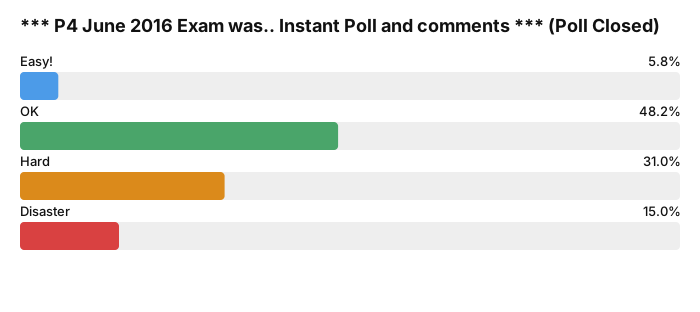
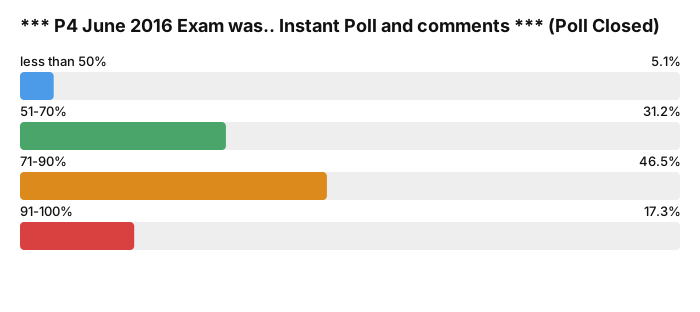
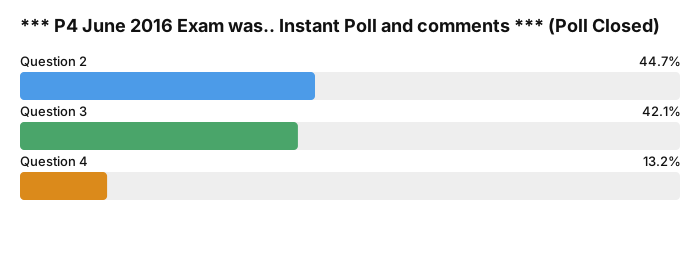
AFM*** P4 June 2016 Exam was.. Instant Poll and comments ***
Mariam my answers are exactly matching with yr ans
I also assume that the project is wholly equity financed .. and did you convert the real rate in nominal ?
Can any one just convert the 13% into the nominal rate and my ans was 16 %
can anyone tell me how VAR was calculated? question wanted it at 95% confidence level which is 5% probability.
and half people are saying Q1 was APV (bcs of subsidised loan, specific project's financial appraisal and ungeared Ke) and half Int'l Investment Appraisal (bcs of tax rates, tax treaty, exchange rates stuff). what was it actually?
in Q2 FRAs seemed better in all cases
@manulik8 said: what about Var who remembers? I just calculated Var at 95% and commented. what about you ?</
For 2) The future it was 4.40 plus 0.50 less the gain on the futures which was 0.30 i believe so the rate would have been 4.60 and then wen rates went down you wud have made a loss on the futures.
I also assume that the project is wholly equity financed .. and did you convert the real rate in nominal ?
No I have not adjusted this rate I have thought that this is the rate to use for discounting. Do not remember if there was said that it is the real rate, if it is the case than taking into accoun inflation will be correct.
FRA gives the most beneficial rate if interest rate rises, but if they fall than option will give the best outcome. I also mentioned that FRA has credit risk. And if the company is happy with it and thinks about to protect against unfavorable outcome than FRA should use. If unhappy with credit risk than futures.
And if wants to benefit from IR decline than options, but premium need to be paid in case of options.
Also I stated that we assumed no basis risk, no transaction costs, no margin to be paid. So before taking final decision take these into account.
var= standerd div *z
95 confidence ris 5%
z= 165
var = 1.3 *1.65 =2.145 so it is positive
but i not finish it
fpr fra locked rate 4.75
but for future contract 35
but i do buy future at sept rate 95.65
and do call option mistak
q 1 okey but i used 13 as df for project and forget aditioal tas
q 3 not good for time presure
Fair exam set. Of course not fair time-wise, as usual, but fair to gain a pass.
In my personal opinion, the 15 minutes reading time should always be spent solving the first question, specially when you see numerical like NPV calculation.
I found the first question on NPV a bit tricky but I had decided that I will not let the feeling of "Where am I going wrong?" ruin the exam. Once you set the plan of solving the answer in your 15 mins time, I believe, you should just keep moving. The important part is to attempt as much as you can as you race with time.
Hoping everyone the best
fra give sam as we used fra 4v9 at 4.25
incear interest to 4.4
pay (libor+.5) =4.9%*21m*5/12 =428750
comp from bank
(4.4-4.25) .15%*21m*5/12 = 13125
net int pay 415625
eff 415625/21m*12/5 = 4.75
decrese to 3.7
pay (3.7+ .5) 4.2% *21m*5/12 =367500
comp to bank (4.25-3.7) .55% *21m*5/12 = 48125
net pay 415625
sam
Guys,
Do you actually calculate gearing based on Market value of equity instead of book value? (Q3C)
Oh gawd, just when i thought there is hope for a borderline 50, now its guaranteed fail T.T
And for Q1, I sulk big time on the timing of funds for the capital expenditure, i ended up with Y0 and Y2 instead of Y0 and Y1.
@stacky said: Guys, Do you actually calculate gearing based on Market value of equity instead of book value? (Q3C) Oh gawd, just when i thought there is hope for a borderline 50, now its guaranteed fail T.T And for Q1, I sulk big time on the timing of funds for the capital expenditure, i ended up with Y0 and Y2 instead of Y0 and Y1.well, If there is book value of the equity, you can use that. Am I missing that? is there any book value of equity given in the passage?
spent 15 mins rap time for q1
spent 2 hours full doing q1
i only had 1 hour left and 2 questions to do
spent 45 mins doing q2
15 mins left no time to read the whole scenario so just wrote benefits and drawbacks of acquisition
overall, q1 & q2 were straightforward and should be easy for many but q1 was extremly time pressured, struggled to do apv calculation right
q2 time was already running low so had to amend the answers again and again, first thought no need to add 0.5 but later realised we need to..futures gave fav. result than FRA (i am afraid if it is right), options if int rate decrease would have the lowest cost
q3 had not time so could not produce calculations but requirements were not straightforward i guess
i am thinking i would marginally fail so sad, thinking to switch to p5 if i fail this time
buy put or buy call?
buy future or sell future?
Did anyone manage the VaR question? It asked the confidence interval for the final outcome not to be negative, which means we first had to find the probability of the outcome being between 0 and the mean of 6.5. With a std. deviation of 1.3, the std. variable is
z = (x-m)/s =(0-6.5)/1.3 = 5
However, the Tables provided in the exam stop at std. variable 3!. Does anyone have a solution for this?
VAR=STD×Tail Value. So VAR=1.3×1.65
I passed p4 last sitting with bang on 50%- first time, by following tutors advice of just answering everything- even if I didn't know how to do calculations- ie attempt calculation, get answer and then analyse that- you get marks for discussion and reasonable suggestions etc. Was tough, didn't finish the paper but it worked. The professional papers are about showing you can prioritise your time and analyse info. Always remember, what feels like a disaster may not be. Many a time I've thought I've failed and managed a pass. Be positive and don't worry for now. If you have done the work, you could do no more!
Also tackle the easy bits first! Ie any of the advantage and disadvantages type questions, bits that can score easy marks easily, giving you time to do calculations!
Ahmedmirza- Yes, I agree with you!
Guy's, there is a reason why P4 is the hardest, toughest paper in ACCA, along with P5,
The "Mediocre" P4 paper you get every once in a while is not easy, its just the normal 'hard' that P4 usually is, what is expected...
so this time it wasn't as disastrous as some of the past papers have been & therefore the P4 paper that comes next in Sept will be a lot harder than this..
You can just look at some of those questions like Nahara Co. for example! If it werent for Mr. Awesome John Moffat, i would never have understood nor even attempted that kind of a question after looking at it...& that is P4 !!
@naveedali24 said: Can any one just convert the 13% into the nominal rate and my ans was 16 %
@naveedali24 said: I also assume that the project is wholly equity financed .. and did you convert the real rate in nominal ?wait what? what real rate? what nominal rate?
@hailey11 said: buy put or buy call? buy future or sell future?We are borrowing money, worry that interest goes up. So we need to sell interest futures, so if interest goes up, futures price will come down, since we sell at a higher price, then now we can get a gain when we close the position by buying it back at a lower price. Put option too, since we want an option to sell
@nkmile64 said: Did anyone manage the VaR question? It asked the confidence interval for the final outcome not to be negative, which means we first had to find the probability of the outcome being between 0 and the mean of 6.5. With a std. deviation of 1.3, the std. variable is z = (x-m)/s =(0-6.5)/1.3 = 5 However, the Tables provided in the exam stop at std. variable 3!. Does anyone have a solution for this?I made the assumption that , the confidence level in which the NPV will be 0. So the maximum loss will be the current NPV of 6.5m then we need to amend the VAR Formula to: 6.5m = K (1.3m)(Squareroot of the project duration) was it 7 years? sorry cant recall. you should get the K equals to 1.88/1.89, if u refer back to the SD table, that will gives u between 0.4699 and 0.4706 You could do the exact and get the value, but due to time constrain, i had to do it quick and assume its a rounded up 0.47 (probably lose some marks). Referring back to the normal bell curve, u will need to +0.5 to it, which gives u 0.97 (97% confidence level) Sorry, i only rmb how it should be done, i am not competent enough to explain why we do it like this.
Did the same thing for Q1 and Q2 same answer.. Did not get enough time for Q3 just answered 5 marks. Crossing figures that just get 50 out of 75-80.. But seems quite difficult. Am afraid might fail marginally ...
Any one did question 4. Didn't find any comment on qus 4. Was it simple evaluation with some normal inc dec calculation ?? I did it in this way.
Re discount rate to be used in NPV - I had a thought last night re the 5%. Given that the WB was involved I think it was to be treated as an under developed country and therefore to use the 13% given was incorrect as it wouldn't take account of the risk involved. I now think it should have been 13% + (5% - T).
I used 13% as it was APV
did any one try number Qn 4 what did they actually what?
a struggling company with many department (nation, local,staple etc) that it wanted to dispose off, offers made using net assets method, then FCF Qn was confusing
hello, please give me some heads up on topics that were tested. Thank you.
I'll try) On the whole: Number 1: APV for international project (translation from its currency and etc.) Maybe a little unusual because cost of capital was given, APV to guess. Number 2: a) classical interest rate risk (forward, futures, options), to calculate net costs of borrowing and effective interest for each. Number 3: M&A: calculate gearing and EP for three options of payment (by shares, by cash, by shares 60% and by cash 40%)
@manulik8 said: Q1 Fair and time pressured, used APV. Q2 FRA 4.25+0.5=4.75% Futures 4.8% Option 4.91 and do not remember. Q3 was disaster !!!Mariam, as be advised by John, the FRA should be incorporates the credit spread already, therefore the FRA should be 4.25% only
Sign into reply to this topic.