Skip to contentSkip to search

ACCA Forums

AFM*** P4 December 2014 Exam was.. Instant Poll and comments ***

Oopentuition_teamAdmin11y ago

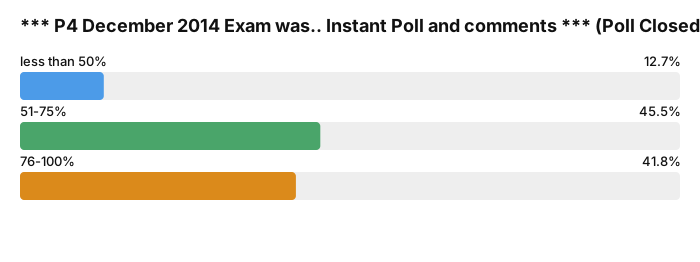
Please vote in our Instant Polls about the P4 December 2014 Exam.
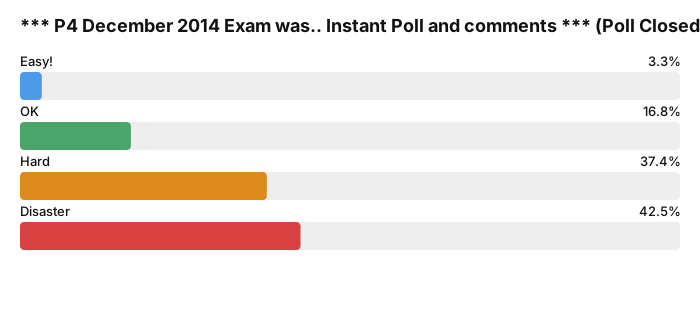
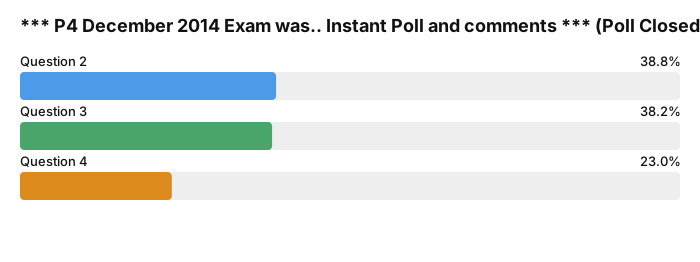
*** P4 December 2014 Exam was.. Instant Poll and comments *** poll results *** P4 December 2014 Exam was.. Instant Poll and comments *** poll results *** P4 December 2014 Exam was.. Instant Poll and comments *** poll results Please note, the ACCA have asked us to allow posting comments only after 5pm UK time.
Llzy_jzy11y ago#31
Also about why the co would want to be set up in the EU free trade zone.
Llzy_jzy11y ago#32
What a paper.... I haven't felt this bad about an exam in ages and I actually like/understand the syllabus! =(
TToyosi11y ago#33
I am sincerely gutted! I studied so much I thought what question will they bring that I won't be able to answer? I was soon to be proved wrong! Indeed nothing prepares you for the level of difficulty to expect in the P4 scenarios. I can't seem to get over that Q1.
Former userFormer user11y ago#34
@lzyjzy said: For q1 I calculated the probability of each scenario (scenario 1, 60%, scenario 2 25% and scenario 3 15%) and took a weighted average of npv.
Was it correct? As I remember 50% that the return would be 40%. If it's the high case, then 20% that return in Y2-4 would be 40%. Anyone please confirm and tell me how you did it?
FFelix11y ago#35
@brizraj said: Hi Felix Refer to the examiner's answer for Dec 12 Q1 Coeden Co Same approach was required. It is some sort of weighted average
Thanks, meaning I need to sit for the June exam. my approach was Beta Asset^2 = Beta non-lux^2 + beta lux^2 never thought that it would be as easy as weighted average the beta.
Former userFormer user11y ago#36
@felix Thanks.
Vvinograd11y ago#37
So many topics which required long detailed calculations were covered in Question 1. The examiner made it as difficult as only possible. Apart from calculations which we are expected to be able to perform under the syllabus, we had to find out some numbers for this calculations in the mess of unclear info, make guesses what the examiner really wanted from us under the examination time constraint. In question one it was unclear whether to discount the project at cost of equity or to use WACC. At first I discounted cahflows at ke, but then I changed my mind and calculated WACC. I stopped several times during question one and thought that I might had been doing something wrong... Question killed my brain and motivation to go on. I started question 2 and did not even attempted any other question.
Former userFormer user11y ago#38
Felix, you had a percentage of 15% for the luxury business. So the rest is 85% other business, like a weighted average....
FFelix11y ago#39
@vinograd said: So many topics which required long detailed calculations were covered in Question 1. The examiner made it as difficult as only possible. Apart from calculations which we are expected to be able to perform under the syllabus, we had to find out some numbers for this calculations in the mess of unclear info, make guesses what the examiner really wanted from us under the examination time constraint. In question one it was unclear whether to discount the project at cost of equity or to use WACC. At first I discounted cahflows at ke, but then I changed my mind and calculated WACC. I stopped several times during question one and thought that I might had been doing something wrong... Question killed my brain and motivation to go on. I started question 2 and did not even attempted any other question.
I think it should be Ke as the cash flow given were FCFE?
Vvivkam11y ago#40
Decision trees, black scholes all in q1??? The confusion is that most questions we did in revision or past exams you have to calculate the FCFE from sales revenue/op cash flow less interest etc. They already gave the FCFE! On top of that there was ROI and changes in FCFE. Where does the put call option come in here and how is it used? I did not know what to do with the probabilities, I completed ignored since that would be under expected valued and probability analysis.
Llzy_jzy11y ago#41
@hale said: Was it correct? As I remember 50% that the return would be 40%. If it's the high case, then 20% that return in Y2-4 would be 40%. Anyone please confirm and tell me how you did it?
Can't say if it was correct. But I took 75%*80% for probability of the first scenario as that would be the probability of both normal growth in the first year (100-25%) AND (multiply) normal growth in the second year (100-20%)... Made up a standard deviation figure for input in the option pricing model. No time to think!!!
TToyosi11y ago#42
Yes I do agree the proxy beta is a weighted average but we must first ungear the equity beta for the luxury business before adding it on to the asset beta for the non luxury business to get the combined asset beta which is the weighted average using 85% and 15%.
TToyosi11y ago#43
Where does the put call option come in here and how is it used? I did not know what to do with the probabilities, I completed ignored since that would be under expected valued and probability analysis.</blockquote The put option was the Lumi offer, means option to abandon(put option) and sell to Lumi for $50m (I think)
Former userFormer user11y ago#44
Hei guys, i used FCFE to calculate the market vale of the company, after that the WACC should have been used to discount
TToyosi11y ago#45
@kamdarvivek said: Decision trees, black scholes all in q1??? The confusion is that most questions we did in revision or past exams you have to calculate the FCFE from sales revenue/op cash flow less interest etc. They already gave the FCFE! On top of that there was ROI and changes in FCFE. Where does the put call option come in here and how is it used? I did not know what to do with the probabilities, I completed ignored since that would be under expected valued and probability analysis.
The put option was the Lumi offer, option to abandon and sell the project to Lumi for $50m (I think).
KKingping11y ago#46
am i right in saying mr gordon was in this exam aswell ,so in one question basically nearly the whole forumla sheet was tested plus more lol
Former userFormer user11y ago#47
Also i had lost time to calculate the market value of debt, as the interest rate was 5,4 but the market rate for B rated companies was 4,8......
Wwilliams197711y ago#48
Can someone please clarify in Q1 the question said something like "the share price is $7.5 which is a multiple of 7.2" and they hope earnings will be a multiple of 7.5? Was this just a red herring, false information there to mislead us
Former userFormer user11y ago#49
I really cannot understand what is this examiner think we can do in 3 hours .. this exam is disaster in all the word meanings ...and cannot be completed in 3 hours
Former userFormer user11y ago#50
yah gordon growth model had to be used (the question 77.3% was remitted and the remaining was kept for future investments) @toyosi - you are right in what you said. I didnt even attempt this part as didnt know how to get the standard deviation
Former userFormer user11y ago#51
Paper was challenging guyz, but, I ddnt panick, I remain composed, started with question 2 then moved to qn 4, , by the time, I finished, being confused, n vafter waffling, @ times, I had 1:30, in full 4 qn, 1, n wat was my approach to qn 1, I guess, I had scored, 25-35 marks, so in qn 1, needed, 25marks, I only calculated wat I know, estimated discount factor(10%), n concerntrated on confusing written parts, The calculation part of the exam was terrible Don't panic, with Acca, I think, the examiners @ times are asking qns, outside the. Scope of their syllabus, I 1st learn n to believe u can score less than 50%, in an exam, after you have read a textbook, cover to cover n dd 90 past qns, with Acca, Its high time we engage Acca, on level of difficulty and syllabus coverage, confusion!!
Vvivkam11y ago#52
even if this exam was 4 hours dont think there is still a decent chance of passing since the information was there to completely confuse you in many different ways most people spent more time thinking than writing - dont understand what is the point of doing past exam questions if it is not similar.
TToyosi11y ago#53
@Williams1977, that sentence threw me off balance. I found the MV of equity which was 7.5 x (800/0.5) then I thought...now what? What do I do with this multiple? So I multiplied it by the MV of equity to give me the Freecashflow. But then at the last minute, I thought the multiple might be the growth for the Freecashflow so I CANCELLED my valuation and did MV x 1.072 instead, my gut instinct tells me I am wrong!
Former userFormer user11y ago#54
I sat there for around 3 hours and lost around 45 mins trying to understand question 1 and thinking what to write.This is the worst paper I sat so far. Terrible !!!!
TToyosi11y ago#55
@brizraj, to be honest I just assumed the standard deviation had to be the second one which affected the cash flow from year two if the project grew according to plan in the first year, also coupled with the fact that Lumi wants to buy the tourism project at the start of year 2.
Former userFormer user11y ago#56
Mee too, but i think we should also use the first year probability though....
Wwilliams197711y ago#57
I calculated market value of debt to be $102 (plus some cents) did anyone get the same?
Former userFormer user11y ago#58
Use Ke (11% given) discount FCFE to perpetuity to calculate MV of equity of Co F. There was growth which I missed but he had given info on retained earning which can be used with Gordon growth formula to give u g WACC Use it to discount the project. Ungear the other company equity beta, do weighted average to get the beta asset of luxury biz alone. Regear using the MVE calculated above and MVD (we needed to calculate this as well) of company F, get ke and risk adjusted WACC. Real Option: What was your answer? As someone said above my calculation using probability was giving crazy results so I stopped. Also Pa amount was quite large. Q4. How many people read it and thought there was a mix up? It looked more like a P5 question, (which I will be taking next).
TToyosi11y ago#59
Yes I got the same @williams1977. Then I applied that on the book value of the debt to get the toral market value of debt.
Vvivkam11y ago#60
@Toyosi isn't one way of calculating standard deviation is the square root of variance - they gave the cash flows and the probability that the growth will reduce by 20%. The differences between each year are the variances and square root of that is the s.d. I am completely guessing here and shooting blanks but on a good day they could be generous and credit you for trying!
Topic lockedNew replies are closed.