FM*** June 2023 ACCA FM exam – Instant Poll and comments ***
Oopentuition_teamAdmin3y ago
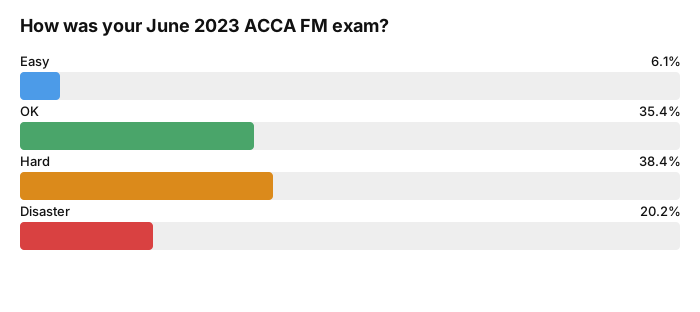
How was your June 2023 ACCA FM exam?
Vote in the Instant Poll
(Comments will be opened after 5PM UK)
CCeri3y ago#31
Wow, I feel incredibly lucky to have had the Working Capital Cycle / NPV calc in Section C - Sensitivity analysis sounds terrible! I'm a bit worried that I missed something in Section C though, because it did seem a little (dare I say it) easy...? Compared to past section C questions I'd studied... ?
Hope you all get good news in July! ?
AAnu3y ago#32
The sensitivity analysis question sounds like a nightmare. I got miller Orr, cash operating cycle, NPV without tax and capital rationing(divisible). It honestly felt relatively decent compared to the questions I saw in the mock and past questions. I also got theories like reasons for soft rationing, different motives for holding cash, how to reduce cash operating cycle.
The section A and B were a little tricky though. There was this pecking order question. I chose Retained Earnings
Debt stock (it is redeemable and negotiable so I assume it’ll be cheaper than a bank loan that is a lot less flexible.
Bank Loans
Equity.
Let me know if anyone answered differently.
NNeel3y ago#33
You were supposed to use "Cost of Goods sold" or Cost of Sales(For WIP and Finished) in other words for the Working Capital Question.
JJane3y ago#34
Yes I got the mcq on the forward exchange rate and money market hedging… I thought so many of the mcq’s were a lot harder than 2 mark Q’s.
Did anyone get the question on fintech? And stakeholders? It said true or false to bankers being connected and shareholders being internal.
I was confused by bankers and thought is it a trick question not saying a bank?
AArnesto3y ago#35
I had the same section C question, found it OK hope I did enough. section A was a disaster and section B was hard.
KKishan3y ago#36
I used the cost of goods sold, I felt the 90% purchases may have been a distractor.
I think I got 73 days as the cash operating cycle but I am not sure if it was the correct answer.
CCKQN3y ago#37
Hey, has anyone got the question about the effective annual rate in section A?
Question:
A company wants to invest the surplus funds. The nominal value of the loan note/ bond is $10000 and the current market value is $9938. The maturity date will be 45 days later. Assume 360 days per year.
Options given are 8.05%, 4.99%... (I could not remember the remaining two options given)
I have no idea about this question. Anyone could guide me on this?
AMAmar Malik3y ago#38
I guess
NNeel3y ago#39
The answer of the working capital cycle is indeed 73 days and the purchases wasn't a distraction it had to be used for calculating the payable days and also for the 6 marker analysis question that followed it.
KUKatrina Uupindi3y ago#40
which questions did you get at part 1 of section C
TTester3y ago#41
What was the outcome of Section C - Factor question (Working Capital)?
Was it beneficial for the company to accept factoring offer?
TTauqeer3y ago#42
yes i got the same question and it was my first section A question . i studied and revied cost of capital so so many times and was so confident regarding this part of the syllabus. i remember calculating risk adjusted cost of equity using Beta asset 3 to 4 times and none of my answers matched the options. and from then and there i was confused .
HBHoney Boo3y ago#43
Does anyone remember what they put for the futures contract? I think the option I selected was a 20k receipt from the bank
GGabrielle3y ago#44
I sat Financial Management last Friday June 9th.
There was a server connection issue in the computer classroom just 18 minutes into the FM paper.
We were delayed by 2hr30mins+ roughly 16+ students just sat in the hot exam room, waiting and hoping we could resume. From 1.50pm to 4.10pm
I have used this exam feedback function and also applied under mitigating circumstances and have had an email response to say "ACCA are aware of this issue and they have added £20 credit to my account as a gesture of goodwill." This is irrelevant to me as my employer pays for my tuition.
But I was wondering if a delay like this has happened to anyone else and what was the outcome?
MMichelle3y ago#45
This is my second sitting of FM, I had put in a lot of work to revision as I got 47 last sitting and really wanted to pass this time around. I found the paper a lot tougher than last time, some of the questions I had never seen the topics being asked in that way. I thought Section C was ok, sensitivity was tough and factoring/working capital was doable.
Second B was a disaster, really tough questions and took a guess at a lot of them. I really struggled with Section B at the last sitting and put a lot of work into revising it, but don’t think I did any better this time around.
Section A was ok, a lot of theory questions, and felt like large sections of the course didn’t even feature. Some really tricky calculations too, don’t think I have ever flagged as many questions as I did this time around.
I really really hope to pass, but Im not sure I answered enough correctly. The 6 week wait is a killer, wish they could get the results back quicker so that you could make a plan for the next exam. I find it really hard to get stuck into a new subject while waiting for results.
For Section C I got the Sensitivity Analysis question and Factoring Question.
Sensitivity Analysis
2a & 2b: For Sensitivity Analysis I wasn’t sure on how to calculate the sensitivity of tax, so using the NPV I adjusted the rate until I got a NPV = 0 results.
I used contribution/NPV to calculate sensitivity but I didn’t remove tax so likely have done it wrong, but I didn’t get the IRR bit so will get minimal marks in this section I fear.
2c. For the theory on the thoughts of the CEO, I tried to explain that S.A. used in conjunction with NPV can give the company a better understanding of the project etc, and tried to outline the pros of S.A. and then mentioned a few of the weakness too that its variables in isolation etc.
2d. For the limitations on accessing finance I outlined generic comments on this as there as very little information in the question, I tried to build on the fact that the market was volatile, hard to price future interest rate hikes etc, and the company could be highly geared etc, and SH might not want additional equity raised, that kind of thing. It was very generic, but there was so little to work off! I also commented on hard and soft rationing, in a general way.
Factoring
For the second question in Factoring, I worked out that the factoring would be more costing than the current situation with bad debts so not to go with the factoring company (question stated non-recourse). Given the sales amount and the 1.5% fee from the factor, it was more costly that the bad debts calculated at 0.5%. As part of this section I worked out the actual receivables days, and also the WACC for the factoring company cost of capital.
For second section I worked out the actual days and then the days saved. Then using the difference in days worked out the cost saving in terms of finance costs. I think I got 73 days like some others here.
Then the theory section of working capital financing and investing (cant remember exactly), I pointed out the difference between financing and investing, the use of LT and ST funding, and aggressive and conservative policy.
Section B
No. 1
Sisters owing an unlisted company -Brother wanted to invest and difference scenarios
For 1st question on preference shares, I just answered 8%, really not sure if that is right but I couldn’t figure it out. Pref shares are non tax deductible, and it was the only answer there that made any sense to me.
No. 2
Fx question. Found this incredibly tough, might have got first one right and maybe theory at end, but was really unsure about the others. Esp the difference in Monkey market v forward.
Section A
Cant remember all the questions but ones of note:
Re-Gearing
They gave the asset beta of a proxy company, so there was no need to de-gear, just re-gear using the proxy asset beta and our companies debt (less tax) and equity. I must have spend 10 minutes on this question as I had really revised it as its my second sitting and I didn’t know it at all the first time around. But that answer I got just wasn’t listed, and I was sure I was applying the formula correctly. I must have missed something. I took a guess at the end but was gutted as I spend a long time revising this topic.
Effective Exchange rate
Compare costs between forward and money market hedge. I did the calculation and was surprised that what I got was on the drop down list, but really unsure if I calculated it correctly. I thought it was a lot of work for a 2 marker
Fintech
Options were that it uses AI, big data and something else, cant quite remember.
Stakeholders
Was confused by this, it said bankers and if they were connected, internal or external. I thought connected, but the word bankers rather than banks confused me and I wonder if it was a distractor.
SSimeon3y ago#46
The answer to the working capital cycle is indeed 73 days and the purchases weren’t a distraction it had to be used for calculating the payable days and also for the 6 marker analysis question that followed it.
—
Isn't it for 3 marks?
1) Cash operating cycle - 6 marks
2) Analysis of how to reduce the Cash operating cycle - 3 marks
3) Miller - Orr - 5 marks
4) Cash Management motives - 6 marks.
Finally, can you tell me what base used for the calculation of the material days? I used the figure given in the question, so payables and material days were calculated with the same base.
SSimeon3y ago#47
You were supposed to use “Cost of Goods sold” or Cost of Sales(For WIP and Finished) in —other words for the Working Capital Question.
—
So, do you mean "Cost of goods Sold" and " Cost of Sales" is the same figure for the question?
This does not help me a lot, because I have calculated 60% markup instead of margin and used the wrong base for Finished goods and WIP days. Probably, this stupid mistake will cost my head on that exam.
SSaqib3y ago#48
@celinekoay Yes I had this question i chose 4.99
CCKQN3y ago#49
May I know how you solve that question? I have no idea until now...

 (Comments will be opened after 5PM UK)