
Skip to content

ACCA Forums

FM*** F9 June 2012 Exam was … Comments and Instant Poll ***

OopentuitionAdmin14y ago
Post your comments about June 2012 F9 exam.

?How did you do? What came up? How did this paper compare to previous exams?

Vote in our Instant Poll
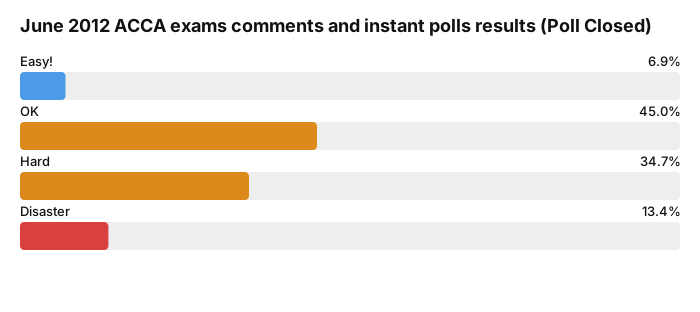
*** F9 June 2012 Exam was … Comments and Instant Poll *** poll results
Former userFormer user14y ago#61
Also,

Just last night I forced my baby brother to listen to me reciting the names used in Islamic finance...Just couldn't get it. He helped me by making me associate them with something. So Mudaraba was "MotherofAbba" or something...which is why I managed to remember at the last minute. So 5 marks are all thanks to him.

I'm thinking of forcing him to sit through my prep for P3 so he can help me with more memory jogs lol.
Former userFormer user14y ago#62
I had time issues having spent one hour each on Questions 1 and 2.
Did Q3 and 4 in a panic and was sweating when I couldn't see what dividend and growth to use in Q4 - just made assumptions e.g.3% growth rate - doesn't sound right though!
Hopefully enough done to get through the exam however!
Former userFormer user14y ago#63
royyston said 1 hour, 25 minutes ago:
Oh yes, my bad. I think I put a forward contract too cos most of the questions I attempted previously were always forward contracts rather than a mm hedge.


gosh, i did the same mistake
Former userFormer user14y ago#64
@mkate said:
gosh, i did the same mistake

Hmm so it was a forward contract, yes?
Former userFormer user14y ago#65
Question 4 was disaster! How to find dividend & how to calculate dividend!
Former userFormer user14y ago#66
royyston said 2 minutes ago:
@mkate said:
gosh, i did the same mistake
Hmm so it was a forward contract, yes?


But, let me think over. Isn't it to calculate the USD cost to receive the euro? I still believe should be money market.
Former userFormer user14y ago#67
1a) NPV, I think I messed up for the inflation rates portion, but still managed to obtain a positive NPV. 1b) EAC= NPV/Annuity factor, tax & CA were ignored so pretty straightforward, should be machine 1 as EAC is cheaper. 1c) Theory- Sensitivity analysis – “What If” analysis to identify critical variables where NPV = 0, probability analysis – choosing the best outcome of each project.

2a) Overtrading- 7 symptoms of overtrading. 1) Rapid increase in sales, 2) Decrease in GP margin, 3) Deterioration of quick and current ratio, 4) increase in inventory days, receivable days, payable days, 5) Asset turnover increased, 6) Overdraft increased, finance costs increased. 7) No change in equity shares, no change in L/T debt. Compare with industry average.

2b) Compare and contrast wc financing policy vs wc investing policy- made a little link to conservative, matching and aggressive policies. short-term/long term in nature.

2c) Miller Orr Model- Upper limit calculated wrongly :)

3a) SMEs vs large companies- define agency problem. lack of finance for SMEs, risk is not as high as large companies.

3b)Debt finance and factors- ??

3c) Mudaraba- Equity financing. Emphasised that it is similar to public issue, private placement, rights issue etc.

3d) Money market hedge and forward market hedge. Should be money market hedge as it is cheaper.

3e) PPP theory, calculated spot rate wrongly. :)

4a)P/E ratio- ?

4b) Ke- Use Capm to find Ke first by plucking in values like Rf and the risk premium. Next with Ke, use DVM to find MVE. Hope it is correct.

4ci) WACC- Ke from part(b), and Mve from part (b) + Kd (given) and Mvd by using proportion because of 75% vs 25% on market value basis. After which can derive WACC. WACC= 10% if I’m not wrong ii) Risk adjusted WACC, Ke changes- find new Ke using Capm formula. Kd is given once again. After which derive both Mve and Mvd by using proportion, this time 60 %, & 40%.. WACC = 10.3%. Discuss variation.

4d) Management of risks (Business, Financial & Systematic)- Totally gave up on this one. :)
Former userFormer user14y ago#68
how was the inflation to be appplied in the q1 sales volume ?
like 1,04^2 for year two ?
Ddarkangel514y ago#69
It was average.
Big thanks to opentuition and John.

What is the answer for the 2nd part of Working capital?
Question was something like differences and similarities between
1, Working capital investment
2, Working capital finance

And what is the answer for Q4 section 4?
Former userFormer user14y ago#70
@mkate said:
But, let me think over. Isn't it to calculate the USD cost to receive the euro? I still believe should be money market.


The home country was using $'s

Company wanted to receive 500 K euros...

So in money market hedging...

the steps would be

1. Apportion interest rate of buying euros (higher rate)
2.Buy Euros
3.Convert euros to dollars
4.Apportion interest rate of depositing dollars (lower rate)
5.Deposit dollars

I think for me, forward contract was cheaper. Don't remember anymore. I'm glad it's over.
Former userFormer user14y ago#71
@zohaibahm3d said:
how was the inflation to be appplied in the q1 sales volume ?
like 1,04^2 for year two ?


Sales Price x (1.04)^2 for year two :) ----if indeed, 4 percent was the inflation rate. Don't remember
Former userFormer user14y ago#72
wow it was indeed 4% it means i did good among many who told me that it was to be applied with sales price X 1.04 irrespective of whichever year !
Former userFormer user14y ago#73
@zohaibahm3d said:
wow it was indeed 4% it means i did good among many who told me that it was to be applied with sales price X 1.04 irrespective of whichever year !


Why would one do that, where inflation is concerned?
Anyway, hope I am right...and that my concepts are brushed up.
Otherwise I'll have something else to worry about, because investment appraisal is supposed to be the topic I am strongest in
Former userFormer user14y ago#74
I went blank with Q1 as to which nominal rate to use. I used 7% for the NPV of the project as we were including tax, and used the 12% rate for the machine part as it told us to ignore tax. That was the only logic I could go on at the time. Not too worried though as it is only a couple of marks. I got it as being machine 1 as the one to purchase.

On Q2 I said the company was overtrading. With part b, was that about aggressive, conservative and moderate policies?

The question on WACC completely threw me even though I'd gone through WACC so much yesterday. Absolute nightmare.
Former userFormer user14y ago#75
@zohaibahm3d said:
wow it was indeed 4% it means i did good among many who told me that it was to be applied with sales price X 1.04 irrespective of whichever year !


OH MY GOD.

They could be right O.O

The sales price and variable cost given were different in each year...so...perhaps...errrrr.
Okay I am incredibly confused now. I'll just go sit in a corner and cry and wait for the results
Former userFormer user14y ago#76
The inflation bit in Q1, the prices were in time zero (current), so year 1 was selling price x 1.04, year 2 was selling price x 1.04^2, and so on up to the power of 4.

Same with variables at 2.5% was it?
Former userFormer user14y ago#77
@razmataz

the last step of deposit USD doesn't mean how much USD you will deposit after receivie EURO, but means how much USD deposit you will lost due to buy EURO at spot rate. That is my understanding.
Former userFormer user14y ago#78
The exam was fair, except from the... marudaba, anyways, respect to the examiner... I also sat the F5 paper (had nothing to do with the syllabus questions were out of this universe and so on... it was like a statement to start an essay, you get the picture...) that is why I am paying my respects :))
Jjm8414y ago#79
@curiousmeerkat said:
The inflation bit in Q1, the prices were in time zero (current), so year 1 was selling price x 1.04, year 2 was selling price x 1.04^2, and so on up to the power of 4.

Same with variables at 2.5% was it?


I do the same thing with you. I assume all price are given in year zero term.
Former userFormer user14y ago#80
For hedge, I choose Forward Market too because the receipt in USD would be larger than in MM hedge. Luckily I divided the annual interest rate to 6 months to make it comparable! It is always tricky for this hedging question!

Also.. I selected 7% for NPV because the Net cashflow is post-tax .. using post-tax WACC sounds sensible for me. And using pre-tax @12% because the EAC ignore taxation....
Former userFormer user14y ago#81
@mkate said:
@razmataz

the last step of deposit USD doesn't mean how much USD you will deposit after receivie EURO, but means how much USD deposit you will lost due to buy EURO at spot rate. That is my understanding.


In my understanding, it is the USD that we will receive by deposit in MM hedge. We dont need to care about EUR loan as it will be being settled by the receipts.
Former userFormer user14y ago#82
@jm84 said:
I do the same thing with you. I assume all price are given in year zero term.

same here as I think the information are all forecast in year zero. hope we get it right!
Jjm8414y ago#83
@angusyiu said:
For hedge, I choose Forward Market too because the receipt in USD would be larger than in MM hedge. Luckily I divided the annual interest rate to 6 months to make it comparable! It is always tricky for this hedging question!

Also.. I selected 7% for NPV because the Net cashflow is post-tax .. using post-tax WACC sounds sensible for me. And using pre-tax @12% because the EAC ignore taxation....


Same. I have been thinking whether to use before or after discount for the EAC. But finally decide to use 12%
Former userFormer user14y ago#84
can i get the answer for cuerrent and new WACC, current ke and new ke please??? can i have an estimate of the MMH n FMH?? i got like $248000 ofr money hedge and $251000 for forward..
Ssohanidevi14y ago#85
how much did u guys got for the forward exchange and money market?
Iimtired14y ago#86
Did you guys notice anything about q1b on machine 2 has included inflation. Then how about machine 1? Isit the figures before inflation?
Iimtired14y ago#87
@sohanidevi said:
how much did u guys got for the forward exchange and money market?


I got $251256 for forward. The difference for mine was $2400+ btw the 2 answers
Ssohanidevi14y ago#88
@imtired
I got $251256 for forward. The difference for mine was $2400+ btw the 2 answers

i got the same thing. the best option was the forward exchange rate since it offers a higher receipt
Former userFormer user14y ago#89
@sohanidevi said:
@imtired
I got $251256 for forward. The difference for mine was $2400+ btw the 2 answers

i got the same thing. the best option was the forward exchange rate since it offers a higher receipt

the difference for mine is more than that. By the way, did you guys divided the annual borrow rate/deposit rate to get 6 mth rate for your calculation?? I think we have to?
Former userFormer user14y ago#90
F9 paper analysis June 2012

1a) NPV using nominal before tax cost of capital of 12%. I think I messed up for the inflation rates portion, but still managed to obtain a positive NPV. Thus accept project as it leads to maximization of shareholders' wealth. 1b) Calculate NPV of machines 1&2 using nominal after tax cost of capital of 7%. Next, EAC= NPV/Annuity factor and tax & CA were ignored so pretty straightforward, should be machine 1 as EAC is cheaper. 1c) Theory: Sensitivity analysis – “What If” analysis to identify critical variables where NPV = 0, Probability analysis – choosing the best outcome of each project.

2a) Overtrading- 7 symptoms of overtrading. 1) Rapid increase in sales, 2) Decrease in GP margin, 3) Deterioration of quick and current ratio, 4) increase in inventory days, receivable days, payable days, 5) Asset turnover increased, 6) Overdraft increased, finance costs increased. 7) No change in equity shares, no change in L/T debt. Compare with industry average. This took me around 40 mins.

2b) Compare and contrast wc financing policy vs wc investing policy- made a little link to conservative, matching and aggressive policies, short-term/long term in nature.

2c) Miller Orr Model- Upper limit calculated wrongly, my goodness. Miller Orr Model assumes that when we are about to hit the lower limit, we liquidate ST investments so that we have adequate cash to return to the return point. Similarly, when we are close to the upper limit, we invest surplus cash to ST investments, which will then drop the cash level to return point which is deemed as the optimum cash balance.

3a) SMEs vs large companies- define agency problem (S/H wealth maximisation vs directors' remuneration). lack of finance for SMEs, risk is not as high as large companies.

3b)Debt finance and factors- ??

3c) Mudaraba- Equity financing. Emphasised that it is similar to public issue, private placement, rights issue etc.

3d) Money market hedge and forward market hedge. Answers should be around 250000+/-, rather close. And I chose forward agreement contract to hedge.

3e) PPP theory, calculated spot rate wrongly. :)

4a)P/E ratio- ?

4b) Ke- Use Capm to find Ke first by plucking in values like Rf and the risk premium. Next with Ke, use DVM to find MVE. Hope it is correct.

4ci) WACC- Ke from part(b), and Mve from part (b) + Kd (given) and Mvd by using proportion because of 75% vs 25% on market value basis. After which can derive WACC. WACC= 10% if I’m not wrong ii) Risk adjusted WACC, Ke changes- find new Ke using Capm formula. Kd is given once again. After which derive both Mve and Mvd by using proportion, this time 60 %, & 40%.. WACC = 10.3%. Discuss variation.

4d) Management of risks :Business, Financial & Systematic - Totally gave up on this one. :)
Topic lockedNew replies are closed.