
Skip to content

ACCA Forums

FM*** F9 June 2012 Exam was … Comments and Instant Poll ***

OopentuitionAdmin14y ago
Post your comments about June 2012 F9 exam.

?How did you do? What came up? How did this paper compare to previous exams?

Vote in our Instant Poll
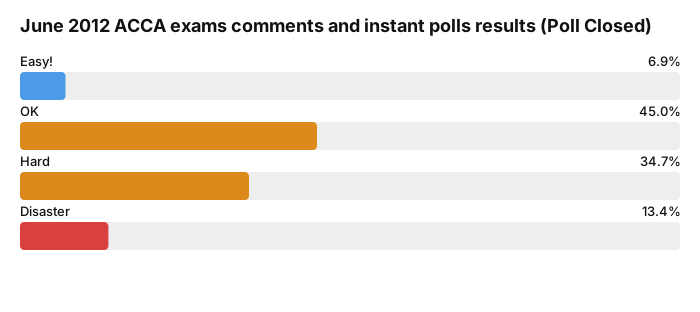
*** F9 June 2012 Exam was … Comments and Instant Poll *** poll results
Jjm8414y ago#31
Q4(a) I got $3million x 5 = $15 million

Actually you do not have to figure out the value of equity, question already given the proportion (and stated is based on market value).
Xxiaofang14y ago#32
for Q3 hedging, the inflation rate was give. for calculation on money hedge and forward hedge, should we included inflation rate (PPP theory)?
Rrazraz14y ago#33
Guys was the discount rate in Q 1) 20%?
Xxiaofang14y ago#34
@razraz said:
Guys was the discount rate in Q 1) 20%?


why is DF @ 20%?
Rrazraz14y ago#35
I cudnt understand the terminology muradhba. The examiner should translate that in English and keep that in bracket. Listen to me tony mr examiner , it's absolutely not fair to give 5 marks for that. There are hardly 3 full sentences about it. Examiner could you suggest me what do I write? And how do u expect us to understand the terminology which we never use in our real lives. Translate that into English next time so that we can write which is which without a confusion. If I fail I blame u
Former userFormer user14y ago#36
1a) NPV, I think I messed up for the inflation rates portion, but still managed to obtain a positive NPV. 1b) EAC= NPV/Annuity factor, tax & CA were ignored so pretty straightforward, should be machine 1 as EAC is cheaper. 1c) Theory- Sensitivity analysis - "What If" analysis to identify critical variables where NPV = 0, probability analysis - choosing the best outcome of each project.

2a) Overtrading- 7 symptoms of overtrading. 1) Rapid increase in sales, 2) Decrease in GP margin, 3) Deterioration of quick and current ratio, 4) increase in inventory days, receivable days, payable days, 5) Asset turnover increased, 6) Overdraft increased, finance costs increased. 7) No change in equity shares, no change in L/T debt. Compare with industry average.

2b) Compare and contrast wc financing policy vs wc investing policy- made a little link to conservative, matching and aggressive policies. short-term/long term in nature.

2c) Miller Orr Model- Upper limit calculated wrongly :)

3a) SMEs vs large companies- define agency problem. lack of finance for SMEs, risk is not as high as large companies.

3b)Debt finance and factors- ??

3c) Mudaraba- Equity financing. Emphasised that it is similar to public issue, private placement, rights issue etc.

3d) Money market hedge and forward market hedge. Should be money market hedge as it is cheaper.

3e) PPP theory, calculated spot rate wrongly. :)

4a)P/E ratio- ?

4b) Ke- Use Capm to find Ke first by plucking in values like Rf and the risk premium. Next with Ke, use DVM to find MVE. Hope it is correct.

4ci) WACC- Ke from part(b), and Mve from part (b) + Kd (given) and Mvd by using proportion because of 75% vs 25% on market value basis. After which can derive WACC. WACC= 10% if I'm not wrong ii) Risk adjusted WACC, Ke changes- find new Ke using Capm formula. Kd is given once again. After which derive both Mve and Mvd by using proportion, this time 60 %, & 40%.. WACC = 10.3%. Discuss variation.

4d) Management of risks- Totally gave up on this one.

Overall, tough paper. :)
Former userFormer user14y ago#37
What discount rate did everyone use for the NPV and EAC question? I used the after tax rate both times... I seem to remover something about always using the after-tax rate even if you're ignoring taxation. Still, a stab in the dark an hopefully won't lose too many marks.

Also, my revision note show using the cost of borrowing instead of the wacc for a cost comparison of two projects, but wasn't given, so I used the WACC anyway?

What did everyone else use? I used 7% both times instead of 12% pre-tax.
Former userFormer user14y ago#38
ps, ignore my predictive text spelling/grammar errors!
Former userFormer user14y ago#39
Q1= took all the figures to the nearest $000...sensitivity analysis and probability can't say anything abt it
Q2= part b about working capital...dunno if its right or wrong
Q3= went well...i guess forward contract was more suitable...don't remember exactly now but probably it was giving more earning
Q4= supposed shares to be 75,000 Calculated EPS by dividing earnings with the assumed shares and did the rest of the part...i don't think so any regearing was needed all we had to do was to re-calculate the equity using the new equity beta...the new wacc after the issuance of debt was around 10% i guess
Rrazraz14y ago#40
@xiaofang81 said:
why is DF @ 20%?

@xiaofang81 said:
why is DF @ 20%?
I think the pre tax rate was given and we had to convert into post tax. Or I acted over smartly? If that's the case I'm the biggest fool alive on earth. I blame Acca for that. I hate u acca
Former userFormer user14y ago#41
@melindamarchal said:
What discount rate did everyone use for the NPV and EAC question? I used the after tax rate both times... I seem to remover something about always using the after-tax rate even if you're ignoring taxation. Still, a stab in the dark an hopefully won't lose too many marks.

Also, my revision note show using the cost of borrowing instead of the wacc for a cost comparison of two projects, but wasn't given, so I used the WACC anyway?

What did everyone else use? I used 7% both times instead of 12% pre-tax.


used after tax wacc for project 1 but used before tax wacc for project 2...may be u r right so 1 mark gone here :(
Former userFormer user14y ago#42
Discount rate - (a) use nominal before tax cost of capital 12% , (b) use nominal after tax cost of capital 7%
Former userFormer user14y ago#43
Note to Royyston...
I got the MM hedge as being a lower amount, BUT it was a RECEIVABLE in euros, the the better option would have been a forward. Only 1 mark though, so wouldn't worry.
Former userFormer user14y ago#44
about degearing. Calm down there was no need to degear. We only do this when a company is planning to diversify into an unrelated area, that means doing something that is not co. In this particular question you were asked to do Wacc currently and after the intro of new debt. The co is still in the same business. Only degear a proxy company to eliminate thier financial risk before you regear to include your own fiancial risk. So there was no need to gear and regear you just needed to call on your {Table tools} for this one. mind you the com was only increasing its gearing l/reducing it and therefore capital structure in terms of equity and debt didnt change..It remained 100%.Easy by using table.
Former userFormer user14y ago#45
@royyston said:
1a) NPV, I think I messed up for the inflation rates portion, but still managed to obtain a positive NPV. 1b) EAC= NPV/Annuity factor, tax & CA were ignored so pretty straightforward, should be machine 1 as EAC is cheaper. 1c) Theory- Sensitivity analysis - "What If" analysis to identify critical variables where NPV = 0, probability analysis - choosing the best outcome of each project.

2a) Overtrading- 7 symptoms of overtrading. 1) Rapid increase in sales, 2) Decrease in GP margin, 3) Deterioration of quick and current ratio, 4) increase in inventory days, receivable days, payable days, 5) Asset turnover increased, 6) Overdraft increased, finance costs increased. 7) No change in equity shares, no change in L/T debt. Compare with industry average.

2b) Compare and contrast wc financing policy vs wc investing policy- made a little link to conservative, matching and aggressive policies. short-term/long term in nature.

2c) Miller Orr Model- Upper limit calculated wrongly :)

3a) SMEs vs large companies- define agency problem. lack of finance for SMEs, risk is not as high as large companies.

3b)Debt finance and factors- ??

3c) Mudaraba- Equity financing. Emphasised that it is similar to public issue, private placement, rights issue etc.

3d) Money market hedge and forward market hedge. Should be money market hedge as it is cheaper.

3e) PPP theory, calculated spot rate wrongly. :)

4a)P/E ratio- ?

4b) Ke- Use Capm to find Ke first by plucking in values like Rf and the risk premium. Next with Ke, use DVM to find MVE. Hope it is correct.

4ci) WACC- Ke from part(b), and Mve from part (b) + Kd (given) and Mvd by using proportion because of 75% vs 25% on market value basis. After which can derive WACC. WACC= 10% if I'm not wrong ii) Risk adjusted WACC, Ke changes- find new Ke using Capm formula. Kd is given once again. After which derive both Mve and Mvd by using proportion, this time 60 %, & 40%.. WACC = 10.3%. Discuss variation.

4d) Management of risks- Totally gave up on this one.

Overall, tough paper. :)


i guess it was forward rate because it was a receipt hedging not payment hedging :)
Former userFormer user14y ago#46
anyhow...we must recognize that OT smart guesses were smart indeed ...see: 1 a) Investment appraisal – lease v buy decision b) Written on replacement 3 a) Capital asset pricing model 4 b) foreign exchange risk management – forward rates and money markets ...almost half exam...nice :) thanks OT, I m not sure I ll pass it, but anyhow I learn something (more) from you!
Former userFormer user14y ago#47
Oh yes, my bad. I think I put a forward contract too cos most of the questions I attempted previously were always forward contracts rather than a mm hedge.
Xxiaofang14y ago#48
@royyston said:
Discount rate - (a) use nominal before tax cost of capital 12% , (b) use nominal after tax cost of capital 7%


I use after-tax 7%
Former userFormer user14y ago#49
Very patchy exam had a few moments where i realised i was going wrong and could backtrack.

The problems in q4 revolved around valuing a company where there had been a series of decreasing dividends with no div paid in current year but increasing dividends predicted from the coming year onwards.

No optimistic but who knows.
Former userFormer user14y ago#50
@xiaofang81 said:
I use after-tax 7%


For both parts?
Bbenfabregas14y ago#51
For the NPV I used 7%. For the EAC I used 12% as the question said to ignore tax?
Ggeorgetav14y ago#52
Can anyone please explain from beginning to end how you would figure out the market values for the equity and debt in WACC calculation?

A few points on other comments:
- I used 12% for NPV and 7% on EAC. The rationale behind it was that in NPV you already take account of tax during all the calculations. Whilst you don't do that on EAC
- Upper limit was 200k+75k
- Return point is 200k+1/3 spread
- My MMH value was $1m compared to $995k on forward - I am gutted about this, as I never managed to remember how you should do it!!!!
- Finance risk - it is exchange and interest risks, which you manage through hedging, matching, netting, leading, lagging, etc.
- Business risk - the systematic risk - consequences of entity's activities, decisions, strategies. Minimise by diversification
- Unsystematic risk - market risk, notthing you can do about it. I should have said that you avoid or transfer it (as per P1) but didn't!
- Compare and contrast fin and invesment policies for WC - that was a bit of a surprise..didn't really know what to say so I kind of talked about each one of them. they both aim to maximise profits, don't they - profitable investments and cheapest finance
Xxiaofang14y ago#53
@royyston said:
For both parts?


yes, for both..am i right?
Former userFormer user14y ago#54
@xiaofang81 said:
yes, for both..am i right?


I used 12% for the first part and 7% for the second because for the EAC calculations, it had something to do with lease or buy decisions which often used nominal after tax cost of capital.
Former userFormer user14y ago#55
1a) NPV, I think I messed up for the inflation rates portion, but still managed to obtain a positive NPV. 1b) EAC= NPV/Annuity factor, tax & CA were ignored so pretty straightforward, should be machine 1 as EAC is cheaper. 1c) Theory- Sensitivity analysis – “What If” analysis to identify critical variables where NPV = 0, probability analysis – choosing the best outcome of each project.

2a) Overtrading- 7 symptoms of overtrading. 1) Rapid increase in sales, 2) Decrease in GP margin, 3) Deterioration of quick and current ratio, 4) increase in inventory days, receivable days, payable days, 5) Asset turnover increased, 6) Overdraft increased, finance costs increased. 7) No change in equity shares, no change in L/T debt. Compare with industry average.

2b) Compare and contrast wc financing policy vs wc investing policy- made a little link to conservative, matching and aggressive policies, short-term/long term in nature.

2c) Miller Orr Model- Upper limit calculated wrongly :)

3a) SMEs vs large companies- define agency problem. lack of finance for SMEs, risk is not as high as large companies.

3b)Debt finance and factors- ??

3c) Mudaraba- Equity financing. Emphasised that it is similar to public issue, private placement, rights issue etc.

3d) Money market hedge and forward market hedge. Should be forward market hedge as it is a receipt and not a payment.

3e) PPP theory, calculated spot rate wrongly. :)

4a)P/E ratio- ?

4b) Ke- Use Capm to find Ke first by plucking in values like Rf and the risk premium. Next with Ke, use DVM to find MVE. Hope it is correct.

4ci) WACC- Ke from part(b), and Mve from part (b) + Kd (given) and Mvd by using proportion because of 75% vs 25% on market value basis. After which can derive WACC. WACC= 10% if I’m not wrong ii) Risk adjusted WACC, Ke changes- find new Ke using Capm formula. Kd is given once again. After which derive both Mve and Mvd by using proportion, this time 60 %, & 40%.. WACC = 10.3%. Discuss variation.

4d) Management of risks- Totally gave up on this one.

Overall, tough paper. :)
Llibratype14y ago#56
7% for a NPV always use after tax since cah flows are after allowing for the tax(see past questions)
12% for b - say to ignore taxation
Oollie7814y ago#57
question 1& 2 seemed pretty fair, other than financing and investment parts of working capital. 3 ok other then murbada or whatever it was, q4 part a seemed very complicated for 4 marks and couldnt do it which didnt help with part b think i got wacc right, was the cost of equity 12% here? on question about interest rate hedging payment i got forward rate to be $24 better option is this right? 50% at best i think!
Aashifraj14y ago#58
q1.i. npv = 2234 may be, used before tax discount factor... 12%
ii. EAC, chosen machine 1 as less costly. used after tax discount factor, 7%
iii. probability & sensitivity.. hope written enough to get 3-4 out of 7..

q2.i. over-trading.. calculated 6 ratios which was already given as sector average .. comment
ii. working capital investment & funding 9 marks.. clearly couldnt understand what to write.. left it to write letter..
iii. easy upper & return point & discussion..

q3.i. sme & medium compared to big co. .. i mentioned about the agency problem
ii. what company will look to take fin and what providers will check to give credit?
iii. mudaraba.. dont know in details.. just written basic things.. hope will get 1-2 out of 5..
iv. forward & money market hedge.. i have chosen forward as will receipt more..
v. purchase power parity.. next year spot rate came 1.9.. dont know exactly but hope described correctly..

q4. worst question for me..
i. valutione pe.. multiplied first year;s earnings by industry pe 5.. and discussion..
ii. cost of equity ke & dividend valuation.. no dividend so how to calculate?!! i did from 3rd year as constant g from 3..
iii. wacc= 10%.. used ke 12% ve = 75% & vd = 25%... new wacc= 10.55% ke 14 may be .. ve60% vd40%..
iv. business, financial & systematic risk.. didnt do too well here .. may get 3-4 out of 9...

please share where i have done wrong or right.. i didnt answe well wroking capital investment and funding theory 9marks and mudaraba 5... in this 14 i hope i may hardly get 5-6... other than the whole exam was ok.. hope to get 60+..
Former userFormer user14y ago#59
Q1
(a) NPV calculation involving inflation and taxation (12 marks)
(b) Asset Replacement (6 marks)
(c) Sensitivity and Probability Analysis (7 marks)

Q2
(a) Calculation of some easy ratios to determine working capital and overtrading analysis (Ratios being: Current ratio, quick ratio, inventory, receivables, payables, sales revenue/net working capital) -12 marks

(b) Working capital policy affecting
(i) WC Investment
(ii) WC Finance
(9 marks)

(c) Miller Orr (4 marks)

Q3.

(a) SME- Explain why Shareholder vs Director conflict is less than in larger companies (3 marks)

(b) Factors affecting debt financing, and what loan providers should consider when providing loan (8 marks)

(c) Mudaraba- explanation and how the company can use it to finance expansion (5 marks)

(d) Forward and Money Market Hedging calculations (6 marks)

(e) Purchasing power parity to determine rate for one year forward contract (3 marks)

Q4.

(a) P/E ratio

(b) Determining cost of equity and using that to find out the value of the business

(c) Current WACCA and New WACC after changing debt:equity ratio

(d) Business, Finance and some other Risk...

Overall impression of the paper:

1. Time constrained
2. TOO MUCH THEORY.
3. WAY TOO MUCH THEORY.
4. Theory, anyone?

Couldn't finish the paper. Attempted about 65%. Went in thinking I'd ace it, came out hoping to clear somehow

God help us all!
Former userFormer user14y ago#60
xiaofang81 said 1 hour, 1 minute ago:
@royyston said:
For both parts?
yes, for both..am i right?


me too. but someone said ignore taxation in project 2, so......
Topic lockedNew replies are closed.