ACCA Forums
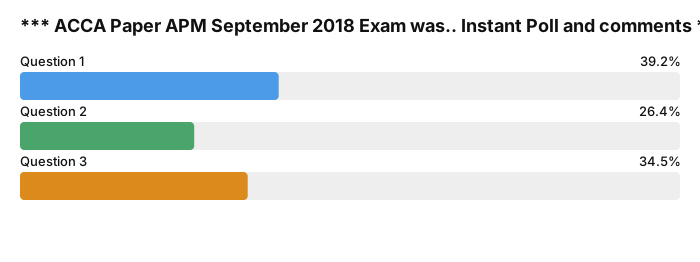
APM*** ACCA Paper APM September 2018 Exam was.. Instant Poll and comments ***
I had a similar approach. Used building block principles and spoke in reference to the scorecard and wider objectives.
First question on KPIs was tricky as had to be linked to the current situation Fearties was faced with (i.e. global expansion and quality problems).
Thought the corporate failure question was okay and pretty straight forward. Advantages and disadvantages of the quantitative models. Gearing was interesting as Thor had high fixed costs but Freeze had the oil spill problem.
BPR question was tricky and wasn't like the previous questions asked.
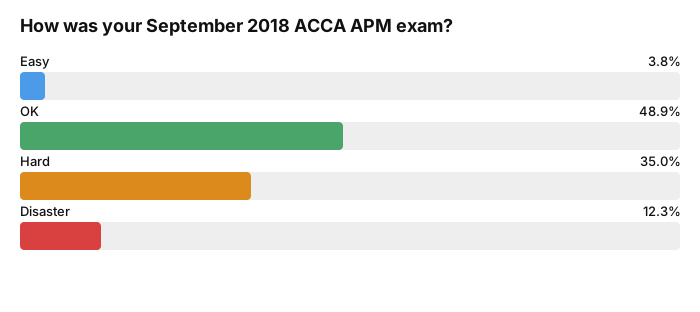
Overall, tough but fair exam. P5/APM is a funny one as you may get a completely different answer to someone else but both score highly. Fingers crossed for everyone!!
I think these were the questions. I may have missed part of Q3
1
i) current financial KPIs and balanced scorecard, correct the ROCE and give two indicators for three areas of balanced scorecard - customers, business processes and innovation & learning to address the challenges facing company
ii) customer surveys and issues with non-financial data
iii) Hopwood's management styles and identify which the company is and suggest what they should potentially be
iv) HR systems, target setting and use of targets in appraisal systems
2
a) Evaluate K Score as a measure for assessing corporate failure for company
b) calculate K score and state if company is in danger of corporate failure
c) financial and operating gearing for two companies - comment whether these are key calculations or not
3
a) Evaluate improvements that could be achieved through BPR outlined in the question, especially in relation to the two key performance indicators set by suppliers
b) IT requirements to ensure meeting performance indicators
c) Ethical implications of continuing BPR for employees, suppliers and environment
I had a similar approach. Used building block principles and spoke in reference to the scorecard and wider objectives.
First question on KPIs was tricky as had to be linked to the current situation Fearties was faced with (i.e. global expansion and quality problems). i got 4.443 or something, but yes it was in the grey area
Thought the corporate failure question was okay and pretty straight forward. Advantages and disadvantages of the quantitative models. Gearing was interesting as Thor had high fixed costs but Freeze had the oil spill problem.
BPR question was tricky and wasn't like the previous questions asked.
Overall, tough but fair exam. P5/APM is a funny one as you may get a completely different answer to someone else but both score highly. Fingers crossed for everyone
@schoolsin said: I got 4.7 ish. Can't remember exactly. Pretty close though. Grey area. Needing more detailed investigation.Yea it was 4.75. grey area. But nit a great deal to say about assessing whether the are at risk i toom the opportunity to bring in some of the environmental factors and potential legal battle threatening the company. K score cant assess that threat if failure so its not particularly accurate.but as someone mentioned ver very similar to a oast exam question!! I found it all quite time pressured. Especially the last one! Racking my brain to remember ethics! And bliody haywoods management styles!! Made that up as i completely missed studying it.
I didn't use Block model either, the question was about BSC therefore I still use the approach. which I think it was right. however Block model would suit more as a model because it was a service company. ( I did mention that fact when I was given KPI in the internal area, as always is about productivity, but also about employees)
I think as long as you make your point in term how to set targets which appraisal approach to take. for ei, it needs to be controllable, fair, easy to measure...and be directly attached with the KPI in order to achieve company goals, is fine. or at least I think so.
It could be a good choice to talk about block model and show you also knows that part but honestly didn't see the point to change the model if the whole question was about BSC.
I didn't mentioned a specific target, I saw this part of the question as the chapter of HR management and how appraisal, rewards needs to be in relation with KPI.
not sure if I took the right approach to answer but as in other part of the question you had to talk about performance indicators hence targets, I didn't see we need to actually provide targets.
I wrote about about the current situation, and changes that must be done adopting the BSC, as the whole question was about that.
Okay I am going to give a shot at going in depth with what I wrote.
Q1) I recalculated the ROCE. however in terms of it being a good KPI I said no. This is because the company is a service company and the calculation does not take intangible assets in to consideration therefore is pointless. Service companies don;t have many assets in the first place.
Revenue is appropriate as an indicator as the company is looking to grow internationally however revenue growth would be more appropriate.
I mentioned operating margin in order to monitor costs as opposed to only operating margin although this would be relevant to the companys objectives as the owners only income comes from the company ( dividends pay etc)
Dividends paid would be appropriate ( i am not sure about this one) however i recommended total shareholder return or eva instead.
Customer:
The customers would be event companies or the actual customer(guest) so I mentioned
the reliability of the security guard ( whether they turn up on time for the event). The company is basing their future expansion on the fact that they are reliable.
The number of incidents solved
The behaviour of the employee while on the job
Internal processes:
Can't remember what i wrote.
Innovation:
The number of training days for the cert
The n umber of security guards that were trained.
1b) I mentioned the subjectivity in customer surveys and suggested scoring which can also be subjective as a way of overcoming this and using trends, Also mentioned that it is harder to collect subjective data and that these should not be used in isolation and should be combined with financial measures.
1c) I was too brief in stating that the company should use a more profit conscious and non accounting style although currently using a profit conscious only.
1d) I went along the lines of CCM ( building block) so mentioned the fact that the employees ( security guards) were not financially inclined ( they are not line managers really) so cannot be assessed on financial measures. They would feel that their individual efforts cannot really affect the overall figures.
As the balanced scorecard has shown that non financial measures are important this should be linked to the rewards too. Therefore use non financial measures that the employee can actually control. like his timing to the event, the number of incidents solved.
Being appraised on factors that they can't control is demotivating and they would not be clear about their objectives.
I suggested stepped bonuses for ex
5 non financial targets
for every one achieved they could get a percentage of their bonus,
1b) sorry hard to gather qualitative data not subjective.
I used net current assets but got 3.75 not 4.75
Q1a. Evaluate the performance system using Balanced score card and suggest two additional measures for Customer Perspective, Internal Perspective & Innovation & Training
Financial Performance - Measures revenue, operating profit, dividends paid and roce. The shareholders' objective was business growth and they also depended on dividends paid. The re-calculation for Roce was 28.5% and 31%. However, Roce is not a good measure for Fearties because it is a service business and may have have a low asset base because it's because resource is its staff. Dividend paid was also a good measure because most of the family members depended on it. I cant remember the rest of what I wrote. I also suggested EVA.
Customer Perspective - Number of repeat customers and brand awareness (The question sspecifically said that management kicked against customer survey scores)
Internal Perspective - % of staff with certification and I can't remember the 2nd one
Innovation - No of training days & I can't remember the 2nd one
b) Problems with using non-financial measures - 1) Difficulty in benchmarking, internally and externally 2) It is highly subjective as it is based on opinions 3) Due to previous focus on financial measures, the mgt information system will need to be changed to enable collection and processing of non-financial information
c) Current management style is budget-constrained because they are overly focused on cutting costs as can be seen in their poor pay package to customer-facing staff, the pay was below the standard of Beeland
I suggested a non-accounting style, especially with the introduction of BSC which had mostly non-financial measures bla bla
d) Something about reward system and appraisals.
I went off point and talked about the elements of a good reward system
1) Strategic perspective - Reward system must be aligned with overall organisational objectives
2) Reward objectives - To recruit and retain (they currently had problems with this)
3) Reward techniques - Ensure rewards are fair within the organisation and also externally by meeting the benchmarked standard...which they currently failed to meet
4) Reward Competitiveness - Ensure external requirements are met e.g relevant legislation or industry requirements
Because I felt I had written rubbish, I proceeded to define what an appraisal is, applied the scenario and talked about the current annual appraisal system being too infrequent and how the employee has to be appraised based on factors he can control.
Question 2. Corporate failure using K-score (very similar to a past question - Culam). This question was a disaster for me, I couldn't quite put my thoughts together in a coherent manner.
I talked about the unsuitability of the K-score for Freeze because the K-score was based on all the failed companies on the Kayland stock exchange which spanned accross various sectors while Freeze was in the oil industry. Also, the data on which the K-score was developed is historical and may be outdated.
Thor is a privately-owned company while the K-score was based on listed companies, Also Thor had a different currency which was translated to Jayland dollars....the risk of foreign currency retranslation can lead to errors bla bla
I cannot remember what my K-score was
Financial Gearing - I got 0.1 for both Freeze and Thor
Operational Gearing - Freeze was less than 1 and Thor was 3+
My interpretation was a disaster
Question 3 - BPR implementation and how it will help the company reduce costs and improve lead times
Implementation of BPR will result in a flattened hierarchy...information flow will be more efficient and information will be available on a real-time basis which will lead to faster decision making.....and therefore, improved lead time
The traditional organisational structure will be broken into process teams
Team members will be given more responsibility which will increase staff motivation
The difference between the current manufacturing and outsourcing was 0.35 or something like that. In addition to the supplier's costs, we had to add the cost of shipping and the import charges
3b) Impact on Information system...
Introduction ERPS, real-time information, can't remember the rest
3c) Impact on ethical standard....The new supplier is 17,000km away...I mentioned the impact this will have on the environment, talked about ensuring the supplier conforms to the labour laws in their country etc etc
I really really really really hope I pass. I am so desperate! Fingers crossed and heart beating for the next one months till results are out!
Topic lockedNew replies are closed.