
Skip to contentSkip to search

ACCA Forums

FM*** ACCA F9 September 2016 Exam was.. Instant Poll and comments ***

Oopentuition_teamAdmin10y ago

Please vote in our Instant Polls about the ACCA F9 September 2016 Exam.
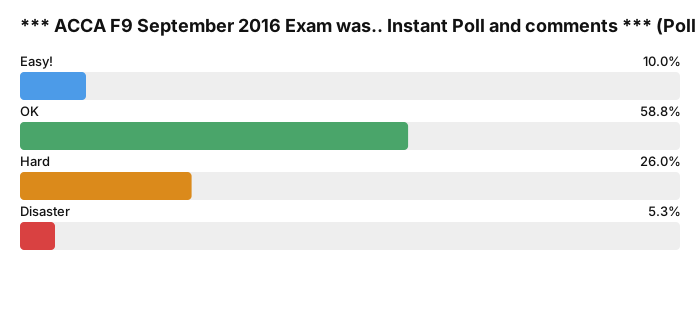
*** ACCA F9 September 2016 Exam was.. Instant Poll and comments *** poll results

Post your comments about the ACCA F9 exam below (comments will be opened after 5pm UK time)

CCee10y ago#91
Overall it was not bad. The multiple choice questions were trickyyyyyyyyyyyy
AArun10y ago#92
Can anyone tell me the right answer for one question on four equivalence theory??....the mcq question
AAwhejevu10y ago#93
Section C was fine for me. The discount got $2000 benefit, the EOQ was 8280. Got about 11m in my NPV. the capm was on ungearing and regearing the asset beta. Section B of 21-25 the business valuation question was cool. Section A was tricky. Keeping fingers crossed
Former userFormer user10y ago#94
My NPV was $11,984,000.
Former userFormer user10y ago#95
hi everyone, for the EOQ question i first calculated TAC without EOQ and then calculated the EOQ and then calculated the TAC again. finally compared with each other. cant remember which one was better though probably first TAC.
Ccarrie10y ago#96
hey i like to share what i did on the last 2 structured questions 31.a.Indicated what will you save if you were given the early settlement discount by suppliers{therefore i focused on payable days and purchases from the supplies instead of receivable and sales since it is given by suppliers and not give by us .i believed acca put sales 1st to confuse you if you didnt read it carefully} i used the purchases from the suppliers which was $1.5 the og payable period was 60days {current payable would be 60/360*1.5} $250,000 revised payables days {if we pay within the new days offer we will pay}30/360*1.5=$125,000 change in the payable{the amount we owe}250 000-125 000 = 125 000 change in finance cost based on the change in receivables 125 000* 4%= $5 000 the administration cost would increase $500 which will reduce savings =(500) the discount given was 0.5% which will be 0.005 * 1.5m=7500 we will save on purchase if discount was given total saving if we're given discount by supplies ie on purchases we will save =12 000 [5000-500+7500] b. i got around the 8281{can't remember but it was some way around there} c. help with receivable 1.credit control 2.credit analysis receivables collection
Ccarrie10y ago#97
For the NPV i got between 10m-11m The benefit of using CAPM is it reflects the required return on investment along with a risk of premium of the entire project. such risk include the business and financial risks such as business structure and capital structure of the firm given that the risk remain unchanged. This method is more certain than the DCF .Since the DCF based on forecast ed sales and production units this risk a high degree of uncertainty and also it shows that inflation rate is fixed when in reality the inflation rate varies based on economic conditions.
Ttbm1310y ago#98
@kerdesha said: change in finance cost based on the change in receivables 125 000* 4%= $5 000 the administration cost would increase $500 which will reduce savings =(500) the discount given was 0.5% which will be 0.005 * 1.5m=7500 we will save on purchase if discount was given total saving if we're given discount by supplies ie on purchases we will save =12 000 [5000-500+7500]
If you pay your A/P faster, it means your working capital will increase and therefore your overdraft will increase. Therefore, 5000 is a cost, not a benefit. It has to be 7500 + (5000) + (500) = 2000
Ttbm1310y ago#99
Section A: I found it difficult. Some questions were quite ambiguous. Also, while some were very easy (took me a second to decide) some took quite a while to calculate (certainly more than the 1.8 minute I had)... but you get 2 points each. In previous papers, you'd get some marks for your workings, even if the result was wrong. With the new MCQ, this is no longer the case. I think this is a problem, in particular in section B where a lot of the calculations involve several steps. EOQ: $2,400,000 components, $5 each, so a total of 480,000 components per year. (I think the wording was a bit ambiguous because it wasn't 100% clear whether the order & storage cost were part of the figure. But I think they said components and this is the only way that makes sense... still, could have been clearer) Current: 1 order per month, so 12 per year. 480,000 / 12 = 40,000 for each order. Order cost: 12 * 248.44 = 2981.28 Storage cost: Average (40,000/2) * 1.06 = 21200 Total: 24181.28 EOQ: sqrt(2*480,000*248.44/1.06) = 15000 480,000 / 15,000 = 32 orders Order cost: 32 * 248.44 = 7950.08 Storage cost = 15,000/2 * 1.06 = 7950.00 Total: 15900.08 EOQ is better (saving of 8281.20). EOQ should be adopted. Notes: 1) Maybe they can negotiate trade discount for placing big orders? 2) I made the calculation as above but I wonder if a real-life calculation would also have looked at changes in working capital. I think it would have been nice for the paper to say that working capital changes can be ignored. (Or does average working capital not change in this example and I'm just confused, hmm)
Ttbm1310y ago#100
I found the CAPM question really hard because CAPM was never used to make investment decisions in the guide I read (not OpenTuition I'm afraid). It was really about financing (cost of finance) and risk. But probably I just didn't get CAPM at all...
Ccarrie10y ago#101
oh yeah ! lol my bad...thank for bringing it to my attention @tbm 13
Mmpi910y ago#102
In NPV calculation, for year 5 did anyone use it for putting any kind of amount?
DDerrick10y ago#103
@accastudent1986 said: But the question stated that the market value of the shares were $3.6 each and would grow by 4% per year for 5 years. Therefore the future value would be $3.6 x 1.04^5 but the question requested the current value so you should discount the future value
Sorry I don't get it. Did you discount only the conversion value or both of them? If like what you said the question asked for the current value, $100 would be a future value as well.
DDerrick10y ago#104
@mpi9 said: In NPV calculation, for year 5 did anyone use it for putting any kind of amount?
I did not, tax was not paid in arrears, maybe the wording of the sentence was weird but that was how I read it,,
DDerrick10y ago#105
@arun12345 said: Can anyone tell me the right answer for one question on four equivalence theory??....the mcq question
I said options 1 & 2 were correct (used interest rate parity and purchasing rate parity) but option 3...:( I said that was wrong. Tried deflating the nominal interest rates and found out that real interest rates for X and Y were exactly the same. And thought of how four way equivalence theory has stated that relative interest rates= relative inflation rates. My answer may be wrong. What did you answer?
Mmpi910y ago#106
@complicated said: I did not, tax was not paid in arrears, maybe the wording of the sentence was weird but that was how I read it,,
Right...me neither. Just i saw that everyone got around 10-11m NPV. Me some less around 9. Something should be good however :)
AArun10y ago#107
Even I did the same buddy.... I got both the rates to be the same.... Even I opted for 1&2
Eengland10y ago#108
Hi evy one can any one please answer that mostly of my multiple choice answer were Option C did any one have same result of mostly Multiple choice with option C or I am wrong ?Just want to confirm as F9 made me tired lol
AArun10y ago#109
For the npv qn was the tax paid in arrears o in the same year???
Ssamir10y ago#110
@arun12345 said: For the npv qn was the tax paid in arrears o in the same year???
Tax paid in the same year, it stated that tax liabilities were settled in the year it took place.
SSyfar10y ago#111
CAPM can be used. Do you remember the regearing and gearing formula? (Asset Beta Function) Well since, that company was moving to a new sector They would use the asset beta function to find out the new Equity Beta for that particular sector. So basically, they would have an accurate estimate of Equity beta and hence also the Cost of Equity which will basically give an overall accurate estimate of the WACC.
JJAMES10y ago#112
in 31b i got something like 81210 the higher cost of current ordering policy than EOQ. is it correct?
Ggregory10y ago#113
There is a high spread in the difficulty of those MCQs. Some are (too) easy and some are mad... I studied well Basis Risk for exemple and I am able to explain the concept in details. But still, I could not answer the exam question. And still now, with my BPP book open, I canno't answer the question. Very frustrating.
SSyfar10y ago#114
I did that same mistake. Phew I am not the only one. We will lose probably only 2 marks for that
Kkelkar10y ago#115
Q 31 NPV was positive around 11 000. Working capital at end of year 4 was positive to receive back initial investment (yr 1 1, 500*1.06, year 2 90*1.6*1.6, so on). Tax to be paid in yr 1,2,3,4 no in arrears very straigtforward. 250 capital allowance was in year 4. NPV is positive around 11,000 ans stated that project acceptance might be affected if the estimates are correctly calculated. For written part Q32 b) just stated CAPM formula and said that if the CAPM rate was less than 12% (disc factor in Q32) then NPV woud be higher to affect the project. Q 32 EOQ was for 13, 487 units. Ordering cost was too high 13,487/2*248=1 672 388 somenthing like that . Forgotten how to find holding costs. Put the holding costs as 1 672 388 just number without formula how to derive that number. As EOQ costs was bigger than 2.5 mln in question did not recommend to go for it. Not sure I am right.
Mm8paza10y ago#116
My answer sheet wasn't compatible with the question paper. There was no way of indication which section c questions I answered. Just wanted to also confirm if the EOQ question, in addition to the COh and COo if it also required us to use the average deposits for the finance charge ?
Eengland10y ago#117
Hi evy one still waiting for reply as asked that did any one have experience of having answer C of multiple choice question as I had mostly answer C ??????
Ssamir10y ago#118
@dskinner83 said: I didn't include the finance charge in the EOQ calculation, I don't think I'd ever seen a EOQ question in practice where the finance charge was part of the workings. I could be wrong though, I just never even considered including it. I just included purchase costs, holding costs and ordering costs. I got the costs with EOQ to be cheaper than current method, so advise using EOQ.
Yeah, Deborah, I got the same. It was similar to one of the questions in the exam kit and the method was as you stated. I think EOQ was 15000 Iirc.
Former userFormer user10y ago#119
For the EOQ question, isn't stating purchase cost irrelevant, because it will be the same regardless how we order. So it is necessary to look at holding and ordering costs?
Ssamir10y ago#120
@suf23 said: For the EOQ question, isn't stating purchase cost irrelevant, because it will be the same regardless how we order. So it is necessary to look at holding and ordering costs?
Won't make a difference as the saving should be the same either way, can't remember what was asked, in an exam kit they did all three, but the saving should be same either way.
Topic lockedNew replies are closed.