
Skip to contentSkip to search

ACCA Forums

FM*** ACCA F9 September 2016 Exam was.. Instant Poll and comments ***

Oopentuition_teamAdmin10y ago

Please vote in our Instant Polls about the ACCA F9 September 2016 Exam.
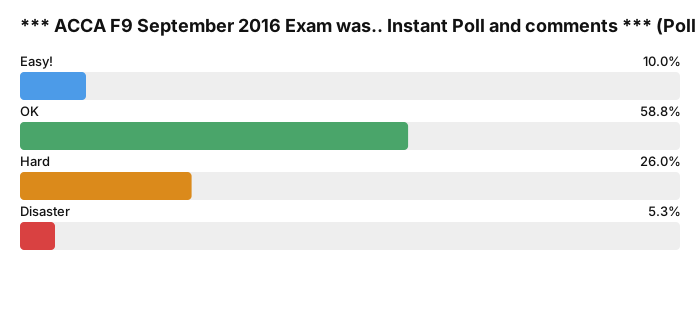
*** ACCA F9 September 2016 Exam was.. Instant Poll and comments *** poll results

Post your comments about the ACCA F9 exam below (comments will be opened after 5pm UK time)

Ddoria10y ago#31
.U.
Former userFormer user10y ago#32
@complicated I waffled on about isolating business risk on the new market, and then using company's gearing to get equity beta....
LLeah10y ago#33
I can't remember the exact figures for EOQ but it confused me a little as they gave the demand as a $ value and so I divided the value by the unit price to get the annual demand - did anyone else pick this up?
Former userFormer user10y ago#34
@leahedwards1 Yes! At first, I used the $ value. Then five minutes later, I was like wait what... I then divided by unit price like you did. EOQ gave 15,000 iirc
LLeah10y ago#35
Phew, I had to look a couple of times and wondered if there was typo error!
JJames10y ago#36
@leahedwards1 said: I can't remember the exact figures for EOQ but it confused me a little as they gave the demand as a $ value and so I divided the value by the unit price to get the annual demand - did anyone else pick this up?
Yeah so I did the value did used that to get a demand of 480k units
Ddoria10y ago#37
CAPM USE FOR ONLY ONE PERIOD. THIS PROJECT HAD MORE THAN ONE PERIOD.
JJames10y ago#38
@suf23 said: @leahedwards1 Yes! At first, I used the $ value. Then five minutes later, I was like wait what... I then divided by unit price like you did. EOQ gave 15,000 iirc
15,000 snap!
JJames10y ago#39
What did we get for a saving on taking the discount? I used the overdraft calc as a cost too. But not sure that was right
Ssamir10y ago#40
I got a NPV of 11.891 million I think it was, i was working in thousands though. The Eoq was cheaper, the saving I got was 8281, this was same as a question in the exam kit I believe. For the Rec management, I calc receivables, finance cost and irrecoverable debt for both 40 and 65 days and worked out the difference and waffled about how discounts or factoring could help to reduce irrecoverable debts in particular. Thought some multiple choice were tricky. For capm, first specified that capm incorporates systematic risk which Wacc doesn't. Then explain how you would degear the asset beta as this will be found from external firms as new project and this doesn't incorporate financial gearing. Then regear with co financial gearing and use capm to get project specific discount rate.
Former userFormer user10y ago#41
@james1114563 I was wondering the same. Was it fall in payables multiplied by the overdraft interest, and adding that extra $500 to get total cost?
AArun10y ago#42
For the scenario based question, in order to find out the 6month forward hedge you'll apportion the annual interest rate for six months right??
Former userFormer user10y ago#43
@Deborah. I did the same. and yes, I was used to offering a discount or employing a factor Qs
Ssamir10y ago#44
@arun12345 said: For the scenario based question, in order to find out the 6month forward hedge you'll apportion the annual interest rate for six months right??
Yeah, pro rata by 6/12
SSharfin10y ago#45
me too got 11000 something
Former userFormer user10y ago#46
@samirrules How did you deal with the working capital in Q #32?
Ssamir10y ago#47
It was 1.5 million in current terms iirc and then inflating at 6% I believe So I worked out the Wc needed 1.5 million (year 0) , 1.59 million (year 1)...... Then you need to work out the incremental cash flows as this is what goes in NPV So year 0 (1.5 million), year 1 (90k), ..... With the full amount +1786000(1.5x1.06^3) being paid out in year 4
Former userFormer user10y ago#48
@samirrules Ah yes! I did the same.
Former userFormer user10y ago#49
Did anyone else hear Mr.Moffat’s voice in their head during the exam? :P
GGavin10y ago#50
@suf23 said: How did you guys answer the CAPM Q in Q #32 (part B)?
I stated that as the risk profile of the business was changing that CAPM would be a better approach than WACC as it accounts for the systematic and company specific risk to determine the required return demanded by investors
DDerrick10y ago#51
@dskinner83 said: Not sure I did this correct, but I worked out the change in the average balance on the supplier's account and then multiplied this by the overdraft rate to get the extra finance charge which would be incurred by paying earlier. Then I added on the admin cost, and took off the discount that would be received in order to get the overall benefit. I can't remember the exact figure I ended up with. It threw me a bit, because I've done more questions on the benefits of offering a discount, as opposed to taking one. Hopefully I picked u pa few marks!
That should be correct! I calculated the revised level of AP by using the purchase costs AFTER the discount. This question was similar to one of the questions in 2007 paper or some where. There was one in Kaplan revision kit too.
Former userFormer user10y ago#52
The 20k saving on EOQ, was the demand not 500k?
Former userFormer user10y ago#53
@accastudent1986 Do you remember what number was your NPV?
DDerrick10y ago#54
@dosalva1 said: CAPM USE FOR ONLY ONE PERIOD. THIS PROJECT HAD MORE THAN ONE PERIOD.
Wow this slipped my mind! But CAPM could be used for each future period, provided that its variables are assumed to be constant. I guess you could write the assumption as a disadvantage,,
Former userFormer user10y ago#55
@Deborah Samir wrote it out: "It was 1.5 million in current terms iirc and then inflating at 6% I believe So I worked out the Wc needed 1.5 million (year 0) , 1.59 million (year 1)…… Then you need to work out the incremental cash flows as this is what goes in NPV So year 0 (1.5 million), year 1 (90k), ….. With the full amount +1786000(1.5×1.06^3) being paid out in year 4"
GGavin10y ago#56
@suf23 said: @accastudent1986 Do you remember what number was your NPV?
If you're referring to the written question in section C then no because i worked to the nearest $ and it got messy lol i remember the technique was something like; Investment (T0) Net trading income (Sales less variable and fixed costs ($500k/pa) all inflated from T1 to T4) Tax payable (20% of above from T2 - T5 [maybe should've been from T1 - T4]) Working capital (starting T0 and repaid in T4) Scrap value (T4) Tax Relief (20% of 25% of NBV of investment from T2 - T5) Net cash flow (sum of the above) DCF (12%) I think that even if tax flows should've been from T1 to T4 i will still scoop up a fair few marks from my answer to this question as i got most of the technique right (hopefully).
DDerrick10y ago#57
@dskinner83 said: MY NPV was something like 12 million, which I thought might be a bit large, but I couldn't see anything obviously wrong. The only bit I wasn't sure of was the working capital - whether to inflate it again to year 4 levels before paying it back, or pay back the year 3 inflated amount. I ended up inflating again, but like I say, really wasn't sure.
You didn't have to inflate it again. The recovered amount should be the year 3's inflated total amount. But your NPV was kinda close to mine and others here (I got 11m plus or some thing, so your other workings should be correct) the maximum mark you'll lose might be a mark :)
Former userFormer user10y ago#58
@accastudent1986 I did the same, except the tax part. Yeah, you get marks for each part separately, so it is def possible to get the bulk of the marks.
Mmpi910y ago#59
I've got 9797000 as NPV...
Ssachin10y ago#60
How you calculate for MCQ she are value of convertible to find ... It was 3 % and cost before tax 10% with tax 30 % ... Do we need to deduct tax from both the figures like 2.1 and 7 % ?? I tried doing with 2.1 but didn't work ... Similar question in case too ....
Topic lockedNew replies are closed.