
Skip to contentSkip to search

ACCA Forums

FM*** ACCA F9 March 2018 Exam was.. Instant Poll and comments ***

Oopentuition_teamAdmin8y ago

Please vote in our Instant Polls about the ACCA F9 March 2018 Exam
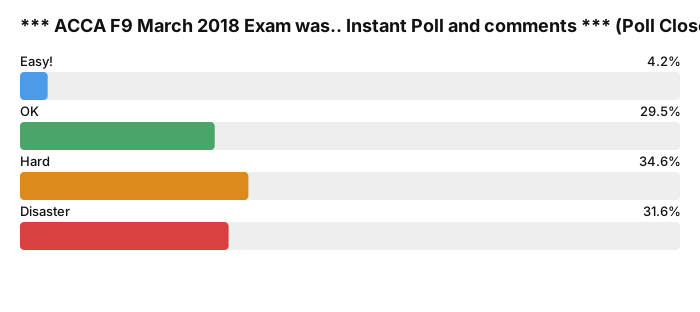
*** ACCA F9 March 2018 Exam was.. Instant Poll and comments *** poll results Post your comments about the ACCA F9 exam below (comments will open after 5pm UK)
SSulman8y ago#31
What did you do/write for option 1 and option 2 question in section C. It was about buying and lease of machine and I wrote I would recommend machine to be leased from £520K per year.
PPrasanna8y ago#32
Growth was 2.8 or 3%
SSulman8y ago#33
Section B Dollor to sibling or something like that 14 sibling future rate 14.13 14.11 13.88 Don't remembered the last option. My answer was14.13 guessed
SSulman8y ago#34
10m Treasury sell now 9.6m buy back 9.65m after 50days What is annual interest.? I knew how to calculate but on my some stupid figure came up.
BBrad8y ago#35
@juliat said: The WACC figures look familiar, I hope I just messed up in adding up rather than the method... can you remember your growth at all?
I think i got 2.89% for the growth rate using the historic growth model. Yep fingers crossed one of us just messed up on some arithmetic and scores almost full on the calculation itself!
SSulman8y ago#36
Ye. I wrote similar to yours. Hope to get 5/5
VVijay8y ago#37
I found section a and section b easy but section c was tough. I studied from kaplan textbook and kaplan exam kit
JJulia8y ago#38
@kanchandhankar said: As far as i remember D 5 yrs ago .2 Latest .23 .2x (1+g)=.23 G= .23/.2 sq root 4 -1 =3.555 =3.6 %
That's what I got!
BBrad8y ago#39
@kanchandhankar said: As far as i remember D 5 yrs ago .2 Latest .23 .2x (1+g)=.23 G= .23/.2 sq root 4 -1 =3.555 =3.6 %
I reckon i've slipped up on my calculator to get 2.9% somehow, but clearly wrote out that exact working in my answer - annoying!
BBabatunde8y ago#40
This march 2018 F9 is really disaster. I can imagine myself reading for June again after all the effort I have put in for this paper, 24/7 reading. I never pay attention to joint probability I ready the study text from chapter 1-20. In fact the examiner need to summon. Secondly MCQ is another thing the ACCA need to review.
BBrad8y ago#41
@kanchandhankar said: I am sure you will get marks of those working even if answer growth was wrong
Good luck with your results!
JJulia8y ago#42
@kanchandhankar said: Good to know :) With this growth I got cost of equity 10.4 =.23 (1+.036)/3.50 +.036 =.104 x =10.4 %
Agrh! I know where I went wrong. I stupidly did not add the growth at the end ?????????? But yes, agree with your figures :-)
AAishling8y ago#43
Joint probability was a shocker! No normal investment appraisal question. I was banking on section C - but now it looks like I'll be back again in June.
MMuma8y ago#44
I had put in much effort on this paper and was so disappointed to see such a section C. December 2017 wasnt half as bad as this one. I wish I had passed then. For the adjusted payback you were meant to explain that you can adjust payback period to reduce the length of project as the longer a project last the more uncertain it becomes. Then the risk adjusted discount factor is just CAPM, the whole ungearing and then regearing process and then using the new beta in the new CAPM.
Jjamila8y ago#45
Section C - joint probability and which source of finance to use to raise capital was easy. The mcqs were really tricky and confusing. I too hope i clear this exam.
TTakatso8y ago#46
Does it mean people writing CBE had total different paper from those of paper based coz I never came across WACC along the whole paper and was expecting it so much together with an NPV...... its a pity coz I'll be sitting for P2 by June and wasn't planning on sitting two papers at once
Sstudyfreaksy8y ago#47
Yeh I think with money market hedge the cost was 1907 something. And with the forward rate for shillings I thinku had to use interest rate parity. I used the deposit rates for shilling and dollar and Exponented the fraction on 0.25 power for 3 months. I got 14.11 as fwd rate. Anyone else got these answers? Any one knows what rates to use for interest rate parity? Deposit or borrow?
LLukman8y ago#48
@STUDYFREAKSY I got an answer of 14.13. I used the “Borrow Rates” as the question clearly stated that the company was short of cash and would strictly have to borrow funds. Because of this statement I used 10 as the spot rate instead of 10.20 for the money market hedge and used the borrow rates when calculating IRP.
LLukman8y ago#49
The exam was a totally unexpected one. I sat there and it took me a good 5 mins to accept the fact that the examiner screwed with us LOL. I started with section A and B and spent a good hour answering what I could and moving on to section C. Q31 Equity Vs Business Finance. Calculated the Theretical ex rights by calculating how many new shares had been issued 2500/5 = 500 new shares. This making total number of shares 3000. Calculated market values by multiplying 2500 * EX DIV PRICE and 500 * discounted price. Divided MV by number of shares to get theoretical ex rights of if I remember correctly somewhere between 4.60 and 4.70. Moving on, calculated the Eps which was basically Profit after tax over number of shares. For equity, the number of shares increased giving EPS OF 0.33 and for debt finance, interest increased this affecting Profit after tax and giving an EPS of 0.35. The new share price was simply PE RATIO that was given multiplied by EPS. I guessed this as I remembered doing this in a past paper. In terms of which is better, I used the debt equity ratio and also spoke about other non financial matters. For Islamic Finance, I spoke about Mudharaba as a alternative to equity and Sukuk for loan notes. Q32 Multiplied the probabilities by the cash flows for each year. Multiplied by discount factor. Compared NPV to investment to see if it was financially acceptable. I got a positive result, so accepted investment. Struggled with part where it asked about NPV being zero. Didn’t spend too much time on it as it was only 1 mark. For highest probability, basically selected 0.5 from year 1 and 0.6 in year 2. The last part required you to talk about only TWO of the 3 mentioned concepts. I selected simulation and spoke about how such methods are used in times of uncertainty in assisting to forcecast. Etc gave some advantages/ disadvantages. Lastly, spoke about risk adjusted discount rates where I mainly spoke about CAPM and specific discount rates talking through the whole process of ungearing and regearing. PLEASE LET ME KNOW YOUR THOUGHTS. Fingers crossed for a pass :)
NNicola8y ago#50
@studyfreaksy said: Yeh I think with money market hedge the cost was 1907 something. And with the forward rate for shillings I thinku had to use interest rate parity. I used the deposit rates for shilling and dollar and Exponented the fraction on 0.25 power for 3 months. I got 14.11 as fwd rate. Anyone else got these answers? Any one knows what rates to use for interest rate parity? Deposit or borrow?
Not sure if this was the same question but did you have rates quoted as v2 - v3? This threw me as I’ve not seen them quoted like this before.
MMuma8y ago#51
Sounds different
NNicola8y ago#52
I got 2.8% I thought 5 years ago would mean the current year would be year 6 so used n=5 I thought this might be one of the few things I might have got right. What a tough paper! Will be doing it all again in June :o(
LLukman8y ago#53
Don’t worry. Let’s hope for the best.
LLukman8y ago#54
Yes so for the EPS after expansion using rights was 1000/3000. 1000 being the Profit after tax and 3000 (2500 old shares + 500 new share). Expansion through debt does not affect the amount of shares. It only affects the Profit after tax because finance costs increases. I hope the above makes sense.
LLukman8y ago#55
How did you answer Q32 @SONAL ?
Sstudyfreaksy8y ago#56
For the EPS, did u increase the pbit? It said that with either source of finance, the 2m expansion would result in an increase in PBIT by 20 % my new Pbit in both cases was 1916.4. (1597/100 x 120) I used that as a starting figure for both debt n equity funded expansion. Then with equity i recalculated PAT, keeping the interest of 315 as same and applying 22 % on PBT. Then calculated PAT. EPS = revised PAT / 3000 shares For debt I took 1916.4 as PBIT, subtracted interest of 475 (315 plus 160) calculated new PAT and divided on existing shares (2500) to arrive at the new EPS. got a better EPS with debt. But debt/equity ratio messed up so in analysis part I wrote to choose equity as it results in a reasonable debt/equity ratio.
Sstudyfreaksy8y ago#57
How about the market value of debt mcq. The nominal was 100. 5/100 interest and redeemed at par plus 10 percent premium. Tax was 20% Did anyone deduct tax from interest? What was ure MV?
LLukman8y ago#58
OMG. I completely missed that out. Let’s hope I don’t lose much for not including that.
AAishling8y ago#59
The 2010 question is not really the same thing. It is on joint probability, just not on investment appraisal. What I have learnt from this exam is that you really have to 1. Know the syllabus inside out 2. Don't rely on past papers/ revision kit 3. ACCA are a company who need resits to keep making profits!!
LLukman8y ago#60
@SONAL Yes I did take all into account. Just that I didn’t inflate the PBIT by 20 percent.
Topic lockedNew replies are closed.