
Trading profits and the tax-year basis
Finance Act 2025 · 2025/26
1 Cash and accruals bases

In this TX lecture: The badges of trade (SoFIRM tests) are not examined in FTX; the opening trading-versus-capital discussion is retained as context.

2 Taxable trading profits for unincorporated businesses

From 2024/25, unincorporated businesses (sole traders/partnerships) calculate their taxable trading profit under the CASH BASIS.
Under the cash basis:
1. Include cash received and cash paid (i.e. no accruals) during the accounting period.
2. Cash received and cash paid includes not only cash received from customers/paid to suppliers, but also cash received/paid on the sale/purchase of capital assets that would normally qualify as plant and machinery for capital allowances purposes (see later) with the exception of cars.
3. Capital allowances and running costs, or the fixed rate mileage allowance (fixed-rate method below) can be claimed on cars.
For an eligible car, the fixed-rate method uses 45p per business mile for the first 10,000 miles in the tax year and 25p thereafter, instead of actual running costs and capital allowances.
Unincorporated businesses can elect to use the ACCRUALS BASIS in which case capital allowances can be claimed on all capital assets (including cars) that qualify as plant and machinery. If the question is silent, assume that the CASH BASIS is being used.
COMPANIES must use the ACCRUALS BASIS.
Land/building acquisition costs are not cash-basis trading deductions. Cars use capital allowances or the permitted mileage method. Other excluded capital categories are not examined in FTX.
3 Adjusting the accounting profit
3.1 Introduction
The tax adjusted trading profit for inclusion within the income tax computation is not the same as the profit shown in the statement of profit or loss.
Accounting profits, or net profit before tax, may have to be adjusted to arrive at tax adjusted trading profit. The main adjustments are to disallow for tax certain non-allowable expenses debited in the accounts and to exclude any non-trading income credited in the accounts.
The proforma used to calculate tax adjusted trading profits is as follows:
£ | |||
Net profit per accounts | X | ||
ADD BACK: Disallowable expenditure* | X | ||
X | |||
LESS: income not assessed as trading profit: | |||
- Income assessable elsewhere (e.g. property income, interest income) | X | ||
- Non-taxable (exempt) income | X | ||
(X) | |||
Adjusted profits before capital allowances | X | ||
LESS: Capital allowances (P&M and SBAs) | (X) | ||
Tax adjusted trading profit | X |
Note:
When preparing this calculation, be careful to start with the NET profit per accounts.
READ THE QUESTION CAREFULLY!
It is important to understand that the object of the exercise is to isolate the profit that purely relates to the business's TRADING activities.
*Just because an expense is disallowed at this point does not mean that the expense is not tax deductible. For example, it may be deductible as a property expense.
3.2 Typical expenditure by a business
The general rule is that expenditure not wholly and exclusively for the purpose of the TRADE is not allowable.
READ THE QUESTION CAREFULLY!
If an expense is not allowable but has been deducted in arriving at the net profit figure, then it must be added back in the adjustment to profits calculation (to reverse what was done in the statement of profit or loss).
The treatment of some expenditure is different depending on whether the CASH BASIS or the ACCRUALS BASIS is being used.
Capital expenditure
on land and buildings is not allowable.
depreciation and losses/profits on sales are not allowable.
a repair to an asset is revenue expenditure and is allowable.
improvement to an asset that qualifies as plant and machinery for capital allowance purposes is allowable under the CASH BASIS but is generally not allowable under the ACCRUALS BASIS.
Entertaining and gifts
entertaining is disallowed, unless entertaining employees.
gifts to employees are allowable but may be included as an assessable benefit within employment income for the employee - see chapter 3.
gifts to customers are only allowable if;
they cost no more than £50 per person per year, and
the gift is not food, drink, tobacco or vouchers exchangeable for goods and services
the gift carries a conspicuous advertisement for the business.
Subscriptions and donations
trade or professional association subscriptions are allowable,
charitable donation (not made under Gift Aid);
if it is small and made wholly and exclusively for trading purposes (e.g. promoting business’ name), and it is to a local charity then it is allowable.
national / international charity donations are not allowable.
charitable donations (made under Gift Aid) are not allowable.
Political donations - these are not allowable.
Legal and professional charges
disallowable if the item to which they relate is disallowable (e.g. land and buildings).
If related to an asset that qualifies as plant and machinery for capital allowance purposes, then allow under the CASH BASIS, but disallow under the ACCRUALS BASIS.
Allow if connected with the trade, e.g. drawing up staff contracts etc.
specifically allowed by statute:
costs of obtaining loan finance for trading purposes
costs of renewing a short lease (50 years or less)
Interest payable
interest paid on borrowings for trading purposes is allowable.
Lease rentals on cars with CO2 emissions exceeding 50 g/km
Under the ACCRUALS BASIS, the disallowed amount is 15% of the leasing charges p.a.
Under the CASH BASIS, the whole amount is allowable.
Premium paid for the grant of a lease
the premium itself is disallowed as is any amortisation of the premium.
the allowable amount for each year of the lease is:
The annual trading deduction for a short-lease premium is the landlord’s taxable premium divided by the lease term. Landlord’s taxable premium = premium × (51 − complete lease years) / 50.
where n is the number of years of the lease.
Fines and penalties - Disallowed unless a parking fine paid on behalf of an employee and incurred whilst on business.
The accounting profit must be adjusted for the private expenditure of the business owner. For example, if the owner uses a car in the business but 20% of his mileage is for private journeys, then only 80% of motor expenses are allowable.
However if the owner provides an employee with a car, and 20% of the mileage is for private use by the employee, then the full amount of motor expenses is allowable. (The employee is then taxed on the private use as employment income - see chapter 3).
Any deduction described as the owner’s salary, or drawings or interest on capital invested in the business is disallowed.
Interest paid on overdue tax is not deductible and interest received on overpaid tax is not taxable.
Any salary paid to the family of the owner of the business must not be above the normal commercial rate for the job.
Only salary at the commercial rate for the work done is allowable, any excess is added back.
If an owner removes goods from the business for his own use, then under the ACCRUALS BASIS he is treated as making a sale to himself at market value.
If the transaction has not been recorded in the accounts, then add in the selling price.
If the transaction has been recorded in the accounts at cost price, then add in the profit.
Under the CASH BASIS, If the transaction has not been recorded in the accounts, then add in the cost price. If the transaction has been recorded in the accounts at cost price, then there is no adjustment needed.
Otherwise allowable revenue expenditure incurred within seven years before trading starts is treated as incurred on the first day of trading. Capital expenditure follows its own cash-basis or capital-allowance rules.
On 1 April 2025 Jeremy started to trade, running a retail clothing shop, and has elected to use the accruals basis. Jeremy’s statement of profit or loss for the year ended 31 March 2026 is as follows:
£ | £ | ||
Gross Profit | 140,880 | ||
Expenses: | |||
Depreciation | 4,760 | ||
Light and heat (Note 1) | 1,525 | ||
Motor expenses (Note 2) | 4,720 | ||
Professional fees (Note 3) | 2,300 | ||
Rent and rates (Note 1) | 3,900 | ||
Repairs and renewals (Note 4) | 5,660 | ||
Sundry expenses (Note 5) | 2,990 | ||
Wages and salaries (Note 6) | 84,825 | ||
110,680 | |||
Net profit | 30,200 |
Notes
Note 1: Private accommodation
Jeremy and his wife live in a flat above the shop. Of the expenditure included in the statement of profit or loss for light, heat, rent and rates, 40% relates to the flat.
Note 2: Motor expenses
During the year ended 31 March 2026, Jeremy drove a total of 12,000 miles, of which 9,000 were for private journeys. He does not claim the fixed rate mileage allowance.
Note 3: Professional fees
Professional fees are as follows:
£ | |
Accountancy | 700 |
Legal fees in connection with the purchase of the clothing shop | 1,200 |
Trade debt collection | 400 |
2,300 |
Included in the figure for accountancy is £250 in respect of advice on inheritance tax planning for Jeremy.
Note 4: Repairs and renewals
The figure of £5,660 for repairs and renewals includes £2,200 for decorating the clothing shop during July 2025, and £1,050 for decorating the flat during August 2025. The building was in a usable state when it was purchased.
Note 5: Sundry expenses
The figure of £2,990 for sundry expenses, includes £640 for gifts to customers of food hampers costing £40 each, £320 for gifts to customers of pens carrying an advertisement for the clothing shop costing £1.60 each, £100 for a donation to a national charity, and £40 for a donation to a local charity’s fete. The fete programs carried a free advertisement for the clothing shop.
Note 6: Wages and salaries
The figure of £84,825 for wages and salaries includes the annual salary of £15,500 paid to Jeremy’s wife. She works in the clothing shop as a sales assistant. The other sales assistants doing the same job are paid an annual salary of £11,000.
Note 7: Goods for own use
During the year ended 31 March 2026, Jeremy took clothes out of the shop for his personal use without paying or accounting for them. The cost of these clothes was £460, and they had a selling price of £650.
Note 8: Plant and machinery
The capital allowances available for the year ended 31 March 2026 are £13,060.
Calculate Jeremy’s tax adjusted trading profit for the year ended 31 March 2026.
Show answerHide answer
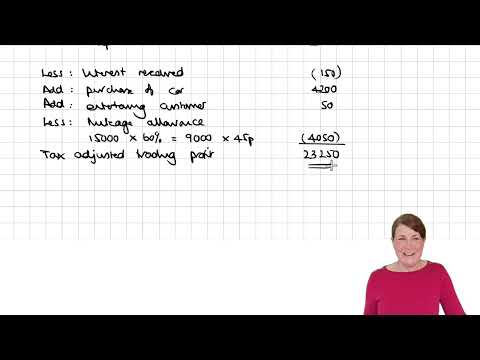
Giles started to trade as a sole trader on 1 April 2025.
The receipts figure in his accounts for year ended 31 March 2026 is as follows:
£ | ||
Cash receipts from customers | 20,000 | |
Bank transfers from customers | 38,000 | |
Cash receipt from sale of machine | 2,500 | |
Interest received on bank account | 150 | |
Total receipts | 60,650 |
The expense payments figure is as follows:
£ | ||
Cash payments for suppliers of goods for resale | 1,200 | |
Bank transfers for purchase of goods for resale | 22,000 | |
Standing orders to utility companies | 6,800 | |
Bank transfer for purchase of car | 4,200 | |
Cheque payment for machinery | 2,900 | |
Petty cash payment for entertaining customer | 50 | |
Interest on bank loan | 300 | |
Total payments | 37,450 |
The car has CO2 emissions of 85g/km and is used 60% of the time for business purposes. Giles drove 15,000 miles in the year and claims the fixed rate mileage allowance in respect of the car.
Calculate Giles tax adjusted trading profit for the year ended 31 March 2026.
Show answerHide answer
Under accruals, irrecoverable trade debts written off and changes in specific allowances for doubtful trade debts can be deductible. A general allowance and non-trade debts are not deductible trading expenses. Under the cash basis an unpaid sale has not been taxed as a receipt, so do not claim a second deduction for the unpaid amount.
4 From a Profit and Loss account to an Income Tax computation
Step | Trading income computation |
1 | Adjust accounting profits for the period of account. |
2 | Calculate capital allowances for that period. |
3 | Deduct capital allowances to find tax-adjusted trading profits. |
4 | Allocate those profits to the tax year using the tax-year basis. |
5 | Enter the allocated trading income in the income tax computation. |
(a) A period of account is the period covered by the profit and loss account but Income Tax computations are prepared for tax years, so a period of account must be matched to a tax year.
(b) A trader may have a year end of 5 April, in which case matching a period of account to a tax year is straightforward, but a trader can choose whatever year end they like.
(c) If the year end is 31 March, then the first few days in April are ignored; i.e. the trading profits of the year ended 31 March 2026 will be taxed in 2025/26.
(d) Special rules are applied when the year end is not 5 April (or 31 March) and also when a trader starts or ceases to trade.
2. Starting To Trade
(a) In the tax year that a trader starts to trade, the assessable trading profits are those that arose from the date trade started until the end of the tax year (5 April), although you should work to the nearest month in the exam; i.e. to 31 March rather than 5 April.
(b) Profits and losses are deemed to arise evenly, and therefore may need to be time apportioned.
Stuart starts to trade on 1 November 2025 and chooses an accounting date of 30 September.
For the accounting period 1 November 2025 to 30 September 2026, tax adjusted trading profits are £22,000.
The first tax year of trade is 2025/26, so the trading income assessment for that year is the profits from 1 November 2025 to 5 April 2026, which is 5 months.
That time period lies completely within the first accounting period which runs from 1 November 2025 to 30 September 2026 which is 11 months.
The trading income assessment for 2025/26 is therefore 5/11 x £22,000 = £10,000.
Alex starts to trade on 1 June 2025 and chooses an accounting date of 31 December.
For the accounting period 1 June 2025 to 31 December 2025, tax adjusted trading profits are £8,000, and for year ended 31 December 2026 they are £24,000.
The first tax year of trade is 2025/26, so the trading income assessment for that year is the profits from 1 June 2025 to 5 April 2026, which is 10 months.
That time period spans the first two accounting periods, so the trading income assessment for 2025/26 is:
£ | ||
1 June 2025 - 31 December 2025 = 7 months | 8,000 | |
1 January 2026 - 5 April 2026 = 3 months, therefore 3/12 x £24,000 | 6,000 | |
Trading income to the Income Tax computation for 2025/26 | 14,000 |
3. Continuing Trades
For continuing trades, the trading profit from 6 April to the following 5 April are assessed (but working to the nearest month, that effectively means the trading profit from 1 April to the following 31 March).
Using the previous example, Alex's tax adjusted trading profits for the year ended 31 December 2027 are £36,000.
The trading income assessment for 2026/27 is as follows:
£ | ||
6 April 2026 - 31 December 2026 = 9 months, so 9/12 x £24,000 | 18,000 | |
1 January 2027 - 5 April 2027 = 3 months, therefore 3/12 x £36,000 | 9,000 | |
Trading income to the Income Tax computation for 2026/27 | 27,000 |
4. Cessation of trade
For trades that are ceasing, the trading profits from 6 April to the date of cessation are assessed in the final tax year of trade.
Using the previous example, Alex ceased to trade on 28 February 2028. His tax adjusted trading profits for the two months ending 28 February 2028 are £1,500.
The trading income assessment for 2027/28 is as follows:
£ | ||
6 April 2027 - 31 December 2027 = 9 months, so 9/12 x £36,000 | 27,000 | |
1 January 2028 - 28 February 2028 | 1,500 | |
Trading income to the Income Tax computation for 2027/28 | 28,500 |
Sarah's tax adjusted trading profits and losses are as follows:
Profit/(loss) | ||
Year ended 31 October 2025 | (18,000) | |
Year ended 31 October 2026 | 6,000 | |
The trading income/(loss) for 2025/26 is as follows: | ||
£ | ||
6 April 2025 - 31 October 2025 = 7 months, so 7/12 x £(18,000) | (10,500) | |
1 November 2025 - 5 April 2026 = 5 months, so 5/12 x £6,000 | 2,500 | |
Loss for 2025/26 | (8,000) |
Sam started to trade on 1 December 2024 and has had the following tax adjusted trading profits and losses:
£ | ||
1 December 2024 - 31 December 2025 | Profit | 13,000 |
Year to 31 December 2026 | Profit | 18,000 |
Year to 31 December 2027 | Loss | (6,000) |
Sam ceased to trade on 31 January 2028. The profit in this final month of trade was £900.
Calculate his assessable profits/(allowable losses) for all relevant tax years.
Show answerHide answer
Capital allowances are computed for each accounting period, then deducted before tax-year apportionment. On commencement add eligible asset expenditure; on cessation compute balancing adjustments rather than normal AIA/FYA/WDA. The detailed allowance rules and examples are in chapter 6.
Mei’s accruals accounts show net profit £32,000 after depreciation £3,000, customer entertainment £600 and private motor costs £400. Bank interest £500 is included in revenue. Capital allowances are £4,000. Calculate taxable trading profit.
Show answerHide answer
Noah has tax-adjusted profits £24,000 for the year to 31 December 2025 and £36,000 for the year to 31 December 2026. Calculate trading income for 2025/26.
Show answerHide answer
5 Given transition profits
For FTX use the examining team’s simplified computation: given transition profits are spread over 2023/24–2027/28, one fifth each year. Include the stated annual amount separately in income; it may affect the personal allowance and Class 4 NIC. Do not calculate the original transition amount or accelerated spreading.
If a question gives the total remaining from the original five-year spread, identify the annual amount carefully; do not divide an already annual amount again.
Olga is given original transition profits £15,000, spread equally for five years. Her normal 2025/26 trading profit is £25,000. Find the annual transition amount and the income entered before other reliefs.