
VAT calculations, invoices and tax points
Finance Act 2025 · 2025/26
1 Output VAT and Input VAT
1.1 Major points
There are several important exam points regarding output VAT and input VAT as follows:
VAT is chargeable on the actual amount received where a discount is offered for prompt payment. If the discount is not taken the VAT is charged on the full sale price and if the discount is taken then the VAT is based on the discounted price.
Relief for irrecoverable (impaired) debts is only available if the output VAT has been accounted for and paid, the debt is over six months overdue and the debt has been written off in the accounts. The relief is claimed as input VAT on the VAT return.
Input VAT cannot be recovered in respect of business entertainment of UK customers or on motor cars (unless they are used 100% for business purposes).
Input VAT cannot be recovered in relation to private use by a proprietor of a business.
Rose Ltd is registered for VAT, and its sales are all standard rated. The following information relates to the company’s VAT return for the quarter ended 31 March 2026:
(1) Standard rated sales amounted to £120,000. Rose Ltd offers its customers a 5% discount for prompt payment and half of the customers took advantage of this discount.
(2) Standard rated purchases and expenses amounted to £35,640. This figure includes £480 for entertaining UK customers.
(3) On 15 March 2026 the company wrote off irrecoverable debts of £2,000 and £840 in respect of invoices due for payment on 10 May and 5 December 2025 respectively.
(4) On 31 March 2026 the company purchased a motor car at a cost of £16,450 for the use of a salesperson, and machinery at a cost of £21,150. Both these figures are inclusive of VAT. The motor car is used for both business and private mileage.
(5) Unless stated otherwise, all of the above figures are exclusive of VAT.
Calculate the VAT payable for the quarter ended 31 March 2026 and state the due date for the submission of the return and the payment of the VAT due.
Show answerHide answer
1.2 Refund of VAT
A claim for a refund of VAT that has been overpaid is subject to a four year time limit.
2 Motor expenses

Input VAT can be recovered in full on fuel purchased by the trader even if some of the fuel is used for private journeys (either by a sole trader/partner or an employee), but to reflect the fact that some of the fuel has gone to making private journeys, output VAT must be accounted for (as if the trader had 'sold on' fuel for private journeys). Output VAT is calculated according to a scale charge based on the car's CO2 emissions.
Note: The scale charge, which is VAT inclusive, will be given to you in the examination.
Provided there is some business use, input VAT can be fully recovered in respect of repairs to a motor car.
Poppy plc is to provide one of its directors with a company motor car which will be used for both business and private mileage.
The company will pay for all the running costs of the motor car, including petrol costing £900 (VAT inclusive) and repairs costing £1,200 (VAT inclusive). The relevant quarterly scale charge is £445 for quarter to 31 March 2026 based on the car's CO2 emission rating.
State the VAT treatment of the cost of petrol and repairs for the quarter to 31 March 2026.
Show answerHide answer
For a 20% VAT-exclusive amount multiply by 20%. For an inclusive amount extract VAT at 20/120=1/6. Do not multiply a VAT-inclusive total by 20%.
For eligible impaired-debt relief the sale’s output VAT must already have been accounted for and paid, the amount must be written off and it must be six months overdue. Claim relief through input VAT.
Input VAT on a car is blocked unless there is exclusive qualifying business use with no private availability, or another permitted use. Block customer entertainment/private expenditure. Use the supplied private-fuel scale charge if relevant.
Tariq has standard-rated sales £36,000 VAT-exclusive, zero-rated sales £5,000 and recoverable purchase VAT £2,400. Eligible impaired-debt relief relates to £1,200 VAT-inclusive unpaid sale already included in output tax. Calculate net VAT.
Show answerHide answer
Uma’s net invoice price is £1,000 with a 2% prompt-payment discount. Compare VAT if the customer pays within the discount terms or does not.
Show answerHide answer
3 VAT returns
In this TX lecture: The substantial-trader payment rules are not examined in FTX.
For the quarter ended 31 March 2026 Buttercup Ltd had output VAT of £12,400 and input VAT of £7,100.
Buttercup Ltd’s VAT return for the quarter ended 31 March 2026 should be submitted by 7 May 2026. VAT of £5,300 (£12,400 - £7,100) is payable, and this is due to be paid by 7 May 2026 along with the submission of the VAT return.
4 The tax point
It is very important to correctly identify the time of supply or 'tax point', as this determines when the output VAT will be due.
The VAT rules that determine the tax point in respect of a supply of goods are as follows:
The basic tax point is the date goods are made available to the customer or the service is completed.
If an invoice is issued or payment received before the basic tax point, then this becomes the actual tax point.
If the tax point is the basic tax point and an invoice is issued within the 14 days after the basic tax point, the invoice date will usually become the actual tax point.
Where a deposit is paid, followed later by the balance due, there will be two tax points; one for the deposit and one for the balance.
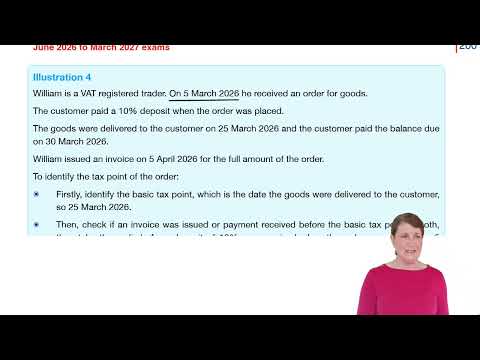
William is a VAT registered trader. On 5 March 2026 he received an order for goods.
The customer paid a 10% deposit when the order was placed.
The goods were delivered to the customer on 25 March 2026 and the customer paid the balance due on 30 March 2026.
William issued an invoice on 5 April 2026 for the full amount of the order.
To identify the tax point of the order:
Firstly, identify the basic tax point, which is the date the goods were delivered to the customer, so 25 March 2026.
Then, check if an invoice was issued or payment received before the basic tax point (if both, then take the earlier). As a deposit of 10% was received when the order was placed on 5 March 2026, the actual tax point of the deposit is 5 March 2026.
Next, check the tax point of the balance due. The tax point of the balance is the basic tax point of 25 March 2026 UNLESS an invoice was issued within 14 days of the basic tax point.
As the invoice was issued on 5 April 2026, which is within the 14 days after 25 March 2026, the invoice date is taken as the actual tax point of the balance.
Normal returns are quarterly, filed and paid electronically within one month and seven days after period end.
Most VAT-registered businesses, including voluntarily registered businesses below the threshold, must keep digital records and submit using compatible software unless an exemption applies.
A return for the quarter ended 30 June 2026 is normally due 7 August 2026.
Vivian delivers goods 10 May 2026, issues the VAT invoice 20 May 2026 and receives payment 30 June 2026. Find the tax point. What if an advance payment was received 1 May 2026?
Show answerHide answer
5 VAT invoices
A VAT registered trader making a supply to another taxable person must issue a VAT invoice within 30 days of the relevant tax point. A VAT invoice must contain certain information.
In this TX lecture: The post-1 January 2023 late-filing and late-payment penalty regime, VAT interest calculations and penalties for an incorrect VAT return are not examined in FTX. The error-disclosure method remains examinable.

While completing the VAT return for the quarter ended 30 September 2025, the Finance Director of Florrich Ltd discovered that an error in the VAT return for the quarter ended 30 June 2025 had resulted in an underpayment of VAT of £59,500.
Florrich Ltd's VAT exclusive turnover for the quarter ended 30 September 2025 was £6.5 million.
If the error is small, it may be corrected in the next VAT return, which in this case is the return for the quarter ended 30 September 2025. An error is small if it is less than the error correction threshold ('de minimis') which is the higher of:
- £10,000
- 1% of turnover (1% x £6.5 million = £65,000) but subject to an upper limit of £50,000
As the error of £59,500 exceeds the threshold of £50,000, the error cannot be corrected in the quarter ended 30 September 2025. HMRC’s VAT Error Correction Team must be notified in writing.
Blanche Ltd understated output VAT by £8,500 on its quarter ended 31 December 2025 return. Its VAT-inclusive turnover for the quarter ended 31 March 2026 is £700,000. How should the error be disclosed?
Show answerHide answer
Include a unique invoice number, date of issue and tax point, supplier name/address/VAT number, customer name/address, description and quantity of goods/services, net unit price, value by VAT rate, the rate/amount of VAT and total price.
Issue a VAT invoice to a taxable customer within 30 days of the supply’s relevant tax point. Keep a copy and supporting credit notes. Validate the invoice before claiming input VAT.
6 Errors on earlier returns
Find the net error: understated output and overstated input increase VAT due; overstated output and understated input reduce it. Retain the cause, date discovered, periods and workings.
A non-deliberate net error no more than £10,000 can be adjusted in the next return. Between £10,000 and £50,000 it can be adjusted only if no more than 1% of the current return’s box 6 sales; above that, separately notify HMRC. Deliberate errors need separate disclosure.
For an increase in tax due adjust output VAT; for a decrease adjust input VAT as appropriate. Do not silently overwrite the old return. The general correction/claim window is four years. Incorrect-return penalties and default-interest calculations are excluded from FTX.
Wei finds output VAT understated £1,500 and input VAT understated £300 in earlier returns. The errors were not deliberate. Find the net adjustment and reporting method.
Show answerHide answer
VAT return entry | In-scope ordinary UK transactions |
Box 1 | Output tax due |
Box 4 | Recoverable input tax, including eligible bad-debt relief |
Box 5 | Difference: net tax payable or repayment |
Box 6 | Sales/output value excluding VAT; include zero-rated sales |
Box 7 | Purchases/input value excluding VAT |
Other boxes | Complete only where relevant; excluded international trade is not taught here |