
Company returns, records and payments
Finance Act 2025 · 2025/26
1 Returns and self-assessment
In this TX lecture: Short-period and associated-company adjustments to the instalment threshold, compliance checks and discovery assessments, and late-payment or repayment interest calculations are not examined in FTX. Use the FTX notes for the instalment threshold.
2 Corporation tax return
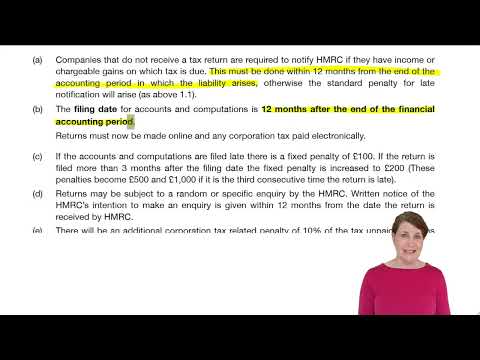
Companies that do not receive a tax return are required to notify HMRC if they have income or chargeable gains on which tax is due. This must be done within 12 months from the end of the accounting period in which the liability arises, otherwise the standard penalty for late notification will arise.
The filing date for accounts and computations is 12 months after the end of the financial accounting period.
Returns must now be made online and any corporation tax paid electronically.
Late filing ordinarily costs £100, increased to £200 after three months; third consecutive late returns increase these to £500/£1,000.
More than six months late adds 10% of tax unpaid at six months after the filing date; more than 12 months late adds another 10%.
HMRC can correct obvious errors within nine months of filing; the company may amend within 12 months of the filing date. Enquiry/discovery rules are outside FTX.
3 Claims
Wherever possible claims must be made on a tax return or on an amendment to it and must be quantified at the time the return is made.
If a company believes it has made an error in a return, an error or mistake claim may be made within four years from the end of the accounting period.
Other claims must be made within four years of the end of the accounting period unless a different time limit is specified.
A company normally notifies HMRC within three months of beginning business. Submit CT600 for each corporation-tax AP, with computations and accounts; one long period of accounts can need two returns.
The return deadline is 12 months after the end of the period of account. A company can amend within 12 months of the statutory filing date. Observe special claim limits, including two-year trading-loss claims.
Accounts/computations use iXBRL(inline eXtensible Business Reporting Language): the visible figures carry machine-readable tags. Check the accounts, tax adjustments, TTP and liability agree with CT600 before electronic submission.
Record the company/AP identity, income categories, gains, capital allowances, loss/donation claims, TTP and tax due. Document the sources and computations; a bare accounts profit is not TTP.
4 Ordinary tax payments
Corporation tax is usually due nine months and one day after the AP ends, paid electronically. The payment deadline differs from the return deadline. Each AP from long accounts has its own payment date.
Olga Ltd has long accounts 1 April 2025–30 September 2026 and does not pay instalments. State the two tax payment dates and the return deadline.
Show answerHide answer
5 Quarterly instalments
For FTX, a company is large if its taxable total profits exceed £1,500,000. Effects of dividends and associated companies on that threshold are excluded; the rate-limit sharing rule does not apply to this threshold in FTX.
For a large company with a 12-month AP, pay four instalments of 25% of the estimated current liability on day 14 of months 7, 10, 13 and 16 counted from the AP start.
The first period of becoming large has an exception where profits do not exceed £10 million and the company was not large in the previous AP. Short-period instalment dates and very-large-company rules are excluded.
Pranav Ltd has been large for several years. Its 12-month AP starts 1 April 2025 and estimated tax is £80,000. Give the four amounts and dates.
Show answerHide answer
6 Records
Companies must keep records until the latest of:
six years from the end of the accounting period
the date any enquiries are completed
the date after which enquiries may not be commenced
All business records and accounts including contracts and receipts must be kept
Failure to keep records can lead to a penalty of up to £3,000 for each accounting period affected
Keep sales/purchase records, bank/loan records, payroll, contracts, donation receipts and asset acquisition/disposal records with the accounts and CT600 workings. Normal retention is six years after the AP ends; unresolved enquiries or specific conditions can require longer retention.
7 Penalties for incorrect returns
The amount of penalty is based on the amount of tax understated, but the actual penalty payable is linked to the taxpayer’s behaviour, as follows:
No inaccuracy penalty applies where a genuine mistake occurs despite reasonable care.
A careless inaccuracy can carry a penalty of up to 30% of the understated tax.
A deliberate inaccuracy can carry a penalty of up to 70%.
A deliberate and concealed inaccuracy can carry a penalty of up to 100%. Apply the supplied behaviour and disclosure table.
A penalty will be substantially reduced where the taxpayer makes disclosure, especially unprompted disclosure to HMRC.
Failure | Ordinary consequence |
Return late | £100; after 3 months total £200; third consecutive late return £500/£1,000 |
Return more than 6 months late | Additional 10% of unpaid tax measured at 6 months after filing date |
Return more than 12 months late | Further 10%, so total 20% tax-related penalty |
Tax paid late | Interest from payment due date; no interest calculation examined |
Incorrect return | Behaviour/disclosure standard penalty table; reasonable-care genuine mistake has no inaccuracy penalty |
Interest on late corporation tax is normally treated as a non-trading loan-relationship debit; repayment interest is taxable under those rules. Do not calculate rates/interest in FTX.
Qasim Ltd’s approved workings show trade £30,000, net interest £2,000, property £3,000, gains £4,000 and donations £1,000. State TTP and the key return checks.