
Company chargeable gains
Finance Act 2025 · 2025/26
1 Gains, indexation and losses
In this TX lecture: The damaged-asset rules are not examined in FTX; compensation for lost or destroyed assets remains examinable.

ST Ltd owned 10 hectares of land which originally cost £26,000 in March 2015. ST Ltd sold 2 hectares of the land in March 2026 for £16,000, incurring legal costs on sale of £1,000.
The remaining 8 hectares were valued at £34,000 in March 2026.
Calculate the chargeable gain on the disposal of the 2 hectares of land in March 2026.
The indexation factor from March 2015 to December 2017 is 0.082.
Show answerHide answer
SC Ltd bought an asset for £23,000 in June 2015. It was destroyed in October 2025. Insurance proceeds of £34,000 were received in March 2026. SC Ltd spent £30,000 on a replacement asset in June 2026.
Calculate the chargeable gain and the base cost of the new asset.
The indexation factor from June 2015 to December 2017 is 0.074.
Show answerHide answer
In this TX lecture: Deriving indexation factors is not examined in FTX; use the factors supplied in a question.

2 General
Unlike individuals, where income tax is paid on income and capital gains tax is paid on taxable gains (i, e, two separate taxes), a company's chargeable gains are included in the calculation of Taxable Total Profits (TTP) and one tax, corporation tax, paid on them along with income.
A UK resident company is chargeable on its worldwide gains and may dispose of a chargeable asset not only by sale but also on the loss or destruction of an asset.
All assets are chargeable assets unless they are specifically exempt.
2.1 Calculation of gains and losses for companies
The calculation of the chargeable gains and allowable losses is much the same as for individuals, with the exception that companies may be entitled to deduct an additional 'cost' known as the 'indexation allowance'.
£ | |
Disposal proceeds (or market value) | X |
Less: incidental costs of disposal | (X) |
Net proceeds | X |
Less: allowable costs | (X) |
Unindexed gain | X |
Less: indexation allowance | (X) |
Chargeable gain | X |
2.2 The indexation allowance
The indexation allowance (IA) uses the rise in the retail price index (RPI) as an allowance for the effects of inflation.
Indexation is frozen at December 2017. Earlier eligible expenditure may still get the supplied factor up to that date; no further indexation accrues after it.
The calculation of the IA for each element of cost is as follows:
Relevant indexation factor × capital expenditure
The indexation factor is applied to the acquisition cost (including incidental costs of acquisition) and enhancement costs separately (as these will be incurred on different dates).
You should use the indexation factor provided in the question for the movement from the month of expenditure to the month of disposal (or December 2017 if disposed of after that date).
The IA is available to reduce a gain but cannot create or increase a loss.
Unused indexation allowance is wasted.
If the RPI falls, rather than increases, between the date of acquisition and the date of disposal, then the indexation allowance is £ Nil.
A company bought an asset on 6 June 1987 at a cost of £20,000.
Enhancement expenditure of £6,000 was incurred on 16 August 1991.
The asset was sold on 2 October 2025.
Incidental costs of sale are £1,000.
Calculate the chargeable gain arising on the disposal of the asset if the gross proceeds of sale were:
(a) £100,000
(b) £60,000
(c) £25,000
The relevant indexation factors are as follows:
June 1987 to December 2017 | 1.729 |
August 1991 to December 2017 | 1.074 |
Show answerHide answer
3 Gains and losses
Capital gains are chargeable to corporation tax.
Capital losses only arise when net proceeds are less than allowable cost.
REMEMBER: Indexation allowance may not be used to either create or increase a loss.If capital gains and losses arise in the same accounting period, they are netted off.
If the resultant figure is a gain, it is charged to corporation tax.
If the resultant figure is a loss, it is carried forward and set against future capital gains.
Capital losses may only be relieved against chargeable gains, not income.
Haruto Ltd sells a chargeable asset for £50,000 with fees £1,000. Original cost £20,000 and enhancement £5,000. Given indexation factors to December 2017 are 0.20 and 0.10 respectively. Find the company gain.
Show answerHide answer
Imran Ltd has proceeds £12,000, cost £10,000 and potential IA £3,000. Calculate chargeable gain.
Show answerHide answer
4 Share matching rules for companies
In this TX lecture: Takeovers and share exchanges are not examined in FTX.

Disposal of shares gives rise to a chargeable gain or allowable loss. It is difficult however to identify which shares are being sold, and therefore establish the cost of those shares sold where it is only some of the shareholding being sold and the shares had been acquired over a period of time at different costs.
It is necessary to identify the shares sold by using matching rules as laid down by HMRC which, are not exactly the same as the matching rules that used when dealing with the same problem for individuals disposing of shares. Thus the shares sold are deemed to be disposed of in the following order:
shares acquired on same day
shares acquired in previous 9 days
shares contained within the share pool which is made up of any shares acquired more than 9 days previous.
The share pool records the number and cost of shares for each acquisition and disposal as it did for individuals, but also has to deal with the fact that companies are entitled to indexation allowance.
Thus whenever the pool changes value (i.e.shares are purchased (including a rights issue) or sold) the pool must be updated for indexation and so the pool has an additional column, 'Indexed Cost' and indexation is kept track of within the pool.
When shares are disposed of, the average cost is deducted from the pool (as for individuals) and for companies the average indexation must be calculated too. This is calculated as the difference between the figures for average cost and average indexed cost which are deducted from the 'Indexed Cost' column.
Indexation factors will be given in the question and indexation allowance is frozen at December 2017.
A Ltd bought the following shares in B Ltd:
20 August 1990 | 1,000 shares at a cost of £5,000 |
16 November 1997 | 2,000 shares at a cost of £12,000 |
7 December 2025 | 500 shares at a cost of £5,000 |
A Ltd sold 2,000 shares on 10 December 2025 for £36,000
Calculate the chargeable gain arising on the disposal in December 2025.
Indexation factors are as follows:
August 1990 to November 1997 | 0.246 |
November 1997 to December 2017 | 0.742 |
Show answerHide answer
5 Bonus issues
A bonus issue increases the number of shares held with no corresponding increase in cost.
The bonus shares are simply added to the number of shares column in the pool.
As a bonus issue does not change the value of the pool, so do not index the pool before adding in the number of shares in the bonus issue, but remember that the next time the pool changes value, the indexed cost in the pool must be indexed from the date of the last indexation that took place, not the date of the bonus issue.
6 Rights issues
A rights issue again increases the number of shares held, but this time there is also a cost associated with the shares. It is therefore dealt with in the same way as any other acquisition.
The indexed cost in the pool is indexed to the date of the rights issue. The rights shares are added to the number of shares column and the cost is then added to both the cost and indexed cost columns in the pool.
Y Ltd acquired 3,000 shares in X Ltd on 20 July 1994 for £10,000. In February 1996 X Ltd made a 1:3 bonus issue.
Y Ltd sold 2,000 shares in March 2026 for £12,000.
Calculate the gain on the disposal of the shares in March 2026.
Indexation factors are as follows:
July 1994 to February 1996 | 0.048 |
February 1996 to December 2017 | 0.843 |
July 1994 to December 2017 | 0.931 |
Show answerHide answer
Apply same-day acquisitions, then acquisitions in the preceding nine days (earliest first, FIFO), then the pool. The company rule looks backward, unlike the individual 30-day look-forward rule. Pool indexation is frozen at December 2017; later acquisitions add cost but get no new indexation.
Jaya Ltd has a pool of 1,000 shares with original cost £10,000. The supplied indexation factor to December 2017 is 0.20; no other indexation applies. In 2025 it buys 500 more shares for £8,000. Later it sells 600 shares for £12,000 with no same-day/previous-nine-day acquisitions. Compute gain.
Show answerHide answer
7 Replacement of business assets (Rollover Relief)
7.1 Definition
A gain may be ‘rolled over’ (and the gain deferred) where it arises on the disposal of a qualifying business asset where the sale proceeds are reinvested in another qualifying business asset.
7.2 Qualifying assets
Both the old and new assets must fall into one of the following categories:
Land and buildings
Fixed plant and machinery
Note that goodwill is not a qualifying asset for companies.
Both the old and new assets must be used in a trade of the vendor.
7.3 The relief
The relief works in the same way for companies as it does for individuals, with the exception that indexation allowance may be available.
The indexed gain is not taxed immediately but is postponed ('deferred') until the company makes a disposal of the replacement asset without further replacement.
The postponement is achieved by deducting the gain deferred on the old asset from the cost of the new asset.
Where the disposal proceeds of the old asset are not fully reinvested, the gain cannot be fully deferred.
The replacement asset must be bought in the period 12 months before to 36 months after the disposal of the old asset.
A claim must be made within 4 years from the end of the accounting period in which the disposal occurred.
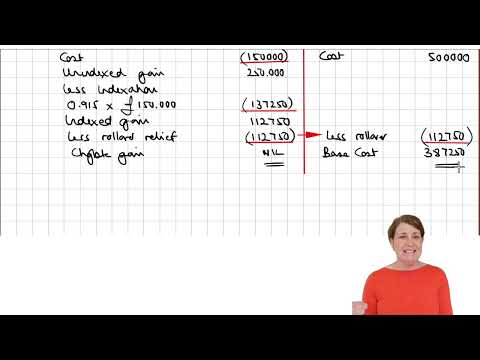
JM Ltd bought a building for use in the trade in October 1994 for £150,000.
The building was sold in March 2026 for £400,000.
In June 2025 JM Ltd had bought some land for use in the trade for £500,000.
The company claims to defer gains whenever possible.
Calculate the chargeable gain on the disposal of the building and the base cost of the land.
The indexation factor from October 1994 to December 2017 is 0.915.
Show answerHide answer
A Ltd bought land for use in the trade in May 2003 for £200,000.
The land was sold in March 2025 for £350,000.
In September 2026 A Ltd bought a factory for use in the trade for £335,000.
The company claims to defer gains whenever possible.
Calculate the chargeable gain on the disposal of the land and the base cost of the factory.
The indexation factor from May 2003 to December 2017 is 0.532.
Show answerHide answer
8 Depreciating assets
8.1 Definition
An asset with an expected life of a maximum 60 years
Fixed plant and machinery
Note: You will only be examined on fixed plant and machinery and leasehold property with a life of 60 years or less.
8.2 Effect
If the new asset is a depreciating asset:
The indexed gain deferred is not deducted from the cost of the new asset
Instead it is postponed until the earliest of:
the disposal of the new asset
the date the new asset ceases to be used in the trade
10 years after the new asset was acquired
YR Ltd bought land for use in the trade in April 1998 for £200,000. The land was sold for £350,000 in May 2019. In March 2020 YR Ltd bought fixed plant for use in the trade, costing £390,000.
YR Ltd sold the fixed plant in February 2026.
YR Ltd has a year end of 31 March.
The indexation factor from April 1998 to December 2017 is 0.710.
Calculate the chargeable gains as far as the above information allows for the years ending 31 March 2020 and 31 March 2026.
Show answerHide answer
When the replacement asset is a depreciating asset, the gain is deferred as in (b) above. However, if a non-depreciating asset is purchased before the deferred gain crystallises, the original gain may be rolled over against the cost of the new, non-depreciating asset and will only crystallise on sale of the non-depreciating asset.
Mighty Ltd has been offered £160,000 for a freehold factory that it owns, and is now considering disposing of the factory. The company acquired the factory on 15 March 1984 and it now has an indexed cost (cost plus indexation) of £120,000. The factory has always been used in Mighty Ltd's trade.
Explain the chargeable gains implications of each of the following alternative courses of action that Mighty Ltd is considering taking to replace the factory if sold:
1. Acquiring a larger freehold factory for £170,000.
2. Acquiring a smaller freehold factory for £155,000 and using the remainder of the proceeds as working capital.
3. Using the proceeds to pay a premium of £180,000 for a 40-year lease of a new factory.
Show answerHide answer
Kofi Ltd sells a qualifying trade building for £120,000 with indexed gain £40,000. It buys a qualifying non-depreciating replacement for £110,000 within the permitted period. Compute immediate gain and replacement cost.
Show answerHide answer
Chika Ltd defers an eligible £15,000 gain into fixed machinery acquired on 1 August 2025. The machinery remains owned but ceases trade use on 1 December 2027. State the release date.