
Cash Transactions
1 Introduction
This chapter deals with accounting for cash.
2 Banks and other financial services businesses
A BANK is licensed to take deposits from the public and to operate current accounts. That licence is what lets it do the thing no other institution can do: run the payment account a business pays and is paid through. A bank offers current accounts and an overdraft facility, deposit and savings accounts, loans, foreign currency, and access to the clearing system.
Other financial services businesses do some of those things but not all of them:
A BUILDING SOCIETY (or, elsewhere, a savings and loan or a mutual) is owned by its members rather than by shareholders. It takes savings and lends on property. Many now also offer current accounts, but property lending is what they exist for.
A CREDIT UNION is a small mutual owned by its members, who usually have something in common — an employer, a trade, a district. It takes members' savings and makes small loans to members, normally at better rates than a commercial lender, but it does not offer the full range of business banking.
A FINANCE HOUSE lends for a specific purchase — hire purchase, leasing, an asset finance agreement on a vehicle or a machine. It does not take deposits.
An E-MONEY INSTITUTION or payment service provider issues prepaid accounts and cards and moves money, but it is not a bank: it may not lend, and the money it holds is not a deposit.
An INSURANCE COMPANY takes premiums and pays claims. It is not in the payments business at all.
A STOCKBROKER or investment manager buys and sells investments on a client's behalf.
For a business, the practical differences are: who can hold the current account through which it trades (a bank, and now some e-money institutions), who can lend it working capital on overdraft (a bank), who is cheapest for a specific asset (a finance house), and how the deposit is protected if the institution fails (deposit protection normally applies to banks, building societies and credit unions, but not to money held by a payment service provider).
3 Types of payment from the bank
Payments can be made from a bank account in four main ways:
Cheque: see later
Internet transfer: now very common. It is vitally important that account log-on details are kept secure. In addition to user-known passwords, some banks now issue devices that generate unique use-once codes. Access to the bank account is then possible only by someone who both knows the password and who possesses the device.
Direct debit. Here the person receiving the funds has the right to extract them from the bank account. This is often used by institutions like insurance companies to collect insurance premiums from clients. The process can be completely automated.
Standing order. Here the person paying instructs their bank to pay a regular amount to the recipient. This is often used to pay regular amounts like rent. The process can be completely automated.
In addition, banks can remove funds from accounts for interest and bank charges.
4 Comparing the forms of payment
Form of payment | How it is processed | How long it takes | Main security procedures |
Cash | Handed over; counted; a receipt is issued; banked using a paying-in slip | Immediate | Two people to count and bank it; a locked till or safe; regular cash counts; never leave large sums on the premises |
Cheque | Written by the drawer; paid in on a paying-in slip; cleared through the bank clearing system | About three days to clear | Cheque books locked away; crossed 'A/C payee'; the payee's name and the amount written so they cannot be altered; two signatures over a set limit; every cheque accounted for, spoiled ones marked VOID and kept |
Debit card | The card is read (chip and PIN, contactless, or the card details online); the bank checks the funds and authorises; the money leaves the account | Authorisation immediate; funds normally next working day | PIN never written down or shared; the card is the account holder's alone; merchants check the card is not damaged or altered; card details are never stored in the accounting records |
Credit card | The same authorisation route, but through the card issuer; the business is billed monthly and pays the issuer | Authorisation immediate; the business pays the issuer at the month end | Spending limits per cardholder; every statement line supported by a receipt; a named person authorises the monthly payment; report a lost card at once |
Direct debit | The payee's instruction to the payer's bank, under a mandate the payer signed | On the agreed date | The mandate is authorised before it is set up; the list of live mandates is reviewed so nothing keeps being collected after a contract ends |
Standing order | The payer's own instruction to the bank to pay a fixed amount on set dates | On the agreed date | Set up and amended only by an authorised person; reviewed regularly |
Internet / automated bank transfer | Entered on the bank's site or app, or uploaded as a payment file from the accounting system | Hours, often minutes | Log-on details never shared; a one-time code device or app; one person prepares the payment and a different person releases it; payee bank details changed only after the change is confirmed with the supplier by telephone |
4.1 Cards in a little more detail
A card payment is the one form where a third party sits in the middle. When a customer pays a business by card, the card is read and the details go to the business's MERCHANT ACQUIRER, which asks the card issuer to authorise the amount. If it is authorised the acquirer pays the business — usually the next working day, and after deducting a small percentage as its charge — and collects from the issuer.
The difference between the two cards is where the money comes from. A DEBIT card takes it out of the cardholder's own bank account. A CREDIT card borrows it from the card issuer, who bills the cardholder later; the cardholder may pay interest, the business does not.
A customer who disputes a card payment can ask the issuer for a CHARGEBACK, and the amount is taken back from the business. That is why the business must keep the receipt, the signature or the record that the PIN was used, and the proof that the goods were delivered.
The security rules around card data are strict and an exam question may ask for them: never write down or store a full card number or security code, never take card details by email, take payments only through the acquirer's own terminal or secure page, check the terminal has not been tampered with, and restrict who may take card payments at all.
Cash remains the riskiest to handle, cheques the slowest, and automated transfers the cheapest and quickest — which is why cheque volumes have fallen so far.
5 Cheques and the clearing system (relatively rare now)
Cheques are unconditional orders in writing given to a bank (the drawee) by the person paying out of his or her bank account (the drawer of the cheque) to pay an amount to the payee (the person receiving the money).
Here is a typical UK cheque
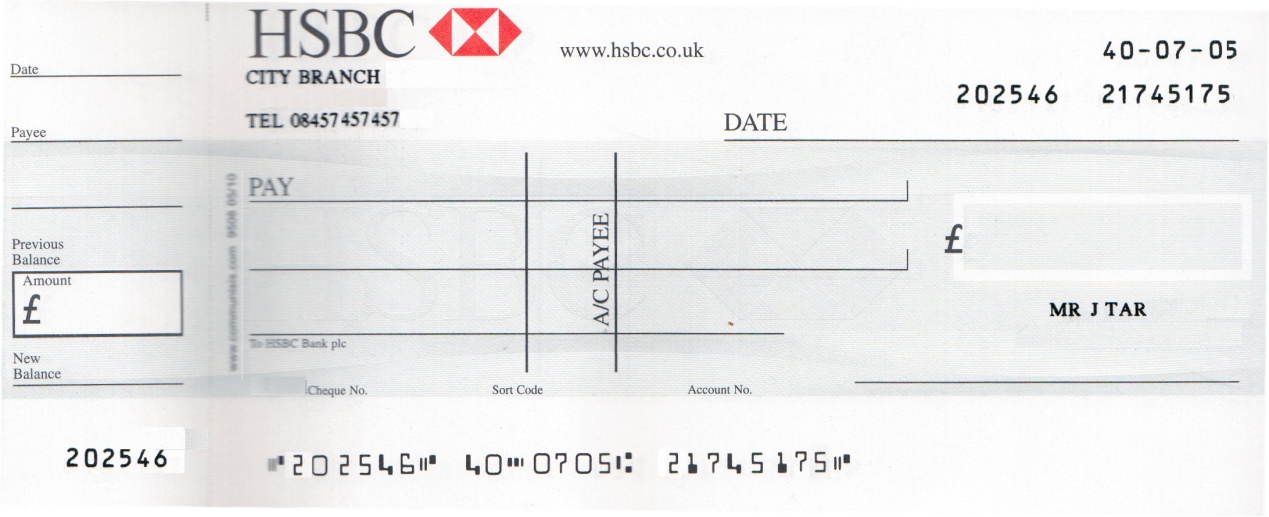
The narrow strip on the left is the counterfoil, which stays in the cheque book as the drawer's record; the rest is the cheque itself.
HSBC is the bank (the drawee ie the institution on whom the cheque is drawn and the order to pay given).
Mr J Tar is the drawer (the person paying the money)
40-07-05 and 21745175 are numbers that identify the bank branch and the bank account
202546 is the cheque number (for identification)
The numbers printed at the top right are reproduced in special machine-readable characters at the bottom of the cheque and these allow automatic processing of the cheque.
The cheque can be torn out of the cheque book leaving a counterfoil onto which details should also be entered.
When completed, the cheque would look like:
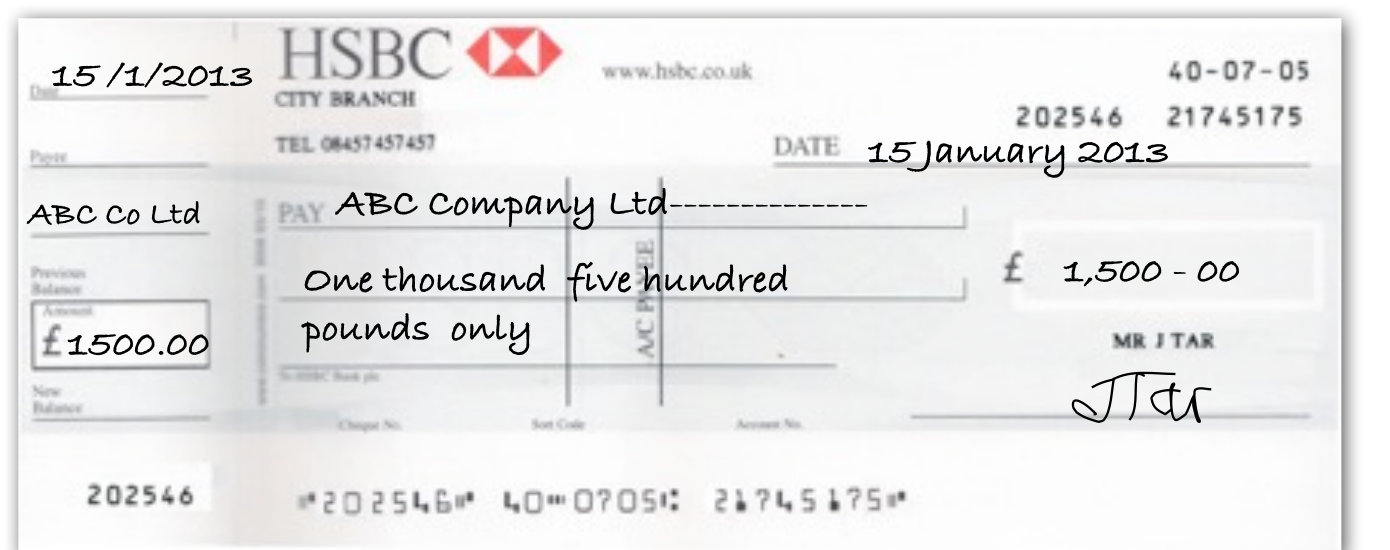
The ABC Company Ltd is the payee (the person who will receive the funds)
Cheque books must be kept securely as the signature of the authorised person (J Tar) could be forged (falsified) and cheques made out improperly to steal funds.
Note that the payee is written as “ABC Company Ltd-------------------“ and the amount as “One thousand five hundred pounds only”. The line after Ltd and the word ‘only’ are to prevent changes being made.
All cheques should be accounted for, even those which are made out incorrectly and scrapped: the cheque should be marked “VOID” in large letters and kept in the cheque book.
When ABC Ltd receives the cheque it is important to pay the cheque into the bank promptly. Delay increases the risk of the cheque being lost, stolen or of J Tar not having the funds to pay.
When ABC Company receives the cheque it must be paid into the company’s bank. This is done using a Paying-in slip.
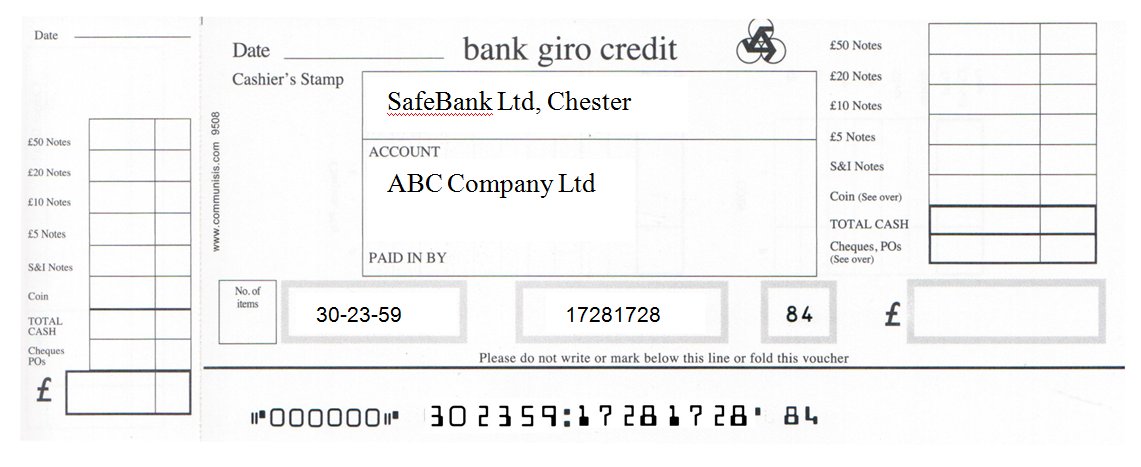
ABC will list cheque details on the reverse of the slip, and the total on the front.
The total will appear in ABC’s bank account at the end of the day, but that does not mean that funds have been safely transferred: the amount is only provisional. The cheque from J Tar has to be sent back to his bank to see if there is enough money in the account. If there is, then Tar’s bank will send the money to ABC’s bank and the funds are transferred at that point.
This process is known as ‘clearing the cheque’ and it takes around three days (Internet transfers are usually completed in a couple of hours).
If J Tar did not have enough funds to pay the money, then the cheque is sent back to ABC’s bank and from there to ABC marked ‘Refer to Drawer’. This means that the cheque has been dishonoured or ‘bounced’. ABC then has to pursue the matter with Tar and the funds that had provisionally appeared in ABC’s account are removed.
6 The cash account
The cash account of the business is where bank account receipts and payments are recorded. In a simple ‘T’ account it would look like;
Dr (Receipts) | Cash Account | Cr (Payments) | |
Balance b/d | 1,200 | Paid to C Clark | 404 |
Cash sales | 240 | Paid to D Drake | 172 |
Received from A Smith | 360 | Wages | 1,200 |
Cash sales | 120 | Cash purchases | 72 |
Received from B Bodkin | 600 | Tax | 300 |
Balance c/d | 372 | ||
2,520 | 2,520 | ||
Balance b/d | 372 | ||
Notes:
At the start of the period there is cash of $1,200.
The receipts from Smith and Bodkin will be the settlement of sales invoices.
The payments to Clark and Drake will be the payment for purchases invoices.
At the end of the period there is cash of $372
Cash transactions carry sales tax just as credit transactions do, and the tax has to go to the sales tax account, not to sales or purchases.
A cash sale of $240 INCLUDING sales tax at 20%:
Sales tax = 240 x 20/120 = $40; net sale = $200
Debit Cash $240
Credit Sales $200
Credit Sales tax account $40
A cash purchase of $72 including sales tax at 20%:
Sales tax = 72 x 20/120 = $12; net purchase = $60
Debit Purchases $60
Debit Sales tax account $12
Credit Cash $72
The cash account itself still shows the single gross figure — $240 in and $72 out. The split happens on the other side of the entry.
7 Bank reconciliations
The cash account (or cash book) records the movements of cash in the business’s bank account. Of course, there are usually many cash movements and it is easy for errors to be made. Fortunately, banks will normally send regular bank statements to their customers (or these can be downloaded or viewed over the Internet) and, by comparing the bank’s version with the cash account version, businesses have a very valuable way of checking that their bank account contains no errors.
However, often the cash account balance and the bank statement balance will differ because of timing and other differences. For example:
The bank might have made interest charges that have not yet been reflected in the cash account.
Cheques issued by the organisation and credited to their cash account, might not yet have reached the payee and not yet gone through the bank account (ie not yet cleared).
The organisation might have forgotten to enter standing orders or direct debits in its Cash Account, though these will have been paid by the bank.
Sometimes if an amount is paid at a different bank, it takes time to make its way to the bank account.
It is therefore necessary to carry out a bank reconciliation to ensure that any difference between the balance shown on the bank statement can be reconciled to (made to agree with) the balance in the cash account.
Bank reconciliations are in indispensable part of the internal control system of a business: cash has many movements and it is a very desirable asset so the accuracy of cash records has to be checked regularly
Here’s an example:
Dr | Cash Account | Cr | ||
Balance b/d 1 May 2013 | 1,900 | CN 1200 | 200 | |
CN 1201 | 150 | |||
Paid in 31 May 2013 | 360 | CN 1202 | 388 | |
CN1203 | 290 | |||
Balance c/d 31 May 2013 | 1,232 | |||
2,260 | 2,260 | |||
Balance b/d 1 June 2013 | 1,232 | |||
[CN = cheque number]
Note CN = cheque number; DD = direct debit; SO = standing order.
Dr | Bank Statement - Safe Bank Inc | Cr | ||
1200 | 200 | Balance b/d 1 May 2013 | 1,900 | |
DD | 50 | |||
Bank charges | 5 | |||
1203 | 290 | |||
Balance c/d 31 May 2013 | 1,355 | |||
1,900 | 1,900 | |||
Balance b/d 1 June 2013 | 1,355 | |||
Note that things seem to be reversed on the bank statement. This is the bank’s document showing its relationship with its customers. If the customer has $1,900 cash in the bank on 1 May then on that date the bank owes its customer $1,900. The customer is therefore a creditor of the bank and this will show a credit balance on the bank statement.
As cash leaves the account then the bank owes the customer less and debits these amounts from the account.
You will see that the closing balances do not agree here: $1,232 compared to $1,355. We have to see if the difference can be explained logically by performing a bank reconciliation.
First compare the two documents and mark off each item which appears on both: they cannot be the cause of any difference.
Dr | Cash Account | Cr | ||
Balance b/d 1 May 2013 | √ 1,900 | CN 1200 | √ 200 | |
CN 1201 | 150 | |||
Paid in 31 May 2013 | 360 | CN 1202 | 388 | |
CN1203 | √ 290 | |||
Balance c/d 31 May 2013 | 1,232 | |||
2,260 | 2,260 | |||
Balance b/d 1 June 2013 | 1,232 | |||
Dr | Bank Statement - Safe Bank Inc | Cr | ||
1200 | √ 200 | Balance b/d 1 May 2013 | √ 1,900 | |
DD | 50 | |||
Bank charges | 5 | |||
1203 | √ 290 | |||
Balance c/d 31 May 2013 | 1,355 | |||
1,900 | 1,900 | |||
Balance b/d 1 June 2013 | 1,355 | |||
Then bring each document up to date for the reconciling items
Bank statement | |||
Opening balance | 1,355 | ||
Less: cheques in cash account not yet on bank statement | CN 1201 | 150 | |
CN 1202 | 388 | ||
(538) | |||
Add: amount paid in but not yet on bank statement | 360 | ||
Up-to-date balance | 1,177 | ||
Dr | Cash Account | Cr | ||
Balance b/d 1 June 2013 | 1,232 | |||
Direct debit | 50 | |||
Bank charges | 5 | |||
Correct bal c/d 1 June 2013 | 1,177 | |||
1,232 | 1,232 | |||
Balance b/d 1 June 2013 | 1,177 | |||
You will see that the two balances now agree.
7.1 Dealing with the differences
A reconciliation is only half the job. What you do with what it throws up is the other half:
Do it regularly — monthly at the very least, and weekly where the bank account is busy. A difference found within days can usually be explained by someone who still remembers it; one found in nine months' time often cannot be explained at all.
Split the differences into the two kinds. Timing differences (unpresented cheques, uncredited lodgements) need nothing but time. Everything else — a direct debit you did not know about, a bank charge, a receipt that never arrived, an amount on the statement you do not recognise — is a real difference and has to be posted or queried.
Post what belongs to you at once: bank charges, interest, direct debits and standing orders you had not recorded, and a dishonoured cheque all go into the cash account the same day you find them.
Query what belongs to the bank the same day, in writing, quoting the date, the amount and the reference, and keep the correspondence with the reconciliation.
Never make the reconciliation balance by inventing an adjustment. An unexplained difference stays unexplained until it is explained, and it is escalated to a supervisor rather than hidden.
Chase anything still outstanding at the next reconciliation. An unpresented cheque more than six months old is stale and should be written back; an old uncredited lodgement means money the business thinks it has and does not.
Be courteous and factual with the bank or the supplier. The difference is very often the business's own error.
The same discipline applies to every other reconciliation in these notes — the petty cash count, the receivables and payables control accounts, and supplier statements.
On 31 July 2013, the cash account of Pizazz Ltd showed a debit balance (ie cash at the bank) of $200. The bank statement showed a credit balance (ie Pizazz had cash in the account) of $339.
The following errors and differences were found;
Cheques in the cash account of $500 had not been presented for payment (ie this amount had not yet left the bank account).
An amount of $250 paid in had not yet been credited to the bank account.
The credit side of the cash account had been undercast (ie under-added) by $70 when working out the closing balance of $200
A payment of $40 by a customer had been sent directly to the bank and was not in the cash account.
Bank charges of $31 had been taken by the bank but were not in the cash account.
The bank had taken $50 out of the bank account because a cheque from a customer that had been credited to the bank account later ‘bounced’ ie was dishonoured. This was not reflected in the cash account
Reconcile the bank account and the cash account, adjusting each as appropriate:
Dr | Cash Account | Cr | ||
Balance b/d 31 July 2013 | 200 | |||
Bank statement | |||
Opening balance | 339 | ||
Up-to-date balance | |||
Show answerHide answer
8 Petty cash
The petty cash book is often kept manually and will usually have analysis columns. Usually the only source of funds will be when the petty cash is topped up by cash from the main bank account, though occasionally there will be small amounts received from staff as payment for personal photocopying, use of the firm’s postage and so on.
Debit | Credit | ||||||||
Date | Narrative | Total | Date | Narrative | Total | Refreshments | Post | Fares | Stationery |
Written up for a week, it looks like this. Note the sales tax column: where the expenditure carries recoverable sales tax it is taken out of the total and analysed separately, because it is going to the sales tax account and not to the expense.
Date | Narrative | Total $ | Sales tax $ | Refreshments $ | Post $ | Fares $ | Stationery $ |
12/7 | Balance b/d | 100.00 | |||||
12/7 | Coffee and milk (voucher 41) | 12.00 | 2.00 | 10.00 | |||
13/7 | Stamps (voucher 42) | 15.00 | 15.00 | ||||
14/7 | Taxi to client (voucher 43) | 18.00 | 3.00 | 15.00 | |||
15/7 | Envelopes (voucher 44) | 23.00 | 23.00 | ||||
Total paid out | 68.00 | 5.00 | 10.00 | 15.00 | 15.00 | 23.00 | |
16/7 | Balance c/d | 32.00 | |||||
100.00 |
Stamps are usually outside the scope of sales tax and envelopes here were bought from an unregistered supplier, so neither carries any — which is why two of the rows have a blank tax column. Always work from the voucher and the receipt, not from an assumption.
At the end of the week the analysis columns are posted to the general ledger:
Debit Refreshments $10.00, Postage $15.00, Travel $15.00, Stationery $23.00, Sales tax account $5.00
Credit Petty cash $68.00
The four analysis columns plus the sales tax column must always add back to the total column — $10 + $15 + $15 + $23 + $5 = $68. That cross-cast is the check that the book has been analysed correctly.
Petty cash is usually kept in a small locking box, the petty cash box.
As payments of cash are made, a petty cash voucher will be filled in showing the amount and purpose of the payment. Ideally, any receipts for the purchase will be stapled to the petty cash voucher and the voucher approved by a manager or supervisor.
Petty cash is usually kept on the imprest system as this prevents too much cash accumulating in the petty cash box. Under this system, on the presentation of the vouchers the balance is topped-up, back to an agreed amount (the petty cash float). The amount of the top-up should equal the sum of the vouchers and the vouchers are filed away.
At any stage, the total of the cash and the vouchers in the box should add back to the agreed maximum balance.
Petty cash float = $100. During the week of 12 July, petty cash amounts paid out amounted to $68 and all amounts were supported by petty cash vouchers and receipts.
Just prior to reimbursement:
Cash in the box should be = 100 – 68 = $32; vouchers amount to $68
Cash + Vouchers = $100 (the agreed float)
The reimbursement process is:
Petty cash float | = | 100 |
Less: authorised expenditure | (68) | |
32 | ||
Petty cash reimbursement | 68 | |
Re-established float | 100 |
The double entry for the reimbursement is the part that is easy to forget. Topping the petty cash box back up is a transfer between two of the business's own assets:
Debit Petty cash $68
Credit Cash (bank) $68
Nothing is charged to an expense at that moment — the expenses were charged when the analysis columns were posted, above. The reimbursement only restores the float.
8.1 Imprest and non-imprest systems
Under the IMPREST system, which is what has been described so far, the float is a fixed amount — here $100 — and the top-up is always exactly the amount of the vouchers. The box therefore starts every period with the same balance. Its advantages are that only a small, known sum is ever at risk, that cash plus vouchers must always equal the float so a shortage shows up immediately, and that the amount of the reimbursement is itself a check on the expenditure claimed.
Under a NON-IMPREST system there is no fixed float. Cash is put into the box as and when it seems to be needed — a round $200 this month, $150 next — so the balance drifts up and down. It is simpler to operate, but it is weaker control: there is no fixed figure to reconcile back to, more cash tends to accumulate in the box, and a shortage is much harder to spot.
Examiners prefer the imprest system for exactly that reason, and so does every internal auditor.
9 FA1 exam focus — Chapter 4
Examiner tip
Do not enter unpresented cheques or lodgements not yet credited in the cash book. They are timing differences. First update the cash book for genuine omissions, then reconcile.
Cash Transactions
10 questionsAnswer the questions one at a time. Your progress is saved so you can leave and come back.
Open chapter practice