
Types of Business Transactions and Documentation
1 Introduction
This chapter gives a brief introduction to organisations, accounting documentation, and computer-based accounting systems.
2 Types of business transaction
An organisation can be defined as:
A social arrangement which pursues collective goals, which controls its own performance and which has a boundary separating it from its environment.
Organisations can include businesses such as companies and partnerships, clubs, charities, government departments, hospitals and schools.
Even if not strictly a ‘business’ all organisations will have business transactions. Typically these will include:
Purchasing goods and materials. Purchases can be for cash or credit. Cash purchases are paid for immediately and are fairly rare in most businesses. Credit purchases are paid for after some time, typically a month or so
Purchasing services, for example, repair s to equipment, advertising, printing costs.
Sales. Cash sales, for example in shops, are paid for immediately. Credit sales are paid for after some time.
Paying wages and salaries.
Purchase of non-current assets.
Raising finance and paying rewards to the suppliers of finance. For example, owners putting in capital or loans being raised from banks. Owners of the business expect rewards based on a share of the profit; banks usually expect interest to be paid.
Accounting for and paying tax.
Movements of cash and money in the bank account. These movements usually arise from the transactions above.
All to these transactions are summarised at the end of accounting periods into two statements:
Statement of financial position Assets (amounts owned) and Liabilities (amounts owed).
Statement of profit or loss Income (such as sales) less expenses (such as rent, wages, electricity, raw materials). If income is greater than expenses, a profit will result.
In the statement of financial position, assets are divided into:
Non-current assets such as equipment, premises, motor vehicles. These are kept long-term in the business.
Current assets such as inventory (stock) receivables or cash. These either are cash or will become cash within 12 months.
Liabilities are divided into:
Current liabilities such as amounts that have to be paid to suppliers (trade payables). These liabilities have to be settled within 12 months.
Long-term liabilities These don’t have to be settled until at least 12 months time
3 Types of business documentation
Each type of business transaction has its own set of documentation. The documentation is needed to:
Control the progress of the transaction
Record the transaction
Provide a history of how the transaction proceeded. This is sometimes known as an ‘audit trail’
Sometimes the documentation is purely internal; sometimes it arises externally or is sent outside the business. Nowadays, the term ‘documentation’ is not confined to paper documents as many business transactions are mostly handled using computerised records.
3.1 The characteristics of good accounting data
A business needs more from its accounting records than that they exist. The data has to be:
Complete — every transaction that happened is in the records and nothing has been left out.
Accurate — the amounts, dates, account codes and customer or supplier references are right.
Valid — every entry is supported by a document and was properly authorised; nothing has been invented.
Timely — transactions are recorded soon enough for the information to still be useful. A sales figure that arrives six weeks late cannot be acted on.
Relevant — the records are analysed the way the business actually needs them (by product, by branch, by customer), not just in one lump.
These five are the test to apply whenever you are asked whether a set of records meets the business's requirements.
Typical documentation is as follows:
Purchase of goods and materials: this will usually be initiated by someone in the warehouse or factory who can see that more materials will soon be needed. Often this person raises a purchase requisition which goes the buyers’ department. Buyers will then raise a purchase order to order goods from the most suitable supplier. Goods, accompanied by the supplier’s delivery note, will be received in the warehouse, where a goods received note will be raised. These must be checked back to the order to ensure that the correct goods are being received. Invoices from suppliers will be received and recorded by the accounting department first in a purchases day book (just a list of invoices received) and then in the payables ledger. Usually suppliers will send statements of account setting out the amounts still owed. Statements act as reminders and also they can be used to check that buyers agree with suppliers’ versions of events. Later the invoices will be paid and a remittance advice sent by the customer to indicate which invoices have been settled.
If goods are returned to suppliers (for example their quality was poor) then buyers will ask for a credit note. This acts like a negative invoice.
Purchasing services: often, these will be recurring items such as rent, electricity, telephone and insurance, and an invoice will be received Sometimes they will be once-off like paying for an advertisement in a newspaper or for the repair of a piece of equipment. These services should have a purchase order. The invoices will be processed by the accounting department who will make sure that the expenses look reasonable compared to previous amounts or who will ensure that the services have been properly ordered and received.
Sales: in a retail organisation sales will be initiated by customers either in a shop or through the internet. Payment will usually take place immediately and the customer given a till (cash register) receipt; a copy of the sales is also recorded by the cash register system. In businesses selling to other businesses, the sales representatives (sales men and sales women) will be responsible for encouraging customers to place sales orders. Once received, orders should result in goods despatch notes being raised and these act as authorisation to despatch the goods from the warehouse and for also sales invoices being created and sent to the customers by the accounting department. The accounting department will also record what each customer owes in the receivables ledger.
Most businesses will send customers statements of account which set out the amounts still owed by customers. Statements act as reminders to customers about what needs to be paid and they also allow customers to check that they agree with the seller’s version of events. Payments by credit customers should be accompanied by remittance advices which detail what is being paid.
If goods are returned by customers (for example their quality was poor) then customers will ask for a credit note. This acts like a negative invoice.
3.2 Debit notes
A debit note runs the other way. It is sent by the CUSTOMER to the supplier to say that the customer believes it has been overcharged, or that goods are being returned, and to ask for a credit note to put it right. A debit note is a request: nothing is posted to the ledgers until the supplier agrees and issues the credit note.
Paying employees: large organisations will have a wages and salaries department which is responsible for calculating amounts owing, and dealing with employees who leave and with new joiners. Sometimes the payments are the same every week or month; sometimes they depend on time records (such as clock cards). In both cases employees will receive a wage or salary slip showing their pay and any deductions for tax etc. The amounts to be paid will usually be passed to the accounting department which will look after the cash transfers to employees.
Purchase of non-current assets: The purchase of these assets will often begin with en employee raising a purchase requisition, for example for a new printer, which is then authorised by a manager or by the company accountant. When the invoice is received, someone needs to ensure that the asset has been received and that it is working properly. These payments are handled in a similar way to purchases of goods and raw materials.
Finance. In companies, shares can be issued in exchange for new share capital. Loans will usually be accompanied by a loan agreement setting out the terms of the loan.
Tax will be paid in response to an assessment by the tax authorities.
Movements in cash and bank account amounts require careful documentation. Cash payments are usually small and usually made through the petty cash system where payments will be supported by petty cash vouchers. Payments from bank accounts will be by cheque or credit transfer. Credit transfers can be:
Specially initiated by the company
Automatic constant amounts (standing orders)
Initiated by the person receiving the money (direct debits).
In all cases there should be documentation to back up the payments.
What are the two main documents produced at the end of accounting periods and what appears on each?
Show answerHide answer
4 Coding systems
It is universal practice in accounting systems to use coding systems to refer to customers, suppliers, accounts and employees. Codes are used because they are concise and precise, and can be subject to computer checking
Concise: Instead of referring to a product as a “50cm high resolution LED monitor”, the product is given a code such as 50HRL. This is much quicker to write or type.
Precise: There might be several makes of 50cm high resolution LED monitors and information might be confusing and ambiguous if the manufacturer (Sony, Panasonic, Samsung LG etc) wasn’t specified. A code number can therefore be used to ensure that products and people are referred to uniquely eg 50HRLLG.
Automatic processing. Codes can also help in processing transactions. For example if all income-related accounts have the structure 1xxxx, all expense-related accounts have the structure 2xxxx, all asset-related accounts 3xxxx and all liability accounts 4xxxx, then this will help the production of the statement of profit or loss (all 1xxxx amounts less all 2xxxx amounts) and the statement of financial position (3xxxx as asset amounts and 4xxxx amounts as liabilities). This is particularly needed in computerised accounting systems because the computer cannot understand that, say, rent is an expense, but doesn’t need this understanding so long as rent is coded, say 21892. Because it starts with ‘2’ it will be treated as an expense.
Checking: If all inventory codes are 7 digits long then forms and input screens can be designed for this. Computers can check that all 7 digits are present, and sometime more sophisticated checks can be carried out on the structure off the code. This reduces the chance of errors.
5 Different methods of coding
There are several methods of coding. Codes should be:
Simple to use
Understandable
Concise
Precise
Expandable
Sequential codes
In this method products or customer are simply allocated numbers in sequence:
0001 Abrahams
0002 Adkins
0003 Ahmad
.
.
.
This is simple and concise, but as constructed might have some faults:
There is no relationship at all between the code and the item/person being encoded.
Expansion might be difficult once you have over 9999 customer if documents and computer files can hold only four digits. Additionally, if someone called Affleck becomes a customer, he will have to be tagged onto the end of the sequence ie not reflecting alphabetical order. To avoid this problem, often sequence codes proceed as 0010, 0020, 0030…etc so that gaps are built in for future use.
Hierarchical or significant digit codes
In a business, hierarchical codes could be used to code the accounts in the general ledger. For example a code such as 3112 could be interpreted as the Machinery Cost Account, using the following system.
3 | 1 | 1 | 2 |
1 = expenses | 1 = non-current assets | 1 = cost | 1 = property |
The great advantage of this type of code is that its structure provides information both to human users and to computers. For example, it would be easy to program the compute to work out the total cost of all non-current assets: simply add up all accounts starting 311.
Block codes
These lie somewhere between simple sequence codes and the full, detailed hierarchical code. They start off giving some information but then lose enthusiasm. So for general ledger codes you might have
1xxx = expenses
2xxx = income
3xxx = assets
4xxx = liabilities
You will see in the next chapter that accounting systems rely on double entry bookkeeping. There it is essential that the accounting entries made are precise and before transactions are recorded in the system it would be normal to attach codes to the transactions.
When a purchase invoice is received from a supplier, three codes would normally be needed:
The code number of the supplier
The code number of the account which describes the purchase net of sales tax
The code number of the input sales tax.
These codes will allow all the required information to be recorded in the ledger system
A SALES invoice is coded in the same way, but from the other side:
the code number of the customer, so the invoice reaches the right account in the receivables ledger
the code number of the sales account that describes what was sold, net of sales tax
the code number of the output sales tax account.
A CREDIT NOTE carries exactly the same three codes as the invoice it cancels — the same customer, the same sales account, the same sales tax account. Only the side of the entry changes. Coding a credit note to a different sales account is a common error: the sales analysis then shows a sale that was never reversed.
List three advantages of using coding systems
Show answerHide answer
6 Examples of business documentation
6.1 Sales invoice
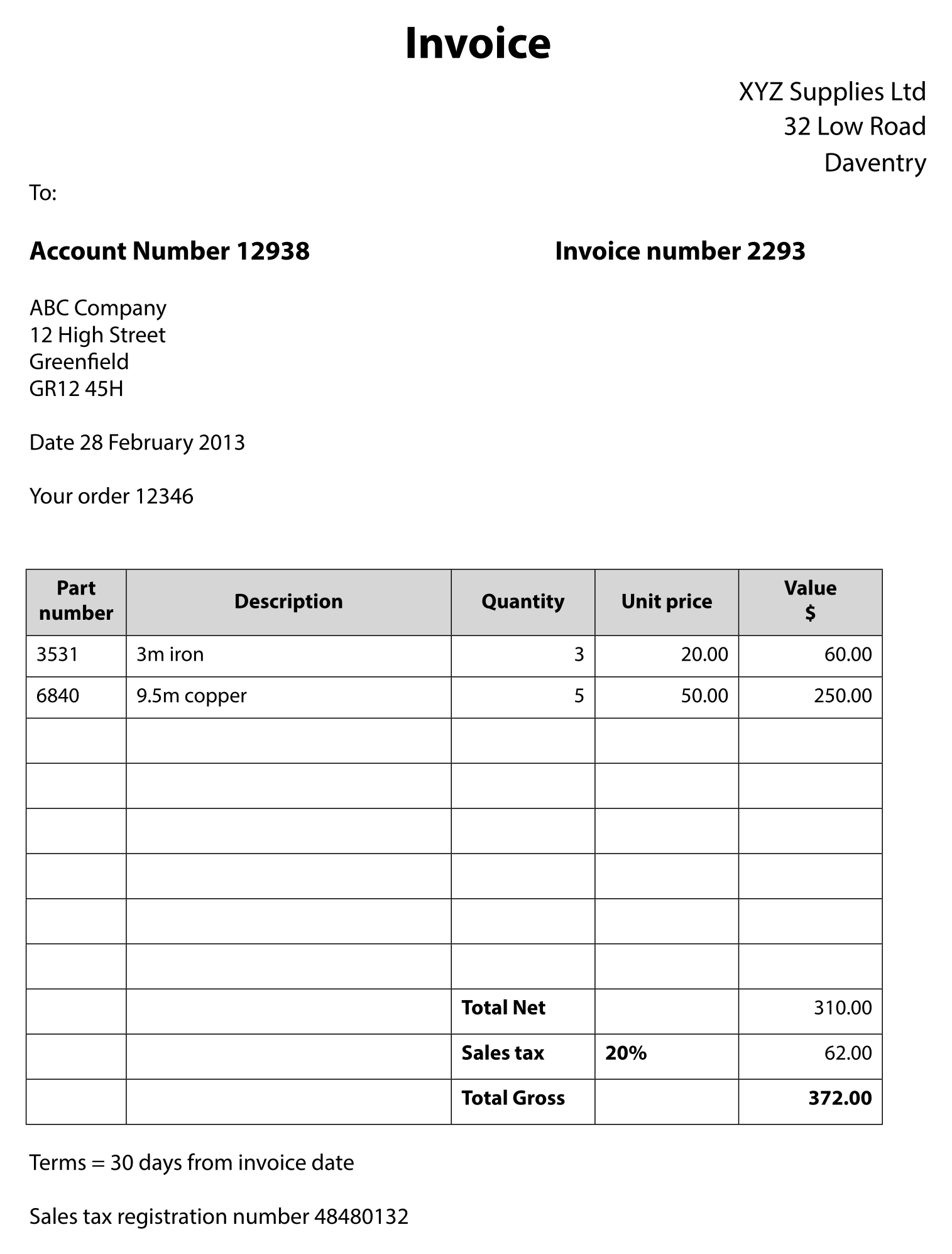
The invoice shows:
Who it is from (XYZ Supplies Ltd)
A unique invoice number (2293)
Who the customer is (ABC Company)
Customer’s account number (12938)
Date of the invoice (28 February 2013)
The customer’s order number (12346 – so that the customer can link it to goods ordered)
Details about goods ordered and now invoiced on this document
Net total, sales tax (VAT) and gross amount due
Terms setting out when the invoice has to be paid by.
6.2 Credit note
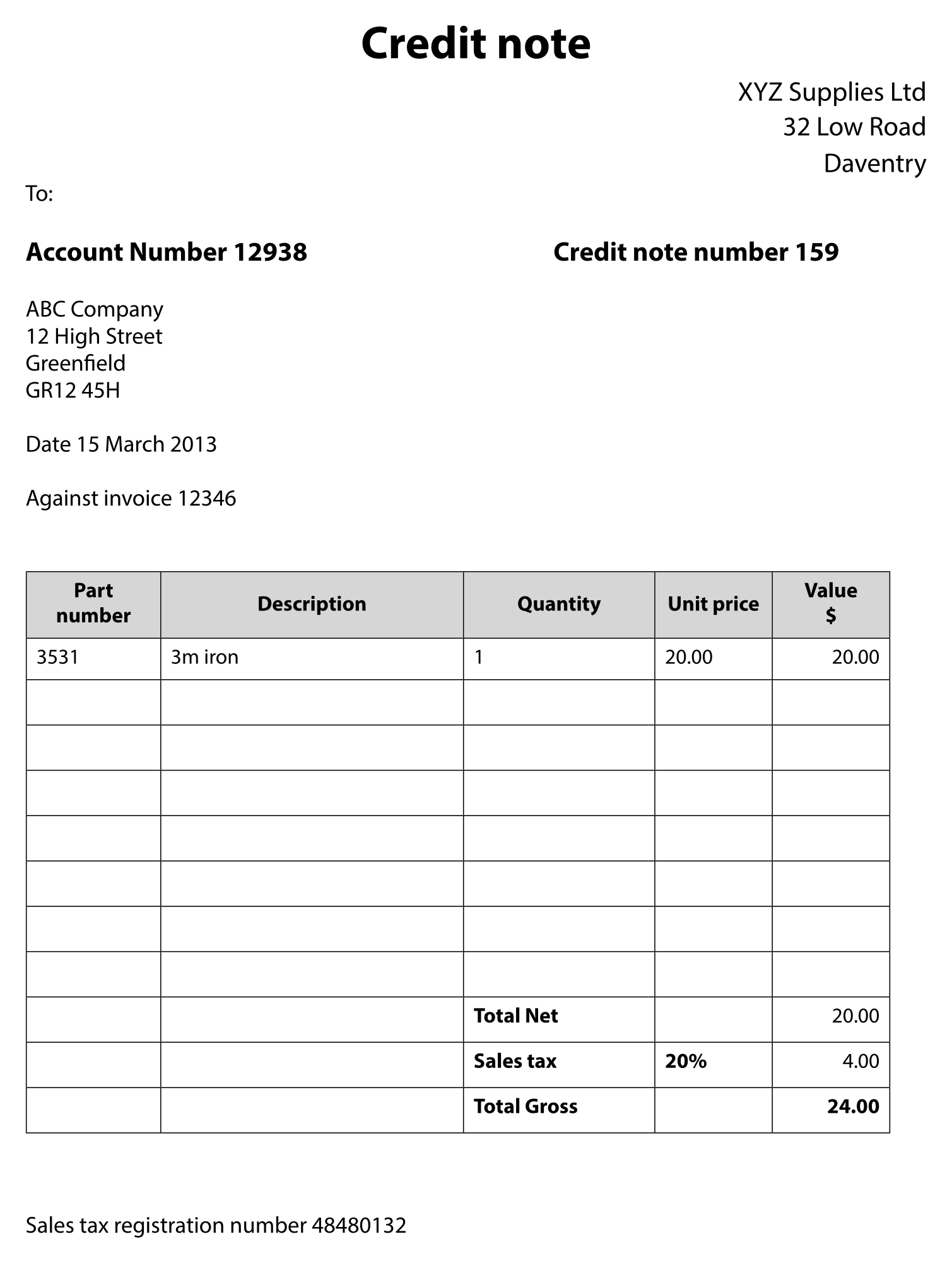
A credit note is like a negative invoice. Credit notes can be issued to correct errors (for example if a previous invoice had used a price that was too high) or to reduce the value of the goods invoiced previously (for example, if were faulty).
6.3 Statement of account
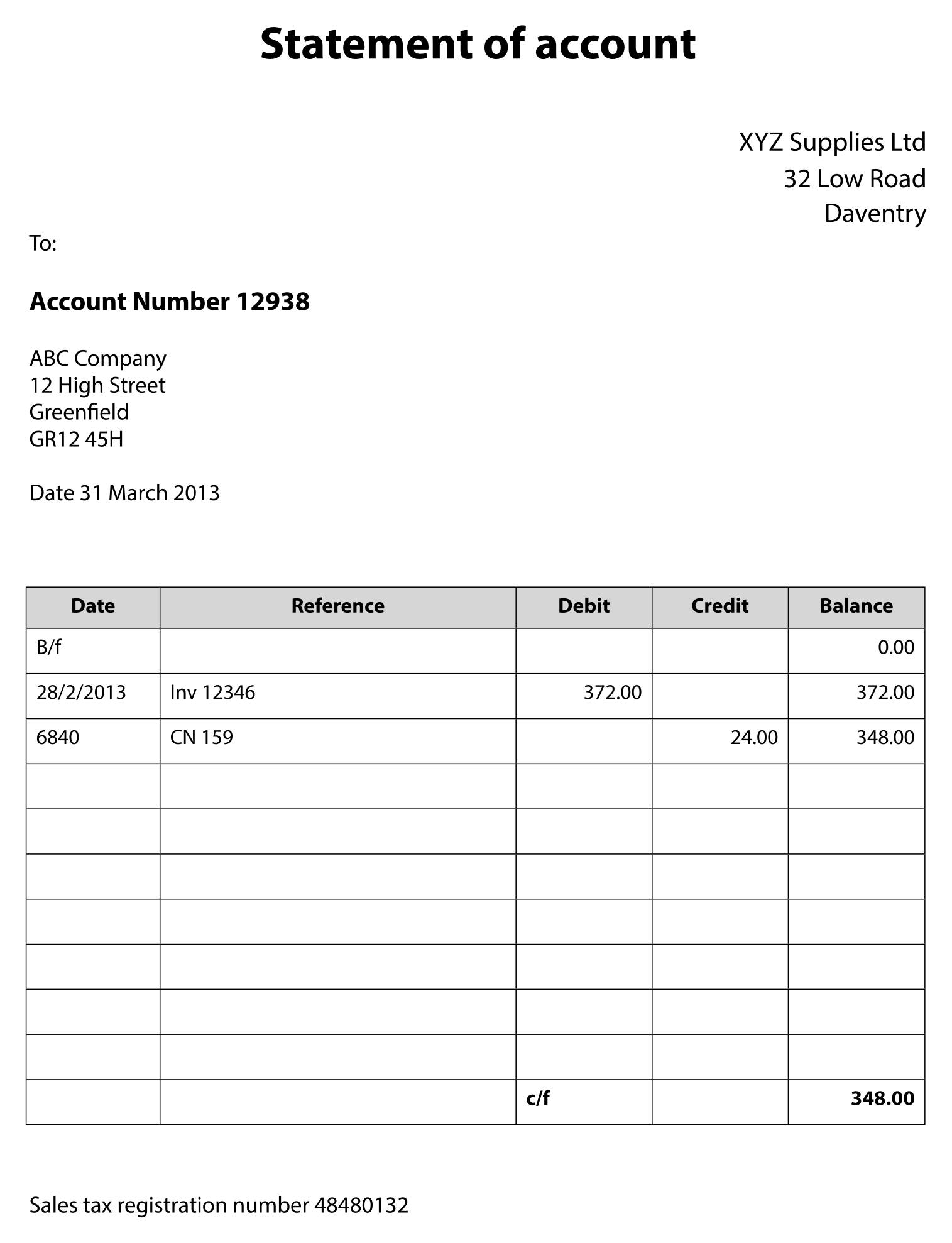
When ABC Company pays the amount owing to XYZ Supplies, it will prepare a remittance advice showing that is paying Invoice 12346 less the amount given in credit. This allows XYZ to keep track of exactly what has been paid and what hasn’t.
6.4 Petty cash voucher
6.5 Preparing these documents
Being able to read a specimen is not the same as being able to draw one up, and FA1 asks for both. Working from the four documents above:
XYZ Supplies sells 4 units of part 3531 at $20.00 each and 2 units of part 6840 at $50.00 each to ABC Company (account 12938) on 30 April 2013, order 12388, sales tax 20%.
To prepare the SALES INVOICE you need, in this order: your own name and address; the customer's name, address and account number; a unique invoice number; the invoice date; the customer's order number; a line for each part showing part number, description, quantity, unit price and value; then the totals.
Total net = 4 x 20.00 + 2 x 50.00 = 80.00 + 100.00 = $180.00
Sales tax at 20% = 180.00 x 20% = $36.00
Total gross = $216.00
Finish with the payment terms (30 days from the invoice date) and the sales tax registration number.
If one of the 3531 parts is then returned as faulty, the CREDIT NOTE carries the same heading information, its own credit note number, the number of the invoice it is against, and one line: part 3531, quantity 1, $20.00. Net $20.00, sales tax $4.00, gross $24.00. Nothing else on the invoice is touched.
The STATEMENT OF ACCOUNT at the month end lists, for that customer only, the balance brought forward, then every invoice as a debit and every credit note and receipt as a credit, in date order, with a running balance, and carries the closing balance forward: 0.00 b/f, invoice 216.00, credit note (24.00), balance c/f $192.00.
A PETTY CASH VOUCHER when you are given a tax-inclusive amount. $54 was spent on stationery; sales tax is 20% and the receipt is for the gross amount.
Sales tax = 54 x 20/120 = $9.00
Net amount = 54 x 100/120 = $45.00
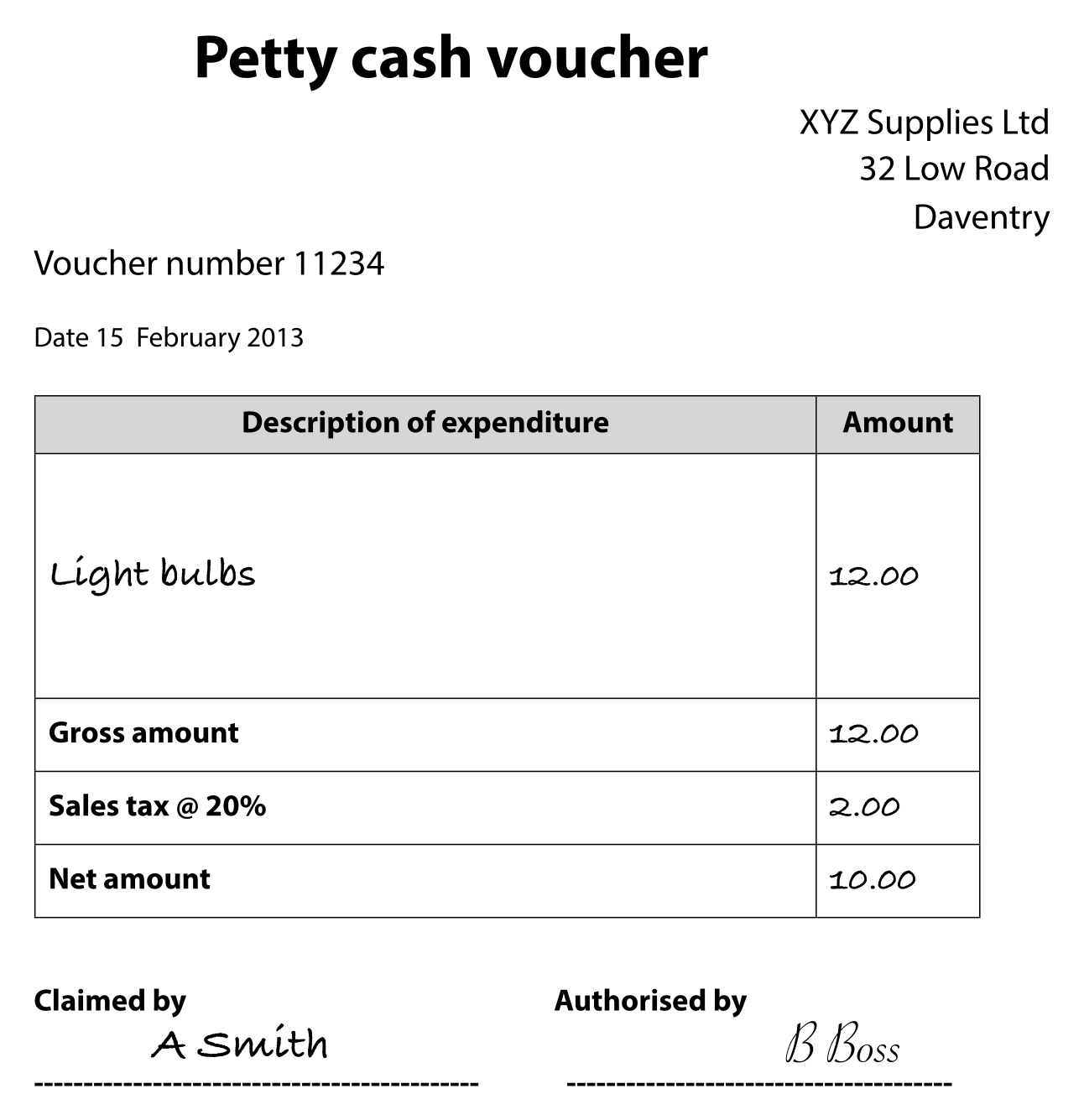
The voucher shows the voucher number, the date, the description of the expenditure, the gross amount $54.00, the sales tax $9.00 and the net amount $45.00, and is signed both by the person claiming it and by the person authorising it.
Note the direction of the fraction: from a GROSS amount you use 20/120, not 20/100. 20/100 is only used when you start from the net amount.
7 Discounts
There are two types of discount that can be offered to customers:
A trade discount (also known as a quantity or bulk discount). This is a simple reduction n the price of the goods. For example, 10% might be offered if at least 10 units are ordered and 20% if at least 100 units are ordered.
A cash (or settlement) discount. This is offered on the condition that payment is received quickly enough. For example, terms might state that a 5% discount is given provided payment is received in less than 30 days. This discount encourages prompt payment.
8 Sales tax
Many countries have a sales tax where an amount is added to goods sold and this amount must later be paid over to the Government. In the UK, the sales tax is called VAT (value added tax).
The amount of the sales before the tax is added is called the net amount, and after tax is added is called the gross amount. Similarly, most purchases will include an amount of sales tax that is charged by the supplier.
It is important to be able to work out gross and net amounts and the amount of tax, and this can best be done by a cost structure.
If sales tax is at 20%, then the cost structure would be:
Net amount | + | sales tax | = | Gross amount |
100 | 20 | 120 |
Once that is established then you can easily move between any of the sales figures using proportions
1) Net amount = 280: therefore
Net amount | + | sales tax | = | Gross amount |
100 | 20 | 120 | ||
280 | ? | ? |
sales tax = 280 x 20/100 = 56, and
gross amount = 280 x 120/100 = 336
2) Tax = 40: therefore
Net amount | + | sales tax | = | Gross amount |
100 | 20 | 120 | ||
? | 40 | ? |
net amount = 40 x100/20 = 200, and
gross amount = 40x 120/20 = 240
3) Gross amount = 840: therefore
Net amount | + | sales tax | = | Gross amount |
100 | 20 | 120 | ||
? | ? | 840 |
sales tax = 840 x 20/120 = 140, and
net amount = 840 x 100/120 = 700
Note that this type of calculation was necessary in the petty cash voucher, above. $12 was charged, of which $2 was the VAT and $10 the net cost
If there are bulk or quantity discounts, the VAT is calculated on the amount after the discount.
The amount of sales tax charged on sales is known as output tax (a tax on goods leaving the business). Business suffer sales tax on their purchases as suppliers have to charge sales tax on their sales; that tax is known as input tax (it is the tax on goods coming into the business).
At the end of each tax accounting period, the net of the sales output and input taxes has is paid to or received from the government.
9 The functions and benefits of a computerised accounting system
Most accounting systems are now computerises and these systems should offer the following advantages over manual systems:
faster provision of information
provision of information that would not be easily available without a computerised accounting system
once the system is set up, cheaper information
more accurate information because arithmetic and certain other errors will be eliminated.
Of course sometimes things go wrong and systems break down or incorrect information is produced. IN particular, if incorrect data is entered, incorrect information will be produced (garbage-in, garbage-out, GIGO).
A computerised accounting system can be represented as:
For example:
Input: Orders are input over the internet
Processing: Prices are accessed on a product file and the order value worked out.
The customers’ account in the receivables ledger (now held on a computer file) is debited.
Inventory records (now on a computer file) are updated.
Output: An invoice is printed for the customer.
Despatch information is displayed on a screen in the warehouse to show the goods that have to be sent.
In general there are two types of processing that can be carried out: batch processing and real-time on-line processing.
Batch processing: transactions are accumulated into batches and then all processed together. Because transactions have to be accumulated it means that there is a delay in processing them so the information held in the accounting system is generally out-of-date. For example, if sales transactions were accumulated during the week and processed to the receivables file on the last day of the week, for most of the time the balances shown owing from each customer would be understated. The balances would be correct only just after processing. Batch processing is not so common now.
Real-time, on-line processing: ‘real-time’ means that files are updated as transaction happen; ‘on-line’ means that the files are permanently accessible to be updated. For example, when you withdraw cash from a cash machine, the machine can access your bank account record (it is on-line) to see if you have the funds. When you take the money out your bank account is immediately updated (real-time).
9.2 Where the data is kept: external servers and the cloud
Accounting software used to run on a computer in the office, with the data files on that computer or on a server in the building. Most small and medium businesses now use a cloud system instead: the software and the data live on the supplier's servers and are reached through a browser or an app.
The advantages are real: no server to buy or maintain, automatic back-ups and software updates, access from anywhere and from a phone, and several people (including the business's accountant) working in the same records at the same time. Bank feeds can load transactions straight into the cash account.
The risks are just as real, and an exam question will want them: the business no longer controls where its data physically sits, it depends on its internet connection and on the supplier staying in business, the data may be held in another country under different data-protection rules, and access is only as safe as the passwords. Strong passwords, two-factor authentication and a check of the supplier's own back-up and security arrangements are the usual answers.
9.3 Finding, displaying and checking the data
A computerised system is not just somewhere to put transactions; the point of it is being able to get them back out. A user will normally be able to:
search or filter — find a transaction by customer, by invoice number, by date range or by amount;
drill down — start from a total in the trial balance, click into the account, and click again into the individual transaction and the scanned document behind it;
display a standard enquiry screen — a customer's account, an aged receivables analysis, a supplier's balance;
run a report to order, and export it to a spreadsheet.
Data is checked as it goes in, not only afterwards. Typical input controls are:
validation checks — a date must be a real date, an account code must exist, an invoice total must equal the sum of its lines;
range and reasonableness checks — an invoice for $1,000,000 in a business whose invoices are usually $1,000 is queried;
a check digit built into customer, supplier and account codes, so a mistyped code is rejected rather than posted to the wrong account;
control totals — the number of invoices and the total value in a batch are counted first, then compared with what the system says it has processed;
duplicate checks — the same supplier invoice number cannot be entered twice.
When an error IS found, it is not simply overwritten. The entry is corrected by a further posting or a journal so that the audit trail still shows what happened, and rejected items go onto an error report that somebody has to clear.
9.4 Period-end routines
At the end of every month (and again, more thoroughly, at the end of the year) the same closing routine is run:
post the totals of the day books for the period;
reconcile the cash account to the bank statement, and the petty cash record to the cash in the box;
agree the receivables and payables control accounts to the totals of the individual accounts in the memorandum ledgers, and reconcile supplier statements;
check that the sales tax account agrees with the return that is due;
extract a trial balance, investigate anything odd, and clear any suspense account;
produce the period's statement of profit or loss and statement of financial position, and the management reports;
close the period so that no further postings can be made into it, and take a back-up.
9.5 The link to other systems in the business
The accounting system does not stand on its own. In most businesses it is fed by, and feeds, the other systems:
sales order processing raises the order and the despatch note, and the invoice it produces posts straight to the receivables ledger and the sales account;
the inventory system is updated by the same despatch, and by goods received notes from the purchasing system;
purchasing raises the order and the goods received note, which the purchase invoice is matched against before it is posted to the payables ledger;
payroll calculates gross pay and deductions and posts the wages journal to the general ledger;
the non-current asset register feeds depreciation, and is agreed back to the asset accounts.
The benefit is that a transaction is entered once and everything that depends on it updates together. The risk is the same thing seen from the other side: one wrong entry spreads into several systems at once.
10 Accounting documents and management reports produced.
Many accounting documents and reports will be routine: invoices, statements, sales analyses, monthly sets of financial statements. However, computerised accounting systems excel at producing exception reports.
Exception reporting is the concept of directing managers’ attention to areas of operations which seem to be performing either exceptionally badly or exceptionally well.
If operations are going more or less as planned, then it is assumed that not much management care is needed there. Managers should concentrate their efforts where operations seem to be diverging from what is expected. Exception reports include:
Slow-paying customers
Slow-moving inventory
Expenses much greater than expected
Failed password attempts at accessing data.
11 Risks to data
In large organisations, which typically can have thousands of transactions, it is very easy for
errors to be made
unauthorised transactions to take place
fraud to be carried out.
Additionally, after data has been successfully recorded it can be lost and this is perhaps an acute danger in computer-based accounting systems where it is very easy to overwrite or erase information.
Good control of all transactions is therefore necessary. ‘Internal control’ is the name given to the system used to control transactions. All transactions should be:
authorised
completely recorded
accurately recorded
safeguarded
An important part of internal control is known as the segregation of duties. This means that transactions are broken down into different stages with a different person being responsible for each stage. So in a purchase transaction, one person should order the goods, another receive and check them, and a third person should pay for them. Because several people are involved in the transaction it will be more difficult for unauthorised transaction to slip through and also each person to some extent checks up on what the previous one has done. For a fraudulent transaction to be processed would probably require collusion (co-operation) between all the parties, and this can be dangerous for the fraudster to organise.
Other types of controls include: signatures to authorise amounts, control totals to ensure all transactions have been processed and the use of sequential documents so check if any go astray.
Accounting data needs to be safeguarded:
If ledgers are maintained manually, then they should be locked each night in a fireproof safe.
If ledgers are computer-based then back-up copies should be taken regularly, ideally daily. Additionally, passwords should be used to prevent improper access to data and all systems should be equipped with virus checkers and firewalls to prevent improper access to data over the internet.
12 Document and record retention policies.
Documents and records should be kept for some time in order to:
Answer queries (for example, what were the sales over the last 4 years to a certain customer?).
Defend legal actions (for example, a customer alleges some years later that faulty goods had been supplied)
Comply with legislation (for example tax legislation in case an enquiry is launched by the tax authorities).
Typically documents have to be retained for around 5 – 10 years depending on local rules.
A retention policy does not give every document the same life. It sorts them into categories and gives each a period:
statutory and tax records — the financial statements, the general ledger, sales tax records and the supporting invoices. These carry the longest period because the tax authorities can enquire into them years later.
payroll and employment records — wage records, tax deductions, pension contributions and contracts of employment, kept for the period the employment legislation requires, and containing personal data that must be kept securely.
contracts, leases, loan agreements and title documents — kept for the life of the agreement and for a period after it ends, in case of a claim.
routine correspondence, quotations and internal memoranda — short retention; these are cleared out to keep the system usable.
bank statements, remittance advices and reconciliations — kept with the accounting records for the same statutory period.
Personal data is the one to watch: a retention policy has to say how long employee and customer data is kept AND that it is destroyed securely when that period ends.
The documents do not have to be kept on the business premises and it is now becoming more common to scan the documents and keep computerised images rather than the originals - which can be very bulky and expensive to store.
13 FA1 exam focus — Chapter 1
Why this matters
Every accounting entry begins with evidence. First identify the business event and its source document; then decide what the system should record.
Common-error warning
Apply a trade discount before calculating sales tax. A settlement discount is considered only when the payment terms are met; do not deduct it automatically at invoice date.
Examiner tip
A system can process data quickly, but it cannot make incorrect input correct. GIGO and exception reporting are tested as information-quality concepts, not just software vocabulary.
Types of Business Transactions and Documentation
10 questionsAnswer the questions one at a time. Your progress is saved so you can leave and come back.
Open chapter practice