
Systematic Risk and the Capital Asset Pricing Model (CAPM)

1 Introduction
Chapters 13 and 14 valued entities by discounting what they will pay their shareholders. Both needed a discount rate, and both took it as given. This chapter is where that rate comes from.
The argument runs in three steps. First, the risk a shareholder faces splits into a part that can be removed by holding a spread of investments and a part that cannot. Second, only the part that cannot be removed earns a return, and the capital asset pricing model measures it and prices it. Third, the same model gives a discount rate for a project — including a project in an industry the company has never operated in, which is what an acquisition is.
A note on scope. Sections 1 to 5 assume the company is financed entirely by equity, so that the whole of its risk is business risk and gearing can be left out of the argument. That assumption is dropped deliberately from the section on geared and ungeared betas onwards, which is where the interesting work is: the last two sections exist precisely to deal with the gearing that the first five ignore.
This recording opens the chapter: business and financial risk, diversification, and the split of total risk into specific and market risk. It predates the 2027 syllabus; check two points against the notes as you watch.
Specific risk: specific risk is unsystematic risk — the part diversification removes — and systematic (market) risk is what is left. The pitfall box in the next section fixes the point; hold the recording to it.
How many shares: most specific risk disappears in a portfolio of 15 to 20 shares.

2 The risk a shareholder faces
Shares in some companies are viewed as inherently more risky than shares in others because the nature of the business is more risky, so the potential fluctuations in future profits — and hence in dividends — are greater. If things go well the shareholders may receive much higher dividends; if they go badly, much lower. The greater the potential fluctuation in returns, the greater we say the risk is.
The total risk of holding a share has two components, and they behave completely differently.
| Unsystematic risk | Systematic risk | |
| Also called | Specific risk, company-specific risk, diversifiable risk. | Market risk, undiversifiable risk. |
| What causes it | Factors inside the particular company or its industry: a strike, the loss of a major contract, a new chief executive, a product failure, an unusually wet summer for a business that sells ice cream. | General economic factors that affect every company to some degree: inflation, interest rates, exchange rates, the level of economic activity, taxation. |
| Can it be diversified away? | Yes. Held alongside enough other shares it cancels out — one company's bad summer is another's good one. Most of it disappears in a portfolio of 15 to 20 different shares. | No. Every company is affected by inflation and by the level of economic activity, and no amount of spreading removes that. It is the floor below which total risk cannot be reduced. |
| Does it earn a return? | No — and this is the whole point. An investor who could have removed a risk for nothing is not compensated for choosing to keep it. | Yes. It is the only risk the market pays for, so it is the only risk that belongs in a required return. |
Specific risk is UNSYSTEMATIC risk. The two names for the diversifiable component — “specific” and “unsystematic” — mean the same thing, and neither of them is “systematic”. It is worth fixing this now, because every later step depends on it: what diversification removes is the unsystematic part, and what CAPM then prices is the systematic part that is left.
Not every shareholder holds a well-diversified portfolio. But we assume that shareholders overall are well diversified, because it is they who determine the market value of a share, and it is the market value that determines the return the share is giving. The capital asset pricing model therefore assumes that it is the level of systematic risk alone that determines the required return from an investment.
The assumption is not harmless, and Chapter 14 relies on the exception. The owner-manager of an unquoted company has most of their wealth in one business and is not diversified, so they face the whole of its risk and will require a return for all of it. That is one reason a CAPM-derived cost of equity understates what such an owner actually requires, and one reason unquoted companies are valued at a discount.
3 Measuring systematic risk: beta
Systematic risk could be measured in several ways, but the standard way is to measure it relative to the risk of the stock market as a whole. A stock market index is the average of the shares that make it up, and it is risky in the sense that it fluctuates. Some shares fluctuate more than the average and some less.
We use β to measure systematic risk. β is defined as the systematic risk of the investment as a proportion of the systematic risk of the market as a whole.
| Beta | What it means |
β = 1 | The same systematic risk as the market. The share is expected to move with the index. |
β > 1 | More risky than the market — an aggressive share. It is expected to rise further than the index in a rising market and fall further in a falling one. Typically an industry whose demand moves sharply with the economic cycle. |
β < 1 | Less risky than the market — a defensive share. Typically a business whose demand barely changes with the economic cycle, such as a utility or a food retailer. |
β = 0 | No systematic risk at all: the return is unaffected by what happens to the market. In practice no investment is completely risk-free, but short-term government securities are assumed to be. |
Betas are not calculated in the examination. They are estimated statistically from several years of a share's returns against the market's returns, and published by financial information services. A question will give you the beta, or give you enough information to derive one — which is what Example 3 does.
4 The capital asset pricing model
This recording sets out the model; its examples and its use in investment appraisal follow on their own recordings below.
CAPM – part 1: the best recording in the set. Its illustrations are nationalised and dated, its account of how beta is estimated is loose, and it has one throwaway “give up, what’s the point?”. It is right on the thing that matters — beta multiplies the risk PREMIUM, not the whole return — and it introduces aggressive and defensive shares.

Investors overall are assumed to be well diversified, so it is the level of systematic risk that determines the required return. The following formula is given to you in the examination:
E(ri) = Rf + βi(E(rm) − Rf)
where:
E(ri) | the return required from investment i — what the model computes, and therefore the discount rate to use for it |
Rf | the risk-free rate: the return on short-term government securities |
E(rm) | the return expected from the market as a whole |
βi | the beta of investment i: its systematic risk as a proportion of the market's |
The bracket, E(rm) − Rf, is the market risk premium — the extra return an investor gets for accepting the market's risk rather than lending to a government. CAPM says the required return is the risk-free rate plus beta times that premium: not beta times the market return.
A trap that catches more marks than anything else in this chapter
A share with a beta of 2 in a market returning 5%, with a risk-free rate of 3%, does not require 10%. It requires 3% + 2 × (5% − 3%) = 7%. The 3% is there whatever the risk; only the premium is scaled by beta.
And read the question carefully: you may be given the market return (in which case you must subtract the risk-free rate to get the premium) or the market risk premium itself (in which case you must not). A question giving “a risk-free rate of 8% and a market premium of 8%” answers 8% + β × 8%; a candidate who reads the second 8% as the market return computes 8% + β × 0% and loses every mark that follows.
4.1 The security market line
Plotted against beta, the model is a straight line. It starts at the risk-free rate — the return on an investment with no systematic risk — and rises by the market risk premium for every unit of beta. This is the security market line, and it is the whole of CAPM in one picture. The graph below uses the figures from Example 7: a risk-free rate of 8% and a market return of 18%, so a premium of 10%.
Three things can be read straight off it. The line crosses the vertical axis at the risk-free rate, because a beta of zero earns no premium. It passes through the market portfolio at β = 1, where the required return is the market return of 18%. And its slope is the risk premium: every additional unit of beta adds 10%, which is why a beta of 2 requires 28% and not twice 18%.
A share whose actual return places it above the line is giving more than the model says its risk deserves, and a share below the line is giving less. That vertical distance has a name, and it is the subject of the alpha values section below.
One short recording works the three examples below.
CAPM – part 2 – Examples: it is right on the point that matters — beta multiplies the risk premium, not the market return — and reaches 15.5% for Q plc and 14.4% for R plc. Use the question’s data throughout: Q plc’s beta is 1.5, and in its variation on R plc the risk-free rate and the market risk premium are both 8%.
Check one figure: for S plc, β = 12 ÷ 17 = 0.7059, which rounds to 0.71, as the answer says.

CAPM (1)
Q plc has a β of 1.5. The market is giving a return of 12% and the risk free rate is 5%.
What will be the required return from Q plc?
Show answerHide answer
CAPM (2)
R plc has a β of 0.8. The market is giving a return of 16% and the risk free rate is 8%.
What will be the required return from R plc?
Show answerHide answer
CAPM (3)
S plc is giving a return of 20%. The stock exchange as a whole is giving a return of 25%, and the return on government securities is 8%.
What is the β of S plc?
Show answerHide answer
5 CAPM and investment appraisal
A short recording works the example in this section — a required return of 13% and a positive net present value, so the project is worthwhile.
One correction: it says that once gearing is introduced the calculation is “off the syllabus”. It is not: geared and ungeared betas are examinable, and the last two sections of this chapter teach them. What holds here is the assumption that the company is financed entirely by equity.

If the financial manager is considering an investment in a new project, then since it is the shareholders' money that is being invested, the project should be appraised in the same way as the shareholders would appraise it if they were investing directly.
If they were investing directly they would base their required return on the systematic risk of that investment — not on the risk of the company making it, and not on how the investment happens to relate to anything else they own. So the required return from the project, and hence the discount rate applied to its cash flows, is calculated from the beta of the project.
CAPM and investment appraisal
T plc is all equity financed. It wishes to invest in a project with an estimated β of 1.4, which is significantly different from the business risk characteristics of T's current operations.
The project requires an outlay of $100,000 and is expected to generate returns of $15,000 p.a. in perpetuity.
The market return is 11% and the risk free rate is 6%.
Estimate the minimum return that T will require from the project and assess whether or not the project is worthwhile.
Show answerHide answer
6 Alpha values
Alpha values: one spoken elision and nothing else. Correct throughout — 4 + 0.6(10 − 4) = 7.6%, so the alpha value is +0.4%.

Even if CAPM works overall, it would be unrealistic to expect it to hold precisely at every moment. Some days the actual return from a share will be a little higher than the model says it should be, and some days a little lower.
The alpha value is the difference between the actual return and the theoretical return given by CAPM. Graphically, it is the vertical distance between the share and the security market line.
α = actual return − CAPM return
Alpha values
D plc has a β of 0.6 and is giving a return of 8%. The market return is 10% and the risk free rate is 4%.
What is the alpha value of D plc?
Show answerHide answer
What an alpha value is for
A positive alpha means the share is giving more than the return its risk requires — it is under-priced, and an investor holding it should keep it and an investor who does not hold it should buy.
A negative alpha means the share is giving less than its risk requires — it is over-priced, and the holding should be sold and the proceeds invested where the required return is being earned.
A portfolio's alpha is the weighted average of the alphas of its constituents, which is how a fund manager's performance is judged: did the portfolio beat the return its systematic risk entitled it to?
Chapter 17 asks the obvious next question. If alpha values can be identified in advance and acted on profitably, the market is not efficient — and in an efficient market any alpha should be competed away almost as soon as it appears.
7 Limitations of CAPM
CAPM is the standard method of arriving at a cost of equity and it is examined as such, but it rests on assumptions and a discussion question expects you to say which:
It is a single-period model. The theory was developed for one period, whereas the investment projects it is used to appraise run for many years, over which the risk-free rate, the market premium and the beta will all change.
Beta is estimated from the past. It is derived statistically from historical returns, and it is not stable: a company that changes its business or its gearing changes its beta, and the estimate obtained depends on the period and the frequency of the data used.
A project's beta usually has to be borrowed. There is no market price for a project, so in practice we use the beta of a quoted company operating in the same type of business — which restricts the method to large projects, and depends on finding a company that really is comparable in its business risk.
The other two inputs are estimates as well. The risk-free rate is proxied by short-term government securities, and the market return is an average of dividends and capital growth over some past period. Different reasonable choices give materially different answers.
It assumes investors are well diversified and that they can borrow and lend freely at the risk-free rate, with no transaction costs and no personal taxation. None of that is strictly true, and the diversification assumption fails outright for the owner of an unquoted business (Chapter 14).
It assumes an efficient market in which prices already reflect the available information — the subject of Chapter 17. If prices are not fair, a return computed from them is not fair either.
The empirical evidence is mixed. Studies find the relationship between beta and return flatter than the model predicts, and find returns related to factors — company size, for example — that beta alone does not capture. Multi-factor models exist for that reason.
8 Geared and ungeared betas
Geared and ungeared betas (1): two minor notices. It explains the debt beta in terms of government default risk, and it invents “beta g” and “beta u” alongside the notation these notes use. Its framing of why a proxy entity’s financial risk has to be stripped out is the best in the chapter.
Its sequel: Geared and ungeared betas (2) works the proxy-beta example and comes with the next section.

Everything above assumed the company was financed entirely by equity, so that the risk of a share was determined solely by the risk of the business. That assumption is now dropped.
If a company is geared, a share in it is more risky because of the gearing effect: interest is a prior claim on the profits, so what is left for the shareholders fluctuates more. So the β of a share in a geared company has been made higher by the gearing than it would have been without it. It measures not simply the riskiness of the business but the gearing effect as well.
We must therefore be careful when comparing the betas of shares in different companies. A higher beta certainly means the share is more risky — but it may be because the company is more highly geared, or because the business itself is inherently more risky, or a combination of the two.
| βₐ the ungeared beta | Also called the asset beta or the earnings beta. The beta the share would have if the company had no debt, so it reflects business risk only. |
| βₑ the geared beta | Also called the equity beta or the share beta. The beta of a share in a company that is geared, so it reflects business risk and financial risk together. This is the beta a published source will give you. |
The names are counter-intuitive and the examiner uses all of them. Asset beta is the ungeared one — the risk of the assets, that is, of the business. Equity beta is the geared one — the risk borne by the equity after the debt has taken its prior claim. If you find it easier, think and write “ungeared” and “geared”, but be able to read both.
The formula for removing the gearing effect is given in the examination and is:
βa = βe × [Ve ÷ (Ve + Vd(1 − t))] + βd × [Vd(1 − t) ÷ (Ve + Vd(1 − t))]
where:
βa | the ungeared β, also known as the asset β or the earnings β |
βe | the geared β, also known as the equity β or the share β |
Ve and Vd | the market values of equity and of debt |
βd | the β of debt |
| t | the rate of corporation tax |
Note that although you are given this formula in full in the examination, unless told otherwise we normally assume that debt is risk free and that therefore βd = 0, which deletes the second term and makes the formula much easier:
βa = βe × [Ve ÷ (Ve + Vd(1 − t))]
Gearing here is expressed as a debt-to-equity ratio, so a “gearing ratio of 0.4” means 0.4 of debt for every 1 of equity — take Ve = 100 and Vd = 40. It is not 40% of the total. Read the question: a gearing ratio expressed as debt ÷ (debt + equity) of 0.4 would mean Vd = 40 and Ve = 60, and every answer that followed would be wrong.
Geared and ungeared βs (1)
P plc has a gearing ratio (debt to equity) of 0.4 and the β of its shares is 1.8.
Q plc has a gearing ratio of 0.2 and the β of its shares is 1.5.
The rate of corporation tax is 30%.
Required:
Which is the more risky share?
Which company has the more risky business activity?
Show answerHide answer
9 CAPM, business risk and project appraisal
This recording works the example in this section through the three steps — proxy beta, ungear, regear.
Where it is right: it treats X’s own beta as a red herring, ungears Y’s 1.8 to 1.5652 at Y’s gearing and the question’s 25% tax, and reaches 23.7% for all-equity finance.
Check two figures against the answer: for 1 : 1 finance the regeared beta is 2.7391 and the discount rate 35.4%; at a gearing of 0.4 the beta is 2.0348 and the rate 28.3% — rounding the beta first gives 28.4% (see the note after the answer).
Notation: its “beta g” and “beta u” are βe and βa in these notes.
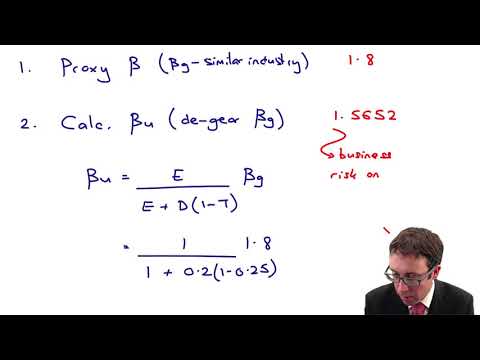
This is where the chapter arrives. A company is appraising a project whose business risk is different from its own — most obviously, an acquisition in another industry (Chapters 11 and 15). Its own beta is no use, because it measures the wrong business. Some other company's beta measures the right business, but with the wrong gearing.
The three steps, and they are always the same three
Find a proxy beta: the equity beta of a quoted company operating in the same industry as the project.
Ungear it using that company's gearing and the tax rate, to strip out its financial risk and leave the business risk of the industry.
Regear it to the gearing at which the project is to be financed, using the same formula the other way round — then put the resulting geared beta into CAPM to get the discount rate.
Miss step 2 or step 3 and the discount rate carries somebody else's capital structure. Set the answer out in those three steps and the marks follow the steps.
The appraising company's own beta is, in this situation, a red herring — it is put in the question to see whether you know that. It reflects the business risk of the industry the company is already in, which is precisely the risk the new project does not have. What the appraising company does supply is the gearing at which the project will be financed, which is what step 3 needs.
Geared and ungeared βs (2)
X plc is an oil company with a gearing ratio (debt to equity) of 0.4. Shares in X plc have a β of 1.48.
They are considering investing in a new operation to build ships, and have found a quoted shipbuilding company – Y plc. Y plc has a gearing ratio (debt to equity) of 0.2, and shares in Y plc have a β of 1.8.
The market return is 18% and the risk free rate is 8%. Corporation tax is 25%.
At what discount rate should X plc appraise the new project if it is to be financed:
entirely by equity;
by debt and equity in the ratio 1 : 1;
so as to maintain X plc's existing gearing ratio of 0.4?
Show answerHide answer
Two points of arithmetic discipline in Answer 7. First, keep the tax rate the question gives you all the way through: this example states 25%, so 1 − t = 0.75 at both the ungearing and the regearing step. Using 0.75 to ungear and 0.7 to regear — the rate from Example 6 — produces 35% and 28% instead of 35.4% and 28.3%. Second, do not round a beta and then use the rounded figure: carrying βₐ as 1.5652 gives 35.4% and 28.3%, whereas rounding it to 1.57 first gives 35.5% and 28.4%. The difference is small here and large in a question with more steps.
The total risk of a share splits into unsystematic (specific) risk, which a portfolio of 15 to 20 shares removes and which therefore earns no return, and systematic (market) risk, which cannot be diversified away and is the only risk the market pays for. Beta measures systematic risk relative to the market: β > 1 is aggressive, β < 1 defensive.
CAPM prices it: E(rᵢ) = Rf + βᵢ(E(rₘ) − Rf). Beta multiplies the risk premium, not the market return, and a question may give you either. Plotted against beta the model is the security market line, starting at the risk-free rate with the premium as its slope; the vertical distance from a share to that line is its alpha — positive means buy, negative means sell.
A geared (equity) beta contains business risk and financial risk; an ungeared (asset) beta contains business risk alone. To find a discount rate for a project in a different industry: take a proxy company's equity beta, ungear it at that company's gearing, regear it at the project's gearing, and put the result into CAPM. Use one tax rate throughout, and do not round the beta before you use it.
CAPM is a single-period model built on an estimated beta, an estimated risk-free rate and an estimated market return, and it assumes investors are diversified and markets are efficient. It is still the standard way of getting a cost of equity, and it is where the discount rates used in Chapters 13, 14 and 15 come from.
10 Test your knowledge
Two quick checks before you move on: work through the flashcards to fix this chapter’s terms and definitions, then sit the objective questions for exam-style practice. Both mark themselves and explain the answers as you go.
Systematic Risk and the Capital Asset Pricing Model (CAPM)
22 questionsAnswer the questions one at a time. Your progress is saved so you can leave and come back.
Open chapter practice