
Weighted Average Cost of Capital (WACC)

Chapters 1 and 2 described where long-term finance comes from and what each instrument promises the investor. This chapter puts a number on it. The return an investor requires is, seen from the other side of the same transaction, the cost the company pays — and once each source has been costed, the sources are weighted together into a single figure: the weighted average cost of capital.
That figure has two uses. It is the discount rate used to appraise investment projects, and it is the minimum return the company as a whole must earn if the value of the business is not to fall.
Bond nominal values: a bond’s nominal (par) value is $100 per unit; there is no underlying $1 instrument being bundled into hundreds. Section 7.3 of these notes states it.

1 The WACC formula
The weighted average cost of capital is the average cost of the company's finance (equity, loan notes, bank loans and preference shares) weighted according to the proportion each element bears to the total pool of funds.
WACC = [ke × Ve ÷ (Ve + Vd)] + [kd × Vd ÷ (Ve + Vd)]
Where:
ke | Cost of equity |
kd | Cost of debt (to the company, after tax) |
Ve | Market value of equity in the company |
Vd | Market value of debt in the company |
Where the company also has preference shares, they are simply a third source: the formula extends to as many terms as there are types of finance, each cost multiplied by that source's share of the total market value of the pool.
The practical method never changes. Build a three-column table — cost, market value, cost × market value — one row per source of finance. Total the market values, total the products, and divide. Everything else in this chapter is about filling in the first two columns.
2 Using WACC as the discount rate in project appraisal
WACC can be used to evaluate the company's investment projects only if the following conditions apply.
No change in financial risk
The company will maintain its existing capital structure. Using the existing market value mix of funds as weights assumes that in the long run funds will be raised in this proportion, so that the gearing of the company will remain unchanged. This implies that the current gearing ratio is thought to be optimal.
No change in business risk
The cost of capital is only valid for the existing level of risk in the enterprise. The project must therefore have the same level of business risk as the company does currently, and must cause no change in that risk.
Small project
The project is small relative to the size of the company, and therefore represents a marginal investment. The costs of capital calculated here refer to the minimum required return of marginal investors, and are therefore only appropriate for the evaluation of marginal changes in the company's total investment.
Pooled funds
No attempt is made to match a project with a particular source of funds. All funds are regarded as forming a pool out of which all projects are financed.
Perfect capital markets
Only under conditions of perfect capital markets will the costs of capital calculated represent the true opportunity cost of the funds used.
If a project is materially riskier than the existing business, discounting it at the company's WACC will make it look better than it is — a bad project gets accepted. If it is materially safer, the WACC will make it look worse than it is and a good project gets rejected. The conditions above are not decoration; they are the boundary of the technique.
3 Market values of the sources of finance
WACC is calculated on market values, not book values. Book value is a historical accounting figure and says nothing about what investors would accept today; market value is the price at which the finance could actually be bought or sold now, and is therefore the opportunity cost of leaving it in place. It is important to convert the book value of each source of finance as follows.
Source | Market value |
Ordinary shares | Ex-div price per share × number of shares in issue |
Preference shares | Ex-div price per share × number of shares in issue |
Traded debt (bonds, loan notes, debentures) | Nominal value / 100 × market price per $100 |
Bank loans and other non-traded debt | Book value — no market value exists because the debt is not traded |
The number of shares in issue is rarely given directly. It has to be worked out from the share capital figure and the nominal value per share: share capital of $4 million in 25c shares is 16 million shares, not 4 million. Getting this wrong is the single most common way of ruining an otherwise correct WACC.
Cost of Equity: the recording says k_e is “d0 divided by p0”. These notes write ke = D / P₀, so that no “(1 + g)” is carried into a formula that does not have one.

4 Cost of equity (ke)
The cost of equity for an incorporated entity is calculated using the dividend valuation model. The model states that the current ex-div market value of a share is the present value of all the future dividends it will pay, discounted at the return the equity shareholder requires:
P0 = D0(1 + g) ÷ (ke − g)
Because the share price is known and the dividends are known, the equation can be rearranged to find the return, ke, that shareholders must have used to arrive at that price:
ke = D0(1 + g) ÷ P0 + g
Where:
ke | Cost of equity |
D0 | Current dividend — the one just paid |
g | Dividend growth rate, assumed constant in perpetuity |
P0 | Current ex-div market value of the share |
4.1 Where dividends are not expected to grow
If dividends are expected to stay the same for ever, g is zero and the model collapses to a perpetuity:
ke = D ÷ P0
So a share paying a constant 30c dividend and trading at $2.50 ex div has a cost of equity of 0.30 / 2.50 = 12%. The same no-growth form is used for preference shares in section 5.
Banks
Banks Ltd has an ex-div share price of $2.50 and has recently paid out a dividend of 10 cents. Dividends are expected to grow at an annual rate of 4%.
Calculate the cost of equity.
Show answerHide answer

4.2 Ex-div and cum-div share prices
The model uses the ex-div price, and examination questions frequently give the cum-div price instead.
Ex-div is the share price immediately after a dividend has been paid — the buyer does not receive that dividend.
Cum-div is the price immediately before a dividend is paid — the buyer does receive it.
The difference between the two is the dividend itself, so:
P0 cum-div = P0 ex-div + D0
A price described as cum div, or a question that says a dividend "is about to be paid" or "is just about to be paid", must have the dividend deducted before the price is used.
Cohen
Cohen Ltd has a cum-dividend share price of $4.15 and is due to pay out a dividend of 35 cents per share. Dividends are expected to grow at an annual rate of 5%.
Calculate the cost of equity.
Show answerHide answer
5 Estimating the growth rate
The dividend valuation model needs a growth rate, and it is almost never given. Two methods are examinable.
Historic growth method: Example 4’s answer is audible only as “is that 78”. This chapter’s figure — 17.85% — governs; the recording can neither confirm nor refute it.

5.1 Historic growth method
Assume that the rate at which dividends have grown in the past will continue. Over n years the dividend has grown from Dn (the dividend n years ago) to D0 (the current dividend), so the compound annual growth rate is:
g = n√(D0 ÷ Dn) − 1
Where:
D0 | Current dividend |
Dn | Dividend n years ago |
n | Number of years of growth |
n is the number of years of growth, not the number of dividends. A dividend paid five years ago and a dividend paid now are six dividends but five years of growth, so the root is the fifth root. Counting the dividends instead of the intervals is the standard error here.
Wilson
Wilson paid a dividend of 25 cents per share 5 years ago, and the current dividend is 42 cents.
The current share price is $5.50 ex-div.
(a) Calculate an estimate of the dividend growth rate.
(b) Calculate the cost of equity.
Show answerHide answer
Stiles
Stiles paid a dividend of 10 cents per share 5 years ago, and the current dividend is 16 cents.
The current share price is $2.36 cum-div.
Calculate the cost of equity.
Show answerHide answer
Gordon’s growth model: where the recording gives the ex-div price as $3.95, it is $4.45 − $0.45 = $4.00. The cost of equity it reaches, 23.77%, is the answer to Example 5 and uses the $4.00.
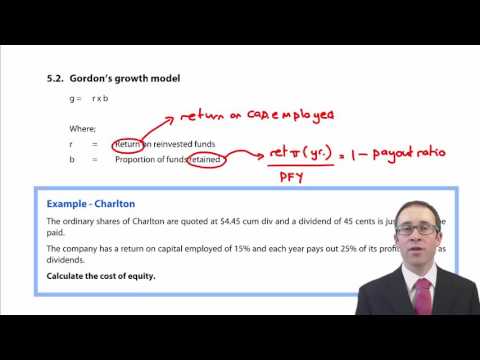
5.2 Gordon's growth model
Historic growth is only as good as the assumption that the past repeats. Gordon's growth model instead builds the growth rate from what actually causes it: a company grows because it retains profit and earns a return on it.
g = r × b
Where:
r | Return on reinvested funds (the accounting rate of return earned on retained profit) |
b | Proportion of profits retained — so if 25% of profit is paid out, b is 0.75 |
Charlton
The ordinary shares of Charlton are quoted at $4.45 cum div and a dividend of 45 cents is just about to be paid.
The company has a return on capital employed of 15% and each year pays out 25% of its profits after tax as dividends.
Calculate the cost of equity.
Show answerHide answer
Cost of Preference shares: the recording gives Example 6’s answer as “7.3 percent”. The figure is 7.27%.

6 Cost of preference shares (kp)
Preference shares carry a fixed charge to the company in the form of a dividend, rather than interest.
Preference shares are normally treated like debt when the sources of finance are weighted together, but the dividend is not tax deductible, so no tax adjustment is made. Their cost is calculated using the dividend valuation model with no growth:
kp = D ÷ P0
where D is the fixed dividend — the coupon rate applied to the nominal value of the preference share — and P0 is its current ex-div market price.
Moore
Moore's 8% preference shares ($1) are currently trading at $1.10 ex-div.
Calculate the cost of the preference shares.
Show answerHide answer

7 Cost of debt (kd)
There is only one approach to the cost of debt. It cannot be called a dividend valuation model, because debt does not pay dividends, but it follows the same principle: the cost is the discount rate that equates the future cash flows to the current market value.
7.1 Two different rates — and which one the company needs
Debt is the one source of finance where the investor's return and the company's cost are not the same number, because interest is deductible against tax. Both are examinable and it is essential to keep them apart.
The investor's return | The company's cost | |
What it is called | Yield — for a redeemable bond, the yield to maturity (or gross redemption yield) | Post-tax cost of debt, kd |
Cash flows discounted | The investor's: price paid out, interest received gross, redemption amount received | The company's: price received, interest paid net of tax relief, redemption amount paid |
Used for | Pricing the bond; comparing one bond with another | The WACC calculation, and nothing else |
The post-tax cost of debt is not simply the yield to maturity multiplied by (1 − T). Tax relief is given on the interest only, not on any premium or discount on redemption, so the two calculations have to be done separately whenever there is a capital element. They coincide only for irredeemable debt bought at par.

7.2 Post-tax cost of bank borrowing
Bank loans, overdrafts and other non-traded borrowings are not bought and sold, so there is no market price and no yield to compute. The company simply pays the contractual rate of interest, and obtains tax relief on it, so the post-tax cost of bank borrowing is:
kd = i × (1 − T)
where i is the interest rate charged by the bank and T is the rate of corporate income tax.
Because there is no market value, bank borrowing enters the WACC weighting at its book value (section 3).
Where the rate is variable, the current rate is used; the exam does not require a forecast of future rates.
Tax relief is assumed to arise in the same period as the interest. Any delay in the tax payment is ignored at this level.
Arrangement or commitment fees are ignored unless the question gives them.
Ball
Ball has a loan from the bank at 8% per annum. The loan has a book value of $5 million.
Corporation tax is charged at 25%.
(a) Calculate the post-tax cost of the bank borrowing.
(b) State the value at which the bank loan should be included in a weighted average cost of capital calculation, and why.
Show answerHide answer
Traded debt: where the recording says a $100 block is one hundred debentures of $1 nominal each, a bond’s nominal (par) value is $100 per unit; there is no $1 instrument underneath it. The rest — interest as the coupon rate on $100 nominal, and the three types of traded debt — is as this section states.

7.3 Traded debt
Traded debt is always quoted in $100 nominal units, or blocks. All calculations are therefore done by reference to $100 of nominal value, regardless of the total amount borrowed.
Interest paid on the debt is stated as a percentage of nominal value ($100 as above). This is known as the coupon rate. It is not the same as the cost of debt: the coupon is fixed by the terms of the issue, whereas the cost of debt depends on today's market price.
Traded debt can be:
irredeemable;
redeemable, at par or at a premium;
convertible, where the investor has the choice of redeeming for cash or taking a specified number of shares instead.

7.4 Irredeemable debt
The interest is a perpetuity and there is no repayment, so the cost of debt is the post-tax interest divided by the market value:
kd = I(1 − T) ÷ P0
Where:
I | Annual coupon interest on $100 nominal |
T | Rate of corporate income tax |
P0 | Ex-interest market value of $100 nominal of the debt |
For the same instrument, the yield to the investor is the gross interest over the same market value, I / P0, with no tax adjustment — the investor's own tax position is not the company's concern.
Bobby
Bobby has 10% irredeemable loan notes that are quoted at $120 ex-int.
Corporation tax is payable at 25%.
Calculate the cost of debt.
Show answerHide answer

7.5 Redeemable debt and the yield to maturity
Where the debt is repaid, the cash flows are no longer a perpetuity and the cost of debt is the internal rate of return of the flows, which now include the redemption value in n years' time. From the company's point of view the relevant cash flows are:
Time | Narrative | Cash flow |
0 | Market value of the debt | P0 |
1 – n | Annual coupon interest paid, net of tax | I (1 − T) |
n | Redemption value of the debt | (RV) |
The IRR is then found by linear interpolation: discount the flows at two rates, one giving a positive net present value and one a negative, and interpolate between them.
IRR ≈ L + [NL ÷ (NL − NH) × (H − L)]
where L and H are the lower and higher discount rates and NL and NH are the net present values at those rates.
The yield to maturity — the return earned by an investor who buys the bond today and holds it to redemption — is the IRR of exactly the same pattern of cash flows taken gross, with no tax adjustment and with the signs reversed (the investor pays the market value and receives the interest and the redemption amount).
Peters
Peters has 10% loan notes quoted at $95 ex-interest, redeemable in 5 years' time at par.
Corporation tax is paid at 25%.
(a) Calculate the post-tax cost of debt to Peters.
(b) Calculate the yield to maturity earned by an investor buying the loan notes today.
Show answerHide answer
Convertible debt: the redemption value is misspoken once as “the 135.50” before being corrected to 135.30, with an audible fumble. Nothing in the working changes.

7.6 Convertible debt
Here the holder has the option to redeem for cash or to convert into shares. The holder will take whichever is worth more at that date, so in calculating the cost of debt the redemption value is assumed to be the greater of either:
the value of the shares on conversion, or
the cash redemption value if the notes are not converted.
The share value on conversion is the number of shares received multiplied by the expected share price at the conversion date — so where the shares are expected to grow at g a year for n years, that is the current price × (1 + g)n × the conversion ratio. Once the higher figure has been identified, the calculation is exactly the redeemable-debt IRR of section 7.5.
Hunt
Hunt has convertible loan notes in issue that may be redeemed at a 10% premium to par value in 4 years. The coupon is 8% and the current market value is $110.
Alternatively the loan notes may be converted at that date into 25 ordinary shares.
The current value of the shares is $5 and they are expected to appreciate in value by 2% per annum.
The tax rate is 25%.
Calculate the cost of debt for the convertible loan notes.
Show answerHide answer
WACC – comprehensive example: the recording settles on “17.68 percent … or to be consistent with the model answer let’s just keep it there”. Work Example 11 from these notes.

8 Putting it together — calculating the WACC
Every WACC question has the same three steps: cost each source of finance, value each source at market value, then weight and average.
Ramsey
The following information is in the statement of financial position of Ramsey:
$000s | |
Ordinary shares (25c) | 4,000 |
8% redeemable bonds | 6,000 |
5% bank loan | 4,000 |
The current ex-div share price is $4.00 and a dividend of 25c has just been paid, which is 10c higher than the dividend paid 5 years ago.
The 8% bonds are trading on an ex-interest basis at $94.00 per $100 bond and are redeemable at par in seven years' time.
Corporation tax is 25%.
Calculate the weighted average cost of capital.
Show answerHide answer
9 What the WACC does not tell you
It is an average. No individual project is financed by the average, and a project whose risk differs from the company's cannot properly be discounted at it (section 2).
It is historic in its weights and current in its costs. It assumes the existing capital structure will be maintained; a large new issue of debt or equity changes the weights and, through financial risk, the costs as well.
The dividend valuation model assumes constant growth in perpetuity, which no company achieves, and it breaks down entirely for a company that pays no dividend.
The historic growth estimate assumes the past repeats. Gordon's growth model assumes the return on reinvested funds and the retention rate are both stable.
Market values move daily, so the WACC calculated today is a snapshot, not a constant.
The weighted average cost of capital weights the cost of each source of finance by its market value. The cost of equity comes from the dividend valuation model, ke = D0(1 + g) / P0 + g, using the ex-div price, with growth estimated either from history — the nth root of D0 / Dn less one — or from Gordon's model, g = r × b. Preference shares use the same model with no growth and no tax relief. For debt, keep the investor's yield to maturity apart from the company's post-tax cost: bank borrowing costs i(1 − T) and is weighted at book value; irredeemable debt costs I(1 − T) / P0; redeemable and convertible debt need the IRR of the post-tax flows, found by interpolation, with the convertible's redemption value being the higher of cash and shares. Weight, average, and remember the technique only holds for a marginal project of the same business and financial risk.
10 Test your knowledge
Weighted Average Cost of Capital (WACC)
22 questionsAnswer the questions one at a time. Your progress is saved so you can leave and come back.
Open chapter practice