
Group statement of cash flows

A consolidated statement of cash flows reports the cash that moved between the group and the outside world. That single sentence settles most of what is different about it. Cash paid by a parent to its own subsidiary has not left the group and does not appear; a dividend paid by a partly owned subsidiary to its outside shareholders has left the group and does.
Everything else you already know about a single company's statement of cash flows carries straight across. What this chapter adds is a short list of group-specific items, one structural change that arrived with IFRS 18, and the workings that produce each figure.
This chapter’s three recordings predate the 2027 syllabus. Their workings are unchanged — this one works Example 1 to the same $1m dividend paid to the non-controlling interests; carry three things with you.
Starting figure: the indirect method now starts from operating profit, not profit before tax. The share of profit of the associate that the recordings remove was never in that figure, and finance costs are not added back (section 2.1).
Interest paid: a financing outflow, not an operating one.
Group structure: the mentions of step disposals and changes in group structure point to topics the 2027 syllabus does not examine; acquiring or disposing of a subsidiary is covered in section 5.3.

1 What is different about a group
Four things, and only four.
A dividend paid to the non-controlling interests. The subsidiary's dividend is split: the parent's share stays inside the group and is eliminated; the outside shareholders' share is a real cash outflow, in financing activities.
A dividend received from an associate. The associate is outside the group, so cash it pays over is a real inflow, in investing activities. It is not "revenue" of any kind — under the equity method it reduces the carrying amount of the investment.
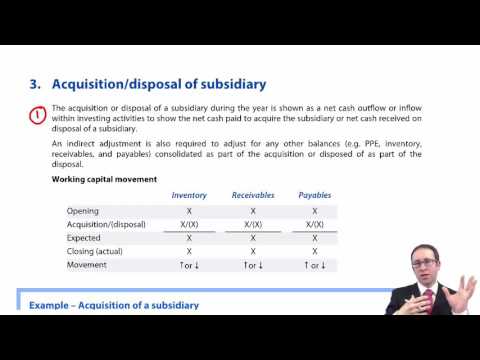
The acquisition or disposal of a subsidiary. Two separate effects: a single net cash figure in investing activities, and an indirect adjustment to every other balance the subsidiary brought in or took away.
Extra non-cash items in the reconciliation — an impairment of goodwill, and any gain or loss on disposing of a subsidiary.
Sections 5 and 6 take each of them in turn. Section 2 deals with the change that affects the top of the statement.
2 IFRS 18 and this chapter
Older material puts interest paid in the wrong place
Older study materials (and questions written before 2027) put interest paid in operating activities and allowed choices for interest and dividends. Under IAS 7 as amended by IFRS 18 the classification is fixed for an ordinary trading company: interest received and dividends received are investing inflows; interest paid and dividends paid are financing outflows. (Different rules apply to banks and other entities whose main business is financing or investing — beyond F2.)
2.1 What that does to the group reconciliation
It makes it shorter, which is not what students expect from a change. Three lines leave the top of the statement and one line moves down it:
The old reconciliation | What happens to it |
Group profit before tax, as the starting point | Replaced by operating profit |
Finance costs, added back | Gone. Finance costs sit below operating profit, so they were never in the starting figure |
Share of profit of associate, deducted | Gone. The share of profit of an associate is investing-category income, below operating profit — it is not in the starting figure either |
Interest paid, inside operating activities | Moves to financing activities |
Depreciation, impairment, gains and losses on disposal, working capital movements, tax paid | Unchanged |
Two of the three classic add-backs have disappeared, because the subtotal you now start from already excludes them. The arithmetic is worth doing once to convince yourself: on the old basis you took profit before tax, added back the finance cost and deducted the associate's profit — and profit before tax plus the finance cost less the associate's profit is operating profit. Starting from operating profit does the same work in one step.
Nothing else about a group statement of cash flows changed. The non-controlling interest working, the treatment of the cash acquired with a subsidiary, the elimination of intra-group cash flows and the working capital adjustment are all exactly as they were. IFRS 18 changed where a result is presented, not what it is.
3 The pro-forma
Consolidated statement of cash flows for the year ended [date]. Items marked * arise only in a group.
$m | $m | |
Cash flows from operating activities | ||
Operating profit | X | |
Adjustments for: | ||
Depreciation and amortisation | X | |
*Impairment of goodwill | X | |
Loss / (gain) on disposal of property, plant and equipment | X/(X) | |
*Loss / (gain) on the disposal of a subsidiary (see 5.4) | X/(X) | |
Decrease / (increase) in inventories | X/(X) | |
Decrease / (increase) in receivables | X/(X) | |
Increase / (decrease) in payables | X/(X) | |
Cash generated from operations | X | |
Tax paid | (X) | |
Net cash from operating activities | X | |
Cash flows from investing activities | ||
Proceeds from the disposal of property, plant and equipment | X | |
Purchase of property, plant and equipment | (X) | |
Interest received | X | |
Dividends received | X | |
*Dividend received from an associate | X | |
*Acquisition of a subsidiary, net of cash and cash equivalents acquired | (X) | |
*Disposal of a subsidiary, net of cash and cash equivalents disposed of | X | |
Net cash used in investing activities | (X) | |
Cash flows from financing activities | ||
Proceeds from the issue of share capital | X | |
Proceeds from / (repayment of) long-term borrowings | X/(X) | |
Interest paid | (X) | |
*Dividends paid to the non-controlling interests | (X) | |
Dividends paid to the owners of the parent | (X) | |
Net cash from financing activities | X | |
Net increase / (decrease) in cash and cash equivalents | X/(X) | |
Cash and cash equivalents at the beginning of the year | X | |
Cash and cash equivalents at the end of the year | X |
4 Two sets of three, and they are not the same classification
IFRS 18 sorts income and expenses into an operating, an investing and a financing category. IAS 7 sorts cash flows under the headings operating activities, investing activities and financing activities. The two sets of three are deliberately parallel and they are not the same classification. An item can sit differently in each.
Item | IFRS 18 category in profit or loss | IAS 7 heading in the statement of cash flows |
Interest paid on borrowings | Financing | Financing activities |
Interest received | Investing | Investing activities |
Income tax | Income taxes — its own category, not one of the three main ones | Operating activities |
Share of profit of an associate | Investing | Not a cash flow at all — the dividend received from the associate is, and it is an investing inflow |
Depreciation | Operating | Not a cash flow at all — an adjustment in the reconciliation |
Purchase of property, plant and equipment | Not an expense; it is capitalised | Investing activities |
Dividends paid | Not an expense; a distribution | Financing activities |
The row that catches people is income tax: it is its own category in the statement of profit or loss — one of the five IFRS 18 defines, the other four being operating, investing, financing and discontinued operations — and it is an operating cash flow in the statement of cash flows.
A word to keep straight
Never call the IFRS 18 operating category "operating activities". That phrase belongs to the statement of cash flows. Saying "this expense goes in operating activities" when you mean the operating category is the fastest way to talk yourself into putting a non-cash item in a statement of cash flows.
5 The group-specific items
5.1 Dividend paid to the non-controlling interests
This is almost never given to you; it is derived. Reconcile the opening and closing non-controlling interests from the consolidated statement of financial position, through everything else that moved them, and the dividend is what is left. A T-account is the quickest way, and the non-controlling interests are part of equity, so the balance is a credit.
Non-controlling interests | |||
Dividend paid (balancing figure) | X | Balance b/f | X |
Disposal of a subsidiary | X | Total comprehensive income attributable to the NCI | X |
Balance c/f | X | Acquisition of a subsidiary | X |
X | X |
The two group-structure lines appear only when there has been an acquisition or a disposal in the year. Acquiring a subsidiary that is not wholly owned creates a non-controlling interest, so it is a credit; disposing of one removes it, so it is a debit.
Where a question happens to give you the subsidiary's own dividend instead, the figure is simply NCI% × that dividend, and no T-account is needed. That is rare.
Consolidated SCF – acquisition/disposal of subsidiary: this recording also covers the dividend received from an associate, and works Examples 2 and 3 to the same figures: a $10m dividend received, $45m net cash paid for Juan, and working capital movements of 58, 15 and 12. Where it says the share of profit of the associate sits immediately before profit before tax, from 2027 it is in the investing category, above finance costs. The consideration for Juan is $50 million — dollars, not pounds.
5.2 Dividend received from an associate
Same idea, from the other side of the statement of financial position. The investment in associate is an asset, so the balance is a debit, and the movement on it is the share of profit added and the dividend taken out:
Investment in associate | |||
Balance b/f | X | Dividend received (balancing figure) | X |
Share of profit of the associate | X | Impairment | X |
Share of the associate's other comprehensive income | X | Balance c/f | X |
X | X |
Or, without a T-account: opening balance, plus the share of profit, less the closing balance. And where the question gives you the associate's own dividend and the group's holding, the answer is simply group % × that dividend.
The inflow goes in investing activities.
5.3 Acquisition or disposal of a subsidiary
There are two entirely separate effects, and a question can ask for either.
Effect 1 — the net cash figure, in investing activities. Buying a subsidiary is a large cash outflow, but the subsidiary arrives with a bank balance of its own which is consolidated from that day. What is reported is the net figure:
Cash flow on acquisition = cash consideration paid − cash and cash equivalents acquired
and on a disposal, the mirror image: the proceeds received, less the cash and cash equivalents that left with the subsidiary. IAS 7 requires the net figure, and a question that gives you both numbers is asking for it.
Effect 2 — the indirect adjustment to every other balance. A statement of cash flows works from the movement in each balance. Where a subsidiary joined the group during the year, the closing balance includes it and the opening balance does not, so the movement is not a cash movement at all — part of it is simply the arrival of the subsidiary's assets and liabilities, whose cash effect has already been dealt with in the net figure above.
The fix is to compare like with like. Take the opening balance, add what was acquired with the subsidiary (or deduct what left with a disposal), and compare that expected figure with the actual closing balance. The difference is the real cash movement. For working capital there is a standard working:
Inventories | Receivables | Payables | |
Opening balance | X | X | X |
Acquired with the subsidiary / (disposed of) | X/(X) | X/(X) | X/(X) |
Expected closing balance | X | X | X |
Actual closing balance | X | X | X |
Movement — increase or decrease | X | X | X |
Then decide the direction of each. A decrease in inventories or receivables is an inflow — you have turned an asset into cash. An increase in payables is an inflow — you have kept the cash and not yet paid the supplier. The opposite movements are outflows. Decide this at the end, once, rather than while you are building the working.
The same "expected against actual" logic applies to every other balance a question gives you, most often property, plant and equipment — where the amount acquired with the subsidiary is one more debit in the T-account.
5.4 Non-cash items in the reconciliation
Impairment of goodwill. An expense that reduces operating profit and moves no cash, so it is added back. In a group question it usually has to be derived: opening goodwill, plus the goodwill arising on any acquisition in the year, less closing goodwill.
Gain or loss on the disposal of a subsidiary. A gain or loss on losing control of a subsidiary is a non-cash item, so it has to come out of the reconciliation — but only if it is inside the figure the reconciliation starts from. That is the test to apply, and it is a question of where the disposal has been presented:
Where the disposal qualifies as a discontinued operation under IFRS 5, the whole post-tax result of that operation is presented as a single line at the foot of the statement of profit or loss, below the income tax expense. It is not inside operating profit, so there is nothing to strip out of the starting figure.
Where it does not, the gain or loss forms part of the group's continuing result. Apply the same test: it comes out of the starting figure if it is in the starting figure. A question will tell you where the gain has been presented, and the adjustment follows from that.
The cash effect is the same either way, and it is not in this reconciliation at all: the proceeds received, less the cash and cash equivalents that left with the subsidiary, is a single net figure in investing activities.
6 Worked examples
Dividend paid to the non-controlling interests
Consolidated statement of profit or loss for the year ended 31 December 20X5 (extract)
$m | |
Operating profit | 83 |
Share of profit of associate | 20 |
Profit before financing and income taxes | 103 |
Finance costs | (12) |
Profit before tax | 91 |
Income tax expense | (31) |
Profit for the year | 60 |
Attributable to: | |
Owners of the parent | 54 |
Non-controlling interests | 6 |
Consolidated statement of financial position as at 31 December 20X5 (extract)
20X5 | 20X4 | |
$m | $m | |
Equity | ||
Non-controlling interests | 115 | 110 |
There was no acquisition or disposal of a subsidiary during the year, and the group recognised no other comprehensive income.
Calculate the dividend paid to the non-controlling interests to appear in the consolidated statement of cash flows for the year ended 31 December 20X5, and state where it appears.
Show answerHide answer
Dividend received from an associate
The same group as Example 1. Its consolidated statement of financial position shows:
20X5 | 20X4 | |
$m | $m | |
Non-current assets | ||
Investment in associate | 190 | 180 |
The associate recognised no other comprehensive income and the investment was not impaired. You are not told the group's percentage holding, nor the dividend the associate paid.
Calculate the dividend received from the associate to appear in the consolidated statement of cash flows for the year ended 31 December 20X5, and state where it appears.
Show answerHide answer
Acquisition of a subsidiary
Pablo group — consolidated statement of financial position as at 31 December 20X5 (extract)
20X5 | 20X4 | |
$m | $m | |
Non-current assets | ||
Property, plant and equipment | 520 | 490 |
Current assets | ||
Inventories | 145 | 195 |
Receivables | 130 | 109 |
Cash and cash equivalents | 50 | 75 |
Current liabilities | ||
Trade payables | 85 | 70 |
On 1 June 20X5, Pablo acquired all of the share capital of Juan for $50 million in cash. The fair values of Juan's identifiable assets and liabilities at the date of acquisition, which are reflected in the Pablo group's year-end balances, were:
$m | |
Property, plant and equipment | 15 |
Inventories | 8 |
Receivables | 6 |
Cash and cash equivalents | 5 |
Payables | (3) |
Show how the acquisition and the movements on inventories, receivables and payables would be dealt with in the consolidated statement of cash flows for the year ended 31 December 20X5.
Show answerHide answer
Group statement of cash flows – comprehensive example: this is Dove, Example 4. The recording starts from profit before tax of $375m, adds back the $55m finance costs, deducts the $40m share of the associate’s profit and puts interest paid in operating activities. From 2027 the statement starts from operating profit of $390m — the same arithmetic in one step — and the $55m interest paid is a financing outflow. Cash generated from operations ($447m) and the $40m decrease in cash are unchanged; net cash from operating activities is $422m and from financing activities $160m (W1). Its other workings agree with the answer below.

Consolidated statement of cash flows
The following draft group financial statements relate to Dove, a public limited company.
Dove group — consolidated statement of financial position as at 31 December 20X5
20X5 | 20X4 | |
$m | $m | |
Assets | ||
Property, plant and equipment | 1,745 | 1,250 |
Goodwill | 1,184 | 1,230 |
Investment in associate | 200 | 190 |
3,129 | 2,670 | |
Inventories | 530 | 580 |
Receivables | 456 | 390 |
Cash and cash equivalents | 190 | 230 |
1,176 | 1,200 | |
Total assets | 4,305 | 3,870 |
Equity and liabilities | ||
Share capital | 1,700 | 1,500 |
Retained earnings | 1,060 | 900 |
Attributable to the owners of the parent | 2,760 | 2,400 |
Non-controlling interests | 575 | 540 |
Total equity | 3,335 | 2,940 |
Long-term borrowings | 300 | 200 |
Deferred tax | 220 | 190 |
Trade payables | 300 | 430 |
Current tax payable | 150 | 110 |
Total liabilities | 970 | 930 |
Total equity and liabilities | 4,305 | 3,870 |
Dove group — consolidated statement of profit or loss for the year ended 31 December 20X5
$m | |
Revenue | 1,765 |
Cost of sales | (1,185) |
Gross profit | 580 |
Distribution costs | (100) |
Administrative expenses | (90) |
Operating profit | 390 |
Share of profit of associate | 40 |
Profit before financing and income taxes | 430 |
Finance costs | (55) |
Profit before tax | 375 |
Income tax expense | (95) |
Profit for the year | 280 |
Dove group — consolidated statement of changes in equity for the year ended 31 December 20X5
Share capital | Retained earnings | Owners of the parent | NCI | Total | |
$m | $m | $m | $m | $m | |
Balance b/f | 1,500 | 900 | 2,400 | 540 | 2,940 |
Issue of share capital | 200 | – | 200 | – | 200 |
Dividends | – | (65) | (65) | (20) | (85) |
Total comprehensive income for the year | – | 225 | 225 | 55 | 280 |
Balance c/f | 1,700 | 1,060 | 2,760 | 575 | 3,335 |
The following information is relevant.
On 1 June 20X5, Dove acquired all of the share capital of Fred for $50 million in cash. The fair values of Fred's identifiable assets and liabilities at the date of acquisition, which are reflected in the Dove group's year-end balances, were: property, plant and equipment $13 million; inventories $20 million; receivables $15 million; cash and cash equivalents $3 million; payables $(9) million — $42 million in total.
Dove owns 20% of an associate. The associate made a profit for the year of $200 million and paid a dividend of $150 million.
During the year Dove charged depreciation of $130 million on its property, plant and equipment, and sold property, plant and equipment with a carrying amount of $43 million for $50 million. The gain on that disposal is included in the group's operating profit.
No subsidiary was disposed of during the year, and Dove made no revaluations.
Prepare the consolidated statement of cash flows for the Dove group for the year ended 31 December 20X5.
Show answerHide answer
7 Exam technique
Objective test questions ask for one figure out of a very large amount of information, and almost always one of five: the dividend paid to the non-controlling interests, the dividend received from an associate, the net cash on an acquisition or disposal, a working capital movement adjusted for an acquisition, or tax paid. Each of them is a two- or three-line working, and each of them is reachable without preparing anything else.
A reliable order for a longer question:
Write down the opening and closing cash and cash equivalents and the movement between them. That is the figure everything else has to reconcile to.
Start the reconciliation at operating profit and take the non-cash items from the statement of profit or loss and the notes: depreciation, goodwill impairment, gains and losses on disposal.
Do the working capital working, adjusting the opening balances for anything acquired or disposed of with a subsidiary.
Tax paid, from a T-account that includes both current and deferred tax.
Investing activities: property, plant and equipment from a T-account; the associate's dividend; the net cash on any acquisition or disposal.
Financing activities: share issues, borrowings, interest paid, and both dividends. The statement of changes in equity usually gives you three of these.
Cast, and check against step 1.
Six ways to lose the marks
Starting at profit before tax. From 2027 the indirect method starts at operating profit, and the finance cost and the associate's profit are then not added back or deducted at all — they were never in the starting figure.
Leaving interest paid in operating activities. It is a financing outflow. This is the single most common carry-over from pre-2027 material.
Consolidating a dividend paid by a partly owned subsidiary in full. Only the non-controlling interests' share left the group.
Reporting the gross cost of acquiring a subsidiary. IAS 7 wants it net of the cash and cash equivalents that came with it.
Comparing raw opening and closing balances in the year of an acquisition. Add what the subsidiary brought in first, then compare.
Treating a fall in goodwill as anything other than an impairment without checking. Goodwill falls because of an impairment, a disposal, or a translation difference on an overseas subsidiary. Rule the other two out before you add it back.
One last thing worth internalising, because it is the reason the whole statement hangs together: reclassifying a cash flow cannot change how much cash there is. IFRS 18 moved interest paid from one heading to another and every subtotal in between changed — and the movement in cash and cash equivalents did not move at all. If a change you have made alters the bottom line, it is not a reclassification and you have made an error.
8 Test your knowledge
Group statement of cash flows
22 questionsAnswer the questions one at a time. Your progress is saved so you can leave and come back.
Open chapter practice