
Associates

An investment does not have to give control to matter. A company that owns a quarter of another company cannot direct what it does, but it can make itself heard, and the returns it earns are its own. IAS 28 Investments in Associates and Joint Ventures deals with that middle ground: investments over which the investor has significant influence but not control. They are neither consolidated nor left at cost. They are accounted for by the equity method, which puts the investor's share of the investee — and only its share — on a single line in each of the two main statements.
Associates – Statement of Financial Position: this recording predates IFRS 18. Its teaching on significant influence, the equity method, impairment and group reserves is unchanged, but one sentence is not: the share of profit of an associate is not shown immediately before profit before tax. From 2027 it is in the investing category, below operating profit and above profit before financing and income taxes (section 3). Where it points back to “chapter five” for the statement of profit or loss, read the chapter Group Statement of Profit or Loss and Other Comprehensive Income.

1 Significant influence
An associate is an entity over which the investor has significant influence. IAS 28 defines significant influence as the power to participate in the financial and operating policy decisions of the investee, but which is not control or joint control of those policies.
Contrast that with control, which is what makes an entity a subsidiary. Control is the power to direct; significant influence is the power to participate. An investor with significant influence cannot appoint the board, but it can be heard at the board.
1.1 The 20% presumption — and it works in both directions
If an investor holds, directly or indirectly, 20% or more of the voting power of an entity, it is presumed to have significant influence, unless it can be clearly demonstrated that it does not. If it holds less than 20%, it is presumed not to have significant influence, unless such influence can be clearly demonstrated.
Both presumptions are rebuttable, and that is what makes this examinable. A holding of 19% with a seat on the board and an interchange of managerial personnel may well be an associate; a holding of 30% in a company controlled absolutely by a single other shareholder, with no board seat and no dealings, may well not be. The percentage is a starting point, not the test.
Above 50% the question does not arise: the investor has control, the investee is a subsidiary and it is consolidated. So in practice an associate is usually a holding of between 20% and 50%.
1.2 Evidence of significant influence
IAS 28 lists the ways significant influence is usually evidenced. Any one of them can support the existence of influence below 20%, and their absence can rebut the presumption above it:
representation on the board of directors or equivalent governing body of the investee;
participation in policy-making processes, including participation in decisions about dividends or other distributions;
material transactions between the investor and the investee;
interchange of managerial personnel; and
provision of essential technical information.
1.3 Control, joint control and significant influence
Three levels of involvement, three standards, three accounting treatments. Keep them apart:
Relationship | Standard | What the investor has | Treatment in the group accounts |
Subsidiary | IFRS 10 | Control — power over the investee, exposure to variable returns, and the ability to use that power to affect those returns | Consolidated line by line, with a non-controlling interest for the part it does not own |
Joint venture | IFRS 11 | Joint control — the contractually agreed sharing of control of an arrangement, which exists only when decisions require the unanimous consent of the parties sharing control, and rights to the net assets of the arrangement | Equity method — the same one line as an associate |
Associate | IAS 28 | Significant influence — the power to participate in the financial and operating policy decisions, but not control or joint control of them | Equity method — one line |
Ordinary investment | IFRS 9 | Neither | A financial asset, measured under IFRS 9 |
IAS 28 covers both associates and joint ventures, which is why its title names both. Everything this chapter says about the equity method applies equally to a joint venture in which the investor has rights to the net assets. A joint operation, where the parties have rights to the assets and obligations for the liabilities, is different — each party accounts for its own share of the assets, liabilities, revenue and expenses — but that is IFRS 11's territory, not this chapter's.
2 The equity method in outline
An associate is not consolidated. Nothing is added across: not its assets, not its liabilities, not its revenue and not its expenses. There is no non-controlling interest in an associate, because the group does not control it and has therefore not brought in the whole of anything.
The equity method
In the consolidated statement of financial position, one line within non-current assets: investment in associate, at the investor's share of the associate's net assets since acquisition, plus goodwill embedded in the cost.
In the consolidated statement of profit or loss, one line: share of profit of associate, the investor's share of the associate's profit for the year.
In other comprehensive income, one line: the investor's share of the associate's other comprehensive income.
The whole method is the word "share". Take your percentage of what happens inside the associate, and nothing else.
3 IFRS 18 and this chapter
Two traps in the new position
A student who reproduces the old layout loses a subtotal. Put the share of profit of the associate immediately before profit before tax and you have placed it below the financing category, so profit before financing and income taxes no longer means what it says.
"Profit before interest and tax" is not the same thing. The old analyst's label meant profit before interest and tax; the new subtotal is operating profit plus the whole investing category. For a company with no investment income and no associate the two coincide. For a group with a significant associate they do not — and the difference is exactly the share of profit of the associate.
From 2027, IFRS 18 classifies the share of profit of an equity-accounted associate or joint venture in the investing category. It is presented below operating profit and above profit before financing and income taxes — that is, above finance costs. Where a recording places it immediately before profit before tax, or calls the subtotal “profit before interest and tax”, follow the chapter. Nothing else is affected: the equity method, the carrying amount, dividends, impairment and the unrealised profit adjustment are all unchanged.
Associates – equity accounting (SFP): nothing it demonstrates is wrong; it says nothing about IFRS 18, and one word is misspoken (“we bought the subsidiary on the 1st of july”). It is right: 70% of 270 is 189.
4 The associate in the consolidated statement of financial position
The investment in associate is shown within non-current assets — alongside property, plant and equipment and goodwill — and is built like this:
Investment in associate (standard working 6) | $ |
Cost of the investment | X |
Add: the group's share of the associate's post-acquisition profits and other comprehensive income | X |
Less: dividends received from the associate since acquisition | (X) |
Less: impairment of the investment in the associate to date | (X) |
X |
Do not deduct the dividends twice
Where a question gives you the associate's retained earnings at acquisition and at the reporting date, the movement between them is already net of every dividend the associate has paid. The group's share of that movement therefore replaces the two middle lines of the working on its own — add it and there is nothing further to deduct for dividends.
The two middle lines are for the other way a question can be set: when you are given the associate's profit for the period and its dividend separately, as in Example 2 below.
Three points about that working carry marks.
Everything in the statement of financial position is cumulative. The post-acquisition movement runs from the acquisition date to the reporting date, not just over the current year.
Every adjustment made here has a matching entry in group reserves. Increase the investment by the share of post-acquisition profits and you must increase group retained earnings (standard working 5) by the same amount; reduce it for a dividend or an impairment and you must reduce group retained earnings too. Miss the second entry and the statement of financial position will not balance.
The cost of the investment is removed from the parent's own statement of financial position. A parent that shows "Investments" as a single figure is usually showing the cost of its subsidiaries and its associates together; that line disappears on consolidation and is replaced by goodwill and by the investment in associate.
Associates – Equity accounting (SPLOCI): this is the Vader group, Example 3. Sith’s profit for the year is $240 million, not the 200 used in the spoken working: 25% × $240m × 8/12 = $40m, less the $2m impairment, gives the $38m the recording reaches. It places the $38m below finance costs; from 2027 it sits between operating profit ($322m) and profit before financing and income taxes ($360m). It attributes only total comprehensive income; profit for the year is attributed too — $230m to the owners of the parent and $10m to the non-controlling interests.

5 The associate in the consolidated statement of profit or loss and other comprehensive income
One line in profit or loss and, where there is any, one line in other comprehensive income:
Share of profit of associate = group % × A's profit for the year
Share of OCI of associate = group % × A's other comprehensive income
Time-apportion the profit if the associate was acquired during the year, in the same way as for a mid-year subsidiary: the group's share runs from the date significant influence was obtained to the reporting date.
Do not time-apportion other comprehensive income. A revaluation gain does not accrue evenly over a year; it is recognised at the moment of the revaluation. If that moment falls in the post-acquisition period, take the group share of the whole gain; if it falls before acquisition, take none of it.
Unlike a subsidiary, an associate produces no non-controlling interest. There is nothing to attribute, because the group has brought in only its own share in the first place.
6 Impairment of the investment in an associate
The investment in an associate is tested for impairment as a single asset. There is no separate goodwill to test, because the goodwill inside the equity-method carrying amount is not recognised separately.
Do not take your share of an impairment
The impairment is calculated on the investment, which is already only the group's share of the associate. Taking a percentage of it would apply the ownership percentage twice. Whatever impairment figure a question gives you, deduct it in full — from the investment in the statement of financial position, and from the share of profit of the associate in profit or loss.
Contrast a subsidiary, where an impairment of goodwill is charged in the subsidiary's own column and is therefore shared with the non-controlling interests when goodwill is measured on the full (fair value) basis.
7 Dividends received from an associate
A dividend received from an associate is not income of the group. Under the equity method the group has already taken its share of the associate's profit; the dividend is simply part of that profit being converted into cash, so it reduces the carrying amount of the investment.
If the parent has recorded the dividend as investment income in its own profit or loss — which it usually has — then the group working must take it out again. That is what the "less: dividends received" line in working 6 does, and it has the matching effect on group retained earnings described in section 4.
A dividend received from an associate is therefore never presented as investment income in the investing category of the consolidated statement of profit or loss. The only associate line there is the share of profit.
8 Unrealised profit on trading with an associate
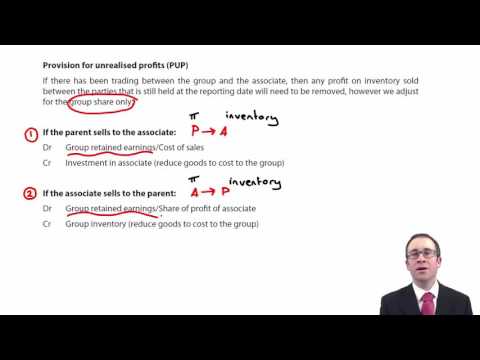
Where the group and its associate have traded and some of the goods are still in inventory at the reporting date, the profit on those goods has not been realised outside the group and must be removed. The idea is exactly the same as for trading between a parent and a subsidiary, with one difference that carries every mark in the topic: because the associate is not consolidated, only the group's share of the unrealised profit is eliminated.
PUP adjustment = group % × unrealised profit in closing inventory
The direction of the sale then decides the entries, because it decides who made the profit and who holds the inventory.
The parent sells to the associate | The associate sells to the parent | |
Who made the profit | The parent | The associate |
Who holds the inventory at the year end | The associate — whose inventory is not in the group statement of financial position | The parent — whose inventory is in the group statement of financial position |
Debit (statement of financial position) | Group retained earnings | Group retained earnings |
Debit (profit or loss) | Cost of sales | Share of profit of associate |
Credit | Investment in associate | Group inventory |
The debit in the statement of financial position is group retained earnings in both cases, because it is the group that has the influence over the transaction. What changes is the credit — you cannot credit inventory that is not in the group accounts, so a sale by the parent to the associate is credited to the investment in associate instead.
Unrealised profit with an associate
LR owns 40% of the equity share capital of GH. During the year to 31 December 20X3, LR purchased goods with a sales value of $500,000 from GH. One quarter of these goods remained in inventories at 31 December 20X3. GH includes a mark-up of 25% on all sales.
Which ONE of the following accounting adjustments would LR process in the preparation of its consolidated financial statements in relation to these goods?
Dr Cost of sales $10,000 / Cr Inventories $10,000
Dr Share of profit of associate $25,000 / Cr Inventories $25,000
Dr Share of profit of associate $10,000 / Cr Inventories $10,000
Dr Investment in associate $25,000 / Cr Cost of sales $25,000
Show answerHide answer
9 Two comprehensive examples
Equity accounting (statement of financial position)
Statements of financial position at 31 December 20X5 are as follows.
Rey | Finn | |
$m | $m | |
Assets | ||
Non-current assets | ||
Property, plant and equipment | 1,560 | 1,250 |
Investments | 1,540 | – |
3,100 | 1,250 | |
Current assets | ||
Inventory | 450 | 580 |
Receivables | 380 | 390 |
Cash | 190 | 230 |
1,020 | 1,200 | |
Total assets | 4,120 | 2,450 |
Equity and liabilities | ||
Share capital | 1,700 | 1,000 |
Retained earnings | 1,450 | 800 |
Total equity | 3,150 | 1,800 |
Non-current liabilities | 520 | 350 |
Current liabilities — trade payables | 450 | 300 |
Total liabilities | 970 | 650 |
Total equity and liabilities | 4,120 | 2,450 |
The following information is relevant to the preparation of the group financial statements.
On 1 January 20X4, Rey acquired 70% of the equity interest of Finn for a cash consideration of $1,340 million. At that date the identifiable net assets of Finn had a fair value of $1,850 million and its retained earnings were $450 million. The excess of fair value over book value is due to an item of property, plant and equipment with a remaining useful life of 10 years at that date.
It is group policy to measure the non-controlling interests at acquisition at their proportionate share of the fair value of the subsidiary's net assets.
On 1 July 20X5, Rey acquired 25% of the equity interest of Ben for a cash consideration of $200 million. Ben's profit for the year was $80 million, out of which a dividend of $20 million was declared on 31 December 20X5. Rey's 25% holding gives it the power to participate in the financial and operating policy decisions of Ben. Rey has recorded the dividend it received as investment income.
Neither the goodwill arising on the acquisition of Finn nor the investment in Ben was impaired during the year.
Rey's "Investments" of $1,540 million is the cost of its holdings in Finn and Ben.
Prepare the consolidated statement of financial position of the Rey group as at 31 December 20X5.
Show answerHide answer
Equity accounting (statement of profit or loss and other comprehensive income)
Statements of profit or loss and other comprehensive income for the year ended 31 December 20X5 are as follows.
Vader | Maul | |
$m | $m | |
Revenue | 1,645 | 1,280 |
Cost of sales | (1,205) | (990) |
Gross profit | 440 | 290 |
Distribution costs | (100) | (70) |
Administrative expenses | (90) | (50) |
Operating profit | 250 | 170 |
Profit before financing and income taxes | 250 | 170 |
Finance costs | (55) | (30) |
Profit before tax | 195 | 140 |
Income tax expense | (35) | (30) |
Profit for the year | 160 | 110 |
Other comprehensive income: | ||
Gain on property revaluation | 100 | 50 |
Total comprehensive income for the year | 260 | 160 |
Neither company holds an investment that generates income in the investing category of its own statement, so for each of them profit before financing and income taxes is the same figure as operating profit. That will not be true of the group.
The following information is relevant to the preparation of the group financial statements.
On 1 July 20X5, Vader acquired 80% of the equity shares of Maul.
On 1 May 20X5, Vader acquired 25% of the equity shares of Sith, and exerts significant influence through its representation on the board of directors. Sith's profit for the year was $240 million.
During the year Vader sold goods to Maul with a sales value of $80 million at a mark-up of 25%. Maul had sold half of those goods by the year end.
It is group policy to measure the non-controlling interests at acquisition at fair value.
Goodwill was tested for impairment at the year end. The goodwill arising on the acquisition of Maul had fallen in value by $5 million; goodwill impairments are charged to administrative expenses. The investment in Sith was also impaired, by $2 million; an impairment of an equity-accounted investment is set against the share of profit of the associate.
Maul revalued its land and buildings at the year end and recorded a revaluation surplus of $50 million through other comprehensive income.
No dividends were declared by any company during the year.
Assume that profits accrue evenly over the year.
Prepare the consolidated statement of profit or loss and other comprehensive income for the Vader group for the year ended 31 December 20X5.
Show answerHide answer
10 Exam technique
Objective test questions on associates are usually one of five things: identify whether an investment is an associate; compute the investment in associate; compute the share of profit; compute a provision for unrealised profit; or place the share of profit correctly in the statement. The first four are arithmetic and the fifth is now a 2027 point.
Six ways to lose the marks
Consolidating the associate. No line-by-line addition, no non-controlling interest. If you have added the associate's revenue to the group's, start again.
Forgetting to time-apportion a mid-year associate — or apportioning its other comprehensive income, which you should not.
Taking your share of an impairment of the investment. Deduct it in full; the percentage has already been applied.
Eliminating the whole unrealised profit when the counterparty is an associate. Only the group's share comes out.
Treating a dividend from an associate as income. It reduces the investment; the parent's own dividend income must be removed from group reserves.
Placing the share of profit below finance costs. From 2027 it is investing-category income and belongs above profit before financing and income taxes.
One arithmetic check is worth the ten seconds it takes. Every adjustment you make to the investment in associate — share of profit, dividend, impairment, unrealised profit on a sale by the parent — must have an equal and opposite effect on group retained earnings. If your consolidated statement of financial position does not balance and an associate is in the question, that is the first place to look.
11 Test your knowledge
Associates
21 questionsAnswer the questions one at a time. Your progress is saved so you can leave and come back.
Open chapter practice