
IFRS 5 Non-current assets held for sale and discontinued operations

IFRS 5 Non-current Assets Held for Sale and Discontinued Operations deals with two connected situations: single assets the entity has decided to sell rather than go on using, and whole operations it has disposed of or shut down. The thread joining them is the same question a user of the accounts asks — which parts of this year's results will happen again next year, and which will not?
Getting an answer to that question is the objective of the standard:
to require entities to disclose information about operations that have been discontinued during the period, separately from the operations that continue; and
so to improve the reader's ability to interpret this year's results and make sensible projections of future performance
These recordings predate IFRS 18 and say nothing about where their amounts land in the 2027 statement of profit or loss. That is this chapter’s closing section, “Where the numbers appear in the financial statements”.
The standard’s title: it is IFRS 5 Non-current Assets Held for Sale and Discontinued Operations — the recordings give the words in a different order.
Discontinued operations and Example 3: the subtotals are now operating profit and profit before financing and income taxes, relating to continuing operations only. The figures the recordings reach (233 and 161) are unchanged; only the labels move.
Example 3: the $7,000 gain analysis is worked in these notes and is on no recording.




1 Non-current assets held for sale
Held for sale
A non-current asset is held for sale when its carrying amount will be recovered principally through a sale transaction rather than through continuing use.
A disposal group is a group of assets, and any liabilities directly associated with them, to be disposed of in a single transaction.
Two conditions must both be met before an asset can be classified as held for sale. It must be:
available for immediate sale in its present condition, and
its sale must be highly probable
For a sale to be highly probable:
management must be committed to a plan to sell the asset
an active programme to locate a buyer and complete the plan must have been started
the asset must be actively marketed at a price that is reasonable in relation to its current fair value
the sale should be expected to take place within twelve months of the date of classification
it should be unlikely that significant changes will be made to the plan, or that the plan will be withdrawn
1.1 Measurement and presentation
From the date of classification the accounting changes in three ways:
The asset is remeasured at the lower of its carrying value and its fair value less costs to sell. Any reduction in value is an impairment, charged to profit or loss
Depreciation stops — the asset is no longer being consumed through use, it is being held for sale
Presentation changes — the asset is shown separately, within current assets, because it will be realised through a sale rather than through continuing use. Liabilities of a disposal group are shown separately within current liabilities and are not netted against the assets
Do not confuse the two "of the two" tests. Under IAS 36 (Chapter 7) an asset is written down to its recoverable amount — the higher of fair value less costs to sell and value in use. Under IFRS 5 a held-for-sale asset is measured at the lower of carrying value and fair value less costs to sell. The reason they differ: once the entity has decided to sell, value in use is irrelevant — it is not going to keep using the asset, so the only route left is the sale.
The eventual sale then gives rise to a profit or loss on disposal in the usual way — proceeds less the carrying value at which the asset is held.
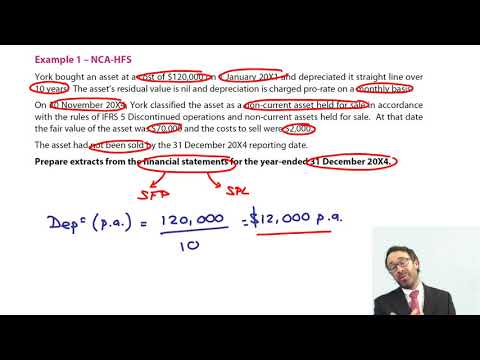
Non-current asset held for sale
York bought an asset at a cost of $120,000 on 1 January 20X1 and depreciated it straight line over 10 years. The asset's residual value is nil and depreciation is charged pro rata on a monthly basis.
On 30 November 20X4 York classified the asset as a non-current asset held for sale in accordance with IFRS 5 Non-current Assets Held for Sale and Discontinued Operations. At that date the fair value of the asset was $70,000 and the costs to sell were $2,000.
The asset had not been sold by the 31 December 20X4 reporting date.
Prepare extracts from the financial statements for the year ended 31 December 20X4.
Show answerHide answer
a held-for-sale asset under the revaluation model
Chester bought an asset on 1 January 20X1 at a cost of $500,000 and holds it under the revaluation model. Its useful life is 50 years. On 31 December 20X8, Chester's reporting date, the asset was classified as held for sale; its fair value was $600,000 and the costs to sell were $25,000.
Take the steps in order. Depreciation for 20X8 of $10,000 ($500,000 ÷ 50 years) is charged first, giving eight years' accumulated depreciation of $80,000 and a carrying value of $420,000.
Cost model $ | Revalued $ | Gain $ | |
Cost (1 January 20X1) | 500,000 | ||
Accumulated depreciation (500,000 ÷ 50 × 8 years) | (80,000) | ||
Carrying value at 31 December 20X8 | 420,000 | 600,000 | 180,000 |
Because the asset is held under the revaluation model it is revalued to its fair value of $600,000 immediately before reclassification, and the revaluation gain of $180,000 is recognised in other comprehensive income under IAS 16 in the normal way. The $600,000 is now the carrying value.
IFRS 5 then measures the asset at the lower of that carrying value and fair value less costs to sell of $575,000 (600,000 − 25,000), so the asset is presented at $575,000.
The $25,000 write-down is exactly the costs to sell, and costs to sell are always charged to profit or loss — they are the incremental cost of disposing of the asset, not a reversal of the revaluation. So profit or loss for 20X8 carries the $10,000 depreciation and the $25,000 write-down, while other comprehensive income carries the $180,000 gain.
2 Discontinued operations
Discontinued operation
A component of an entity that has either been disposed of or is classified as held for sale, and that:
represents a separate major line of business or geographical area of operations;
is part of a single co-ordinated plan to dispose of such a line of business or area; or
is a subsidiary acquired exclusively with a view to resale.
A "component" is a part of the business whose operations and cash flows are clearly distinguishable from the rest, both operationally and for financial reporting. A single shop closing is not a discontinued operation; withdrawing from retailing altogether is.
An operation that is being abandoned rather than sold can never be classified as held for sale — nobody is buying it. It becomes a discontinued operation only when it actually ceases to operate. Deciding to close it, even irrevocably, is not enough: until the operations stop, the results stay in continuing operations, with the intention disclosed in a note. Example 2 turns on exactly this point.
2.1 Presentation
The point of the standard is to separate the recurring from the non-recurring, so:
a single amount is presented on the face of the statement of profit or loss for the total post-tax result of discontinued operations — their post-tax profit or loss for the period, plus the post-tax gain or loss on remeasuring them to fair value less costs to sell or on disposing of them;
an analysis of that single amount — revenue, expenses, pre-tax result, tax, and the gain or loss on disposal — is given either on the face or in the notes;
everything above the discontinued line relates to continuing operations only, and comparatives are restated on the same basis so the two years are comparable.
Discontinued operations
Angola's car manufacturing operation has been making substantial losses. Following a meeting of the board of directors it was decided to close down the car manufacturing operation on 31 March 20X6. The company's reporting date is 31 December and the car manufacturing operation is treated as a separate operating segment.
Explain how the decision to close the car manufacturing operation should be treated in Angola's financial statements for the years ending 31 December 20X5 and 20X6.
Show answerHide answer
Discontinued operations
Ruta Co's statement of profit or loss for the year ended 31 December 20X7, before any IFRS 5 presentation, is:
20X7 $000 | 20X6 $000 | |
Revenue | 700 | 550 |
Cost of sales | (300) | (260) |
Gross profit | 400 | 290 |
Distribution costs | (100) | (70) |
Administrative expenses | (70) | (60) |
Profit from operations | 230 | 160 |
During the year the entity ran down a material business operation, with all activities ceasing on 30 March 20X7. The results of that operation, which are included in the figures above, were:
20X7 $000 | 20X6 $000 | |
Revenue | 60 | 70 |
Cost of sales | (40) | (45) |
Distribution costs | (13) | (14) |
Administrative expenses | (10) | (12) |
Loss from operations | (3) | (1) |
The entity made gains of $7,000 on the disposal of non-current assets of the discontinued operation. These have been netted off against the administrative expenses of that operation.
Prepare the statement of profit or loss for Ruta Co for the year ended 31 December 20X7, complying with IFRS 5 and disclosing the required information on the face of the statement. Ignore taxation.
Show answerHide answer
3 Where these appear in the financial statements
IFRS 18 (Chapter 5) classifies income and expenses into five categories: operating, investing, financing, income taxes, and discontinued operations. So:
the operating, investing and financing categories, and both required subtotals — operating profit, and profit before financing and income taxes — relate to CONTINUING operations only
the discontinued operations category is the single post-tax amount, presented after profit for the year from continuing operations
a non-current asset held for sale sits in current assets in the statement of financial position, shown separately; the impairment on classification is an operating expense of the period
Two disclosures complete the picture: a description of the asset or operation and the facts and circumstances of the sale or closure, and — where a plan to sell is abandoned — the reason and the effect of ceasing to classify the asset as held for sale.
4 Test your knowledge
Two quick checks before you move on: work through the flashcards to fix this chapter’s terms and definitions, then sit the objective questions for exam-style practice. Both mark themselves and explain the answers as you go.
IFRS 5 Non-current assets held for sale and discontinued operations
21 questionsAnswer the questions one at a time. Your progress is saved so you can leave and come back.
Open chapter practice