
IASB Conceptual Framework

1 Introduction
The IASB's Conceptual Framework for Financial Reporting provides the underlying principles, concepts and definitions that underpin all financial statements prepared under IFRS. It is the foundation on which the individual accounting standards are built. The Framework:
ensures that accounting standards are developed on a consistent set of concepts
provides guidance where no specific standard exists – preparers fall back on the Framework's definitions and recognition criteria
assists the IASB in improving existing standards
helps ensure that financial statements contain information that is useful to users
helps prevent creative accounting, by anchoring judgements and estimates to fundamental principles
The Framework is not itself an accounting standard, and nothing in it overrides any specific IFRS. Where a standard exists, the standard is applied; the Framework fills the gaps and explains the reasoning.
The 2018 revision
The current Framework was issued in March 2018. It added new material on measurement bases, presentation and disclosure, and derecognition; updated the definitions and recognition criteria for assets and liabilities; and restored or clarified the concepts of prudence, stewardship, substance over form and measurement uncertainty.
Framework (1)
The IASB's Conceptual Framework for Financial Reporting sets out the concepts that underlie the preparation of financial statements.
Which one of the following does the Framework NOT cover?
A The format of financial statements
B The objective of financial statements
C Concepts of capital maintenance
D The elements of financial statements
Show answerHide answer

2 The objective of financial reporting
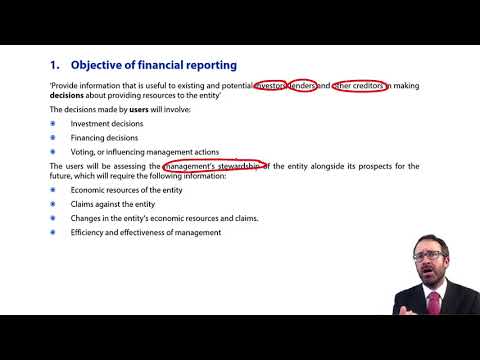
The Framework states that the objective of general purpose financial reporting is to:
Objective
Provide financial information about the reporting entity that is useful to existing and potential investors, lenders and other creditors in making decisions about providing resources to the entity.
The decisions those users make involve:
investment decisions – buying, holding or selling equity and debt instruments
financing decisions – providing or settling loans and other forms of credit
voting, or otherwise influencing, management's actions
Users also need to assess management's stewardship – how efficiently and effectively the directors have used the entity's resources – alongside the entity's prospects for future net cash inflows. To make these assessments, users need information about:
the economic resources of the entity (its assets)
the claims against the entity (its liabilities and equity)
changes in the entity's economic resources and claims (its performance and other changes)
how efficiently and effectively management has discharged its responsibilities
3 Qualitative characteristics – what makes information useful

The Framework identifies the characteristics that financial information must have if it is to be useful. Two are fundamental – without them the information is not useful at all – and four enhance the usefulness of information that is already relevant and faithfully represented.
3.1 Fundamental qualitative characteristics
Relevance – the information is capable of making a difference to the decisions made by users. Relevance is affected by the item's nature and by its materiality: information is material if omitting, misstating or obscuring it could influence users' decisions.
Faithful representation – the information faithfully represents the substance of what it purports to represent (substance over legal form). A faithful representation is complete (includes the descriptions and explanations users need), neutral (free from bias – supported by the exercise of prudence, i.e. caution under conditions of uncertainty) and free from error. The level of measurement uncertainty in an estimate affects how faithfully it can represent an item.
3.2 Enhancing qualitative characteristics
Comparability – users can identify similarities and differences between entities, and for the same entity year on year
Verifiability – independent, knowledgeable observers could reach consensus that the information represents what it claims to represent
Timeliness – information is available in time to influence decisions; the older it is, the less useful it becomes
Understandability – information is classified and presented clearly and concisely, for users who have a reasonable knowledge of business and economic activities
3.3 The cost constraint
Reporting is subject to a cost constraint: the benefits of providing a piece of information should justify the cost of producing it.
Qualitative characteristics (1)
The IASB's Conceptual Framework identifies faithful representation as one of the fundamental qualitative characteristics of financial information.
Which one of the following is NOT an element of faithful representation?
A Information should be timely
B Information should be free from material error
C Information should be free from bias
D Information should be complete
Show answerHide answer
Qualitative characteristics (2)
The IASB's Conceptual Framework identifies characteristics which make financial information faithfully represent what it purports to represent.
Which of the following are examples of those characteristics?
(1) Accruals
(2) Completeness
(3) Going concern
(4) Neutrality
A (1) and (2)
B (2) and (4)
C (2) and (3)
D (1) and (4)
Show answerHide answer
4 Financial statements and the reporting entity

A reporting entity is an entity that is required, or chooses, to prepare financial statements. It need not be a single legal entity – it can be a portion of an entity, or two or more entities together.
Financial statements report the entity's assets, liabilities, equity, income and expenses, and may be prepared as:
consolidated financial statements – a parent and its subsidiaries reporting as a single reporting entity (group accounts)
unconsolidated financial statements – the individual financial statements of a single entity, such as the parent alone
combined financial statements – two or more entities that are not linked by a parent–subsidiary relationship reporting together
Financial statements are prepared:
from the perspective of the entity as a whole, not of any particular group of investors, and
on the assumption that the entity is a going concern – that it will continue in operation for the foreseeable future
5 The elements of financial statements

The Framework defines five elements. The definitions matter: every accounting standard applies them to its own subject matter, and exam questions test their application.
Element | Definition |
Asset | A present economic resource controlled by the entity as a result of past events. An economic resource is a right that has the potential to produce economic benefits |
Liability | A present obligation of the entity to transfer an economic resource as a result of past events |
Equity | The residual interest in the assets of the entity after deducting all its liabilities |
Income | Increases in assets, or decreases in liabilities, that result in increases in equity – other than contributions from holders of equity claims |
Expenses | Decreases in assets, or increases in liabilities, that result in decreases in equity – other than distributions to holders of equity claims |
Some applications of the definitions:
a credit sale increases an asset (receivables), so income is recognised
releasing deferred income reduces a liability, so income is recognised
a credit purchase or an accrual increases a liability, so an expense is recognised
control – not legal ownership – is what makes a resource an asset: a leased asset that the entity controls is recognised even though the entity does not own it
6 Recognition and derecognition

Recognition is the process of including an element in the financial statements. An asset or liability (and any related income or expense) is recognised when recognition provides users with information that is relevant and gives a faithful representation of the item. This links recognition directly back to the fundamental qualitative characteristics: an item so uncertain in measurement, or so immaterial, that including it would not help users is not recognised.
Derecognition is the removal of all or part of an asset or liability from the financial statements:
an asset is derecognised when the entity loses control of all or part of it (for example, on sale)
a liability is derecognised when the entity no longer has a present obligation for all or part of it (for example, when it is paid off)
7 Measurement

The Framework describes the bases on which the amounts of assets and liabilities can be measured:
Historical cost | Current value |
The price of the transaction that gave rise to the item – what was paid to acquire the asset, or received to incur the liability (less depreciation or amortisation where relevant) | Updated to reflect conditions at the measurement date – there are three current value bases (below) |
Fair value – the price that would be received to sell the asset (or paid to transfer the liability) in an orderly transaction between market participants – an exit value (the detail is in IFRS 13)
Value in use (assets) / fulfilment value (liabilities) – the present value of the cash flows the entity expects from using the asset (or expects to pay to fulfil the liability)
Current cost – the cost of an equivalent asset at the measurement date – an entry value, useful where no active market exists
the same asset, four measurements
A machine cost $200,000 on 1 January 20X1 and has a ten-year life. At 31 December 20X2 (two years later):
Historical cost: $200,000 less two years' depreciation of $20,000 p.a. = $160,000
Fair value: the machine could be sold today for $180,000
Current cost: an equivalent new machine now costs $250,000; less two years' depreciation of $25,000 p.a. = $200,000
Value in use: the machine will generate $28,000 a year for its remaining eight years; discounted at 5% (8-year annuity factor 6.463), $28,000 × 6.463 = $180,964
Each basis is a legitimate measurement of the same asset – the accounting standards specify which basis to use, and when, for each type of asset and liability.
Measurement
In a country where the economy is growing and prices are subject to regular increases, which of the following are FALSE when using historical cost accounting compared to current value accounting?
(1) Historical cost profits are understated in comparison to current value profits
(2) Capital employed calculated using historical cost is understated compared to current value capital employed
(3) Historical cost profits are overstated in comparison to current value profits
(4) Capital employed calculated using historical cost is overstated compared to current value capital employed
A (1) and (2)
B (1) and (4)
C (2) and (3)
D (2) and (4)
Show answerHide answer
8 Presentation and disclosure
Where this recording says the topic is “covered more in IAS 1”, read IFRS 18 (Chapter 5). The standard was renamed and rewritten; the presentation and disclosure principles the recording states are unchanged.

The Framework treats the statement of profit or loss as the primary source of information about an entity's performance for the period: in principle, all income and expenses are included in it.
However, income and expenses arising from changes in the current value of an asset or liability may be recognised in other comprehensive income (OCI) where that provides more relevant information – the revaluation of property, plant and equipment (Chapter 6) is the classic example.
Amounts recognised in OCI are subsequently reclassified to profit or loss only where doing so gives more relevant information; otherwise they remain in equity (as with a revaluation surplus, which is transferred directly to retained earnings, never through profit or loss).
9 Capital maintenance

Capital maintenance asks: when has an entity genuinely made a profit? Profit is earned only after the entity's capital at the end of the period is at least equal to its capital at the start (excluding transactions with owners). The Framework describes two concepts:
Financial capital maintenance – capital is the money value of net assets. Profit is the increase in money capital over the period. This is the concept used in conventional financial statements; where price inflation is significant, current purchasing power (CPP) accounting adjusts non-monetary items (such as PPE and inventory) by a general price index so that profit is not overstated by inflation
Physical (operating) capital maintenance – capital is the entity's productive capacity. Profit is earned only after providing for the (specific) current cost of replacing the operating capacity consumed – applied through current cost accounting (CCA), which adjusts for specific price changes in the entity's own assets
Application of the Framework
Two accounting standards examined earlier in your studies are:
IAS 2 Inventories
IAS 16 Property, Plant and Equipment
Apply the principles outlined in the IASB Conceptual Framework to each of the accounting standards above.
Show answerHide answer
10 IAS 8 Basis of Preparation of Financial Statements
New to the 2027 syllabus is IAS 8 Basis of Preparation of Financial Statements. When IFRS 18 replaced IAS 1 (see Chapter 5), the requirements dealing with how financial statements are prepared – as opposed to how they are presented – were brought together in IAS 8, which was renamed from its old title 'Accounting Policies, Changes in Accounting Estimates and Errors'.
10.1 The basis of preparation
IAS 8 requires financial statements to be prepared on a consistent, comparable basis. The general features are:
Going concern – financial statements are prepared on a going concern basis unless management intends (or has no alternative but) to liquidate the entity or cease trading
Accrual basis – transactions are recognised when they occur, not when cash is received or paid
Consistency – the presentation and classification of items is retained from one period to the next unless a change gives more reliable and relevant information or is required by a standard
Materiality and aggregation – each material class of similar items is presented separately; immaterial amounts are aggregated with similar items
Offsetting – assets and liabilities, and income and expenses, are not offset against each other unless a standard requires or permits it
Comparative information – comparative amounts for the preceding period are disclosed for all amounts reported
10.2 Accounting policies, estimates and errors
IAS 8 also deals with the three ways in which reported figures can change, and how each is accounted for:
Change | What it is | Accounting treatment |
Change in accounting policy | A change in the principles or bases applied – e.g. changing the inventory cost formula from FIFO to weighted average | Retrospective – comparatives are restated as if the new policy had always applied |
Change in accounting estimate | A revision of a judgement about uncertain future events – e.g. revising an asset's useful life or the allowance for irrecoverable debts | Prospective – applied to the current and future periods only; comparatives are not restated |
Prior period error | A material misstatement or omission in previously issued financial statements – e.g. a fraud or arithmetic error now discovered | Retrospective restatement – comparatives are corrected as if the error had never occurred |
Accounting policies are selected by applying the relevant IFRS; where no standard applies, management uses judgement to develop a policy that is relevant and reliable, referring to the requirements of standards dealing with similar issues and to the Conceptual Framework. Policies are applied consistently to similar transactions.
Exam focus
The examiner's favourite distinction: a change of accounting policy is applied retrospectively, but a change of accounting estimate is applied prospectively. Changing a depreciation method or useful life is a change of estimate, not of policy. The focus in F1 is on these main principles – detailed computations are not expected.
The Conceptual Framework underpins all IFRS. Financial reporting aims to give investors, lenders and other creditors information that is useful for decisions and for assessing stewardship. Useful information is relevant and faithfully represented (complete, neutral, free from error), and enhanced by comparability, verifiability, timeliness and understandability, subject to a cost constraint. The five elements – assets, liabilities, equity, income and expenses – are recognised when recognition is relevant and faithfully representative, and measured at historical cost or a current value (fair value, value in use / fulfilment value, or current cost). Profit or loss is the primary performance statement, with some current-value changes taken to OCI. Capital may be maintained in financial or physical terms. IAS 8 sets the basis of preparation (going concern, accruals, consistency, materiality, no offsetting, comparatives) and requires policy changes and error corrections to be applied retrospectively but changes in estimates prospectively.
11 Test your knowledge
Two quick checks before you move on: work through the flashcards to fix this chapter’s terms and definitions, then sit the objective questions for exam-style practice. Both mark themselves and explain the answers as you go.
IASB Conceptual Framework
22 questionsAnswer the questions one at a time. Your progress is saved so you can leave and come back.
Open chapter practice