
Working capital: management techniques

These two recordings predate the 2027 syllabus. They are sound on ordering and holding costs, the EOQ and how to test a bulk discount; carry two things with you.
Inventory management: where the lecture describes the cost of the investment in inventory as lost sales, it is the return the money tied up could earn elsewhere — part of the holding cost. Lost sales are a stock-out cost (see “Inventory management”). The techniques apply to retailers as well as manufacturers.
Bulk discounts: at the 1,000-unit batch the annual purchase cost falls, from $1,200,000 to $1,176,000 — which is why $1,189,600 is the lowest total (see “Bulk discounts”).


The next four recordings cover receivables and payables; carry four things with you.
Trade receivables: the CIMA Certificate paper is Fundamentals of Financial Accounting (BA3); the one named credit agency is an example, not the market; and collection is now electronic rather than posted letters.
Costs of financing receivables: read 2 ÷ 98 = 0.02041 as a decimal (2.041%), not a percentage; annualised, it gives 10.1% (see “Settlement discounts”). The example left for you to try is worked in these notes.
Factoring: the spoken net cost is 29,521 — the conclusion, reject, is unaffected. Invoice discounting is normally confidential, with the client still collecting; the recording describes only what happens on default.
Payables: where the second example concludes the company should not pay sooner, the answer is the reverse: take a supplier’s discount when refusing it costs more than your borrowing rate (see “Payables”). Overtrading is covered only in these notes.


1 Inventory management
Manufacturers and retailers hold inventory so that they can meet customer demand as it arises, and so that production is not halted for want of a component. Holding inventory is not free, though: the money tied up in it could be earning a return elsewhere, and the goods have to be stored, insured and eventually written off if they do not sell. Cutting inventory to the bone saves those costs but raises the risk of a stock-out – an unfilled order, an idle production line, a lost customer.
Inventory management is the business of finding the order size that balances those opposing costs. Four categories of cost are in play:
Cost category | What it includes | Effect of ordering in larger quantities |
Ordering costs | Raising and processing each purchase order, carriage inwards, goods-inwards inspection. Largely fixed per order, whatever the order size. | Falls – fewer orders are placed each year |
Holding costs | The finance cost of the money tied up, storage space and handling, insurance, deterioration, obsolescence and theft. | Rises – average inventory held is higher |
Stock-out costs | Contribution lost on sales that cannot be made, customers lost for good, emergency purchases at premium prices, production stoppages. | Falls – a larger buffer makes running out less likely |
Purchase cost | The price paid for the goods themselves. | Constant per unit – unless the supplier offers a bulk discount |
The first two are the ones the classic model works with, because they move in opposite directions and can both be quantified. Stock-out costs are real but hard to measure, and are normally handled by holding a buffer (safety) inventory rather than by calculation.
In practice, inventory levels are also driven by the production system. A just-in-time approach aims to have materials arrive exactly when they are needed, pushing inventory – and its holding cost – back onto the supplier. It depends on reliable suppliers and short, dependable lead times; where those are absent, the stock-out risk outweighs the saving.
2 Economic order quantity (EOQ)
The economic order quantity is the order size that minimises the total annual cost of ordering and holding inventory. Working with an annual demand of D units, a cost of Co for placing one order, and a cost of Ch for holding one unit for one year:
Annual ordering cost = number of orders per year × cost per order = (D ÷ Q) × Co
Annual holding cost = average inventory held × holding cost per unit = (Q ÷ 2) × Ch
Average inventory is taken as Q ÷ 2 because, on the model’s assumptions, inventory falls at a steady rate from Q immediately after a delivery to zero immediately before the next one.
As the order quantity Q rises, ordering cost falls and holding cost rises. Total cost is at its lowest where the two lines cross – and it is that point the EOQ formula finds:
EOQ = √(2CoD ÷ Ch)
Plotting the two costs against order quantity shows why the answer sits where it does. The figures are those of Example 1 below: annual demand 32,000 units, $15 per order, $1.20 to hold a unit for a year.
The curve is flat-bottomed, which is a comfort in practice: ordering 800 or 1,000 units instead of the exact 894 costs only a few dollars a year more. A precise answer matters in the exam; to the nearest sensible order size is fine in real life.
The model rests on assumptions that exam questions like to probe:
Demand is known, constant and spread evenly through the year.
The lead time between placing an order and receiving it is known and constant.
The purchase price per unit is fixed – no bulk discounts (that assumption is relaxed in the next section).
Ordering cost per order and holding cost per unit are both known and constant.
No stock-outs are allowed, and orders arrive complete in a single delivery.
EOQ
The annual demand for an item of inventory is 32,000 units. The item costs $40 per unit to purchase, with order costs of $15 per order. The annual inventory holding cost is $1.20 per unit.
Calculate the economic order quantity for this item and the total annual cost of inventory.
Show answerHide answer
3 Bulk discounts
If the supplier offers a lower price for ordering in larger quantities, the EOQ formula no longer gives the answer on its own – the formula takes no account of the purchase price, and the whole point of the discount is that the purchase price changes. The purchase cost must therefore be brought into the comparison.
The method is simply to total up all three costs at each candidate order quantity and pick the cheapest:
Calculate the EOQ in the usual way, and work out the total annual cost at that quantity – ordering cost plus holding cost plus purchase cost at the normal price.
Repeat the calculation at each order quantity that triggers a discount, using the discounted price for the purchase cost.
Choose the quantity with the lowest total annual cost.
Only the discount thresholds themselves need testing: between two thresholds the price is fixed, so total cost is lowest at the EOQ, and above a threshold there is no reason to order more than the minimum that earns the discount.
Bulk discounts
Annual demand is 120,000 units. Ordering costs are $30 per order and holding costs are $20 per unit per annum. The material can normally be purchased for $10 per unit, but if 1,000 units are bought at one time they can be bought for $9,800 for the batch. If 5,000 units are bought at one time, they can be bought for $47,500 for the batch.
What reorder quantity would minimise the total cost?
Show answerHide answer
4 Trade receivables
Offering credit wins sales: a customer who can pay in 30 days will buy from you rather than from a competitor demanding cash. But every credit sale creates a receivable, and a receivable is money the business has spent but not yet collected – it has to be financed until the cash arrives, and some of it will never arrive at all.
Managing receivables therefore means controlling three things:
who is granted credit in the first place;
the terms on which it is granted; and
how the money is collected once the invoice has gone out.
4.1 Assessing credit status
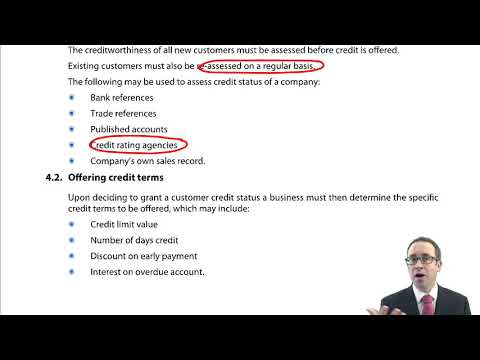
The creditworthiness of every new customer should be assessed before any credit is offered, and existing customers should be re-assessed periodically – a customer who was sound three years ago may not be sound today. Sources of evidence include:
a bank reference, obtained through the customer’s own bank;
trade references from other suppliers who already deal with the customer;
the customer’s published financial statements, and the liquidity and gearing ratios drawn from them;
a report from a credit rating or credit reference agency; and
for an existing customer, the business’s own record of how promptly that customer has paid in the past – usually the most reliable evidence of all.
4.2 Offering credit terms
Once a customer has been approved, the specific terms have to be set. These normally cover:
the credit limit – the maximum the customer may owe at any one time;
the credit period – the number of days allowed for payment;
any settlement (cash) discount for early payment; and
interest or charges on overdue balances.
Terms need not be identical for every customer. A large, financially strong customer may reasonably be given a higher limit and a longer period than a new, unproven one; that is credit management, not favouritism.
4.3 Collecting debts
Collection depends on applying a simple procedure rigorously and on time. A typical escalation, each step triggered by a set number of days past the due date, runs:
issue a statement of account;
send a reminder;
send a second, firmer reminder, and put further supplies on hold;
telephone the customer directly to establish why payment has not been made;
threaten legal action or referral to a debt collection agency; and
take that action.
The discipline matters more than the wording. A customer with limited cash pays the suppliers who chase; the business that never chases finances the ones that do. Modern credit-control software automates the early steps – statements and reminders are issued on schedule without anyone remembering – and electronic payment methods shorten the collection period once the customer does act, because a direct debit or bank transfer clears in a day or two rather than the week a posted cheque used to take.
Progress is monitored through an aged analysis of trade receivables – a list of what each customer owes, split by how long each amount has been outstanding. There is no prescribed layout, but a typical analysis looks like this:
Customer | Total | Current | 31–60 days | 61–90 days | Over 90 days |
Adler & Co | 42,000 | 30,000 | 12,000 | – | – |
Brant Ltd | 18,500 | 4,000 | 3,500 | 5,000 | 6,000 |
Cove plc | 60,000 | 60,000 | – | – | – |
Total | 120,500 | 94,000 | 15,500 | 5,000 | 6,000 |
The analysis directs the effort. Cove owes the most but is entirely within terms and needs no action; Brant owes far less in total but has $11,000 more than 60 days old, and is the account to chase – and the one to consider providing against as an irrecoverable debt.
5 Costs of financing receivables
Two costs arise from giving customers credit, and both can be calculated. The first is the cost of financing the receivables balance; the second is the cost of any settlement discount offered to shrink it.
5.1 Interest cost
Money owed by customers has to be funded, usually by short-term borrowing. The annual cost is therefore:
Interest cost = Receivables balance × Interest rate
Anything that changes the receivables balance – a change in credit terms, a tightening of collection, a factoring arrangement – changes this cost, and that change is what the decision turns on.
Interest cost
EFG has year-end receivables of $10m, based on total sales for the year of $42m. Any increase in receivables is financed from an overdraft carrying an interest rate of 10%.
(a) Calculate EFG’s receivables days.
(b) Calculate the interest cost associated with financing the receivables.
Show answerHide answer
5.2 Settlement discounts
A settlement (cash) discount offers the customer a reduction for paying early – for example 2% off if the invoice is settled within 10 days rather than the usual terms.
The advantages are that receivables and the interest cost of financing them both fall, and that customers who pay quickly are less likely to become irrecoverable debts. Against that:
the discount is expensive – it is given up on every invoice, including those from customers who would have paid promptly anyway;
cash receipts become harder to forecast, because it is not known in advance who will take the discount; and
customers may take the discount and still pay late, which costs the business twice over unless the terms are enforced.
Whether the discount is worth offering is a straightforward comparison: work out what it costs as an annual rate, and set that against the rate at which the business borrows. If the discount costs more than the overdraft, it is cheaper to keep borrowing.
For a discount of d per cent that brings payment forward by n days, the customer pays (100 − d) instead of 100, so the return the business is giving up over those n days is d ÷ (100 − d). Compounding that over a year:
Settlement discounts
EFG has year-end receivables of $10m, based on total sales for the year of $42m. Any increase in receivables is financed from an overdraft carrying an interest rate of 10%.
EFG offers a discount of 2% for payment within 10 days.
Using the compound interest method, calculate the effective annualised cost of offering the discount.
Show answerHide answer
Annual interest
Dory’s customers all pay their accounts at the end of 60 days. To try to improve its cash flow, Dory is considering offering all customers a 1.5% discount for payment within 14 days. Assume overdraft interest is 15%.
Calculate the implied annual (interest) cost to Dory of offering the discount, using compound interest methodology and assuming a 365-day year and an invoice value of $500.
Show answerHide answer
6 Factoring
6.1 CIMA Official Definition
Factoring
The sale of debts to a third party (the factor) at a discount, in return for prompt cash. A factoring service may be with recourse, in which case the supplier takes the risk of the debt not being paid, or without recourse, when the factor takes the risk.
In practice a factor provides some or all of three services: it advances cash against the invoices (typically a high percentage of their value, straight away); it runs the sales ledger and chases the debts; and, if the arrangement is without recourse, it absorbs the loss on any debt that goes bad. The business pays a fee for the service and finance charges on the cash advanced – and, without recourse, more again for the credit protection. Chapter 16 introduced factoring as a source of short-term finance; this is where an offer of it is costed.
Advantages
Cash is received far sooner, shortening the cash operating cycle and cutting the interest cost of financing receivables.
The internal cost of running credit control falls, and management time is freed up.
The factor is a specialist and is often more effective at collecting than an in-house department.
It is particularly useful for small and fast-growing businesses, where a credit control department cannot keep pace with the growth in sales volume.
Without recourse, the risk of irrecoverable debts passes to the factor.
Disadvantages
It should cost more than an efficiently run internal credit control department – the factor has to make a profit on the service.
Factoring has historically been associated with companies in difficulty, so customers and suppliers may read it as a sign of trouble.
Customers may not want to deal with a third party, and the relationship with them is no longer wholly in the company’s hands.
The company may give up some control over who is granted credit.
Once ledger administration has been handed over, rebuilding an internal credit control function is not easy.
6.2 Invoice discounting
Invoice discounting is the finance without the service: selected invoices are used as security for borrowing, and the money is repaid when the customers settle. The company keeps its own sales ledger and does its own collecting, so the arrangement is confidential – the customers need not know it exists, which avoids the reputational objection to factoring altogether. It is a temporary source of finance rather than an outsourcing of credit control, and it is generally cheaper for that reason. Factoring companies typically offer both services.
Factoring
Coral Limited currently has turnover of $25m. Receivables turnover is currently 40 days. Interest is charged on its overdraft at 12%.
A factoring company has offered its services for an annual fee of 1% of turnover. The factoring company can reduce receivables turnover to 15 days. The factor will also generate an administrative saving for the company of $15,000.
Should Coral Limited accept the factor’s offer?
Show answerHide answer
7 Payables
Trade payables are the mirror image of receivables, and the cheapest short-term finance a business has. Taking a further month to pay gives the business a further month’s use of the cash, at no interest – so the working capital instinct is to take the full credit period on every invoice, and never to pay early without a reason.
There are limits to how far that can be pushed:
paying beyond the agreed terms puts the credit account at risk, and supplies with it – a stopped account can halt production far more expensively than the cash it saved;
the supplier may charge interest or fees on overdue amounts;
the business loses any settlement discount offered for early payment; and
a reputation for slow payment weakens the business’s negotiating position on price and terms next time, and – in a growing number of jurisdictions – large companies must publish how quickly they actually pay their suppliers, which makes the practice visible.
The third of these can be calculated in exactly the same way as a discount offered to customers, simply viewed from the other side. Refusing a supplier’s discount means keeping the money for the extra days and forgoing the discount, so the effective annual cost of refusing is:
If that rate is higher than the cost of the company’s own short-term finance, the discount is worth taking – borrow on the overdraft if necessary and pay the supplier early. If it is lower, keep the cash and pay at the end of the credit period.
The receivables and payables discount calculations are the same arithmetic seen from opposite ends. For receivables you are deciding whether to offer a discount (a cost you compare with your borrowing rate); for payables, whether to take one (a return you compare with the same rate). Read the question carefully to see which side of the transaction you are on.
Supplier finance has also moved on. Supply chain finance arrangements let a supplier be paid early by a bank at the buyer’s (usually stronger) credit rating, while the buyer still pays on the original due date – so both sides gain. Some buyers run dynamic discounting schemes instead, offering suppliers a sliding discount for payment on any date before the due date. Both are ways of using the strength of the buyer’s balance sheet without simply stretching the supplier.
8 Overtrading
Overtrading is what happens when a business expands its turnover rapidly without the capital to support it – which is why it is also called under-capitalisation. It is a working capital failure, not a trading failure: the business is winning the sales and may well be profitable, but it does not have the cash to fund the working capital those sales require.
The pattern is consistent. Growth is achieved by working the existing non-current assets harder rather than by investing in new ones, so the sales-to-non-current-assets ratio climbs. Inventory rises as the business produces ahead of demand, and receivables rise faster still, because generous credit terms are one of the things winning the extra sales. That growing working capital has to be financed, and a business unable or unwilling to raise long-term capital finances it from whatever is quickest – the overdraft and its own suppliers.
The result is rising short-term borrowing and falling liquidity. The tell-tale is the quick ratio: the current ratio may hold up, because the inventory and receivables that are building up are themselves current assets, but strip the inventory out and the deterioration shows. Both liquidity ratios, and the cash operating cycle whose lengthening is the other early warning, are defined and worked in Chapter 17.
Symptoms of overtrading
a rapid increase in turnover;
a falling quick ratio – and eventually current liabilities exceeding current assets;
a sharp increase in the ratio of sales to non-current assets;
lengthening inventory days and receivables days;
an increase in the payables payment period, as suppliers are stretched;
rising short-term borrowing and a falling cash balance; and
falling profit margins, as the extra sales are bought with discounts and concessions.
The danger is that this finance can disappear at short notice. An overdraft is repayable on demand and suppliers can withdraw credit the moment they lose confidence, so a general tightening of credit – or one nervous supplier – can push a profitable, growing business into insolvency. It is a reminder of where this part of the syllabus began: businesses fail for want of cash, not for want of profit.
The fundamental remedy is to match the finance to the assets it is funding: replace short-term borrowing with long-term finance – a term loan or an injection of equity – so that the permanent increase in working capital is permanently funded. In the shorter term the business can slow the growth to what it can fund, tighten credit control to bring receivables down, and reduce inventory levels.
Inventory is managed by trading ordering costs against holding costs – the EOQ finds the order size where they balance, and bulk discounts are tested by comparing total annual cost, purchase price included, at each threshold. Receivables are managed by assessing credit status, setting terms, and collecting rigorously with an aged analysis; a settlement discount is worth offering only if its effective annual cost is below the borrowing rate. Factoring and invoice discounting turn receivables into cash at a price. Payables are free finance within the agreed terms and dangerous beyond them. Push all of this too hard while growth outruns the capital base and the result is overtrading.
9 Test your knowledge
Two quick checks before you move on: work through the flashcards to fix this chapter’s terms and definitions, then sit the objective questions for exam-style practice. Both mark themselves and explain the answers as you go.
Working capital: management techniques
20 questionsAnswer the questions one at a time. Your progress is saved so you can leave and come back.
Open chapter practice