
Short-term finance and cash investment

1 Introduction
The cash flow forecast prepared in Chapter 15 tells the business what is coming: a cash deficit that must be financed, or a cash surplus that should be put to work. This chapter deals with both sides – the sources of short-term finance available to cover a deficit, and the instruments available for investing surplus cash for short periods.
This recording predates the 2027 syllabus. It is sound on the four sources of short-term finance, the principles for investing surplus cash and the treasury-bill example; carry three things with you.
Commercial paper: its modest return is not because it is unsecured — being unsecured adds risk, which is why the issuer’s credit standing is everything and only large, creditworthy companies issue it (see “Commercial paper”).
The 270-day term: a US registration threshold, not a general rule.
Notes-only: banks and other financial institutions, choosing between the sources, and money market funds.
2 Sources of short-term finance
2.1 Trade payables (trade credit)
Taking credit from suppliers is the most basic source of short-term finance: between receiving the goods and paying for them, the business is effectively being financed by its supplier. Using the full credit period on offer – paying on day 30 of 30-day terms rather than immediately – is free, and needs no negotiation, which is why trade credit is normally the first source used.
The risk lies in pushing beyond the agreed terms. Paying late may incur interest, damages the relationship, and at worst the supplier refuses to supply at all – leaving the business with nothing to sell and a damaged reputation. Trade credit is therefore excellent finance for very short periods, but only within the agreed terms.
2.2 Bank overdrafts
An overdraft is a facility agreed with the bank that allows the business to borrow, up to a set limit, on its current account. Interest is charged only on the amount actually borrowed day by day, which makes an overdraft flexible – the balance can rise and fall with the daily cash position – and interest paid is a tax-deductible expense.
The key drawback is that an overdraft is legally repayable on demand: the bank can recall the facility at any time. An overdraft suits a business whose cash inflows are uncertain in timing, precisely because the borrowing can expand and contract as needed.
2.3 Short-term loans
A short-term loan is an agreement to borrow a fixed amount for a fixed period, with an agreed repayment schedule. Unlike an overdraft it cannot be recalled on demand, so the finance is certain for its term – but it is also inflexible: interest runs on the full amount borrowed whether or not the cash is currently needed. A loan suits a business that knows how much it needs and when it will be able to repay – for example, to cover a deficit the cash flow forecast shows will reverse in six months.
2.4 Debt factoring
Debt factoring raises cash from the receivables ledger: the receivables are sold to a factoring company, which advances cash (usually a large percentage of the invoices’ value) and then collects the debts itself for a fee. Because the factor specialises in credit control it is often more effective at enforcing credit terms, so factoring is both a source of short-term finance and an external means of controlling the level of receivables. It comes at a cost, however – the fee plus the discount on the amount advanced. Factoring is examined in detail, with calculations, in Chapter 18.
2.5 Banks and other financial institutions
Most of the sources above are provided by the banking system: commercial banks provide current accounts, overdrafts and short-term loans, while specialist institutions – factoring companies (often bank subsidiaries), invoice discounters and providers of supply-chain finance – lend against receivables and trade flows. Larger companies can also borrow directly from the money markets by issuing commercial paper (see below). The business’s trade partners matter too: suppliers provide finance through trade terms, and a strong trading relationship can often be used to negotiate extended terms for a difficult period rather than resorting to borrowing.
2.6 Choosing between the sources
Source | Cost | Best suited to |
Trade payables | Free within agreed terms | Very short-term needs; every business, all the time |
Overdraft | Interest on the daily balance used | Fluctuating, uncertain cash needs |
Short-term loan | Interest on the full amount | A known amount needed for a known period |
Debt factoring | Fee plus finance cost – relatively expensive | Fast-growing businesses with large receivables and limited credit-control resources |
Exam questions often describe a business’s situation – certain or uncertain cash flows, a known or unknown borrowing period – and ask which source of finance fits. Match flexibility (overdraft) to uncertainty, and fixed borrowing (loan) to certainty.
3 Investing short-term cash
When the forecast shows a surplus, leaving the cash idle in a current account earns nothing. The surplus should be invested for the period until it is needed. Four principles guide the choice of investment:
Maturity. When is the investment repaid, and does that date match the date the forecast says the cash will be needed? Closely related is liquidity – can the investment be sold or withdrawn early if plans change, and at what penalty?
Risk. How likely is it that the amount invested will not be repaid in full? Surplus operating cash should not be gambled: only low-risk instruments are appropriate.
Security. Is the investment backed by anything – government backing, deposit insurance, or collateral? Most short-term instruments are unsecured, which is why the standing of the counterparty matters.
Yield. The return earned, whether as interest or as the difference between the purchase price and the maturity value.
The four pull against each other: higher yield generally means accepting more risk or a longer, less liquid commitment. For short-term surpluses of a few weeks or months, businesses accept low returns in exchange for safety and liquidity.
3.1 Interest-bearing bank deposits
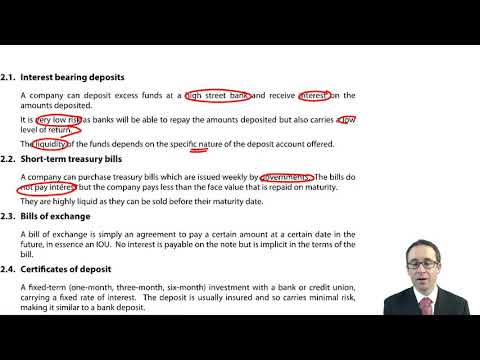
Cash can simply be placed on deposit with a bank to earn interest. Risk is very low, and so is the return. Liquidity depends on the account’s terms: instant-access accounts can be drawn on demand, while notice accounts and fixed-term deposits pay more but charge a penalty (or lose interest) on early withdrawal.
3.2 Treasury bills
Treasury bills are short-dated government debt, issued at regular auctions (weekly in the UK) with maturities of up to a year – commonly 91 days. They pay no interest; instead they are issued at a discount to their face value, and the return is the difference between the price paid and the face value received at maturity. Backed by the government, they carry minimal risk, and because they are actively traded they are highly liquid – they can be sold before maturity, at a price reflecting interest rates at the time.
3.3 Bills of exchange
A bill of exchange is a legally enforceable promise that a set amount will be paid on a set future date – in essence a tradable IOU arising from a trade transaction between two companies. An investor can buy the bill for less than its face value and collect the full amount at maturity; as with a treasury bill, no interest is paid and the return is implicit in the discount. Because the payer is a company rather than a government or bank, a bill of exchange carries more risk than a treasury bill or bank deposit.
3.4 Certificates of deposit
A certificate of deposit (CD) is a fixed-term deposit (one, three or six months, for example) with a bank or credit union, carrying a fixed rate of interest. The deposit is commonly insured, so risk is minimal – similar to an ordinary bank deposit – and negotiable CDs can be sold on before maturity, which improves their liquidity.
3.5 Commercial paper
Commercial paper is short-term unsecured borrowing issued by large, creditworthy companies, typically for terms under 270 days (in the US, paper under 270 days avoids full securities registration). It is purchased at a discount, with longer-dated paper offering higher rates. Because it is unsecured, the credit standing of the issuer is everything; minimum investment amounts are large, so it is an instrument for substantial corporate surpluses.
3.6 Money market funds
In practice many treasurers now invest surplus cash through money market funds – pooled funds that spread the money across a portfolio of the instruments above (deposits, treasury bills, CDs, commercial paper). They offer same-day or next-day access with diversified, low risk, and have largely become the default home for corporate short-term cash alongside bank deposits.
3.7 Comparing returns
Because discount instruments do not pay interest, comparing them with an interest-paying deposit means converting the discount into an effective annual rate. If an investment earns a periodic return r over a period of t days, the annualised return is:
Short-term cash investment
A company has surplus funds to invest for a short-term period of 3 months and has the following two investments to consider:
Treasury bills
Purchase the central bank’s treasury bills for $995 per $1,000 today for a period of 91 days.
Bank deposit account
Invest in a 30-day notice bank deposit account with a variable rate of interest of 2.5% per annum, payable quarterly.
Explain the advantages and disadvantages to the company of each of the investments, using calculations where relevant.
Show answerHide answer
A cash deficit is financed with trade credit, an overdraft (flexible, repayable on demand), a short-term loan (fixed, certain) or factoring (expensive but frees up receivables). A cash surplus is invested judged on maturity/liquidity, risk, security and yield – deposits, treasury bills, bills of exchange, CDs, commercial paper and money market funds, with higher yield always bought at the price of more risk or less liquidity.
4 Test your knowledge
Two quick checks before you move on: work through the flashcards to fix this chapter’s terms and definitions, then sit the objective questions for exam-style practice. Both mark themselves and explain the answers as you go.
Short-term finance and cash investment
17 questionsAnswer the questions one at a time. Your progress is saved so you can leave and come back.
Open chapter practice