
IAS 7 Statement of Cash Flows

1 Introduction
The statement of profit or loss measures performance on the accruals basis: revenue is recognised when it is earned and expenses when they are incurred, whether or not any cash has moved. A profitable company can therefore still run out of cash — and it is a shortage of cash, not a shortage of profit, that makes a business fail. The statement of cash flows completes the picture by reporting the cash that actually flowed in and out during the period.
Like the statement of profit or loss, it is drawn up for the year ended — it explains a period of activity, not a position at a point in time. IAS 7 requires the cash flows to be classified under three headings, with a fourth block at the foot reconciling the movement in cash:
Operating activities – the day-to-day trading of the business: the cash generated from buying and selling goods and services, less the tax paid.
Investing activities – buying and selling non-current assets, plus the interest and dividends received on investments held.
Financing activities – raising and repaying long-term finance: share issues, loans taken out and repaid, lease payments, interest paid and dividends paid.
Movement in cash and cash equivalents – the three totals added together, reconciling opening cash and cash equivalents to closing.
IFRS 18 and this chapter
From 2027 the statement of profit or loss is presented under IFRS 18: income and expenses are classified into operating, investing and financing categories, with two required subtotals — operating profit and profit before financing and income taxes. IFRS 18 is taught in Chapter 5; we do not repeat it here.
When IFRS 18 was issued it also amended IAS 7, and this chapter applies the amended standard: the indirect method now starts from operating profit (not profit before tax), and interest and dividend cash flows have fixed homes — interest and dividends received are investing activities, and interest and dividends paid are financing activities. The old free choices have gone.
These recordings predate IFRS 18, which amended IAS 7. Every technique they teach still works, but carry three things with you.
Starting point: where the lectures start the indirect method from profit before tax and work back, start from operating profit itself; the rest of the working is unchanged (see “The indirect method”).
Interest and dividends: interest and dividends paid are financing outflows, with no option to show dividends paid in operating activities; interest and dividends received are investing inflows (see “Financing activities”).
The full example: with the $14,000 of interest paid under financing, net cash from operating activities is 219 and financing is (184); the change in cash is still (4) (see “Putting it all together”). Check one figure as you go: the increase in payables adds 6.



2 Pro-forma statement of cash flows
In the exam you will not be asked to produce a complete statement of cash flows, but you can be asked to calculate any single figure in it, and to say which heading any item belongs under. Learn the shape:
Statement of cash flows for the year ended [date] | |
$m | |
Operating activities | |
Operating profit | X |
Depreciation and amortisation | X |
Impairment losses | X |
Loss/(gain) on disposal of PPE | X/(X) |
(Increase)/decrease in inventories | (X)/X |
(Increase)/decrease in receivables | (X)/X |
Increase/(decrease) in payables | X/(X) |
Cash generated from operations | X |
Tax paid | (X) |
Net cash from operating activities | X |
Investing activities | |
Purchase of PPE | (X) |
Proceeds from sale of PPE | X |
Interest received | X |
Dividends received | X |
Net cash used in investing activities | (X) |
Financing activities | |
Proceeds from issue of shares | X |
Loans raised/(repaid) | X/(X) |
Payment of lease liabilities | (X) |
Interest paid | (X) |
Dividends paid | (X) |
Net cash from/(used in) financing activities | X/(X) |
Change in cash and cash equivalents | X/(X) |
Opening cash and cash equivalents | X |
Closing cash and cash equivalents | X |
Older study materials (and questions written before 2027) put interest paid in operating activities and allowed choices for interest and dividends. Under IAS 7 as amended by IFRS 18 the classification is fixed for an ordinary trading company: interest received and dividends received are investing inflows; interest paid and dividends paid are financing outflows. (Different rules apply to banks and other entities whose main business is financing or investing — beyond F1.)
3 Cash and cash equivalents
Cash means cash on hand and demand deposits — money in the till and in the bank current account.
Cash equivalents are short-term, highly liquid investments held to meet short-term cash commitments rather than for investment or any other purpose, which are readily convertible into known amounts of cash and are subject to an insignificant risk of a change in value. In practice that means an investment acquired with a maturity of three months or less — a short-dated government bond or a treasury bill bought as a temporary home for spare cash. "Short-dated" on its own is not enough: check the maturity at the date of acquisition, the purpose it is held for, and the risk to its value.
A bank overdraft is negative cash only where it is repayable on demand and forms an integral part of the entity’s cash management — the tell-tale is a balance that commonly fluctuates between positive and overdrawn. Where both conditions are met, deduct it when calculating the cash and cash equivalents balance. An overdraft that does not meet both conditions is a borrowing like any other: it is a financing liability, and drawing it down or repaying it is a financing cash flow.
Cash and cash equivalents
Statement of financial position at 31 December 20X5 (extract)
20X5 | 20X4 | |
$’000 | $’000 | |
Current assets | ||
Government bonds (short-dated) | 1,200 | 1,000 |
Cash | 400 | – |
Current liabilities | ||
Overdraft | – | 150 |
The government bonds were acquired with a maturity of three months or less and are held to meet short-term cash commitments. The overdraft is repayable on demand and forms an integral part of the company’s day-to-day cash management.
Calculate the movement in cash and cash equivalents.
Show answerHide answer
4 Operating activities
Operating activities are the principal revenue-producing activities of the entity, together with anything that is not investing or financing — the cash effect of day-to-day trading.
IAS 7 allows two methods of arriving at the cash generated from operations:
The direct method – build the figure from cash records: cash received from customers less cash paid to suppliers and employees.
The indirect method – start from operating profit in the statement of profit or loss and adjust it back to a cash figure. This is the method almost every company uses, so it is the one to know thoroughly.
Watch the wording in objective test questions. Cash generated from operations is the trading figure before tax paid; net cash from operating activities is after deducting tax paid. They are different lines in the statement.
4.1 The direct method
The direct method takes its figures straight from the accounting records:
$’000 | |
Cash received from customers | X |
Cash paid to suppliers | (X) |
Cash paid to employees | (X) |
Other operating cash payments | (X) |
Cash generated from operations | X |
Where sales and purchases are on credit, reconstruct the cash through the receivables and payables ledger accounts — or use the shortcut: opening balance + statement of profit or loss figure − closing balance = cash.
Direct method
Extracts from a company’s general ledger show the following information:
$’000 | |
Sales for the year | 4,700 |
Purchases for the year | 3,300 |
Wages and salaries | 580 |
Other operating expenses | 430 |
Receivables at start of year | 400 |
Receivables at year end | 500 |
Payables at start of year | 300 |
Payables at year end | 450 |
Calculate the cash generated from operations to appear in the company’s statement of cash flows.
Show answerHide answer
4.2 The indirect method
The indirect method starts with operating profit — the subtotal IFRS 18 requires on the face of the statement of profit or loss — and works it back to cash in two stages:
Add back non-cash items that were charged (or credited) in arriving at operating profit: depreciation, amortisation, impairment losses, and losses (deduct gains) on disposal of non-current assets.
Adjust for working capital movements – the changes in inventories, receivables and payables over the year.
$’000 | |
Operating profit | X |
Depreciation | X |
Loss/(gain) on disposal of PPE | X/(X) |
(Increase)/decrease in inventories | (X)/X |
(Increase)/decrease in receivables | (X)/X |
Increase/(decrease) in payables | X/(X) |
Cash generated from operations | X |
Get the working capital signs from first principles rather than memory. More inventory means cash was spent buying it — an outflow. More receivables means sales were made but the cash has not been collected — an outflow. More payables means goods were bought but the cash has not yet left — the cash is still in your back pocket, so add it on.
If you have seen the indirect method before 2027, you learned to start from profit before tax, add back the finance cost and deduct investment income. Do not do that any more. Operating profit already sits above those items in the IFRS 18 statement of profit or loss, so there is nothing to add back or strip out — and interest paid now appears under financing activities, not operating.
Indirect method
Statement of profit or loss (extract) for the year ended 31 December 20X5
$’000 | |
Operating profit | 3,200 |
Investment income | 150 |
Profit before financing and income taxes | 3,350 |
Finance cost | (500) |
Profit before tax | 2,850 |
Income tax | (350) |
Profit for the year | 2,500 |
Statement of financial position (extract) as at 31 December 20X5
20X5 | 20X4 | |
$’000 | $’000 | |
Current assets | ||
Inventory | 6,500 | 7,200 |
Receivables | 4,300 | 3,900 |
Cash | 250 | 500 |
Current liabilities | ||
Trade payables | 5,200 | 6,500 |
Depreciation for the year was $850,000.
Calculate the net cash from operating activities to appear in the company’s statement of cash flows.
Show answerHide answer
4.3 Interest paid and tax paid
The finance cost and the tax charge in the statement of profit or loss are accruals-based expenses. The statement of cash flows needs the amounts actually paid, which you find by adjusting each expense for the opening and closing balance on the related liability — either in a ledger account or with the shortcut opening balance + expense − closing balance = cash paid.
Interest payable | |||
Balance b/f | X | ||
Bank (cash paid, β) | X | Finance cost (SPL) | X |
Balance c/f | X | ||
X | X | ||
Tax payable | |||
Balance b/f | X | ||
Bank (cash paid, β) | X | Tax expense (SPL) | X |
Balance c/f | X | ||
X | X | ||
Remember where each lands in the statement: tax paid is deducted within operating activities, while interest paid is a financing outflow.
Interest and tax paid
Statement of profit or loss (extract) for the year ended 31 December 20X5
$’000 | |
Finance cost | (500) |
Income tax expense | (350) |
Statement of financial position (extract) as at 31 December 20X5
20X5 | 20X4 | |
$’000 | $’000 | |
Current liabilities | ||
Tax payable | 180 | 210 |
Interest payable | 120 | 90 |
Calculate the interest paid and the tax paid to appear in the company’s statement of cash flows.
Show answerHide answer
5 Investing activities
Investing activities are the acquisition and disposal of non-current assets — at this level chiefly property, plant and equipment, though the same logic covers intangibles and investments — together with the interest and dividends received on investments held.
5.1 Disposals of PPE
A disposal touches the statement of cash flows in two places:
The proceeds – the actual cash received – are an investing inflow.
The gain or loss on disposal is not a cash flow at all. It was included in operating profit, so the indirect method removes it: add back a loss, deduct a gain.
Profit or loss on disposal = Proceeds − Carrying value
Questions give you two of the three terms and expect you to find the third.
Profit or loss on disposal
DBA disposed of a piece of plant and equipment in the year for $250,000. Its carrying value at the date of sale was $225,000.
Show how this would be presented in the statement of cash flows for DBA.
Show answerHide answer
5.2 Acquisitions of PPE
The cash spent on additions is rarely given directly — reconstruct it from the movement in the carrying value of PPE. Depreciation and disposals reduce the carrying value; revaluations and cash additions increase it:
PPE (carrying value) | |||
Balance b/f | X | Depreciation | X |
Revaluation (in the year) | X | Disposals (at carrying value) | X |
Cash additions (β) | X | Balance c/f | X |
X | X | ||
Use the revaluation that arose during the year — the movement in the revaluation surplus — not the cumulative balance. Last year’s surplus is already inside the opening carrying value. And remember a revaluation is not a cash flow: it affects this reconstruction only.
Acquisition of PPE
Statement of financial position (extract) as at 31 December 20X5
20X5 | 20X4 | |
$’000 | $’000 | |
Property, plant and equipment | 13,200 | 12,500 |
Revaluation surplus | 500 | 150 |
Additional information:
1. Depreciation of $850,000 was charged in the year.
2. An item of machinery with a carrying value of $100,000 was disposed of for $120,000.
Calculate the cash outflow for the purchase of property, plant and equipment to appear in the statement of cash flows.
Show answerHide answer
5.3 Interest and dividends received
Interest and dividends received on investments are investing inflows. As with interest paid, if there are opening and closing receivable balances, adjust the income figure to find the cash: opening receivable + income − closing receivable = cash received. With no accrued balances, the income figure is the cash received.
6 Financing activities
Financing activities are the changes in the size and composition of the entity’s equity and borrowings — plus, under the amended IAS 7, the interest and dividends paid on that finance.
Debt – compare opening and closing borrowings (loans, debentures, loan stock, current and non-current). An increase means debt was issued: a cash inflow. A decrease means debt was repaid: a cash outflow. The capital element of lease payments (Chapter 11) is also a financing outflow.
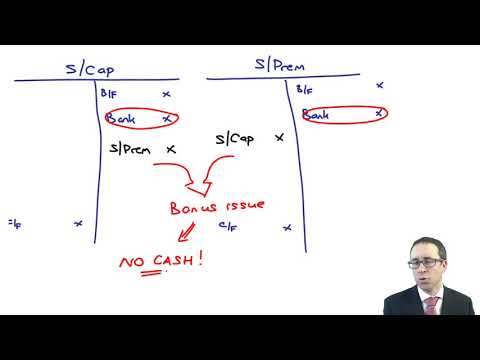
Equity – the cash raised from a share issue is the combined movement in share capital and share premium.
A bonus issue raises no cash: it debits share premium (or retained earnings) and credits share capital. If a question mentions one, reconstruct the share capital and share premium accounts rather than simply differencing the opening and closing totals — otherwise the bonus issue will masquerade as cash raised.
Dividends paid – paid out of retained earnings. Reconstruct the retained earnings account: opening balance plus profit for the year, less the closing balance, is the dividend paid.
Retained earnings | |||
Balance b/f | X | ||
Dividend paid (β) | X | Profit for the year (SPL) | X |
Balance c/f | X | ||
X | X | ||
7 Putting it all together
Statement of cash flows
Statement of profit or loss for the year ended 31 December 20X5
$’000 | |
Revenue | 360 |
Cost of sales and other operating expenses | (150) |
Operating profit | 210 |
Finance costs | (14) |
Profit before tax | 196 |
Income tax expense | (62) |
Profit for the year | 134 |
Statement of financial position as at 31 December 20X5
20X5 | 20X4 | |
$’000 | $’000 | |
Non-current assets | ||
Cost | 798 | 780 |
Accumulated depreciation | (159) | (112) |
Carrying value | 639 | 668 |
Current assets | ||
Inventory | 12 | 10 |
Trade receivables | 34 | 26 |
Bank | 24 | 28 |
Total assets | 709 | 732 |
Equity | ||
Share capital | 180 | 170 |
Share premium | 18 | 12 |
Retained earnings | 343 | 245 |
Total equity | 541 | 427 |
Non-current liabilities | ||
Bank loan | 100 | 250 |
Current liabilities | ||
Trade payables | 21 | 15 |
Income tax | 47 | 40 |
Total equity and liabilities | 709 | 732 |
Additional information:
1. During the year the company paid a dividend of $36,000.
2. Included within expenses are a loss on disposal of $9,000 and depreciation of $59,000.
3. Additions to property, plant and equipment include $45,000 for the purchase of a new piece of machinery — the only addition in the year.
Prepare a statement of cash flows for the year ended 31 December 20X5 in accordance with IAS 7.
Show answerHide answer
The statement of cash flows explains the year’s movement in cash and cash equivalents under three headings. Operating: start from operating profit, add back non-cash items, adjust for working capital, deduct tax paid. Investing: purchases and sales of non-current assets, plus interest and dividends received. Financing: share issues, loans raised and repaid, lease payments, interest paid and dividends paid. Reconstruct any missing figure from the opening balance, the profit or loss figure and the closing balance — a ledger account never lies.
8 Test your knowledge
Two quick checks before you move on: work through the flashcards to fix this chapter’s terms and definitions, then sit the objective questions for exam-style practice. Both mark themselves and explain the answers as you go.
IAS 7 Statement of Cash Flows
22 questionsAnswer the questions one at a time. Your progress is saved so you can leave and come back.
Open chapter practice