
The Finance Function in the Digital Age

1 Introduction
Organisations now operate in contexts that are fast-changing, unpredictable and often disruptive. New technologies appear and mature within a few years, competitors can emerge from entirely different industries, customer expectations shift quickly, and regulation struggles to keep pace. The finance function has to operate in – and make sense of – this environment.
This chapter looks at what the digital world means for finance professionals themselves: the mindset and skills they need, the effect of automation on the work they do, and how the shape and structure of the finance function has changed as a result – from the traditional triangle to the modern diamond shape. The next chapter looks at what the finance function actually does.
This lecture was recorded under the previous syllabus. It covers the same ground as this chapter – the digital mindset, the skills finance professionals need and how open each kind of finance work is to automation, the technologies driving the change (taught in full in Chapter 3) and the changing shape of the finance function – and remains a good foundation, but note: where the lecture calls the new shape a hexagon, the 2027 syllabus and these notes call it the diamond – see 'From triangle to diamond' for its four levels; retained finance and the new areas for finance to focus on are covered only in these notes; and the automation percentages it quotes are past estimates, not forecasts.
2 The digital mindset
2.1 What is a mindset?
A mindset is an established set of attitudes and assumptions held by a person: the go-to methods of thought that they automatically reach for when confronted with a problem.
At one time a single, static mindset could last a whole career. Little in the environment, the marketplace or technology changed very much, so one settled set of rules and approaches would serve for decades.
That static environment has gone. Markets, competitors, economies and technology now change rapidly and continually, and a fixed mindset will not do. What is needed instead is a growth mindset: a willingness to keep learning, to adapt, to respond to challenges and to solve problems that have not been met before.
A digital mindset is a growth mindset applied to technology. It means that finance professionals are continually aware of, and alert to, how digital technology will affect both them and the organisations they work for – the opportunities it creates as well as the dangers. Technologies that should already be on your radar include:
Cloud computing
Big data and data analytics
Process automation (including robotic process automation)
Artificial intelligence – including machine learning and generative AI
Data visualisation
Blockchain
The internet of things and mobile connectivity
3-D printing
Social media
These are examined in detail in Chapters 3 and 4. For now the point is simply that a modern finance professional cannot treat technology and data as somebody else's responsibility.
3 Skills needed by finance professionals
Finance professionals carry out a range of functions, and not all of them are equally open to automation. McKinsey, a firm of management consultants, analysed work activities in 2016 and estimated roughly how much of each type of activity could be automated with the technology then available:
Activity | Potential for automation (2016) |
Collecting data | ~ 64% |
Processing data | ~ 69% |
Applying expertise | ~ 18% |
Stakeholder interactions | ~ 20% |
Managing others | ~ 9% |
Treat the percentages as an illustration of the pattern, not as current facts: routine, high-volume, rule-based activities (collecting and processing data) are the most automatable, while judgement, persuasion and leadership are the least.
Since that study, generative AI (systems that can draft text, analysis, code and summaries) has pushed automation further up the table. Tasks in the ‘applying expertise’ category – drafting report commentary, producing a first-cut analysis, writing spreadsheet formulae – can now be partly automated too. The direction of travel is clear: the routine layers of finance work keep shrinking, and the human contribution moves further towards judgement, communication and leadership.
CGMA's work on the changing competencies of finance professionals suggests that they will need four broad sets of skills:
Technical skills relating to finance and accounting. Finance professionals will still apply these skills themselves, but where a task is automated or performed by AI they must also be able to judge whether the automated process is working correctly and producing information that is fit for decision-making. Broadly, technical skills cover data collection, data processing and some of applying expertise.
Business skills, such as judgement, commercial acumen, and awareness of market, environmental and technological change. These align with applying expertise, because expertise can only be applied properly within a particular business context.
People skills. For example, an analysis might clearly show that production of a component should be outsourced. That conclusion affects the managers and employees currently making the component in-house, so the finance professional needs diplomacy, persuasion and consensus-building if the logic of the analysis is to be accepted. This aligns with stakeholder interactions.
Leadership skills: the ability to motivate and inspire staff so that the organisation can be transformed, when necessary, to deal with changed futures. This aligns with managing others.
4 Automation and the future of work
4.1 Which areas of finance are most susceptible to automation – and why?
An activity is easy to automate when it is high-volume, repetitive, rule-based and works on structured data. Much traditional finance work fits that description exactly:
Recording transactions and posting ledgers
Matching and processing invoices, and making payments
Reconciliations (bank, supplier, intercompany)
Producing standard reports, such as aged receivables listings
Routine credit decisions based on credit scores
Payroll processing
These tasks follow defined rules, are performed the same way every time, and their inputs and outputs are structured – which is precisely what software does faster, more cheaply and more accurately than people. That is why the lower levels of the traditional finance department have been automated first.
4.2 New areas for finance to focus on
Automation does not make the finance function redundant – it changes where finance adds value. As machines take over collecting and processing information, finance professionals are freed to concentrate on using it:
Business partnering – working alongside operations, marketing, HR and IT to influence decisions and improve performance (covered further in later chapters).
Analysis and insight – interpreting the output of automated systems and data analytics, and turning it into recommendations.
Communication – telling the story behind the numbers to boards, managers and other stakeholders in a way that influences what they do.
Stewardship of technology and data – checking that automated processes, algorithms and AI outputs are accurate, unbiased and used ethically. Somebody has to be accountable for what the machines produce, and finance is well placed to be that somebody.
Strategy and leadership – shaping how the organisation responds to a fast-changing environment.
A recurring exam theme: automation removes the routine, transaction-processing layers of finance work and pushes the human contribution up towards insight, influence and leadership. Keep that one-line story in mind – it explains the changing skills above and the changing shape of the finance function below.
5 The shape of the finance function
5.1 The triangle
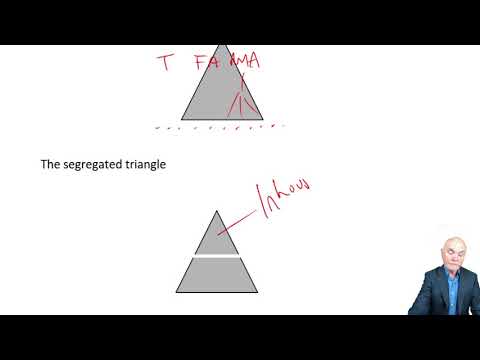
The traditional shape of the finance function was a triangle, representing a simple hierarchy.
At the top was the finance director. Descending through the triangle there would be the chief accountant, then the heads of accounts receivable, accounts payable, and wages and salaries, all the way down to a broad base of junior accounting staff recording and posting transactions. Essentially, the triangle is a traditional organisation chart:
It can be developed to represent groups or divisions, in which case it could look like this:
5.2 The segregated triangle: shared services and outsourcing
The split in the triangle represents what happened as businesses grew, often becoming global: communications and IT technology made it possible to take the routine, high-volume work at the bottom of the triangle out of individual business units and perform it somewhere else. There are two main ways of doing this:
Shared service centres – the organisation keeps the work in-house but concentrates it in one centre (often in a lower-cost country) that serves the whole group. For example, a global company might process all of its invoices and payroll in a single centre in India or Poland.
Outsourcing – the work is handed to an external specialist provider altogether. It has long been common to outsource payroll, and to hand the receivables ledger to specialist companies such as debt factors.
Both routes offer economies of scale, standardised processes and lower costs, because the work is routine and can be done more efficiently at high volume. Both also carry risks: distance from the business, loss of local knowledge and – particularly with outsourcing – loss of direct control and dependence on the provider. The results of the processing are transmitted back to the centre, where people higher up the hierarchy use them to make business decisions.
5.3 Retained finance
Once the routine transaction processing has been moved to shared service centres, outsourced or automated, what stays behind is called the retained finance organisation: the finance activities the organisation deliberately keeps in-house and close to the business.
Retained finance concentrates on the work that needs judgement, business knowledge and personal influence: business partnering with other functions, specialist expertise (such as tax and corporate reporting), oversight and control of the shared service centres and outsourced providers, and strategic leadership of the finance team. It is the growth of retained finance – while the transactional base shrinks – that changes the shape of the function, as we now see.
5.4 From triangle to diamond (CGMA: the changing shape of the finance function)
CGMA's research concludes that the triangle no longer describes the modern finance function. Automation has stripped away much of the broad base of routine work, while the middle layers – where information is turned into insight and influence – have grown. The result is a diamond shape, with four levels:
Level 4 – Finance operations. The base of the diamond: collecting, assembling and extracting data, and processing transactions to generate information and preliminary insight – for example, producing an aged analysis of the receivables ledger. These tasks are mostly routine, and many are already automated or soon will be, which is why this level is now much smaller than the base of the old triangle. Managers are still needed here – partly to run what remains, and partly to push the use of technology further.
Level 3 – Specialist areas. Specialists in financial planning and analysis (FP&A), taxation, corporate reporting and decision support, who analyse the information generated below to produce insight – for example, running ‘what-if?’ experiments or sensitivity analysis on an investment project. Analytical technology is automating parts of this level too.
Level 2 – Business partnering for value. Together with specialist work at Level 3, business partnering forms the widened retained middle of the diamond; the precise balance varies by organisation. Business partners apply expertise and experience to the insight produced at Level 3 in order to influence and shape the decisions the organisation makes: which products to make, what prices to charge, whether to buy in or produce in-house. Stakeholders across the business have to understand the financial information and may need to be persuaded to support particular decisions.
Level 1 – Strategic leadership. Leading the finance team so that it creates the impact the organisation needs. Organisational and technological change is constant, so leadership must keep the function's structure, skills, processes and technology under continual review. The relatively flat top of the diamond reflects the fact that leadership is now more collaborative: the heads of financial reporting, management accounting, treasury and so on must co-operate closely, rather than one person controlling everything.
Notice how the four levels map onto what finance does with information: Level 4 generates information, Level 3 turns it into insight, Level 2 uses it to influence decisions, and Level 1 leads the team to create impact. This ‘information to impact’ idea is developed in Chapter 2.
5.5 Why has the shape changed?
Two forces drove the change from triangle to diamond:
The changing role of the finance function. There is now far more emphasis on management (and management accounting) and relatively less on financial accounting and record-keeping. Because finance is involved in almost every aspect of an organisation – manufacturing, purchasing, invoicing, cash flow, investment appraisal, performance measurement – it has a uniquely holistic view of the business. Hence the term ‘partnering for value’: finance works with internal partners, such as departmental heads, who have to embrace decisions and plans.
Technology. Routine processes are automated, and data analytics improves the accuracy of predictions. Artificial intelligence – increasingly including generative AI – continues to make inroads into higher-skilled work as well, reducing the number of people needed at the lower and middle levels.
The evolution of the finance function's shape (a favourite exam topic): the triangle (simple hierarchy with a broad transactional base) became the segregated triangle (routine work moved to shared service centres or outsourced), and automation of what remained produced today's diamond: a small finance-operations base, a large middle of specialists and business partners – the retained finance organisation – and a collaborative leadership team at the top.
6 Test your knowledge
Two quick checks before you move on: work through the flashcards to fix this chapter’s key terms and definitions, then sit the objective questions for exam-style practice. Both mark themselves and explain the answers as you go.
The Finance Function in the Digital Age
20 questionsAnswer the questions one at a time. Your progress is saved so you can leave and come back.
Open chapter practice