
Ethics
Ethics is the study of what counts as right and wrong conduct — and for an accountant it is not an optional extra. The whole value of the profession rests on the work being competent, honest and impartial, so a member who cannot be trusted has nothing left to sell.
This chapter builds the frame the rest of BA4 sits in. It asks whether ethical truths are absolute or relative; sets out the three schools that people reason from; shows what poor ethics actually costs a business; explains where an accountant's rules come from, and how a rules-based code differs from a framework-based one; and finishes with the gap between an organisation's values and an individual's, and why lifelong learning is itself an ethical duty.
Chapter 2 then takes the CIMA Code of Ethics itself — the five fundamental principles, the threats to them and what a member must do about them.
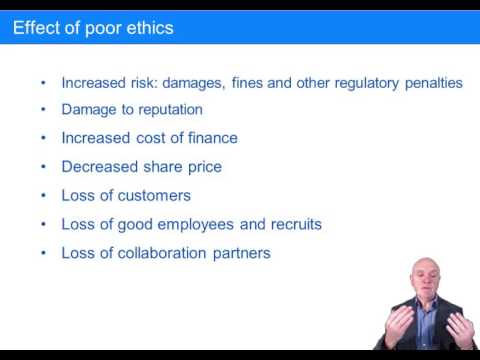
Watch the lecture with this chapter. It works through the same material in the same order and adds several worked illustrations that are not printed here — insider dealing as an example of an ethical standard that changed, the transplant problem as the limit of utilitarian reasoning, and a pharmaceutical concealment as the consequences of poor ethics.
Two things in this chapter are not on the recording. The lecture does not reach §6 (accountants and the public interest), §9 (managing a responsible business and what CIMA gives a member to work with) or §11 (lifelong learning and CPD). It also names the FRC's Auditing Practices Board as a current body; that name was retired in 2012 and §7.3 explains what replaced it. Read the notes for those three sections; nothing else in the recording is contradicted.
1 Introduction
Ethics is a branch of philosophy that involves examining, categorising, justifying and recommending concepts of right and wrong behaviour. Ethics also deals with the moral principles that govern a person's decisions and behaviour.
Ethical standards within business have become very important and poor ethics often leads to fines, loss of trust and falls in shareholder value.
Ethical standards for accountants are vital and represent professional accountants’ “unique selling proposition”. What’s the point in paying an accountant unless their work is competent, honest and impartial? It is vitally important that accountants are trusted and believed: that implies high ethical standards.
2 Absolute v relative
There is a clear distinction between ethical theories based on absolute values and those based on relative values
Absolute value theorists
Assume that there is only one set of moral rules that are unchanging and always true.
But truth in one culture must be different from the truth in another. Consider the different truths behind Christianity and Islam.
So most of the “absolute school” now accepts that each separate culture has its own truths.
But, even then, some truths are international and intercultural – for example, unprovoked murder by one person of another must surely be a basic unacceptable anti–social act, whatever the culture, religion, geographical location.
Relative value theorists
Accept that there are many moral/ethical codes each of which evolves over time and each could be different from every other.
As a result they are more openly accepting of differing codes of ethics: the relative theorists do not believe in the “one moral truth”.
They accept the need for evolution of moral codes.
They accept also the idea of different races, religions, sects… having their own codes of ethics.
Auditors in one country may well accept as normal an activity by a client which would be seen as abnormal by auditors in other countries.
3 Schools of ethics
Those who study ethics attempt to classify the ways in which ethics lead to decisions. The classifications are known as “ethical schools”. Summaries of the main schools are:
School | The question it asks | So an act is right when… |
Teleology, also called utilitarianism or consequentialism | What are the consequences of this act? | its consequences serve some intrinsic good. Utilitarianism puts it as the greatest good for the greatest number. |
Deontology, or duty-bound ethics | What duty am I under, and what rights do others have? | the act itself is right, whatever follows from it. Rightness sits in the action and in the duties and rights around it, not in the outcome. |
Virtue ethics | What would a person of good character do? | it is what a virtuous person would do. The focus is on moral character and on a life well lived, achieved by practising the virtues. |
The same situation, answered three ways. Someone plainly needs help. A utilitarian points to the fact that helping will maximise well-being. A deontologist points to the fact that in helping you act in accordance with a moral rule — do unto others as you would be done by. A virtue ethicist says that helping would be charitable and benevolent, and that those are virtues a good life requires.
All three reach the same answer here, which is why the schools are easy to confuse. They come apart when the consequences and the duty point in opposite directions.
Ethics in accountancy primarily uses the virtue ethics approach.
4 The consequences of poor ethics in business
Irrespective of which school of ethics you adopt, or whether you are an absolutist or relativist, being ‘ethical’ is good for profits, particularly because most unethical behaviour will be discovered and then the consequences are serious.
An ethical organisation will suffer less from legal penalties and damages. For example, paying employees below legal minimums is likely to give rise to fines. Under-declaring profits for tax will lead to large penalties. Concealing the harmful side effects of a product can lead to huge damages.
An ethical approach reduces risk for investors and this will reduce the return they require. Cheaper finance means higher profits.
Better people are likely to be attracted to become employees of ethical companies.
Customers might boycott and abandon unethical companies.
Ethical companies will find other companies more eager to cooperate (eg a joint venture). No one wants to be tainted by a company with a poor reputation.
Ethical companies will be trusted to deliver what they promised in the way they promised.
5 Business and professional ethics
Carrying on a business or being part of the accountancy professions means that you will be continually faced with decisions that have ethical consequences. For example:
You are a pharmaceutical company developing new drugs. How much testing should be carried out before the drugs can be marketed? More testing might identify unwanted side-effects, but more testing will delay treatment for people who are very ill.
Your factory is old and inefficient and you are thinking of moving to a new one with more efficient use of energy, in another area of the country with better transport connections. The factory’s carbon footprint will be reduced, but existing employees will lose their jobs.
You run an airline. You transport passengers for business and leisure and to visit overseas family members. However, airlines also cause noise and air pollution.
House builders create accommodation for families, but they might build over attractive land and displace wild-life.
You are an accountant reporting to a lender on the prospects of a client. A poor report will lead to business closure and redundancies but an optimistic report might lead to the lender losing their investment.
6 Accountants and the public interest
The public interest
The CIMA Code of Ethics states that a distinguishing mark of the accountancy profession is its acceptance of the responsibility to act in the public interest. A professional accountant's responsibility is therefore not exclusively to satisfy the needs of an individual client or employer.
The “public” includes all users of financial information and decisions: corporate boards, shareholders, auditors, suppliers, consumers, governments, and financial industries (e.g., banking, insurance, legal, and investment services). It also includes citizens and taxpayers, who are affected by the fiscal decisions of governments for public expenditure and the distribution of public resources.
“Interest” describes the responsibilities that professional accountants have to society. Examples of these responsibilities include:
Providing sound financial and business reporting to investors and all stakeholders affected by that reporting.
Promoting the comparability of financial reporting and auditing across different countries.
Reducing economic uncertainty throughout the economy.
Requiring that accounting professionals apply high standards of ethical behaviour and professional judgment.
Specifying appropriate educational requirements (including continuing professional development) and qualifications for professional accountants.
Specifying regulatory and disciplinary procedures for the accountancy profession.
Encouraging governments and public sector organisations to provide sound fiscal information and decision-making.
7 Sources of professional rules and ethics
An accountant's ethical obligations arrive from five directions at once, and a member has to satisfy all five. Where they conflict there is an order of precedence: the law comes first.
The law. Local law must be complied with, and takes precedence over everything below. But most legal systems say very little about how an accountant should approach an ethical problem, which is why codes exist at all.
IFAC. The International Federation of Accountants is the global body for the accountancy profession. CIMA is one of its member bodies, and a member body undertakes to meet the standards issued by the boards IFAC supports.
IESBA. The International Ethics Standards Board for Accountants writes the international ethical code and its supporting guidance. It is an independent standard-setting board, now part of the International Foundation for Ethics and Audit (IFEA); IFAC supports its work but does not own it. Note the name: Ethics, not “Ethical”. The CIMA Code of Ethics is based on the IESBA code.
National regulators and oversight bodies. See §7.3 below.
CIMA. CIMA members must comply with local law, with local financial reporting and auditing standards, and with the CIMA Code of Ethics.
7.1 Why a framework of laws, regulations and standards is needed at all
A market only works if the numbers in it can be relied on. Left to itself, every party to a transaction has some incentive to overstate what it is offering and understate what it is asking. Laws set the outer boundary of what is permitted; regulations and standards fill in the detail of how information must be prepared and presented; and ethical codes govern the judgment that neither of the first two can reach. Remove any one layer and the reliability the market is paying for disappears.
It also explains why CIMA and IFAC each have a code rather than leaving ethics to the law. The law is national, slow to change and written after the event. A professional code is international, applies to the member wherever they work, and can require conduct that the law does not compel.
7.2 International bodies: IFAC and IESBA
IFAC's role is to develop and promote international standards, and to co-ordinate the profession so that an accountant's work means the same thing in every country. IESBA, the independent ethics standard-setter that IFAC supports, issues the International Code of Ethics for Professional Accountants, which CIMA has adopted almost in full. Chapter 2 works through what that code requires.
7.3 National oversight bodies — the UK as the illustration
Most developed economies have two national functions sitting between the international standard setters and the individual accountant: a body that oversees the professional bodies themselves (that they admit, monitor and discipline their members properly), and a body that sets national auditing standards. In the UK both functions live inside one organisation, the Financial Reporting Council.
The Financial Reporting Council (FRC) is the UK regulatory body that promotes good corporate governance and reporting, and is responsible for implementing international financial reporting and auditing standards in the UK.
The Conduct Committee is one of the FRC board's committees. It oversees the FRC's conduct work: monitoring of the Recognised Supervisory and Recognised Qualifying Bodies (which is what allows members of an accountancy body to carry out audits), audit quality reviews, corporate reporting reviews, professional discipline, and oversight of the regulation of accountants and actuaries. It took over the work of the FRC's former Professional Oversight Board.
Auditing standards for the UK are set by the FRC itself, through its own board and committee structure. Until July 2012 that was the job of a separate body, the Auditing Practices Board. The APB's work is what the FRC still does: standards and guidance for auditing, for reporting accountants on investment circulars, and for auditors' integrity, objectivity and independence — the object being public confidence in the audit.
Two names to be careful with in the exam. Older textbooks and older lectures — including this chapter's own recording — talk about the Professional Oversight Board and the Auditing Practices Board as live bodies. Both names are historic. What matters, and what the syllabus is really testing, is that a country needs those two functions — oversight of the professional bodies, and national auditing standards — not the label that happens to be attached to them this decade.
A successor regulator for the FRC, the Audit, Reporting and Governance Authority (ARGA), has been proposed in the UK for several years. It is not in place, and the FRC remains the regulator.
Note that CIMA members cannot audit unless they are also members of another appropriate body.
7.4 CIMA
CIMA members must comply with local laws, with local financial reporting and auditing standards, and with the CIMA Code of Ethics, which is based on the IESBA Code of Ethics. The Code binds a member irrespective of their field of activity, of their contract of employment, and of any other professional memberships they hold.
The CIMA Code of Ethics is covered in detail in Chapter 2.
8 Ethical codes
Many organisations and companies are developing their own ethical codes. Areas covered can include:
Equal opportunity/discrimination
Bullying
Use of the internet
Reporting wrong-doing
Bribery
Money-laundering
Response to conflicts of interest
Here are extracts from Amazon’s code of ethics:
I. Compliance with Laws, Rules and Regulations
Employees must follow applicable laws, rules and regulations at all times.
II. Conflicts of Interest
…employees are expected … to act … in the best interests of Amazon.com. A "conflict of interest" exists when an employee's personal interest interferes with the best interests of Amazon.com. For example, a conflict of interest may occur when an employee or a family member receives a personal benefit as a result of the employee's position with Amazon.com. … the Legal Department will consider the facts and circumstances of the situation to decide whether corrective or mitigating action is appropriate.
III. Insider Trading Policy
Employees of the Company may not a) trade in stock or other securities while in possession of material non-public information or b) pass on material non-public information to … or recommend to others that they trade in stock or other securities based on material non-public information.
IV. Discrimination and Harassment
Amazon.com provides equal opportunity in all aspects of employment and will not tolerate any illegal discrimination or harassment of any kind…
V. Health and Safety
Amazon.com provides a clean, safe and healthy work environment. Each employee has responsibility for maintaining a safe and healthy workplace by following safety and health rules and practices and reporting accidents…Violence and threatening behaviour are not permitted. …
VI. Price Fixing
Employees may not discuss prices or make any formal or informal agreement with any competitor regarding prices …
VII. Bribery; Payments to Government Personnel
Employees may not bribe anyone for any reason, whether in dealings with governments or the private sector. …
VIII. Record keeping, Reporting, and Financial Integrity
Amazon.com's books, records, accounts and financial statements must be maintained in appropriate detail.
IX. Questions; Reporting Violations
Employees should speak with anyone in their management chain or the Legal Department when they have a question about the application of the Code of Conduct …The Amazon.com Legal Department has developed … reporting guidelines for employees who wish to report violations of the Code of Conduct. … Amazon.com will not allow retaliation against an employee for reporting misconduct by others in good faith…Employees who violate the Code of Conduct will be subject to disciplinary action up to and including discharge.
X. Periodic Certification
The Legal Department will designate certain employees who, based on their level of responsibility or the nature of their work, will be required to certify periodically that they have read, understand and complied with the Code of Conduct.
XI. Board of Directors
With respect to their service on behalf of the Company, Amazon.com's Board of Directors must comply with the relevant provisions of this Code of Conduct…
There are two approaches to formulating and applying ethical codes:
Rules based
Framework based
Rules-based (compliance-based) | Framework-based (integrity-based) | |
How it works | Specific checks, with punishments or sanctions attached. Controls are implemented through checklists that employees sign off as evidence that they have complied. | Guiding principles plus a culture that promotes ethically sound behaviour. Few, if any, checklists; compliance rests on trusting employees to do the right thing. Any checklist is high level and asks whether the principles were followed. |
Its great strength | The organisation designs exactly the checks it thinks it needs, and can produce evidence that each employee went through them. | Flexible. It reaches novel ethical problems that nobody thought to write a question about, and it is far less bureaucratic. |
Its great weakness | The organisation cannot possibly check every decision — the bureaucracy would be enormous — and it cannot foresee every dilemma. If there is no question covering the problem, does the employee get off the hook? | It demands real trust, and not everyone has the moral discernment the approach assumes. There is also no evidence afterwards that anybody actually thought about it. |
What it relies on | Detection and sanction. | Training, tone from the top, and the employee's own judgment. |
The speed camera. A driver who sees a speed camera slows down, to comply with the limit and avoid a fine. That is the rules or compliance approach — and the danger is obvious: the same driver speeds up again where there is no camera.
The framework or integrity approach would have instilled in the driver that breaking the limit is dangerous and morally wrong. That driver drives ethically whether or not a camera is watching.
9 Managing a responsible business
Writing a code is the easy part. Running a business responsibly means recognising the ethical issues before they become incidents, and then having somewhere to go when one arises. The issues that most often reach a management accountant are:
How results are presented — the pressure to smooth, to shift a cost into next period, or to make a forecast more optimistic than the evidence supports.
Bribery, facilitation payments, gifts and hospitality, especially in overseas operations and in procurement.
Money laundering, and knowing where a customer's money has come from.
Conflicts of interest — a relative or a personal investment on the other side of a decision you are taking.
How the workforce is treated: equal opportunity, discrimination, bullying, health and safety.
Confidential and personal data — who may see it, and what it may be used for.
The conduct of suppliers, whose behaviour attaches to the buyer's reputation whether or not it attaches to the buyer's legal liability.
Most of these are covered later in BA4 in their own right — governance in chapters 3 and 4, fraud in chapter 6, corporate social responsibility in chapter 7, and the employment issues in chapter 9.
9.1 What CIMA gives a member to work with
A member facing one of these tensions is not on their own, and the exam expects you to know what is actually available:
The CIMA Code of Ethics. The obligations themselves, and the framework for working through a threat. Chapter 2.
CIMA's Ethical Checklist. A published step-by-step route through an ethical conflict — check your facts, is it ethical, is it legal, which principles are affected, who is affected, escalate internally then externally, take advice, and as a last resort refuse to remain associated with it. Set out in full in chapter 2 §6.
The CIMA ethics helpline. Confidential advice, free to members and registered students.
CIMA's responsible-business material. Guidance, cases and research on ethics, anti-bribery, speaking up and sustainability.
CIMA does not do this in isolation. It is a member body of IFAC, which is why the CIMA Code is the IESBA code; and CIMA and the American Institute of CPAs together form the Association of International Certified Professional Accountants, through which they publish jointly on ethics, governance and sustainability reporting. The practical consequence for a member is that the standard being applied to them is an international one, not a local one.
10 Organisational and personal values
There is no reason that an organisation’s values and the personal values of its employees will be the same:
Unless there is some overlap there are going to be difficulties: the ethics and virtues as perceived by employees will be at odds with what the organisation perceives and needs. Successful organisations get as much overlap as they can — the right-hand panel above — because an employee whose own values already point the same way needs supervising far less than one whose do not.
The two sets of values can be brought towards each other by:
Recruitment: try to ensure that new employees share at least some of the organisation’s values.
Training: for example courses, group discussions and role play that examine ethical dilemmas.
Ethical codes: these explain how employees should act and will also set out sanctions if the code is breached.
Corporate culture: a strong emphasis from the top on how things should be done in the organisation.
10.1 When the two stances pull apart
An organisation has a corporate ethical stance — the standard of behaviour it holds itself to, which may be no more than the law requires or may go well beyond it. Every employee has a personal ethical stance. As a member, you also carry a third: a professional stance, set by the CIMA Code, which follows you from employer to employer.
Those three stances are answerable to different people, and that is what makes a conflict a conflict rather than a simple mistake:
Stance | Whose interests it is built around | Where it can pull against the others |
Corporate | The company's owners, and whatever wider group the board has chosen to commit to — customers, employees, suppliers, the community, the environment. | A stance set to satisfy shareholders in the short term can ask an employee to do something they think is wrong, or ask a member to present information in a way the Code does not permit. |
Personal | The individual's own conscience, upbringing, culture and beliefs. | It may be stricter than the employer's code, in which case the employee is uncomfortable; or looser, in which case the employer cannot rely on the person without supervision. |
Professional | The public interest — every user of the information, not only the employer who pays for it. | It overrides an instruction from the employer, and it survives the employee leaving. This is the stance a CIMA member cannot negotiate away. |
So the overlap the diagram above asks for is not only between the organisation and the individual. A responsible employer also has to be able to live with the professional stance of the accountants it employs — which is exactly why the Code protects a member who refuses an instruction, and why the last step of CIMA's checklist is to walk away.
10.2 The virtues an organisation looks for
The virtues and values that organisations will, in general, like to see in their employees are:
Reliability: employees should do what they say they will do, both in terms of quality and in meeting deadlines.
Responsibility: employees should be willing to be accountable for their actions and decisions.
Timeliness: meet deadlines. Do not have undue delays in carrying out tasks or communicating with others.
Courtesy: it is important to be courteous to others both inside and outside your organisation. Discourtesy will generate neither friends, concessions nor more work.
Respect: towards other people and their views – even if you think they are wrong.
11 Lifelong learning and CPD
This can be defined as:
“The provision or use of learning opportunities, both formal and informal, throughout people's lives in order to promote continuous development and improvement of the knowledge and skills needed for employment and personal fulfilment”
It is often described as being:
ongoing
voluntary
self-motivated.
The concept recognises that in many businesses and organisations the pace of change is now often very fast. You only have to think about the impact of information technology and the Internet on most businesses. Unless employees and management keep up-to-date, their organisations will probably fail.
Within the accountancy profession it is important to keep up to date when preparing reports or giving advice. For example, developments in costing, such as activity based costing, might be more effective in producing information on which to base reliable decisions. Obviously it is important to keep up-to-date with tax and accounting standards. In fact, it would be unethical not to keep up to date.
Note that it is not only technical matters that change. Ethical matters also change and indeed the changes in ethics might be backed up by changes in the law. For example, attitudes towards bullying, discrimination, corporate social responsibility, bribery and corporate governance have all changed markedly over the last 20 years or so. Not to keep up to date is liable to lead towards expensive legal action.
This is the ethical duty, not merely a good habit. Chapter 2 sets out the five fundamental principles of the CIMA Code, and one of them is professional competence and due care. A member is required to keep their professional knowledge and skill at the level needed to give a competent service, and to act diligently. Meeting that requirement in practice is what continuing professional development (CPD) is: a planned, recorded cycle of assessing what your role needs, closing the gap, and evaluating whether it worked. Falling behind is not just careerism — it is a breach of the Code.
12 Chapter questions
Work each one before reading the answer.
Which TWO of the following statements are correct?
A Teleology looks at the consequences of an action to determine whether the action is ethical
B Deontology looks at the motives for an action to determine whether the action is ethical
C Teleology looks at the motives for an action to determine whether the action is ethical
D Deontology looks at the consequences of an action to determine whether the action is ethical
Show answerHide answer
Which of the following are likely long-term consequences of poor ethics in an organisation? (Choose all that apply)
A Lower finance costs
B A better reputation
C Greater risk
D More customers
E Problems with regulators
F Fewer opportunities for collaboration
Show answerHide answer
A CIMA member finds that a local law requires accountants to report suspicious transactions to the authorities. This means that the accountant has to divulge confidential information in contravention of a general ethical duty of confidentiality.
Which duty takes precedence?
A The law takes precedence
B The accountant’s ethical code takes precedence
Show answerHide answer
What do the initials IFAC and IESBA stand for?
Show answerHide answer
What are the two approaches to establishing and administering ethical codes?
Show answerHide answer
13 Test your knowledge
Two quick checks before you move on: work through the flashcards to fix this chapter’s key terms and definitions, then sit the objective questions for exam-style practice. Both mark themselves and explain the answers as you go.
Ethics
12 questionsAnswer the questions one at a time. Your progress is saved so you can leave and come back.
Open chapter practice