
Adjustments to Profit and Suspense Accounts

This chapter is about putting errors right. In an adjustments-to-profit question you start from a draft profit and add or subtract the effect of each error to reach the correct profit. In a suspense account question the trial balance does not agree: the difference is put into a suspense account, each error is corrected by a journal entry, and any error that affected only one side of the double entry also clears part of the suspense account. When every error has been found, the suspense account has no balance left.
1 Introduction
These are two areas, often related, asking you to show the effect of correcting errors. They are a good way of testing your knowledge and understanding of bookkeeping, without requiring you to produce lots of t-accounts.
Both kinds of question test the same skill: for each error, decide what was done, what should have been done, and what entry puts it right. The types of error (omission, commission, principle, original entry, reversal, compensating errors) were described in Chapter 3.
1.1 Adjustments to profit
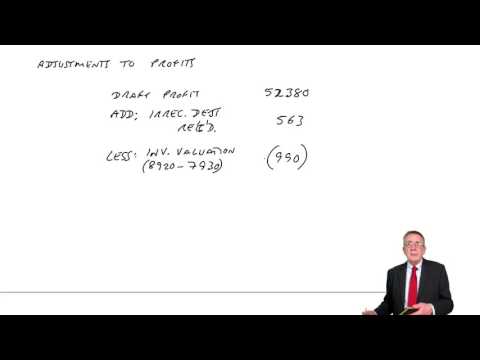
In these questions, a set of draft (or rough) financial statements have been prepared. However, subsequently various errors and omissions have been discovered.
Our task is to calculate the correct profit. However, you are not required to produce a new Statement of Profit or Loss. Therefore we produce a statement which starts with the profit from the financial statements, adds or subtracts to adjust for the various errors listed, and ends with the correct profit.
For each error ask one question: once it is corrected, will the profit be higher or lower? An error that touches only statement of financial position accounts (for example, cash received from a customer posted to the wrong customer’s account) does not change the profit at all and is left out of the statement.
Error found | Effect of correcting it on profit |
An expense left out, or understated (for example depreciation not charged, an accrual not made) | Deduct — expenses go up |
Income left out, or understated (for example discount received not recorded, an irrecoverable debt recovered) | Add — income goes up |
An expense charged that belongs to next year (a prepayment not made) | Add — expenses go down |
Revenue recorded twice, or a sale recorded that has not yet happened | Deduct — revenue goes down |
Closing inventory overstated (for example cost above net realisable value) | Deduct — cost of sales goes up |
Capital expenditure treated as an expense (for example a machine debited to repairs) | Add back the cost (less any depreciation that should now be charged) |
Drawings recorded as an expense (for example the owner’s private bill debited to an expense account) | Add — drawings are not an expense |
Alison’s draft financial statements show a net profit for the year of $52,380. Subsequently, the following errors come to light:
No entry has been made for $563 cash received from Adele, a customer whose debt was written off last year as irrecoverable.
Closing inventory valued in the draft accounts at its cost of $8,920, was believed to have a potential sales value of $7,930.
Goods which had cost $2,000 had been sent to a customer just before the year end on a sale or return basis. These had been accounted for as a firm sale, with a profit of 20% of cost. No confirmation of the sale had been received from the customer.
A payment for rent charged in full to the current year included $490 which relates to the next accounting period. No adjustment had been made for this when preparing the draft accounts.
Prepare a statement of adjustments to profit in order to calculate the correct net profit for the year.
Show answerHide answer
2 Suspense Accounts

In an earlier chapter we looked at the Trial Balance. The trial balance should balance, and if it does not then there must be errors somewhere that need to be found.
However, it is likely that the difference on the trial balance is the net result of several errors. In practice, we would have to start checking the bookkeeping entries until we found an error. It would then be useful to have a note of how much errors still remained in order that we would know when we had finally found all the errors!
A common way of doing this (and a common exercise in the examination) is to open a t-account called the Suspense Account (or Difference Account) with a balance equal to the trial balance difference. This is in some ways an artificial account, in that had the double entries all been correct then there would be no trial balance difference.
However, it does provide a useful check when finding errors. Every time we find an error in the bookkeeping, we will correct it and at the same time make an entry in the Suspense Account to show that part of the difference had been found. When all the errors have been found, the balance on the Suspense Account will fall to zero.
A suspense account is also used for a second, simpler reason. If a bookkeeper knows one side of an entry but not the other — for example, $10,000 has been paid for a car but the bookkeeper does not know which account to debit — the unknown side can be posted to suspense for the time being. When the correct account is known, the amount is taken out of suspense (Cr Suspense) and put where it belongs (Dr Motor vehicles). Either way, a suspense account is a temporary account and must not appear in the final financial statements.
2.1 Which errors affect the suspense account?
Only an error that makes the debits and credits unequal causes a trial balance difference, so only those errors are corrected through the suspense account. The errors described in Chapter 3 that leave the trial balance agreeing are corrected with an ordinary journal between the ledger accounts, with no suspense entry.
Error | Does the trial balance still agree? | Suspense entry when corrected? |
Omission, commission, principle, original entry, complete reversal, compensating errors | Yes — debits still equal credits | No |
Only one side of an entry posted | No | Yes |
A different amount on each side (for example a transposition in one account only) | No | Yes — the difference |
An amount posted to the wrong side of one account (the other side correct) | No | Yes — twice the amount |
Both entries made on the same side | No | Yes — twice the amount |
An account added up wrongly (a casting error) | No | Yes — the difference |
A balance left out of the trial balance, or copied into it wrongly | No | Yes (there is no error in the ledger itself) |
2.2 Opening the suspense account
Add up the trial balance. If the debits are larger, the suspense account needs a credit balance equal to the difference to make the trial balance agree; if the credits are larger, it needs a debit balance.
2.3 Correcting errors with a journal entry
For each error, work out the entry that was made, the entry that should have been made, and the journal that gets from one to the other. If only one side of the original entry was wrong, the other side of the correcting journal goes to the suspense account. Each correcting journal has a narrative, as in Chapter 11.
Error (cash book correct in each case) | Correcting journal |
Rent paid of $760 was posted to the Rent account as $670 | Dr Rent $90; Cr Suspense $90 |
A $250 payment for repairs was credited to the Repairs account instead of debited | Dr Repairs $500; Cr Suspense $500 (cancel the wrong $250 credit and make the right $250 debit) |
Cash sales of $840 were not posted to the Sales account | Dr Suspense $840; Cr Sales $840 |
A credit sale of $560 was entered in both the Sales account and the Receivables account as $650 | Dr Sales $90; Cr Receivables $90 (both sides wrong by the same amount — no suspense entry) |
Purchase of a machine for $3,000 was debited to Repairs | Dr Machinery $3,000; Cr Repairs $3,000 (error of principle — no suspense entry) |
Notice the two transposition cases. Where the wrong figure is in one account only (rent $670 instead of $760), the trial balance is out by the difference and the correction goes through suspense. Where the same wrong figure is in both accounts (the sale at $650), the trial balance still agrees and the correction is between the two ledger accounts only.
Biruta has prepared the following trial balance.
Dr $ | Cr $ | |
Motor Van, at cost | 5,500 | |
Inventory | 6,230 | |
Sales ledger Control Account | 19,167 | |
Cash at bank | 218 | |
Petty Cash | 50 | |
Purchase Ledger Control Account | 13,166 | |
Prepayments | 490 | |
Accruals | 70 | |
Motor Van – accumulated depreciation | 2,000 | |
Sales | 93,870 | |
Purchases | 76,182 | |
Rent expense | 1,200 | |
Wages expense | 12,500 | |
Electricity expense | 516 | |
Telephone expense | 230 | |
Accountancy expense | 500 | |
Van expenses | 280 | |
Depreciation expense | 1,000 | |
Capital | 10,000 | |
124,063 | 119,106 |
The trial balance does not balance, and Biruta realises that this means that there must be errors in the bookkeeping.
On investigation, the following errors are discovered:
A transposition error was made when posting a sales day book total of $8,132. The correct figure was entered in the sales ledger control account, but it was posted to the sales account as $1,832.
The balance on the electricity account was incorrectly recorded and should read $615.
One cash payment for electricity of $200 had been recorded throughout as $20.
When accounting for the telephone accrual of $70 at the year end, a single entry had been made. It was the expense account entry that had been missed out.
A mistake had been made when casting the purchases account. The total should have been $77,356.
You are required to open a suspense account. For each error make any relevant entries in the suspense account.
Show answerHide answer
2.4 Suspense accounts and profit together
The two kinds of question are often combined: correct the errors through the suspense account, then show how the corrections change the draft profit. Only corrections that touch a statement of profit or loss account (income or expense) change the profit; corrections between asset, liability and capital accounts do not.
The trial balance of Kofi Mensah, a trader in Kumasi, at 31 December 2018 shows debits of $96,450 and credits of $95,860. The difference was put into a suspense account and draft financial statements were prepared showing a profit of $28,600. The following errors were then found:
Discount received of $240 was correctly entered in the payables ledger control account but was not posted to the Discount received account.
Rent paid of $1,350 was correctly entered in the cash book but was posted to the Rent account as $1,530.
Office equipment bought for $2,000 was debited to the Repairs account. (Ignore depreciation.)
Sales returns of $505 were correctly debited to the Sales returns account but were also debited to the receivables ledger control account.
Wages of $840 paid were correctly entered in the cash book but were not posted to the Wages account.
Required:
Write the journal entries, with narratives, to correct the errors.
Prepare the suspense account.
Prepare a statement of adjustments to profit showing the corrected profit.
Show answerHide answer
3 Test your knowledge
Two quick checks before you move on: work through the flashcards to fix this chapter’s terms and definitions, then sit the objective questions for exam-style practice. Both mark themselves and explain the answers as you go.
Adjustments to Profit and Suspense Accounts
12 questionsAnswer the questions one at a time. Your progress is saved so you can leave and come back.
Open chapter practice