
Books of Prime Entry

Businesses do not post every transaction straight to the ledger. Each transaction is first listed in a book of prime entry — the sales and purchase day books, the returns day books, the cash book, the petty cash book or the journal. At the end of each month the totals are posted to the nominal ledger, which is where the double entry happens. Alongside, a memorandum sales ledger and purchase ledger keep an account for each customer and supplier. Petty cash is controlled with an imprest: the float is topped up each period by exactly what was spent.
1 Introduction
We have now covered all of the day-to-day bookkeeping (and also the four types of adjustment required for preparation of the financial statements). However, it would be far too time-consuming for all but very small businesses to record every single transaction in the way we have been doing.
In practice we make the process more efficient by listing each transaction in one of several books (known as the books of prime entry) and only make the double entries in the nominal ledger at the end of each month using the totals from the books of prime entry.
2 The Books of Prime Entry
The tutor uses several names for the same books: the sales day book is also called the sales journal, the purchase day book the purchase journal, the sales ledger the receivables ledger and the purchase ledger the payables ledger. In the fourth lecture he also says that the entries for returns come “in a later chapter” — on this page the returns day books and their entries are in this section.

As stated in the introduction, these are books in which we simply list each transaction as it occurs. (They are also called Books of First or Original Entry). They do not form part of the double entry – they are simply lists – but they do mean that we have a record.
At the end of each month we will take the totals from these books and perform the double entry in the nominal ledger accounts.
Each business will keep whatever books of prime entry that it finds useful, however the main ones (of which you should be aware) are the following:
The Cash Book
This will list all receipts and payments in and out of the bank.
It will usually be split into two books – one for receipts and one for payments.
The Purchase Day Book
This will list all purchases on credit (from the suppliers’ invoices).
The Sales Day Book
This will list all sales on credit (from copies of the sales invoices sent to customers).
The Returns Day Books
The sales returns day book lists goods returned by credit customers (from the credit notes we send them); the purchase returns day book lists goods we return to credit suppliers (from the credit notes they send us).
The Petty Cash Book
This will record all receipts and payments of loose cash.
The Journal
This will be used to record any other, less common, transactions that are not covered by the other books.
(The entries for dealing with the Inventory at the end of a period, that we covered in the previous chapter, are an example of a transaction that may be recorded in this book).
At the end of the month the total of each book is posted to the nominal ledger like this:
Book of prime entry | Source document | Debit (month-end total) | Credit |
Sales day book | Sales invoice | Receivables | Sales |
Purchase day book | Supplier’s invoice | Purchases | Payables |
Sales returns day book | Credit note sent to the customer | Sales returns | Receivables |
Purchase returns day book | Credit note received from the supplier | Payables | Purchases returns |
Cash receipts book | Receipts, paying-in slips | Cash | each analysis column (e.g. Receivables, Sales, Capital) |
Cash payments book | Cheque counterfoils, bank transfer records | each analysis column (e.g. Payables, Rent, Wages) | Cash |
In this chapter the cash book is a list and the double entry is made in a separate Cash account in the nominal ledger. Many businesses instead use the cash book itself as the cash account, so that it is both a book of prime entry and part of the double entry — the result is exactly the same.
3 The Sales and Purchases Ledgers
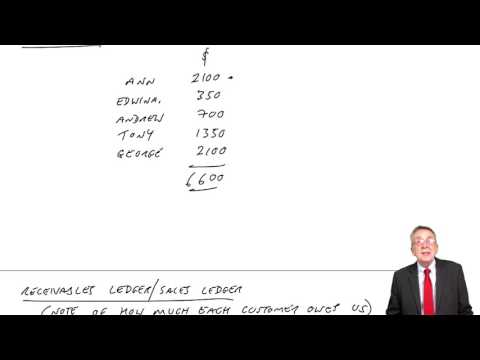
You will remember that in the Nominal Ledger we have a Receivables Account and a Payables Account. The balances on these accounts represent the total receivables and total payables respectively. However, they do not show the amounts owing from or to each individual customer or supplier.
This is fine for the Statement of Financial Position – all we need is the total receivables and total payables. However, we obviously need a day by day record for each individual customer and each individual supplier, in order to be able to chase customers and to know how much to pay each supplier.
A record of how much each customer is owing to us will be kept in the Sales Ledger. There will be an account for each customer and an entry will be made every time we make a sale or receive cash. The information will be obtained from the Sales Day Book and from the Cash Receipts Book.
It is extremely important to note that the Sales Ledger is not normally part of the double entry system of the business, but is simply a memorandum (or note) record of the amount owing to us by each individual.
In a similar way a record will be kept of how much we are owing to each individual supplier in the Purchase Ledger.
The sales ledger is also called the receivables ledger, and the purchase ledger the payables ledger. Because the totals of these ledgers should agree with the Receivables and Payables accounts in the nominal ledger, those two nominal ledger accounts are also known as control accounts (Chapter 15).
4 A comprehensive illustration
The illustration below shows every step: listing the transactions in the books of prime entry, keeping the sales and purchase ledgers, posting the month-end totals to the nominal ledger and extracting a trial balance. The lectures in sections 2 and 3, and the one below, work through it.

Pattie started business on 1 January 2008 as a trader in chairs. Her transactions during her first month were as follows (in date order):
(a) She paid $6,000 into a separate bank account for the business.
(b) The business bought chairs for $1,600 cash.
(c) The business sold some of the chairs for $1,200 cash.
(d) The business bought a van for $2,500 cash
(e) The business bought more chairs for $400, on credit from Chris.
(f) The business bought more chairs for $800 from Chris, on credit
(g) The business bought chairs for $600 on credit from William
(h) The business sold some of the chairs for $2,100 to Ann on credit.
(i) The business sold some chairs for $350, on credit to Edwina
(j) The business sold some chairs on credit for $700 to Andrew
(k) Rent for the month was paid of $300
(l) Paid three quarters of the amount due to Chris
(m) Received $1,000 from Ann in respect of the amount owing by her
(n) Pattie paid another $4,000 of her own money into the business bank account
(o) Chairs were purchased on credit from William for $1,000, and on credit from Bertha for $1,600
(p) Chairs were sold for $1,350 on credit to Tony
(q) Chairs were sold to George for $2,100 on credit
(r) The business paid wages of $400 to the shop assistant
(s) Pattie withdrew $700 cash from the business bank account, for herself.
(there was no closing inventory)
Write up the books of Prime Entry for the month
Write up the relevant accounts in the Sales and Purchase Ledgers
Post the totals from the Books of Prime Entry to the relevant accounts in the Nominal (General) Ledger
Prepare a Trial Balance at the end of the month.
Show answerHide answer
Notice the check this gives. The Receivables account in the nominal ledger shows $5,600 in total, and the list of balances in the sales ledger shows who owes it — also $5,600. The Payables account ($3,500) agrees with the purchase ledger list in the same way. If a total and its list do not agree, a mistake has been made somewhere. This check is developed in Chapter 15 (control accounts).
5 A diagram of the complete bookkeeping system
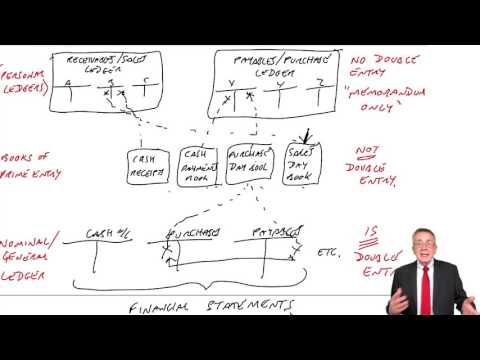
The diagram puts the whole system on one page:
Every transaction is first listed in a book of prime entry (from its source document). The books are lists, not double entry.
At the same time, each credit sale, credit purchase, return, receipt and payment is copied to the customer’s account in the sales ledger or the supplier’s account in the purchase ledger. These ledgers are memorandum records only.
At the end of the month the total of each book (and each analysis column) is posted to the nominal ledger. This is the double entry.
The balances on the nominal ledger accounts are listed in a trial balance, and the financial statements are prepared from it.
6 The petty cash book
In the above example, there was no petty cash. This is very common in examinations, and ‘cash’ refers to all cash – we do not separate between cash at bank and petty cash.
However, in practice there will be two records kept of cash – the cash receipts and cash payments books will record cash in and out of the bank, whereas the petty cash book will record cash in and out of the petty cash box (the loose cash).
Normally this book will record both receipts and payments (in one book) since there are unlikely, in most businesses, to be many transactions. It is also often the only book of prime entry that is actually part of the double entry bookkeeping i.e. we will actually debit the petty cash book with receipts.
Since most companies will have expenditure from petty cash, but no receipts of loose cash, money will periodically have to be taken from the bank. If this is not controlled properly, there is a danger of theft by an employee. One very standard way of controlling is the imprest system of petty cash, whereby cash is drawn from the bank at regular intervals e.g. weekly, and the amount drawn is exactly equal to the amount spent during the previous week. As a result the balance is always ‘topped up’ to the same fixed amount, which fixes an upper limit on the amount that could ever be stolen.
Each payment from the tin is supported by a petty cash voucher with its receipt. At the end of the period the vouchers are added up, the cash left in the tin is counted, and the two together should equal the imprest amount. The cash drawn from the bank to restore the imprest equals the total of the vouchers (imprest − cash left).
Grace Mensah looks after the petty cash at Mensah Traders in Accra. The imprest is $200, and on 1 March the tin holds $200. During the week she pays out:
Date | Payment | $ |
2 March | Postage stamps | 23.50 |
3 March | Office cleaner | 40.00 |
4 March | Coffee and milk | 18.75 |
5 March | Taxi fare to the bank | 35.00 |
6 March | Printer paper | 26.25 |
Write up the petty cash book for the week, with analysis columns for postage, cleaning, travel and office supplies, and balance it.
How much cash must be drawn from the bank on 8 March to restore the imprest?
Give the double entries for the week’s expenses and for the reimbursement.
Show answerHide answer
7 Test your knowledge
Two quick checks before you move on: work through the flashcards to fix this chapter’s terms and definitions, then sit the objective questions for exam-style practice. Both mark themselves and explain the answers as you go.
Books of Prime Entry
12 questionsAnswer the questions one at a time. Your progress is saved so you can leave and come back.
Open chapter practice