
Chargeable Gains – Companies – Reliefs

1 Replacement of business assets (Rollover Relief)
1.1 Definition
A gain may be ‘rolled over’ (and the gain deferred) where it arises on the disposal of a qualifying business asset where the sale proceeds are reinvested in another qualifying business asset.
1.2 Qualifying assets
Both the old and new assets must fall into one of the following categories:
Land and buildings
Fixed plant and machinery
Note that goodwill is not a qualifying asset for companies.
Both the old and new assets must be used in a trade of the vendor.
1.3 The relief
The relief works in the same way for companies as it does for individuals, with the exception that indexation allowance may be available.
The indexed gain is not taxed immediately but is postponed ('deferred') until the company makes a disposal of the replacement asset without further replacement.
The postponement is achieved by deducting the gain deferred on the old asset from the cost of the new asset.
Where the disposal proceeds of the old asset are not fully reinvested, the gain cannot be fully deferred.
The replacement asset must be bought in the period 12 months before to 36 months after the disposal of the old asset.
A claim must be made within 4 years from the end of the accounting period in which the disposal occurred.
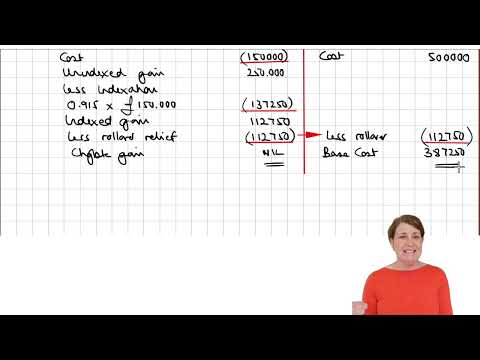
JM Ltd bought a building for use in the trade in October 1994 for £150,000.
The building was sold in March 2026 for £400,000.
In June 2025 JM Ltd had bought some land for use in the trade for £500,000.
The company claims to defer gains whenever possible.
Calculate the chargeable gain on the disposal of the building and the base cost of the land.
The indexation factor from October 1994 to December 2017 is 0.915.
Show answerHide answer
A Ltd bought land for use in the trade in May 2003 for £200,000.
The land was sold in March 2025 for £350,000.
In September 2026 A Ltd bought a factory for use in the trade for £335,000.
The company claims to defer gains whenever possible.
Calculate the chargeable gain on the disposal of the land and the base cost of the factory.
The indexation factor from May 2003 to December 2017 is 0.532.
Show answerHide answer
2 Depreciating assets
2.1 Definition
An asset with an expected life of a maximum 60 years
Fixed plant and machinery
Note: You will only be examined on fixed plant and machinery and leasehold property with a life of 60 years or less.
2.2 Effect
If the new asset is a depreciating asset:
The indexed gain deferred is not deducted from the cost of the new asset
Instead it is postponed until the earliest of:
the disposal of the new asset
the date the new asset ceases to be used in the trade
10 years after the new asset was acquired
YR Ltd bought land for use in the trade in April 1998 for £200,000. The land was sold for £350,000 in May 2019. In March 2020 YR Ltd bought fixed plant for use in the trade, costing £390,000.
YR Ltd sold the fixed plant in February 2026.
YR Ltd has a year end of 31 March.
The indexation factor from April 1998 to December 2017 is 0.710.
Calculate the chargeable gains as far as the above information allows for the years ending 31 March 2020 and 31 March 2026.
Show answerHide answer
When the replacement asset is a depreciating asset, the gain is deferred as in (b) above. However, if a non-depreciating asset is purchased before the deferred gain crystallises, the original gain may be rolled over against the cost of the new, non-depreciating asset and will only crystallise on sale of the non-depreciating asset.
Roll over relief is the only relief available to a company and is often examined in TX. Ensure that you fully understand the rules, the conditions and how it works.
You may have to write out the rules as well as calculate gains to make sure you can do this for easy marks, as follows:
Mighty Ltd has been offered £160,000 for a freehold factory that it owns, and is now considering disposing of the factory. The company acquired the factory on 15 March 1984 and it now has an indexed cost (cost plus indexation) of £120,000. The factory has always been used in Mighty Ltd's trade.
Explain the chargeable gains implications of each of the following alternative courses of action that Mighty Ltd is considering taking to replace the factory if sold:
1. Acquiring a larger freehold factory for £170,000.
2. Acquiring a smaller freehold factory for £155,000 and using the remainder of the proceeds as working capital.
3. Using the proceeds to pay a premium of £180,000 for a 40-year lease of a new factory (it is possible that a freehold warehouse will also be bought in the next two or three years for an estimated cost of £200,000).