
Capital Gains Tax – Individuals – Reliefs


1 Introduction
Reliefs from capital gains tax are important. Some reliefs:
- reduce the rate at which tax is paid on the gain;
- defer the gain and therefore the payment of the tax;
- exempt some or all of the gain from tax.
The main reliefs include:
Business Asset Disposal Relief (BADR)
Investors' relief
Replacement of business asset relief (Rollover relief))
Gift (holdover) relief (GR)
Private Residence Relief (PRR) and letting relief.
2 Business Asset Disposal Relief (BADR)
2.1 Introduction
This relief is available for individuals disposing of a business or a part of a business that is capable of separate operation.
The relief covers the first £1 million of qualifying gains that an individual makes during their lifetime. This qualifying gains are taxed at a capital gains tax rate of 14% (up to the lifetime limit) regardless of a persons taxable income, with any excess gains being charged at 24%.
The rates for BADR and Investors relief are given to you in the tax tables:
Lifetime Limit | - Business Asset Disposal Relief | £1,000,000 | |
- Investors' Relief | £1,000,000 | ||
Rate of tax | 14% |
2.2 Conditions
The business must have been owned for 2 years prior to the date of disposal
The relief is available on:
A disposal of the whole or part of a business run as an unincorporated business (sole trader or partnership). The relief is not therefore available if a trader simply disposes of an asset that is used in the trade (but see next point on sale of assets post cessation of trading) The assets must be used for the purpose of the business, so the relief is not available on investments.
Individual business assets of the individuals’ or partnerships’ trading business that has now ceased. Note the disposal of assets must take place within three years of the cessation of trade.
The disposal of shares in a trading company where the individual has at least a 5% shareholding in the company AND is also an employee (part time or full time) of the company for the 2 years prior to disposal.
F five percent
T trading company
T two years both ownership of the shares and
W worked for company prior to disposal
There is no restriction of the relief if the company owns investments. The company is either a trading company or it is not, there is no apportionment of the gain eligible for relief.
2.3 Time limit for claim
The relief must be claimed by 31 January which is nearly two years following the end of the tax year in which the disposal is made. Thus for 2025/26 by 31 January 2028.
On 30 September 2025 Daisy sold a business that she had ran as an unincorporated trade since February 2014. The sale resulted in the following capital gains and capital losses on the disposal of the business assets:
£
Goodwill | 250,000 |
Factory | 320,000 |
Warehouse | (90,000) |
In December 2025 Daisy also sold her 20% shareholding in Bed Ltd, an unquoted trading company. Daisy had been an employee of Bed Ltd from the date she acquired the shares in July 2016. The gain arising was £370,000.
Calculate Daisy’s Capital Gains Tax liability for 2025/26.
Show answerHide answer
2.4 Further points
The gains qualifying for business asset disposal relief are deemed to firstly use any amount of unused basic rate band.
The AEA and any capital losses should be deducted firstly from gains that do not qualify for business asset disposal relief as they are taxed at a higher CGT rate (18% or 24%).
Where the £1 million lifetime limit is exceeded, gains in excess of the limit will be subject to the normal rates of CGT.
The easiest approach in dealing with questions that include gains qualifying for business asset disposal relief and gains that do not qualify is to keep the gains separate.
Anne sold her shareholding in Annie Ltd, a trading company, for £500,000 in 2025/26. The shares had cost her £50,000 in July 1993. She owned 100% of the shares in Annie Ltd and had been a full time director since the date of acquisition. She had not previously made any disposals qualifying for business asset disposal relief.
In addition she sold an antique painting realising a capital gain of £100,000.
Anne had capital losses brought forward of £25,000 from 2024/25 and her taxable income for 2025/26 was £18,000.
Calculate Anne’s Capital Gains Tax liability for 2025/26.
Show answerHide answer
3 Investors’ Relief
Investors' relief applies to external investors in trading companies which are not listed on the stock exchange; i.e. unquoted/unlisted companies.
Investors' relief has its own separate £1 million lifetime limit and qualifying gains are taxed at 14%.
Qualifying shares must:
Have been subscribed for by the individual on or after 17 March 2016 in an unquoted trading company and held for a minimum period of 3 years from 6 April 2016.
Unlike business asset disposal there is no minimum level of shareholding required and the shareholder must not have been an employee or director of the company (other than an unpaid director).
The mnemonic STUNT can be used to remember the conditions:
S subscribed for on or after 17 March 2016
T trading company
U unquoted/unlisted
N not worked for the company
T three year ownership period from no earlier than 6 April 2016
On 20 October 2025 Ashley sold 30,000 shares in Toon Ltd, an unquoted trading company, for £375,000 net of selling expenses of £10,000.
Toon Ltd has in issue one million £1 ordinary shares that had been subscribed for at par by the existing shareholders on 1 September 2017. Ashley had subscribed for 40,000 shares, but has never worked for Toon Ltd.
On 3 March 2026 Ashley sold 10,000 shares in Boone plc, a quoted investment company, making a chargeable gain of £7,000. He had bought the shares from a friend in January 2016.
In 2025/26 Ashley had taxable income of £60,000.
Calculate Ashley's Capital Gains Tax liability for 2025/26.
Show answerHide answer
4 Replacement of business assets relief (Rollover Relief)
4.1 Definition
A gain may be ‘rolled over’ (deferred) where it arises on the disposal of a qualifying business asset where the sale proceeds are reinvested in another qualifying business asset within the qualifying time period.
4.2 Qualifying assets
Both the old and new assets must fall into one of the following categories:
Land and buildings
Fixed plant and machinery
Goodwill (of an unincorporated business)
Both the old and new assets must be used in a trade of the vendor.
4.3 The relief
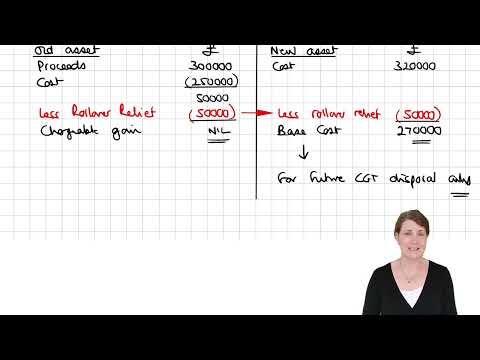
The gain is not taxed immediately but is postponed ('deferred') until the trader makes a disposal of the replacement asset without further replacement.
The postponement is achieved by deducting the gain deferred on the old asset from the cost of the new asset. This reduced cost is used on the future disposal of the new asset.
Where the disposal proceeds of the old asset are not fully reinvested, the gains cannot be fully deferred (see below).
The replacement asset must be bought in the period 12 months before to 36 months after the disposal of the old asset.
Where the disposal of the business assets also qualifies for business asset disposal relief , rollover relief could potentially be claimed on some of the gains and then any remaining gains could be eligible for BADR.
A claim must be made within 4 years from the end of the tax year in which the disposal occurred, so for disposals in 2025/26 by 5 April 2030.
Jones purchased a property for use in his business in March 2008 for £250,000. In August 2025 he sold the property for £300,000 and spent £320,000 in June 2025 on a new business property.
Calculate the gain to be deferred and the base cost of new asset.
Show answerHide answer
Full Rollover relief is only available when ALL the proceeds from the sale of the old asset are reinvested in another qualifying asset.
If only part of the proceeds are reinvested, part of the gain becomes chargeable at the time of disposal, and cannot be deferred.
The amount chargeable is the LOWER of:
the amount not reinvested
the full gain
Jerome bought a factory in June 2006 for £680,000. In August 2025 he sold the factory for £800,000. He moved into a rented factory until January 2026 when he purchased and moved to a new factory.
Assuming that all beneficial claims are made calculate the base cost of the new factory if it was purchased for:
(a) £750,000
(b) £600,000
Show answerHide answer
4.4 Non-business use
Full rollover relief is only available where the asset being replaced (the old asset) was used entirely for trade purposes throughout the trader’s period of ownership.
Where this condition is not met rollover relief is limited to the proportion of business use.
The asset is treated as two separate assets, one that qualifies for relief (the part used in the trade) and another that does not.
The replacement asset must also be used in the trade.
Jake purchased a factory in May 2015 for £540,000 for use in his trade, but let out 15% of the factory. In July 2025 he sold the factory for £600,000 and having bought another factory in June 2025 to be used entirely for business purposes for £650,000 and claimed rollover relief.
(a) What is the chargeable gain arising on the disposal in July 2025?
(b) What is the base cost of the new factory?
Show answerHide answer
5 Reinvestment in depreciating assets
5.1 Definition
Qualifying depreciating assets for rollover relief include fixed plant and machinery and leasehold land and buildings where the lease is for no more than 60 years.
Note: You will only be examined on fixed plant and machinery and leasehold property with a life of 60 years or less.
5.2 Effect
If the replacement asset is a depreciating asset, then:
The gain deferred on the 'old' asset is not deducted from the cost of the 'new' asset.
Instead it is postponed until the earliest of:
the disposal of the new asset
the date the new asset ceases to be used in the trade
10 years after the new asset was acquired.
Business asset disposal relief is only available if any gains remaining after this relief are in relation to the disposal of the whole business.
Charles purchased a freehold factory in May 2011 for £300,000 for use in his trade. In June 2025 he sold it for £500,000 and in May 2025 bought a 55 year leasehold factory building for £600,000.
In February 2026 Charles sold the leasehold factory for £640,000 and moved into rented premises.
Calculate the chargeable gains arising on the disposals of the freehold factory in June 2025 and the leasehold factory in February 2026, assuming Charles claims to defer gains where possible.
Show answerHide answer
5.3 Acquisition of a new non-depreciating asset
If a new non-depreciating asset is acquired before the deferred gain becomes taxable, rollover relief can be claimed on the deferred gain.
The capital gain on the original asset is then rolled over into the new non-depreciating asset and the depreciating asset is, effectively, ignored.
6 Relief for the gift of business assets - gift/holdover relief

6.1 The nature of the relief
The gift of an asset may give rise to a CGT liability for the donor, even though the donor (the person making the gift) has not received any funds with which to pay the tax. The donor is treated as making a disposal of the asset at market value.
Gift holdover relief (GR) allows the gain on the gift of certain assets to be held over (deferred) against the base cost of the asset for the donee.
The donee (the person receiving the gift) is treated as if they acquired the asset at market value less the deferred gain.
As a result:
there is no gain (or a reduced gain) arising on the donor at the time of the gift, as effectively, the donor gives away some or all of the gain along with the asset.
the chargeable gain effectively arises on the donee later (as their base cost is reduced) and will be taxed at the appropriate rate of CGT applicable on the date of that disposal.
David bought an asset for £60,000 in June 2020. In September 2025 he gifted it to his son Tommy, when its market value was £100,000. The asset qualified for gift holdover relief.
Assuming David and Tommy make a claim for gift holdover relief calculate Tommy’s base cost of the asset.
Show answerHide answer
6.2 Interaction with business asset disposal relief
When a claim for gift holdover relief is made, the donor may lose entitlement to business asset disposal relief.
If the asset qualifies, then gift holdover relief, if claimed, is applied before business asset disposal relief.
6.3 Availability of the relief
The relief is only available to individuals not companies.
The relief must be claimed; it is not automatic.
The claim is a joint claim by both the donor and donee and must be made 4 years from the end of the tax year in which the disposal occurred, so for a gift made in 2025/26 the claim must be made by 5 April 2030.
6.4 Qualifying assets
Gift holdover relief may be claimed on the gift of the following assets:
Assets used in the trade of:
the donor (i.e. where he/she is a sole trader or a partnership).
the donor’s personal trading company.
assets owned personally by the individual and used by him in his personal trading company.
Shares and securities of trading companies:
any percentage of shares in a limited company (the shares or securities are not quoted on a recognised stock exchange).
shares or securities in the individual’s personal trading company (quoted shares where the individual owns at least 5% of the voting rights).
Note that unlike BADR, there is no requirement for the individual to work in the personal trading company.
6.5 Sale at undervalue
Gift relief applies to both outright gifts but is also available for sales made at undervalue (i.e.below market value), where there is an element of gift.
The chargeable gain and gift relief calculations are as follows:
The MV at the date of the sale at undervalue is used as the proceeds in calculating the gain (i.e. the actual proceeds received is ignored).
The amount of the gain chargeable is the excess of actual proceeds over original cost. The balance of the gain (if any) is deferred under gift relief.
Therefore, if the actual proceeds received are no more than the original cost of the asset:
gift relief is available in full and none of the gain is chargeable.
If the actual proceeds received are greater than the original cost of the asset:
any excess = chargeable to CGT at the date of the sale at undervalue, and
gift relief available = the remainder of the gain.
Richard acquired a 25% holding in an unquoted trading company in March 2006 for £60,000. He immediately became an employee of the company.
In March 2026 he sold the shares to his son Elliot for £85,000 when their value was £200,000. Richard and his son claimed relief for a gift of a business asset.
(a) What is Richard's Capital Gains Tax liability for 2025/26?
(b) What is the base cost of the shares for Elliot?
Show answerHide answer
6.6 Assets not wholly used for trading purposes
Where only part of an asset is used for trading purposes, or where an asset has been used for only part of the donor’s period of ownership, then gift holdover relief is restricted.
Where the gift is shares (quoted or unquoted) and the individual owns at least 5% of the voting rights, then the capital gain on the shares eligible for relief is calculated by multiplying the gain by the following fraction:
Market value of company’s chargeable business assets (CBA) |
Market value of company’s chargeable assets (CA) |
Note that this treatment is completely different to that which applies for business asset disposal relief. Remember that for business asset disposal relief purposes there is no question of apportionment. A company is either a trading company (and therefore qualifies for the business asset disposal relief) or it is not.
6.7 Chargeable assets (CA) and chargeable business assets (CBA)
Chargeable assets are those assets which would give rise to a chargeable gain or allowable loss on disposal (excludes cars, stock, debtors and cash which are exempt from CGT) held by the company, including both those used in the business and those held as investments.
Chargeable business assets are those chargeable assets that are used for the purposes of a company’s trade only and excluding investments such as shares or properties that are let out to tenants.
Johan owns 100% of the shares in Johan Ltd of which he is the managing director. On 1 December 2025 he made a gift of the shares to his son when the market value of the shares was £800,000. The shares cost £200,000 in February 2003. At the time of the gift Johan Ltd owned the following assets.
£ | |
Freehold trading premises | 500,000 |
Goodwill | 200,000 |
Investments | 100,000 |
Stock and work in progress | 150,000 |
Debtors | 80,000 |
Cash | 170,000 |
1,200,000 |
Calculate Johan's Capital Gains Tax on disposal of the shares in Johan Ltd and base cost of the shares for his son.
Show answerHide answer
7 Private Residence Relief

7.1 The sale of an individual's only or main private residence is covered by Private Residence Relief (PRR) The relief also covers grounds up to half a hectare.
The relief is available in full if the taxpayer occupied the property throughout the entire period of ownership. Where occupation has been for only part of the period, only a proportion of the gain is covered by the relief, as follows:
Gain × | Period of occupation |
Period of ownership |
7.2 There are however, periods of absence which are deemed to be full occupation. They include:
Last 9 months of ownership if the property was the individual's main residence at some point in time.
Any period during which the individual was required by his employment to live abroad.
Any period up to four years during which the individual is required to live elsewhere in the UK due to employment or self employment
Up to three years for any reason.
Points (b – d) must be preceded and followed by periods of actual occupation, but for points (b – c) if the individual could not reoccupy due to the terms of employment requiring them to work elsewhere, by concession, the condition of actual occupation following the period of absence is relaxed.
Where there has been a period of absence:
Calculate the gain on the disposal of the property.
Compute the total period of ownership.
Calculate the periods of deemed and actual occupation (see below).
Calculate the PRR exemption as follows:
Gain × Periods of occupation/Total period of ownership.
Then consider letting relief, if applicable (see below).
7.3 Business use
Where part of a residence is used exclusively for business purposes throughout the period of ownership, the gain in relation to that part is not covered by relief.
If part of the residence was only used for business purposes for some of the period of ownership, the last 9 months of deemed occupation will still be given in full.
7.4 Letting relief
Letting relief is available to cover any gain not covered by PRR if part of the property is rented out while the remaining part is being occupied by the taxpayer. Letting relief does not apply when the property is rented out in its entirety for a period of time during the period of ownership and does not apply to properties that are let out throughout the period of ownership.
Letting relief is the lower of:
£40,000
gain attributable to letting (gain × periods of letting/total period of ownership)
PRR given (i.e. the letting relief can never be greater than the PRR)
David bought a house on 1 April 2000 for £10,000. He lived in it until 30 June 2000 when his employer sent him to work overseas for 2 years but moved back into the house on his return to the UK on 1 July 2002. He lived in the house until 31 December 2008 before leaving to live and work elsewhere in UK. David did not return to the house, which was let to tenants until it was sold on 30 June 2025 for £150,000.
Calculate the chargeable gain arising.
Show answerHide answer
Dora bought a three-storey house on 1 November 2014 for £160,000. She occupied the whole of the house until 1 May 2020 when she let out the top floor to a tenant up to when she sold the house for £420,000 on 1 May 2025.
Calculate the chargeable gain arising.
Show answerHide answer
As the calculation for Capital Gains Tax is simple - Proceeds - cost = Gain, the examiner, while asking the basics, will want to test your ability to mitigate or reduce an individual's liability to tax with the reliefs covered in this chapter.
Section A - MCQ - may be as follows:
Section B/C questions - capital gains will be a part of these questions. You will have to calculate gains, but then you may have to deal with a relief. The question may be completely about CGT or may include an element of IHT (see later chapters) or even IT. Be aware that the TX (UK) exam may have multiple tax questions in Section C particularly.
Learn the rules in case you have to write them out.
This is a very important chapter.