
Capital Gains Tax – Individuals


1 Individuals and Companies
Individuals are subject to Capital Gains Tax (CGT) on their chargeable gains arising in the tax year.
The chargeable gains of a company however, are included on the company’s Corporation Tax computation along with its taxable income and the company’s overall taxable total profits are then subjected to Corporation Tax, as you will see later in these course notes.
A chargeable gain or allowable loss arises on a:
chargeable disposal of a
chargeable asset by a
chargeable person.
The basic calculation of the chargeable gain is a simple one, deducting the allowable costs of an asset from its proceeds when it is sold. A company (NOT an individual) may then further reduce any gain for the effects of inflation by the deduction of an 'Indexation Allowance' - a relief for the effects of inflation.
1.1 Chargeable Disposal
A chargeable disposal will usually occur on the sale of whole or part of an asset, but can arise when an asset is gifted, lost or destroyed. There is no chargeable disposal on gifts to charities, or upon the death of the taxpayer, when assets will pass free of CGT to the beneficiaries at their market (probate) value.
1.2 Chargeable Assets
All assets are chargeable unless specifically exempt.
Exempt assets include:
Motor vehicles suitable for private use
National Savings Certificates and premium bonds
Foreign currency for private use
Decorations awarded for bravery
Damages for personal injury
Life insurance policies
Works of art given for national use
Gilt edged securities (Government Securities such as Exchequer Stock)
Qualifying Corporate Bonds (Corporate loan stock)
Certain chattels (see later)
Investments held in an ISA
Stock, debtors and cash of a business
1.3 Chargeable Person
An individual who is resident in the UK is a chargeable person and is liable to CGT on their worldwide assets.
1.4 CGT computation
A chargeable (or capital) gain or allowable (capital) loss of an individual is computed for each individual asset disposed of in the tax year as follows:
Disposal consideration (proceeds of sale) | X |
Less: selling expenses | (X) |
Net proceeds | X |
Less: allowable expenditure (costs) | (X) |
Capital gain / (Capital loss) | X / (X) |
The disposal consideration is usually the proceeds received on the sale of the asset.
However, market value must be substituted for actual proceeds where:
a disposal is not made at arm’s length (e.g. a gift)
the disposal is to a connected person (e.g. close relatives (parents, siblings and children)).
The selling expenses or incidental costs of disposal (e.g. auctioneer’s fees, estate agent fees and legal costs) may be deducted from the consideration to give net proceeds.
When quoted shares are gifted the value may not be given in the exam and should be calculated as the mid price based on the day’s quoted prices given in the question.
Jenny gifted 1,000 shares in M plc when they were quoted at 400p - 408p
Calculate the value to be used for capital gains disposal proceeds
Show answerHide answer
The following types of allowable expenditure may be deducted from net proceeds:
The acquisition cost of the asset:
generally the purchase cost.
if the asset was inherited, the probate value (i.e. the market value at the date of the death).
if the asset was received as a gift, the market value at the date of the gift.
Capital expenditure on enhancing the value of the asset e.g. extensions, associated architect’s fees etc.
Incidental costs of acquisition may include legal fees, surveyor’s fees, stamp duty.
A capital loss will arise if the total allowable costs exceed the net proceeds.
Once the gain or loss on each individual asset sold has been calculated, then it is necessary to calculate the net chargeable gains arising in the tax year; i.e. chargeable gains less allowable losses as follows:
£ | |
Capital gains in tax year | X |
Less: Capital losses in tax year | (X) |
Net chargeable gains in tax year | X |
Less: AEA | (3,000) |
X | |
Less Capital losses b/f | (X) |
Taxable Gains | X |
CGT × 18% / 24% | X |
Capital Gains Tax liability | X |
1.5 Annual Exempt Amount (AEA)
Every individual (not a company) has an exempt amount for each tax year. For 2025/26 it is £3,000.
If the annual exempt amount is not used it is wasted.
1.6 Rates and payment of CGT
Rates of tax: | |||
– Lower rate | 18% | ||
– Higher rate | 24% |
The rate of CGT depends on the basic rate band remaining after an individual’s taxable income.
A CGT rate of 18% is applied on those taxable gains that fall into any remaining basic rate band (or extended basic rate band if the person makes gift aid donations and/or pays personal pension contributions).
Once there is no basic rate band remaining, the rate increases to 24% on the excess.
In exam questions, income tax should be calculated first, and capital gains tax calculated separately afterwards (if the question requires it).
Payment of capital gains tax
Payment of CGT is generally due in full by 31 January following the end of the tax year (i.e. 31 January 2027 for the tax year 2025/26).
For UK residential property, the CGT is due within 60 days of completion (more detail is given later in this chapter).
Tina sold a painting on 1 July 2025 for £500,000. She purchased the painting in February 1998 for £350,000.
She also disposed of a commercial investment property for £310,300 on 1 December 2025 and incurred legal fees of £15,000 on the disposal. She had purchased the property in August 1999 for £200,000.
In addition she sold an antique vase for £10,000 in January 2026 which had cost her £15,000 in September 2023.
Tina had capital losses brought forward from previous tax years of £15,000. Tina’s taxable income for 2025/26 is £50,000.
Calculate Tina’s Capital Gains Tax liability for 2025/26.
Show answerHide answer
In 2025/26 Matthew has trading profit of £20,000 and sold an antique vase giving rise to a capital gain of £15,300.
Calculate Matthew’s Capital Gains Tax liability for 2025/26.
Show answerHide answer
In 2025/26 Elliot has trading profit of £45,270 and sold a painting giving rise to a capital gain of £23,300.
He made a gift aid payment of £2,400 in 2025/26.
Calculate Elliot’s Capital Gains Tax liability for 2025/26.
Show answerHide answer
Gaynor had a trading profit assessment of £21,770 in 2025/26 and no other taxable income. She sold two assets during the tax year, a residential investment property on 1 July 2025 giving rise to a chargeable gain of £27,300 and a diamond ring in January 2026 which gave rise to a chargeable gain of £12,000.
Calculate Gaynor’s Capital Gains Tax liability for 2025/26 and state the due date(s) for payment.
Show answerHide answer
2 Losses
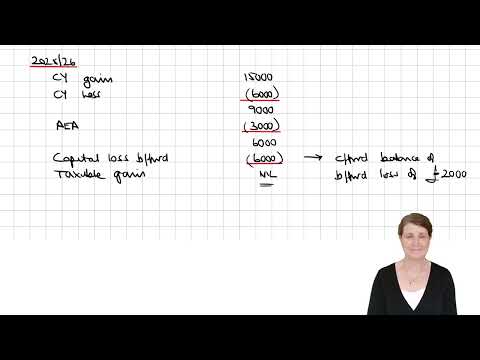
Where capital losses arise they are set against capital gains in the same tax year.
The current year losses set off is made to the maximum possible extent; it cannot be restricted to avoid wasting the Annual Exempt Amount (AEA).
If there are insufficient gains to set off against the capital losses in the year they arise, the unrelieved capital losses will be carried forward to offset against future capital gains.
If net gains do arise then the AEA is then deducted from any net chargeable gains of the tax year, but if the AEA is larger than the chargeable gains the remaining AEA is lost. The capital losses brought forward are then deducted after the AEA and therefore will not waste the AEA.
Any capital losses brought forward that are unused are carried forward.
Fiona and Jane made capital gains and capital losses for the years 2024/25 and 2025/26 as set out below:
Fiona | Jane | ||
2024/25 | |||
Capital gains | 14,000 | 7,000 | |
Capital losses | 12,000 | 15,000 | |
2025/26 | |||
Capital gains | 17,000 | 15,000 | |
Capital losses | 4,200 | 6,000 |
Calculate the taxable gains for Fiona and Jane for both tax years and the amount of any losses carried forward at the end of 2025/26.
Show answerHide answer
3 Transfer of assets between a husband and wife or between civil partners
For Capital Gains Tax purposes, the transfer of assets between spouses or civil partners will always be deemed to take place at a value that would give rise to neither a gain nor a loss; this is not an election, it is a rule. Actual proceeds and/or market value are ignored.
The transfer is said to be a no gain/no loss transfer. Essentially the transferor is deemed to make the disposal at cost and the transferee acquires the asset at the original cost of the transferor.
The no gain/no loss transfer rules may be advantageously used by these taxpayers to utilise the AEA of both parties, and to take advantage of capital losses and lower capital gains tax rates. For example, it would be better for each spouse to have taxable gains of £10,000 each rather than one spouse have taxable gains of £20,000. It would also be better for a basic rate taxpayer to have taxable gains, taxed at 18% instead of a higher rate taxpayer who would be taxed at 24% on the same gains.
Gollum bought a ring in July 1995 for £12,000. He transferred it to his civil partner Frodo in December 2025 when its market value was £20,000. Frodo then sold the ring in January 2026 for net proceeds of £20,000.
Calculate any capital gain for Gollum or Frodo in 2025/26.
Show answerHide answer
4 Part Disposals
A chargeable gain may arise if only part of an asset is disposed of.
For example, if a taxpayer acquires 100 hectares of land and subsequently sells 40 of those hectares, this will give rise to a chargeable gain but a specific problem arises regarding what figure of cost should be used in the gains calculation.
The cost of the whole asset is multiplied by the following fraction to compute the allowable cost of the part now sold:
A |
A + B |
where:
A = Gross proceeds of part disposed
B = Market value of the remainder of the asset at time of disposal (this will be given in the question)
Stanley owned 10 hectares of land which originally cost £24,000 plus legal fees of £2,000 in March 2022. He sold 2 hectares of the land in December 2025 for £16,000, incurring legal fees of £1,200.
The remaining 8 hectares were valued at £34,000 in December 2025.
Calculate the chargeable gain on the disposal of the 2 hectares of land in December 2025.
Show answerHide answer
5 Chattels

A chattel is a tangible moveable asset.
A wasting chattel is one with an estimated life of 50 years or less. These are exempt assets. Examples include racehorses, greyhounds (dogs), yachts (boats), caravans, machines.
There is an exception for plant & machinery on which capital allowances have been claimed, these assets are treated as non wasting chattels. If plant and machinery is not covered by the non-wasting chattel exemption in note (d) below, then a gain would need to be computed upon its disposal. Such a calculation is seldom required however as it would normally be sold for much less than cost. A capital loss will not however arise in this situation as capital allowances will already have given tax relief for the net cost of the asset.
A non-wasting chattel is one with an estimated life of more than 50 years. Examples include antiques and paintings. There are special rules to determine the chargeable gain or capital loss as follows:
Cost | Proceeds | Treatment |
|---|---|---|
≤ £6,000 | ≤ £6,000 | Exempt |
≤ £6,000 | > £6,000 | Normal calculation but the gain is restricted to a maximum 5/3 x (Gross proceeds – 6,000) |
> £6,000 | <£6,000 | Deemed Gross Proceeds = £6,000 |
> £6,000 | > £6,000 | Normal calculation of the gain or loss |
Jonah sold the following assets in 2025/26:
(a) an antique table which cost £3,000 in February 2019 and sold for £5,000
(b) a painting which cost £2,000 in January 2022 and sold for £10,000. Selling costs were £500.
(c) an antique vase which cost £8,000 in June 2004 and sold for £3,000. Selling costs were £100.
(d) a vintage car which had cost £7,000 in July 2001 and was sold for £9,000
Calculate Jonah's net chargeable gains in 2025/26.
Show answerHide answer
6 Other wasting assets (that are not chattels)
An example of a wasting asset which is not a chattel is a copyright.
The allowable expenditure is deemed to waste away over the life of the asset on a straight line basis.
When a disposal is made, the allowable expenditure is restricted to take account of the assets natural fall in value. This fall in value is deemed to occur on a straight line basis over its predictable useful life.
On 1 December 2011 Zahir bought a 30-year copyright for £24,000.
He sold it for £38,000 on 1 December 2025.
Calculate the chargeable gain arising on the sale of the copyright in December 2025.
Show answerHide answer
7 Payments on account for CGT on disposal of residential property
Earlier in this chapter we learned that the CGT liability for a tax year was payable by the 31st January following the end of the tax year, so for 2025/26 any CGT payment must be made by 31st January 2027.
A payment on account however, along with a return to HMRC, must be made within 60 days of the disposal of a residential property.
In computing the payment on account the following deductions should be made from the gain:
Any current tax year capital losses incurred prior to the property disposal
The AEA of the tax year
Any capital losses b/f at the start of the tax year
It will also require an estimate of how much, if any, of the taxpayer’s basic rate band will be available for the tax year – this information will be provided in the exam.
The chargeable gain will then also be included in the normal self assessment CGT computation for the tax year with any payment on account then being deducted in deriving the final CGT liability to be paid by the normal due date of 31 January following the tax year.
Illustration
Lee is a higher rate taxpayer and during 2025/26 made the following chargeable disposals:
10 May 2025 | A gain of £22,500 on the disposal of a painting |
8 July 2025 | A loss of £12,300 on the disposal of shares |
31 October 2025 | A gain of £64,500 on the disposal of a residential property |
20 January 2026 | A loss of £11,000 on the disposal of shares |
Calculate Lee's Capital Gains Tax liability for 2025/26, stating the amount of the payments and the dates by which they should be paid.
Answer
As a residential property was sold on 31 October 2025, a payment on account will be required to be made by 30 December 2025 and will be computed as follows:
£ | ||
Residential property gain 31 October 2025 | 64,500 | |
Less: | Capital loss 8 July 2025 | (12,300) |
AEA 2025/26 | (3,000) | |
Taxable gain | 49,200 | |
Taxed @ 24% | 11,808 | |
The additional CGT due by 31 January 2027 will be computed as follows:
£ | ||
Residential property gain | 64,500 | |
Other gains | 22,500 | |
Losses (£12,300 + £11,000) | (23,300) | |
AEA 2025/26 | (3,000) | |
Taxable gains | 60,700 | |
Taxed @ 24% | 14,568 | |
The additional CGT due is therefore: £14,568 - £11,808 = £2,760.
In attempting Section A or Section B/C questions on calculations of CGT it is EVEN MORE important than ever to ensure that you read and understand the information provided in the question, for example:
Does the question give you the figure of taxable gains (which is after deducting any capital losses and AEA), or does the question just tell you the chargeable gains and you have to then compute the taxable gains?
Does the question give you the taxable income of the taxpayer for the tax year or are you simply provided with income figures that require you to deduct the personal allowance of the taxpayer to compute the taxable income?
In addition read carefully the requirement of the question to ensure that you are actually answering the correct requirement, for example:
Does the requirement actually ask you to calculate the CGT liability of the taxpayer or simply to compute the taxable gains of the taxpayer?
Does the requirement ask you to compute the taxable gains (after AEA and losses b/f) or simply the chargeable gains (before AEA and losses b/f)?
Do NOT rush into calculations before you have properly understood the requirement of the question and the information given in the question!
Capital Gains tax is occasionally examined alongside Inheritance Tax in preparation for the ATX-UK exam. You may also be required to advise on reliefs and ways to minimise the liability to CGT (see later chapters)
A Section A MCQ might look as follows: