
Current issues and Sustainability


1 Making Materiality Judgements (IFRS Practice Statement)
Note the definition of material:
Information is material if omitting, misstating or OBSCURING it could reasonably be expected to influence decisions of the primary users of financial statements.
Learn the 4 steps that an entity should follow in assessing what is material for inclusion in the financial statements.
Identify information that may be material for primary users – providers of finance.
Assess whether this information is actually material by size or nature.
Present the information clearly and concisely.
Stand back and look at the information as a whole to see what may need to be added or deleted.
2 Accounting for a natural disaster / global event
Recent events have taught us that a natural disaster, such as a pandemic, can have far-reaching implications for the financial statements.
A scenario question may ask you to consider the impact of such an event. Examples of standards which would be relevant are set out below. (You may be able to think of other standards that are relevant).
IAS 1 Presentation of financial statements
It is possible that there are going concern issues:
If the entity is now insolvent, the financial statements will have to be prepared on a break-up/liquidation basis;
If (as is more likely) the business is not yet insolvent, but faces going concern uncertainties, appropriate disclosures must be made in the notes to the financial statements.
IAS 2 Inventories
If products cannot be sold then net realisable value may be less than cost.
IAS 20 Accounting for government grants and disclosure of government assistance
In the event of government support being received (e.g., the furloughing of employees), the benefit of such support must be matched to the underlying expenses in the profit and loss account.
IAS 36 Impairment of assets
A global catastrophe is clearly an impairment indicator. The entity must calculate the recoverable amount of the relevant cash generating units, and any loss would normally be recognised in the profit and loss account.
IAS 37 Provisions, contingent liabilities and contingent assets
Businesses may need to reorganise: if redundancies are necessary, provisions should be recognised if there is a constructive obligation (detailed plan communicated to those affected before the reporting date).
IFRS 9 Financial instruments
Bad debts may be inevitable. If, for example, these are regular trade receivables, the business must make an allowance for total expected credit losses. (Remember that the complex ‘three stage model’ applies to loan assets but not to trade receivables).
3 Accounting issues – climate change
3.1 Introduction
The IASB Foundation set up a body known as the International Standards Sustainability Board (ISSB).
Membership is global with members from Africa, America, Asia-Oceania and Europe. Thus, the ISSB is not dominated by the views of one country (or continent).
The ISSB is developing IFRS Sustainability Disclosure Standards.
Two standards have been issued and these are summarised below.
3.2 IFRS S1 STANDARD – DISCLOSURE OF SUSTAINABILITY-RELATED FINANCIAL INFORMATION
OBJECTIVE
To require an entity to disclose information about its sustainability-related risks and opportunities that is useful to primary users of financial statements in making decisions relating to providing resources to the entity.
SCOPE
An entity may apply IFRS Sustainability Disclosure Standards whether or not its financial statements are prepared in accordance with IFRS.
CONCEPTUAL FOUNDATIONS
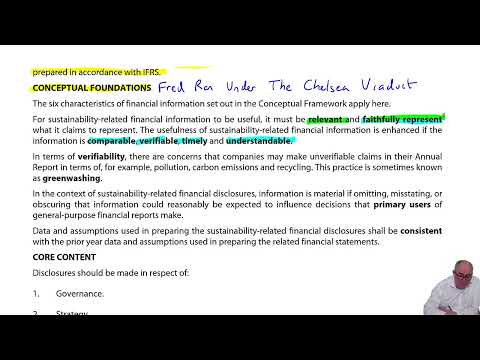
The six characteristics of financial information set out in the Conceptual Framework apply here.
For sustainability-related financial information to be useful, it must be relevant and faithfully represent what it claims to represent. The usefulness of sustainability-related financial information is enhanced if the information is comparable, verifiable, timely and understandable.
In terms of verifiability, there are concerns that companies may make unverifiable claims in their Annual Report in terms of, for example, pollution, carbon emissions and recycling. This practice is sometimes known as greenwashing.
In the context of sustainability-related financial disclosures, information is material if omitting, misstating, or obscuring that information could reasonably be expected to influence decisions that primary users of general-purpose financial reports make.
Data and assumptions used in preparing the sustainability-related financial disclosures shall be consistent with the prior year data and assumptions used in preparing the related financial statements.
CORE CONTENT
Disclosures should be made in respect of:
Governance.
Strategy.
Risk management; and
Metrics and targets.
Disclosures on governance will enable users to understand the governance processes, controls and procedures an entity uses to monitor, manage and oversee sustainability-related risks and opportunities. Examples would be:
how and how often the board is informed about sustainability-related risks and opportunities.
how the board oversees the setting of targets related to sustainability-related risks and opportunities.
Disclosures on strategy will enable users to understand an entity’s strategy for managing sustainability-related risks and opportunities. Examples would be:
a description of the current and anticipated effects of sustainability-related risks and opportunities on the entity’s business model.
the effects of sustainability-related risks and opportunities on the entity’s financial position, financial performance and cash flows for the reporting period (current financial effects).
Disclosures on risk management will enable users to understand an entity’s processes to identify, assess, prioritise and monitor sustainability-related risks and opportunities. Examples would be:
whether and how the entity prioritises sustainability-related risks relative to other types of risk.
whether and how the entity has changed the processes it uses compared with the previous reporting period.
Disclosures on metrics and targets will enable users to understand an entity’s performance in relation to its sustainability-related risks and opportunities. Examples would be:
how the metric is defined.
whether the metric is validated by a third party and, if so, which party.
GENERAL REQUIREMENTS
An entity shall report its sustainability-related financial disclosures at the same time as its related financial statements. The entity’s sustainability-related financial disclosures shall cover the same reporting period as the related financial statements.
An entity whose sustainability-related financial disclosures comply with all the requirements of IFRS Sustainability Disclosure Standards shall make an explicit and unreserved statement of compliance. An entity shall not describe sustainability-related financial disclosures as complying with IFRS Sustainability Disclosure Standards unless they comply with all the requirements of IFRS Sustainability Disclosure Standards.
JUDGEMENTS UNCERTAINTIES AND ERRORS
An entity shall disclose information to enable users to understand the judgements made and uncertainties considered in the process of preparing its sustainability-related financial disclosures.
An entity shall correct material prior period errors by restating the comparative amounts for the prior period(s) disclosed unless it is impracticable to do so.
3.3 IFRS S2 STANDARD – CLIMATE-RELATED DISCLOSURES
OBJECTIVE
To require an entity to disclose information about its climate-related risks and opportunities that is useful to primary users of financial statements in making decisions relating to providing resources to the entity.
SCOPE
The Standard applies to climate-related risks to which the entity is exposed, and climate-related opportunities available to the entity.
Climate-related risks may be physical or transition.
Physical risks arise, for example, from adverse climate-related events such as fires and floods.
Transition risks arise as economies transition to less carbon usage (e.g. the move from diesel to electric cars).
CORE CONTENT
Disclosures should be made in respect of:
Governance.
Strategy.
Risk management; and
Metrics and targets.
The content of IFRS S2 is similar to S1, but it makes reference to climate-related (as opposed to sustainability-related) issues throughout.
However, it would be worth learning a few of the specific climate-related metrics:
Gross greenhouse gas emissions (metric tonnes of carbon dioxide).
Amount of capital expenditure on climate-related risks and opportunities.
Percentage of executive remuneration linked to climate-related considerations.
Learning the metrics is only half the work: the exam gives a draft disclosure to critique. Ask whether each metric is defined and its measurement basis explained, whether it has been validated externally, and whether targets are set, monitored and reported against actual performance. Vague narrative and missing methodology are marks waiting to be claimed.
3.4 FINALLY – A NOTE ABOUT EUROPEAN STANDARDS
The European Union has produced a set of sustainability standards known as the European Sustainability Reporting Standards (ESRS). You are expected to understand the principal differences. Examples are:
IFRS Sustainability Standards are intended only for primary users of the financial statements whereas ESRS are for a far wider range of stakeholders.
There are significantly more ESRS than IFRS Sustainability Standards.
ESRS apply a concept known as ‘double materiality’:
Financial materiality which would impact investor decisions.
Impact materiality which would consider the impact of the company on people or the environment.
IFRS S1 and S2 use a single, investor-focused test: financial materiality. The European standards use double materiality, adding impact materiality — the company’s effect on people and the environment. Asked how the two approaches differ, describe both limbs; describing the IFRS test alone does not answer the question.
Relevant examiner articles on the ACCA (students) website:
Cryptocurrencies
Climate change and IFRS Accounting Standards
IFRS Sustainability Disclosure Standards
4 Employability and Technology Skills
4.1 Introduction
The ACCA has introduced this new section into the syllabus for all of the Applied Skills and Strategic Professional examinations now that all the examinations in all locations will be computer based.
However, it does not require the same sort of learning as for other syllabus areas because it is primarily focused on ensuring that students are capable of using the Computer Based Exam software.
The level of skill needed to be able to use the CBE software can also be beneficial for your employment.
Many students will already have a high level of skill on computers and be familiar with the use of word processors and spreadsheets. However, those provided in the exam software might not be identical to those that you are familiar with and, in addition, it is essential that you are able to navigate the software efficiently so as not to waste time in the exam.
There are many excellent resources available on the ACCA website to assist you, and so in this chapter we will direct you to some of the relevant ACCA pages and explain their importance.
4.2 Navigating the exam and the tools available
The exam screen has a top bar and a bottom bar.
On the top bar there are options to call up an ‘online calculator’, to call up the ‘scratch pad’, and to ‘flag for review’.
The online calculator is used in the normal way and can be switched at any time between a basic mode and a scientific mode. You can use your own calculator instead provided that it does not store or display text.
The scratch pad can be used to make notes and do your own rough workings, but nothing written on the scratchpad will actually be marked. You will also be provided with paper if sitting the exam in an exam centre and so you can use this for workings instead - the paper will be collected in at the end of the exam but, again, nothing on this rough paper will be marked. (Note: if you are sitting the exam remotely then paper is not allowed and you can only use the scratchpad.)
The ‘flag for review’ option enables you to put a mark against a question to enable you to quickly come back to it again later. This is for questions where you are unsure about your answer and want to do more work on it later should there be time.
On the bottom bar are the arrows for moving forwards or backwards through the questions. In addition, there is a ‘navigator’ option which when chosen displays a list of all of the questions enabling you to go straight to a particular question.
You can watch a video illustrating the use of all these features by visiting the following page:
and clicking on the link to “CBE workspace management video”.
4.3 Section A of the exam
Question 1 requires a mix of calculations and explanations. You should make use of both the spreadsheet and word processor.
In Question 2 it is likely that you will only need to use the word processor.
Details of the functions available such as underlining and ‘copy and paste’ are in the ACCA booklet.
4.4 Section B of the exam
This section comprises two 25-mark questions and each question will contain a combination of calculation and written parts. The emphasis will be on explanations.
As with Section A you will be provided with a word processor and a spreadsheet. You may find that you do not need the spreadsheet in one or both of these questions.
4.5 ACCA Resources
You will find many resources on the ACCA website and the more you refer to them the better.
Go first to the following page:
https://www.accaglobal.com/gb/en/student/exam-support-resources/professional-exams-study-resources/strategic-business-reporting/introduction.html Introduction to Strategic Business Reporting | ACCA Global
On this page, under the heading “Resources” you will find a link to download “SBR essentials on one page”. Clicking on this will download a useful small chart headed up “How to approach Strategic Business Reporting”. One of the headings on this chart is ‘Links to support resources’ and clicking on each of the items listed in turn will take you to more detail. Each of these ‘Key Resources’ is worth reading.
In addition, it is important to visit the following page:
On this page you will find useful information, but also towards the bottom of the page you will find a link to “CBE Guidance Document”. This will download a leaflet which details everything about the CBEs including, importantly, a list of the functions and formulae available in the spreadsheet and the word processor (and how to input the formulae in the spreadsheet).
On the same webpage, there is information on how to access the CBE specimen and practice exams - it is essential to use these resources in your exam preparation.
4.6 Revision Kit Live
On our main Paper SBR page you will find a link to a section called ‘Revision Kit Live’ in which you will find lectures working through several past exam questions. It includes a lecture working through the whole of question 1 from a computer-based exam, not just explaining the answers but importantly the approach to CBE.