
Strategic planning models


1 What is a ‘strategic plan’?
The term ‘strategic plan’ typically refers to a long-range plan (at least three years, and often for five or longer) affecting the whole of the organisation. It should be addressing the questions of what the organisation will be doing and what it will look like in terms of size and structure in, say, five years. Some organisations use the alternative names of ‘long range plan’ or ‘corporate plan’ instead of ‘strategic plan’.
2 The rational model
2.1 Diagram
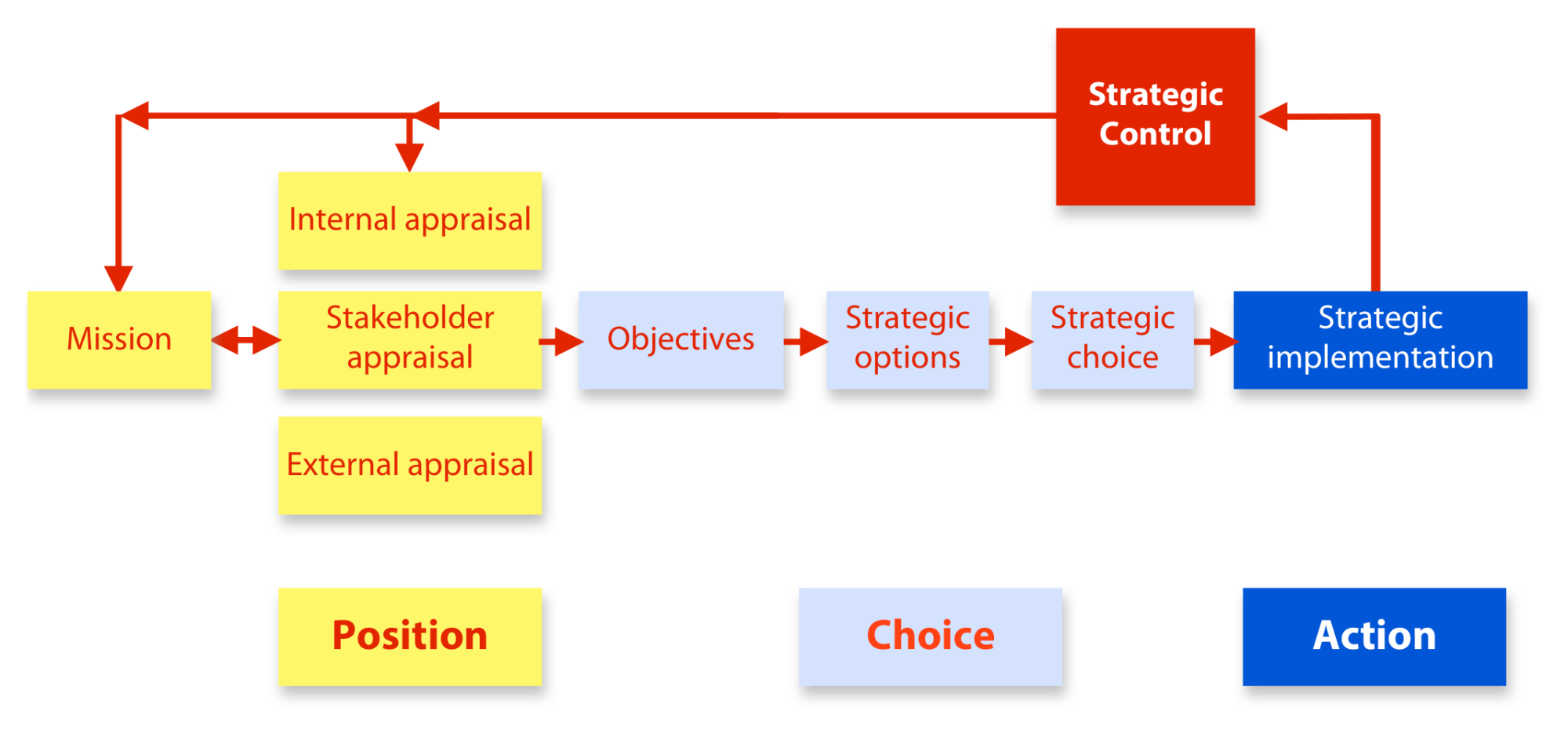
2.2 Position
The rational model is an approach to strategic planning which first of all investigates the position of the organisation. To establish the organisation’s position means carrying out of an internal appraisal, an external appraisal, and also an appraisal of stakeholders, that is, an appraisal of the various parties affected by the organisation and what they want from it. This stage is information gathering.
2.3 Choice
Once the current position has been established, the organisation can go on to set objectives. The objectives must take into account, for example, what the economy is doing, what competitors are doing, and what the organisation’s resources will allow it to do. The objectives are what you want to achieve; the strategy, or strategic options, are how you might go about achieving that. For example, if the objective was to increase profits by 20%, one strategy might be to take over another company. An alternative strategy might be to expand abroad. A third strategy which could possibly generate the required profit growth might be to subcontract much of the production activities.
Once the strategies have been set out and examined, one can be chosen. This will often be a compromise, for example, between high risk and high return or lower risk and lower return.
A powerful method of choosing a suitable strategy is to look at its suitability, feasibility and acceptability. This will be examined more fully later.
2.4 Implementation
The third stage is the action stage: strategic implementation. Everything up to here has been investigation and high-level planning. Too often, perhaps, organisations feel that is enough, but without implementation of the plans, strategic analysis is a waste of time and effort. Strategic implementation is hard, sustained work. As explained above, usually strategic plans will have planning horizons of five years or so, and look at the whole organisation. Strategic plans are therefore high-level documents, but implementation is a matter of detail. The strategic plan has to be broken down by department and by year. Often these small parts of the strategic plan can be regarded as discrete projects. The project objectives and constraints can be communicated by budgets, given to each department or cost centre.
2.5 Control
If every department meets its budget the strategic plan will be realised. However, it rarely is. Not only are there inherent difficulties in the planning process, but almost certainly the environment will change, and what had been a good plan will have to be modified. This is where strategic control comes in. The plan must be continually reviewed to see if it is still relevant and also we must try to make sure that the organisation's performance is appropriate.
3 Rarely linear
The previous diagram and narrative presented strategic planning as a linear process beginning with strategic position or analysis, then moving to strategic choice, and then turning the strategic choice in action. This is the Johnson, Scholes and Whittington model. The following diagram simply illustrates that a linear process may oversimplify matters.
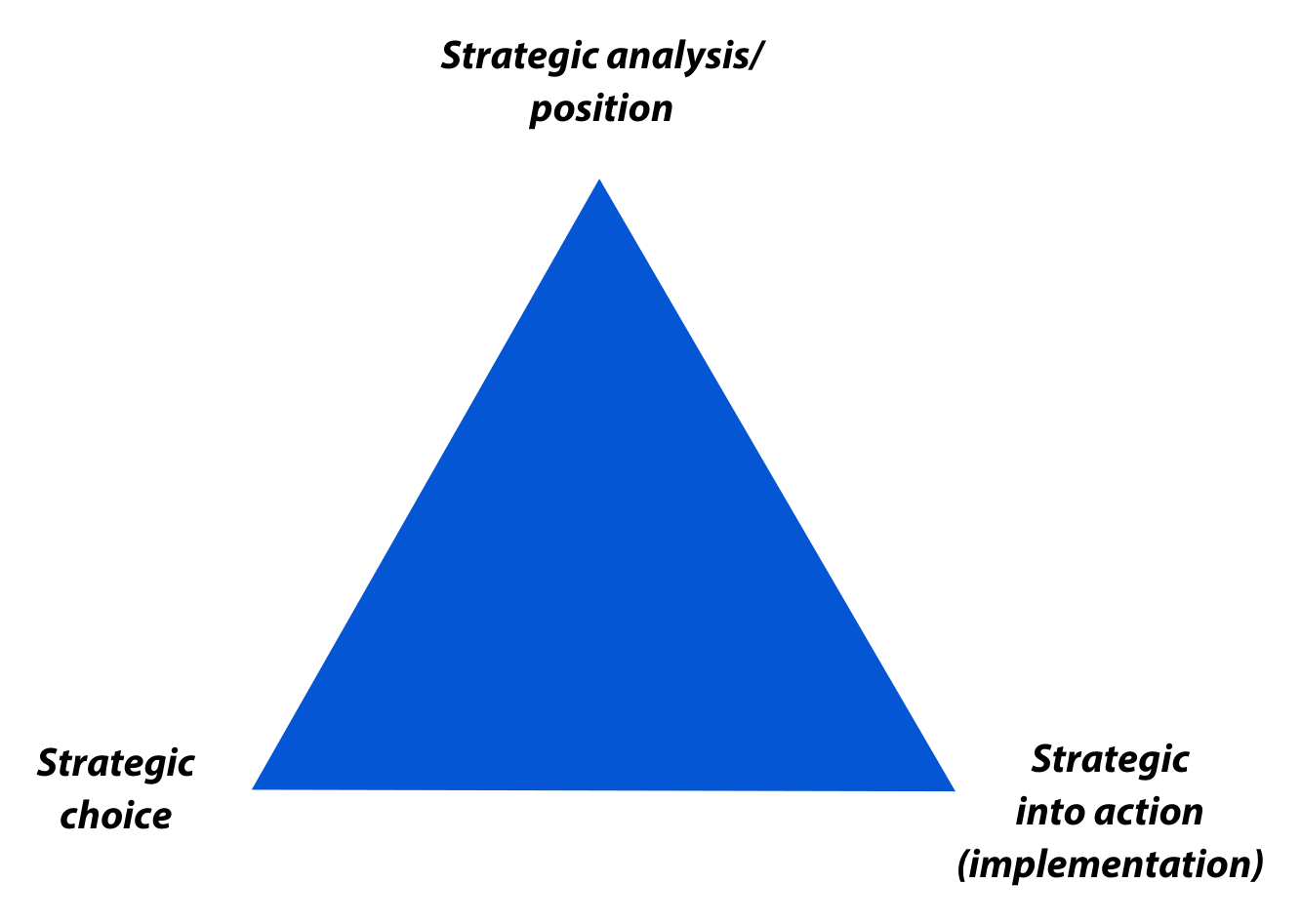
For example, once you begin implementing a strategy inevitably you find out more information and this may mean that you go back and review your strategy and make different choices. The three stages are inevitably linked and inform one another.
Emergent strategies become apparent as time passes and new opportunities or threats have to be dealt with.
4 Logical incrementalism
Not everyone agrees the five-year rational plan is a proper approach to strategic planning. Adherents to incrementalism say that strategy should be small extensions of past policies. They maintain this view because they claim:
It will be very unusual for strategic managers carefully to evaluate all options as it would be very difficult and time-consuming to do so.
It is unlikely that managers know all the relevant facts. This is known as bounded rationality. If you don’t know all the facts, you can’t evaluate all options.
Therefore, to say that you have plan for five years is a type of arrogance. It would be better making small logical adjustments as time goes by.
5 Freewheeling opportunism
The ultimate anti-planning stance is held by freewheeling opportunists. Followers of this approach do not like planning. Just as some people when going on holidays like to know exactly where they will be each night of the holiday. Others find such detailed planning anathema and that planning restricts the freedom of action. Freewheeling opportunists are often entrepreneurs. These people are going to starting businesses, but then tend to lose interest once the business matures somewhat and each day-to-day careful administration.
Freewheeling opportunists can make decisions very quickly, but they might not have investigated the facts fully and thought through the implications.