
Transfer Pricing


1 Introduction
In a previous chapter we looked at divisionalisation. When a company is divisionalised it is very common to have the situation where one division supplies goods or services to another division.
If we are measuring the performance of each division separately then it becomes important that divisions are able to charge each other for goods or services supplied.
In this chapter we will explain the importance of this, and also the importance of divisions charging each other ‘sensible’ transfer prices.
2 What is a transfer price?
The transfer price is the price that one division charges another division of the same company for goods or services supplied from one to the other. It is an internal charge – the ‘sale’ of one division is the ‘purchase’ of the other. Although it will be reflected in the results for each division individually, there is no effect in the accounts of the company as a whole.
Division A produces goods and transfers them to Division B which packs and sells them to outside customers.
Division A has costs of $10 per unit, and Division B has additional costs of $4 p.u.. Division B sells the goods to external customers at a price of $20 p.u.
Assuming a transfer price between the divisions of $12 p.u., calculate:
the total profit p.u. made by the company overall
the profit p.u. made by each division
3 Why have a transfer price?
The reason for having a transfer price is to be able to make each division profit accountable. If, in the previous example, there was no transfer price and goods were transferred ‘free of charge’ between the division, then the overall profit for the company would be unchanged. However, Division A would only be reporting costs, and Division B would be reporting an enormous profit. The problem would be compounded if Division A was selling the same product externally as well as transferring to Division B.
4 Cost-plus transfer pricing
A very common way in practice of determining a transfer price is for the company to have a policy that all goods are transferred at the cost to the supplying division plus a fixed percentage.
Division A has costs of $15 p.u., and transfer goods to Division B which has additional costs of $5 p.u.. Division B sells externally at $30 p.u.
The company has a policy of setting transfer prices at cost + 20%.
Calculate
the transfer price
the profit made by the company overall
the profit reported by each division separately
5 Goal congruence
If we are properly divisionalised, then each divisional manager will have autonomy over decision making. It will be therefore the decision of each manager which products are worth producing in their division (for these purposes we assume that each division has many products and therefore stopping production of one product will not be a problem).
A cost-plus approach, which easy to apply can lead to problems with goal congruence in that in some situations a manager may be motivated not to produce a product which is in fact to the benefit of the company as a whole.
Division A has costs of $20 p.u., and transfer goods to Division B which has additional costs of $8 p.u.. Division B sells externally at $30 p.u.
The company has a policy of setting transfer prices at cost + 20%.
Calculate:
the transfer price
the profit made by the company overall
the profit reported by each division separately
Determine the decisions that will be made by the managers and comment on whether or not goal congruent decisions will be made.
6 “Sensible” transfer pricing to achieve goal congruence.
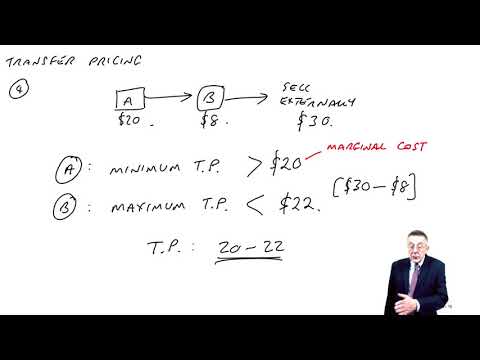
The previous example illustrates that unless care is taken to set the transfer price sensibly, decisions may be made that are not goal congruent.
In the examination you can be asked to suggest sensible transfer prices. (As we will illustrate, you will normally be asked to state a range rather than one specific price.)
There is a ‘rule’ that may be applied. However, it is dangerous to simply learn a rule without fully understanding the logic. We will therefore build up the rule using a series of small examples, and then state the rule at the end.
Division A has costs of $20 p.u., and transfer goods to Division B which has additional costs of $8 p.u.. Division B sells externally at $30 p.u.
Determine a sensible range for the transfer price in order to achieve goal congruence.
Division A has costs of $15 p.u., and transfers goods to Division B which has additional costs of $10 p.u.. Division B sells externally at $35 p.u.
A can sell part-finished units externally for $20 p.u.. There is limited demand externally from A, and A has unlimited production capacity.
Determine a sensible range for the transfer price in order to achieve goal congruence.
Division A has costs of $15 p.u., and transfers goods to Division B which has additional costs of $10 p.u.. Division B sells externally at $35 p.u.
A can sell part-finished units externally for $20 p.u.. There is unlimited external demand from A, and A has limited production capacity.
Determine a sensible range for the transfer price in order to achieve goal congruence.
Division A has costs of $8 p.u., and transfers goods to Division B which has additional costs of $4 p.u.. Division B sells externally at $20 p.u.
Determine a sensible range for the transfer price in order to achieve goal congruence, if Division B can buy part-finished goods externally for:
$14 p.u.
$18 p.u.
7 The ‘rule’ for sensible transfer pricing
The following rule summarises the results from the previous examples:
7.1 Minimum transfer price:
7.2 Maximum transfer price:
(Note: we always assume that both divisions are manufacturing many products and that discontinuing one product will have no effect on the fixed costs. It is therefore only the marginal costs that we are interested in when applying the above rules.)
8 Capacity limitations
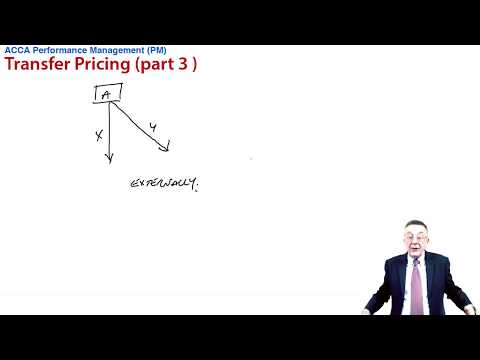
In one of the previous examples there was a limit on production in one of the divisions. This problem can be made a little more interesting, although the same rule as summarised in Section 7 still applies.
A is capable of making two products, X and Y.
A can sell both products externally as follows:
X | Y | |
External selling price | 80 | 100 |
Variable costs | 60 | 70 |
Contribution p.u. | 20 | 30 |
A has limited labour available.
The labour hours required for each product are
X: 5 hours p.u., Y: 10 hours p.u.
A has unlimited external demand for both products.
Division B requires product Y from Division A.
Calculate the minimum transfer price that should be charged by A for supply of Product Y to Division B.
Transfer pricing
10 questionsAnswer the questions one at a time. Your progress is saved so you can leave and come back.
Open chapter practice