
Inventory Control

1 Introduction
There are many approaches in practice to ordering goods from suppliers. In this chapter we will consider one particular approach – that of ordering fixed quantities each time.
For example, if a company needs a total of 12,000 units each year, then they could decide to order 1,000 units to be delivered 12 times a year. Alternatively, they could order 6,000 units to be delivered 2 times a year. There are obviously many possible order quantities.
We will consider the costs involved and thus decide on the order quantity that minimises these costs (the economic order quantity).
2 Costs involved
The costs involved in inventory ordering systems are as follows:
the purchase cost
the reorder cost
the inventory-holding cost
Purchase cost
This is the cost of actually purchasing the goods. Over a year the total cost will remain constant regardless of how we decide to have the items delivered and is therefore irrelevant to our decision.
(Unless we are able to receive discounts for placing large orders – this will be discussed later in this chapter)
Re-order cost
This is the cost of actually placing orders. It includes such costs as the administrative time in placing an order, and the delivery cost charged for each order.
If there is a fixed amount payable on each order then higher order quantities will result in fewer orders needed over a year and therefore a lower total reorder cost over a year.
Inventory holding cost
This is the cost of holding items in inventory. It includes costs such as warehousing space and insurance and also the interest cost of money tied up in inventory.
Higher order quantities will result in higher average inventory levels in the warehouse and therefore higher inventory holding costs over a year.
3 Minimising costs
One obvious approach to finding the economic order quantity is to calculate the costs p.a. for various order quantities and identify the order quantity that gives the minimum total cost.
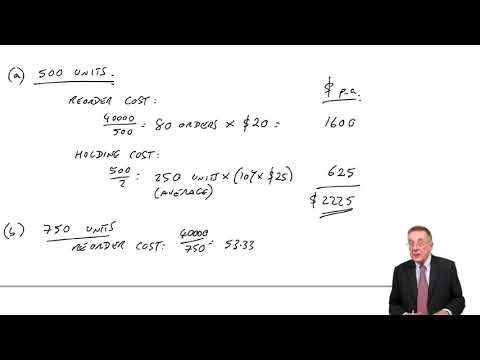
Janis has demand for 40,000 desks p.a. and the purchase price of each desk is $25. There are ordering costs of $20 for each order placed. Inventory holding costs amount to 10% p.a. of inventory value.
Calculate the inventory costs p.a. for the following order quantities, and plot them on a graph:
500 units
750 units
1,000 units
1,250 units
Show answerHide answer
4 The EOQ formula
A more accurate and time-saving way to find the EOQ is to use the formula that is provided for you in the exam.
The formula is:
Where Co = fixed costs per order
D = annual demand
CH = the inventory holding cost per unit per annum
(Note: you are not required to be able to prove this formula)
For the information given in Example 1,
(a) use the EOQ formula to calculate the Economic Order Quantity.
(b) calculate the total inventory costs for this order quantity.
Show answerHide answer
5 Quantity discounts

Often, discounts will be offered for ordering in large quantities. The problem may be solved using the following steps:
Calculate EOQ ignoring discounts
If it is below the quantity which must be ordered to obtain discounts, calculate total annual inventory costs.
Recalculate total annual inventory costs using the order size required to just obtain the discount
Compare the cost of step 2 and 3 with the saving from the discount and select the minimum cost alternative.
Repeat for all discount levels
For the information given in Example 1 the supplier now offers us discounts on purchase price as follows:
Order quantity | discount |
0 to < 5,000 | 0 % |
5,000 to < 10,000 | 1 % |
10,000 or over | 1.5 % |
Calculate the Economic Order Quantity.
Show answerHide answer
6 The Economic Batch Quantity

In the earlier examples, we assumed that we purchased goods from a supplier who delivered the entire order immediately.
Suppose instead that we have our own factory. The factory can produce many different products (using the same machines). Whenever we order a batch of one particular product then the factory will set-up the machines for the product and start producing and delivering to the warehouse immediately.
However it will take them a few days to produce the batch and during that time the warehouse is delivering to customers.
As a result the maximum inventory level in the warehouse never quite reaches the order quantity, and the formula needs changing slightly.
where:
CO = fixed costs per batch (or set-up costs)
D = annual demand
CH = inventory holding cost per unit per annum
R = rate of production per annum
It is also worth learning that the average inventory level in this situation will be:
(Note that this formula will not be given to you in the exam)
A company has demand for 50,000 units p.a.
They produce their own units at a cost of $30 per unit, and are capable of producing at rate of 500,000 units p.a.
Machine set-up costs are $200 for each batch.
Inventory holding costs are 10% p.a. of inventory value.
Calculate the Economic Batch Quantity, and the costs involved p.a. for that quantity.
Show answerHide answer
7 Re-order level and ‘safety’ inventories

In the previous paragraphs we have considered the re-order quantities for inventory - that is the quantity that we should order each time.
However, in real life, it is unlikely that the supplier will deliver our order instantly - for example, it might take a week for the delivery to arrive - and therefore we need to place an order when we still have some units left. If we do not have sufficient units in inventory to last us until the delivery arrives, then we will run out of inventory and have to turn customers away.
The time between the placing of an order and the delivery arriving is known as the lead time.
The level of inventory at which time we should place a new order is known as the re-order level.
A company has a demand from customers of 100 units per week.
The time between placing an order and receiving the goods (the lead time) is 5 weeks.
What should the re-order level be? (i.e. how many units should we still have in inventory when we place an order).
Show answerHide answer
In practice, the demand per day and the lead time are unlikely to be certain.
What therefore we might do is re-order when we have more than 500 units in inventory, just to be ‘safe’ in case the demand over the lead time is more than 500 units. Any extra held in inventory for this reason is known as safety inventory, or buffer inventory.
A company has a demand from customers of 100 units per week.
The time between placing an order and receiving the goods (the lead time) is 5 weeks.
The company has a policy of holding safety inventory of 100 units.
What should the re-order level be?
Show answerHide answer
Alternatively, if we do know the maximum demand over the lead time and want to be certain of not running out of inventory then the re-order level needs to be equal to the maximum possible demand over the lead time.
Demand from customers is uncertain and is between 70 and 120 units per week.
The lead time is also uncertain and is between 3 and 4 weeks.
What should the re-order level be if we are to never run out of inventory?
Show answerHide answer
Although our answer to example 7 (a re-order level of 480 units) will mean that if the very worst should happen then we will still have enough units to fulfil demand, much of the time the demand will be lower than the maximum and/or the lead time will be shorter than the maximum.
If the demand over the lead time is less than the re-order level then it will mean we still have some units in inventory when the new delivery arrives.
It therefore means that the maximum inventory level will be the maximum number left in inventory, plus the number of units delivered.
The maximum number left in inventory is the re-order level less the minimum demand over the lead time.
Demand from customers is uncertain and is between 70 and 120 units per week.
The lead time is also uncertain and is between 3 and 4 weeks.
We have a re-order quantity of 1,000 units each time.
What is the maximum inventory level?
Show answerHide answer
Inventory Control
6 questionsAnswer the questions one at a time. Your progress is saved so you can leave and come back.
Open chapter practice