
Behavioural Aspects of Budgeting

1 Introduction
In the previous chapter we looked at how budgets are prepared. In this chapter we will consider how the budget can affect the behaviour of managers.
2 Motivation
An important use of budgets is for them to become the targets for managers. This will only work if our managers are motivated to attempt to achieve (or to perform better than) the targets that have been set.
It is therefore important that consideration is given as to how best to motivate the managers.
3 Factors that influence motivation
The main factors influencing how well the managers will be motivated are:
to what extent they were involved in preparing the budgets and therefore in setting the targets
how easy or difficult will it be for the managers to achieve the targets
how the managers will be rewarded for achieving their targets (or punished for not achieving them!)
We will consider each of these factors briefly in the following paragraphs.
4 Participation in the preparation of budgets
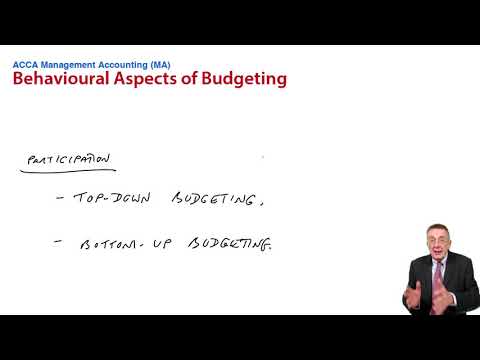
There are two basic approaches to the way budgets are prepared:
one approach is for top management to prepare the budgets and then to impose them on their managers. This is known as top-down budgeting
the alternative approach is to get the managers to prepare their own budgets and for top management to then approve them (after obviously due discussion). This is known as bottom-up budgeting.
The second approach – bottom-up budgeting – is a participative approach and is regarded as being more motivational for the managers because they were involved in setting their own targets. The danger is that they deliberately budget targets that are easy for them to achieve – it is up to top management to be aware of this and to question the managers well before approving the budgets.
5 The impact of targets
It is important that the targets are demanding of the managers – the purpose of them is to help improve the performance of the business – but at the same time they need to be achievable by the managers. If the manager feels that it is simply not possible to achieve his or her target, then there is the danger that they just stop trying completely.
6 Incentive schemes
The most common way of motivating managers to improve is to reward them - the level of the reward being dependent on the degree to which they achieve, or better, their targets.
The reward can be given in several ways, such as the following:
the promise of promotion
an increase in salary
a cash bonus
a bonus given in shares in the company
Behavioural Aspects of Budgeting
5 questionsAnswer the questions one at a time. Your progress is saved so you can leave and come back.
Open chapter practice