
Process Costing – Joint Products

1 Introduction
Sometimes, one process may produce several products. In this case we need to decide on a cost per unit for each of the products. These products, produced in the same process, are known as joint products.
Joint products refer to our main products with full sales value. However, there may be an additional product (or products) which is produced incidentally and has a relatively low sales value (effectively a waste product). This is known as a by-product.
2 Accounting treatment
Any sale proceeds of a by-product are subtracted from the joint costs of the process.
The net total cost of the process is then split between the joint products.
For the examination, there are two ways of splitting the joint costs:
The physical units basis
The market value at the point of separation basis.
3 Physical units basis
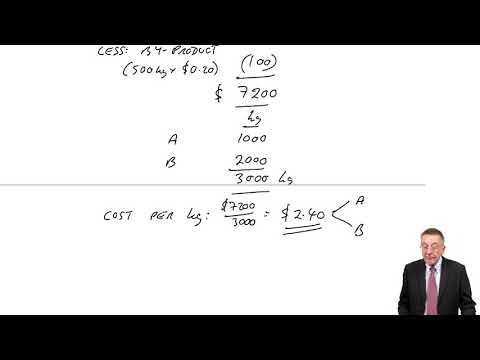
Under this method, the same cost per unit is applied to all the joint products
During August, the following costs were incurred in a process:
Materials (3,500 kg) | $5,000 |
Labour and overheads | $2,300 |
The production from the process was as follows:
kg | ||
Product A | 1,000 | selling price $5 per kg |
Product B | 2,000 | selling price $2 per kg |
by-product X | 500 | scrap value $0.20 per kg |
Calculate a cost per kg and profit per kg for A and B using the physical units basis.
Show answerHide answer
4 Market value basis
Under this method the costs per unit are calculated so as to be in the same proportions as the market values of each product
During August, the following costs were incurred in a process:
Materials (3,500 kg) | $5,000 |
Labour and overheads | $2,300 |
The production from the process was as follows:
kg | ||
Product A | 1,000 | selling price $5 per kg |
Product B | 2,000 | selling price $2 per kg |
by-product X | 500 | scrap value $0.20 per kg |
Sales during the period were 800 kg of A and 1,500 kg of B.
Calculate a cost per kg and profit per kg for A and B using the market value basis
Show answerHide answer
5 Net-realisable value approach
The market value approach is not always possible. This is because the products will often require further work (and therefore costs) after leaving the process. We have to use the net realisable value at a point of separation as an approximation to the market value.
The net realisable value is the final market value less costs incurred after leaving the joint process.
During September the following costs were incurred in a process:
Materials (3,500 kg) | $5,000 |
Labour and overheads | $2,300 |
The production from the process was as follows:
kg | ||
Product A | 1,000 | selling price $8.40 per kg |
Product B | 2,000 | selling price $4.50 per kg |
by-product X | 500 | scrap value $0.20 per kg |
All the output of A and B incurred further processing at a cost of $4.80 per kg for A and $2.20 per kg for B.
Calculate a cost per kg for A and B using the net realisable value approach.
Show answerHide answer
Process Costing – Joint Products
4 questionsAnswer the questions one at a time. Your progress is saved so you can leave and come back.
Open chapter practice