Inventory Control (part 1) The EOQ Formula - ACCA Management Accounting (MA)
YouTube video
67 Comments
A
Amarnath Sha·
hi sir
the example 1 says holding costs amount to 10% per annum of inventory value, and it asks to find out inventory cost per annum
is it not that the inventory value is ordering cost + purchaing cost and then we need to take 10% on this
J
John MoffatTutor·
No - the inventory cost is only as I state in our free lecture.
A
Amarnath Sha·
Okay Sir
A
Amarnath Sha·
Hi Sir,
Is the inventory value only the actual cost of the item ($25 per desk), or do we need to add the ordering cost ($20 per order) to calculate the annual inventory value?
A
A·
John, thank you for the valuable material you have put out. Your efforts are greatly appreciated.
Regarding the 10% holding cost assumption: I am curious, how is this 10% deduced in practical terms? How does one conclude that holding costs amount to x%? I am thinking of this in terms of real-world application.
I would appreciate your elaborate answer.
J
John MoffatTutor·
Higher levels of average stock means that the business will have had to borrow more money (and therefore having to pay interest) or will be using money that they could have deposited to earn interest (and will therefore be losing interest that they could have earned). The % used will be the interest rate.
A
A·
Thank you for your reply and explanation.
Under which ACCA module can I learn more deeply about this in real-world applications?
A
Allison·
Why is 500/2 the average in holding cost?
J
John MoffatTutor·
Because the level of inventory keeps fluctuating between 500 and zero.
V
Valijon·
Example 1
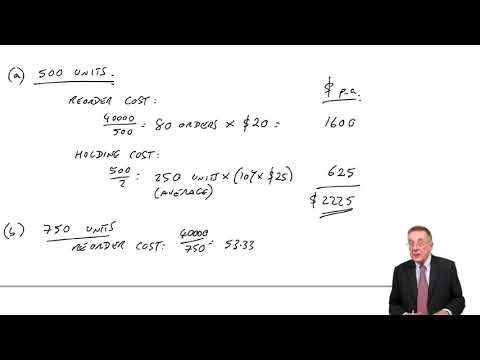
(a) why only reorder cost is calculated for the whole year (40,000/500=80@20=1600), while inventory holding cost is calculated only for one time order ((500/2=250*(25*10%))=625
is 625 cost is only for 500 units or for the whole 40,000 yearly units?
Please clarify, i can't sleep untill i understand
A
Aryan·
625 is for whole year because the company is only gonna order 500 units per order so on an average there will be only 250 units that we are storing in the inventory so holding cost will only apply to 250 units for the entire year so the answer 625 dollars is p.a.
S
S·
Where did the total of $2225 come from after the the $625?
J
John MoffatTutor·
It was added to the 1,600 above it (the reorder cost).
R
Raj Shekhar·
why was total purchase cost (20*40000) while calculating the annual inventory cost at different reorder quantities was not included in the calculation?
J
John MoffatTutor·
Because unless there are quantity discounts (which is covered later in the lectures) then the total purchase cost over the year is the same whatever the order quantity, and is therefore not relevant to the decision.
R
Raj Shekhar·
Excellent lecture as usual. Not only these lectures are interesting to watch but your brilliant explanations with examples make them 100 times easier to understand. These lectures are billion times better than any paid coaching.
J
John MoffatTutor·
Thank you for your comment :-)
H
Himanshu·
In management accounting, when using the EOQ formula we assume that the inventory holding cost will be half of the quantity ordered multiply into inventory holding cost value value, and then we assume that this is what it is going to cost us for the whole year but does it give us the holding value of just one ordered batch? since we are going to incurr the same cost of all the future batches they why dont we multiply it by future order number as well?
J
John MoffatTutor·
The average inventory level (which is half the order quantity) is the average level throughout the year.
We multiply by the holding cost per unit per year and so the result is the total holding cost for the year.
S
Syed·
There is a variation on the Total Holding Cost equation where we add min inventory to Q/2 , when can and can't we use this variation of the equation ?
J
John MoffatTutor·
If you are given the demand per month, then multiply by 12 to get the demand per year.
N
Nayana·
When Demand units given on per month how to calculate eoq ? It’s demand units * one year quarter 4 or demand units * 12 months which one is correct ?
S
SALOME·
Thank you, Sir, for the lectures. I suppose the reason purchase cost is not included in determining EOQ is because as your note says, the purchase cost does not change no matter the number of orders. Therefore, it is irrelevant in the calculation.
Please correct if i am wrong.
H
HsuPyae·
Could you please explain sir? relation between EOQ , Ordering cost and Holding cost. if holding cost decreas, how to effects on EOQ and ordering cost and why, Many thanks
J
John MoffatTutor·
That should all already be clear from the lecture and from using the formula.
Ask in the Ask the Tutor forum (not here) if you are still not clear after watching the lecture again.
H
HsuPyae·
Well, Thank you sir.
A
Asif·
Greetings sir. I wanted to pass on to you an easy way to teach everyone how to remember the EOQ formula. I got it from one of my teachers in the past.
It would be the way you would order at a Fish & Chips Restaurant :) :
2 COD fish / 1 CHips please.
I hope you benefited.
Wish you the best.
J
John MoffatTutor·
Thank you, but you do not need to remember the formula because it is given to you in the exam!! See the formula sheet in our free lecture notes.
A
Asif·
I know that. Just a help for anyone who wanted to remember it the easy way. Goodbye.
A
Afnan·
Hello sir,
I have a question....Example 2 says - "calculate the inventory costs for this order quantity". Shouldn't we also include purchase costs as it is also an inventory cost? I do get when it said that purchase costs doesn't make a difference if there are no discounts or something but the question clearly says to calculate inventory costs......
I
ishamadhani·
Dear Sir
I had a doubt. In the example which we solved wherein we were supposed to calculate inventory cost for different order quantities. In that, while calculating holding cost, why did we multiply the average inventory by 10% of $25 (the price of each desk). Holding cost is 10% PER ANNUM. Won't multiplying 10% to each desk's price be wrong?
J
John MoffatTutor·
If we are costing over a year (as we usually are) then it is correct to take 10% of $25. From day to day the inventory levels (and therefore the holding cost will be higher and lower). However we are multiplying the average inventory (the average level held throughout the year) by the $2.50 per unit.
A
Aktanbek·
Hello! At the beginning of this chapter we said that there are 3 costs in inventory holding system: 1) the purchase cost 2) the reorder cost and 3) the inventory cost. Why we did not include the purchase cost in our examples when we calculated inventory costs?
J
John MoffatTutor·
Because it is not affected by the order quantity except when there are quantity discounts as explained in the next lecture.
J
John MoffatTutor·
Correct :-)
N
Ning·
Hello sir
I have a question about example 1, why do you ues units divided by 2 when you calculate the carrying cost? I'm not sure why it's an average?
N
Ning·
As the graph you draw near the start of the lecture shows, the new 1000 units are added after each use. The first time you put 1,000 units in the warehouse, Inventory holding cost is created, and even after you run out of units, the next 1,000 units are added. Why not calculate the maximum Inventory holding cost and use average instead?
A
Angelica Amposta·
hello sir :))
in your example, when asked fr the total inventory cost, you only included the holding cost and ordering cost. However, in the kaplan books, they include purchase cost as well.
which should we follow when asked in the exam??
J
John MoffatTutor·
It depends what the question asks for. If it is not clear, then for multiple choice questions it will be obvious from the choices given. In other questions the computer would mark either correct.
A
Angelica Amposta·
i see. thank you :)) the videos are very helpful
H
hamza·
I dont understand that why we take avg inventory not the 1/3 or 1/4 etc?
J
John MoffatTutor·
Because the level of inventory fluctuates between the order quantity and zero units. Therefore the average inventory throughout the year is half the order quantity.
I illustrate this with a graph near the start of the lecture.
C
chisomm·
Great lecture. thanks.
J
John MoffatTutor·
Thank you for your comment :-)
C
Camille·
Hi Sir,
For the holding cost; why is it that we divide the order quantities by 2?
J
John MoffatTutor·
Because the level of inventory fluctuates between the order quantity and zero units. Therefore the average inventory throughout the year is half the order quantity.
I illustrate this with a graph near the start of the lecture.
C
Camille·
Oh I see now. Thank you sir.
J
John MoffatTutor·
You are welcome :-)
U
Umar·
We are assuming that half of the inventory is always there in our storage?
could you please elaborate on the average. if its an assumption its totally fine i get that but practically its not like that or is it?
why are we taking avg. only, it be any other ratio let say 1/3 or 1/4 of order quantity?
thanks in advance.
J
John MoffatTutor·
We are certainly not assuming that half of the inventory is always there!!
Immediately after a new delivery is received then the inventory will be the amount ordered. This inventory is used up over time and falls to zero immediately before the next order is received. So the level of inventory is fluctuating between the full order amount and zero. On average it will therefore be held way between the two.
Please watch the start of the lecture again where I illustrate this with a graph.
U
Umar·
That is true the inventory will be between the two levels but i think we can not simply take avg. lets say we reorder at 10 units in inventory considering buffer inventory. total need is 100 units every month. practically we wont let the inventory reach zero right. for sake of MA we are assuming inventory reached zero.
so in the above example we will be holding 100 units but we can not simply take 45 just because on average we are holding between 0 to 90 as the inventory is fluctuating between 0 and 90.
i did watch that illustration but i am still confused, as we are just placing line in between to define that on average.
really appreciate your help.
J
John MoffatTutor·
If we hold buffer (or safety) inventory, then the average inventory will be higher by the amount of the buffer. However this will not effect the calculation of the EOQ.
B
blamohjulius·
I don't really understand eoq discount calculation pls can u help me out
Z
zihan·
Sir, thank you so much for the great lecture!! :)
J
John MoffatTutor·
Thank you for your comment :-)
M
mahammedrza·
Thank you. Very Clear clarifying.
After I watch lectures I get it. Although when I read from BPP Study book, I get confused. I don't know whether they give hard examples and question or the exam standart is like that.
J
John MoffatTutor·
The lectures cover everything needed to be able to pass the exam well.
However you must also buy a Revision Kit from one of the ACCA approved publishers - they are full of exam standard questions for practice, and practice is vital to passing the exam.
M
Martin·
I don't get the concept of average inventory...
J
John MoffatTutor·
The level of inventory will fluctuate throughout the year. It will be high every time a new order is received, and will then go low as the inventory is used. The cost of holding it will therefore be high when the inventory is high, and will be low when the inventory is low. So we base our costing on the average level throughout the year - half way between the highest level and the lowest level.
M
Martin·
Thank you for the response...I get it now...
J
John MoffatTutor·
You are welcome :-)
M
Muhammad Hamid·
Very good understanding
J
John MoffatTutor·
Thank you for your comment :-)
L
lbasusi·
Thank you Sir!
J
John MoffatTutor·
You are welcome :-)
J
John MoffatTutor·
kirimi: Thank you for your comment :-)
K
kirimi·
I really liked this video. Simple and easy to understand.


the example 1 says holding costs amount to 10% per annum of inventory value, and it asks to find out inventory cost per annum
is it not that the inventory value is ordering cost + purchaing cost and then we need to take 10% on this
Is the inventory value only the actual cost of the item ($25 per desk), or do we need to add the ordering cost ($20 per order) to calculate the annual inventory value?
Regarding the 10% holding cost assumption: I am curious, how is this 10% deduced in practical terms? How does one conclude that holding costs amount to x%? I am thinking of this in terms of real-world application.
I would appreciate your elaborate answer.
Under which ACCA module can I learn more deeply about this in real-world applications?
(a) why only reorder cost is calculated for the whole year (40,000/500=80@20=1600), while inventory holding cost is calculated only for one time order ((500/2=250*(25*10%))=625
is 625 cost is only for 500 units or for the whole 40,000 yearly units?
Please clarify, i can't sleep untill i understand
We multiply by the holding cost per unit per year and so the result is the total holding cost for the year.
Please correct if i am wrong.
Ask in the Ask the Tutor forum (not here) if you are still not clear after watching the lecture again.
It would be the way you would order at a Fish & Chips Restaurant :) :
2 COD fish / 1 CHips please.
I hope you benefited.
Wish you the best.
I have a question....Example 2 says - "calculate the inventory costs for this order quantity". Shouldn't we also include purchase costs as it is also an inventory cost? I do get when it said that purchase costs doesn't make a difference if there are no discounts or something but the question clearly says to calculate inventory costs......
I had a doubt. In the example which we solved wherein we were supposed to calculate inventory cost for different order quantities. In that, while calculating holding cost, why did we multiply the average inventory by 10% of $25 (the price of each desk). Holding cost is 10% PER ANNUM. Won't multiplying 10% to each desk's price be wrong?
I have a question about example 1, why do you ues units divided by 2 when you calculate the carrying cost? I'm not sure why it's an average?
in your example, when asked fr the total inventory cost, you only included the holding cost and ordering cost. However, in the kaplan books, they include purchase cost as well.
which should we follow when asked in the exam??
I illustrate this with a graph near the start of the lecture.
For the holding cost; why is it that we divide the order quantities by 2?
I illustrate this with a graph near the start of the lecture.
could you please elaborate on the average. if its an assumption its totally fine i get that but practically its not like that or is it?
why are we taking avg. only, it be any other ratio let say 1/3 or 1/4 of order quantity?
thanks in advance.
Immediately after a new delivery is received then the inventory will be the amount ordered. This inventory is used up over time and falls to zero immediately before the next order is received. So the level of inventory is fluctuating between the full order amount and zero. On average it will therefore be held way between the two.
Please watch the start of the lecture again where I illustrate this with a graph.
so in the above example we will be holding 100 units but we can not simply take 45 just because on average we are holding between 0 to 90 as the inventory is fluctuating between 0 and 90.
i did watch that illustration but i am still confused, as we are just placing line in between to define that on average.
really appreciate your help.
After I watch lectures I get it. Although when I read from BPP Study book, I get confused. I don't know whether they give hard examples and question or the exam standart is like that.
However you must also buy a Revision Kit from one of the ACCA approved publishers - they are full of exam standard questions for practice, and practice is vital to passing the exam.