
International Court of Arbitration

1 ICA International Court of Arbitration
the ICC International Court of Arbitration was established in 1923
promotes the use of arbitration procedures in commercial disputes
oversees all elements of arbitration process:
maintains lists of prospective arbitrators
confirms appointment of arbitrators
makes decisions about challenges to arbitrators
approves arbitrators’ awards
fixes arbitrators’ fees
the ICC Court administers cases and scrutinises awards; it does not decide the parties’ dispute itself
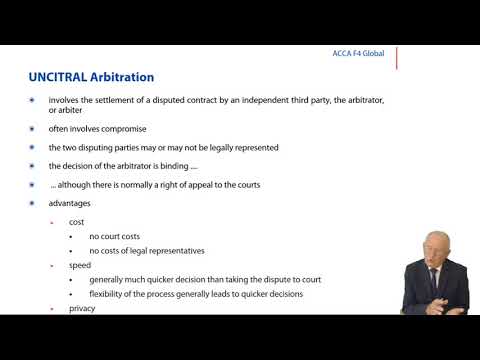
2 UNCITRAL Arbitration
involves the settlement of a disputed contract by an independent third party, the arbitrator, or arbiter
often involves compromise
the two disputing parties may or may not be legally represented
negotiation, mediation and conciliation are non-binding ADR processes; litigation gives a binding court judgment and arbitration gives a binding award
an award is final and binding; it may be challenged or set aside only on narrow grounds, not by an appeal on the merits
advantages
cost
no court costs
no costs of legal representatives
speed
generally much quicker decision than taking the dispute to court
flexibility of the process generally leads to quicker decisions
privacy
court proceedings are a matter of public record
arbitration is a private, unpublicised matter
informality
court proceedings can be extremely stressful
the informality of the arbitration process is much less stressful
expertise
the arbitrator should be an acknowledged expert in contract law area under dispute
a judge is an expert in law with possibly no experience in the disputed matter
decisions
because arbitration is not bound by precedent, decisions of an arbitrator are likely to be more innovative
3 UNCITRAL – arbitration
the requirement of qualifications for an arbitrator should be established within the arbitration agreement
if no qualification requirement has been agreed, then anyone may be selected
no one should be prevented from serving as an arbitrator on the grounds of their nationality alone
an arbitrator should be independent and unbiased
any nominated arbitrator should disclose any relevant facts which may be seen to impair their independence
similarly, if it becomes the case that independence is threatened, an arbitrator should disclose the circumstances
if it becomes impossible for an appointed arbitrator to continue to act, they should withdraw from the position, or
both parties may agree that the appointment should be terminated, or
either party may challenge the arbitrator concerning independence
4 UNCITRAL – arbitration
for a dispute to be submitted to arbitration, under the UN’s Model Law on International Commercial Arbitration the agreement to turn to arbitration must be in writing
there should therefore by an “arbitration clause” agreement
to qualify as “being in writing” one of the following requirements should be appropriate
it should be contained in:
a document, signed by both parties
an exchange of documents clearly referring to such an agreement / clause
an exchange of documents of a legal nature clearly referring to such an agreement / clause
another written contract between the parties referring to the arbitration agreement / clause
the arbitration tribunal
if the parties have agreed to have a sole arbitrator, the two parties should agree on that person’s identity
if the parties cannot agree, they will need to refer the matter to a nominated court or tribunal for them to decide the identity of the arbitrator
if the parties have not agreed on a sole arbitrator, the Model Law states that there should be three arbitrators
one chosen by each of the two disputing parties, and
one chosen by the two arbitrators
5 UNCITRAL – arbitration
disadvantages
privacy!
one party in the dispute may actually want the publicity
application of the law
independent arbitrators do not necessarily have expertise in the interpretation and application of the law, whereas
judges in courts are experts in this field
predictability
arbitrators are not bound by precedent so may be inconsistent when compared with decisions in similar disputes, whereas
judges are bound to follow the principles of precedent so dispute resolution may be seen as predictable
precedent
resolution under arbitration creates no precedent so future similar dispute resolution could differ from the earlier arbitration decision, whereas
where a dispute lies beyond the scope of established precedent, a court decision could be seen to create a new precedent upon which later similar dispute resolution will be based
6 UNCITRAL – arbitration – application to have an arbitration award set aside / cancelled
incapacity
occurs when one party in the dispute is suffering under an incapacity when the tribunal hearing took place
notice
occurs when insufficient notice has been given of either
the appointment of an arbitrator, or
the date of the proceedings
invalidity of the agreement
if the tribunal decision is invalid under the law governing the dispute contract
public policy
where a decision from a tribunal is claimed to be against the public policy of the claimant’s state
subject matter
tribunals are restricted to making awards only on matters included within the agreement to seek arbitration
composition of the panel of arbitrators
if the proper requirements of panel selection have not been followed (normally three arbitrators)
Where a question asks what is NOT required, the word is always capitalised — take the time to test each option. On an arbitral award under the Model Law, the award must state the place of arbitration and a copy must go to each of the parties, but it need not be signed by all of the arbitrators. (LW GLO S23–A24 examiner's report, Question 1, page 3.)
7 UNIDROIT – International Institute for the Unification of Private Law
independent inter-governmental organisation
studies the need for and how to modernise, harmonise, standardise and co-ordinate private law in an international context
of particular concern is international trade law
three tier structure
secretariat
responsible for day-to-day running
governing council
supervises policy
draws up a work programme
supervises how the secretariat carry out the program
general assembly
the ultimate decision making body
approves the budget
approves the work programme
elects the governing council
International Commercial Arbitration
8 questionsAnswer the questions one at a time. Your progress is saved so you can leave and come back.
Open chapter practice