
Structure of The Legal System



1 Civil Law
Private law
To settle disputes between individuals
No concept of punishment
Objective is to compensate the wronged party
Need to prove ‘on the balance of probability’
Sued in court
If liable, then compensation payable
Claimant and defendant
Personal action brought by the aggrieved party
Court may award damages or an equitable remedy if damages are inadequate
2 Criminal Law
Public law
A wrongdoer has broken the law
A wrong done to society
Prosecuted in court
If guilty, then punished
Community service, fine, imprisonment
Prosecutor and accused
Need to prove ‘beyond reasonable doubt’
the police investigate offences and may charge less serious cases; the CPS decides whether to prosecute more serious cases by applying the evidential and public-interest tests
3 Common Law
Development started with effect from 1066
King’s representatives attended local courts
Then met in London on a regular basis to discuss
Over a period of 200 years, law was commonised – “Common Law”
Cornerstone of Common Law is judicial precedent
Ratio decidendi and obiter dicta
With commonisation came recognition of deficiencies
Highlighted the need for alternative remedies – Equity
Common Law remedy is ‘damages’ – a monetary award
Common Law courts were separate from court of equity until the late nineteenth century
4 Equity Law

Grew from the recognition of deficiencies of Common Law
If a monetary award of damages was not appropriate, there was nothing else to offer
In fourteenth century, Aequitas
Chancellor’s court
Early seventeenth century, Earl of Oxford’s case
Equity shall prevail
Confirmed by 1873 – 1875 Judicature Acts
Main remedies :
Specific performance
Injunction
Rescission
Rectification
Remedies are given at Court’s discretion
Only given if damages are inadequate
5 Ratio Decidendi
Ratio is ‘the reason for the decision’
Ratio is binding on future judges in similar cases
Reversing – higher court reverses lower court decision in same case
Overruling – higher court overrules lower court decision in different case
Distinguishing – court avoids earlier precedent by distinguishing the facts
Ratio not binding if made without care (per incuriam)
Ratio not binding if in conflict with a basic principle of law
Ratio not binding if in conflict with European law
Ratio not binding if made in inferior court
6 Civil law system
civil law system – comprehensive written codes, usually derived from Roman law; judges apply the code rather than develop binding precedent
Do not skip the systems you do not work under. The examining team make the point every year: the syllabus covers common law, civil law and Sharia, and the systems other than your own are examined in every sitting. Candidates who study only the one they practise under risk leaving untouched the marks that would have carried them through. (LW GLO S23–A24 examiner's report, page 2.)
7 Sharia law
Sharia - a way to a watering place
Quran - primary source of Sharia law
Sunnah - what has come to be accepted conduct
Shia, Hanafi, Maliki, Hanbali, Shafii
the five schools of law
they provide further details / interpretation of acceptable conduct and application of the law
a Sharia judge may refer to these secondary schools to determine how to apply the law
Ijtihad - methods of interpreting the law
taqlid - the belief that no further interpretation is required
ijma - one of two methods of interpretation open to a judge who is not a follower of the taqlid thinking
ijma is a consensus of opinion of legal scholars or judges
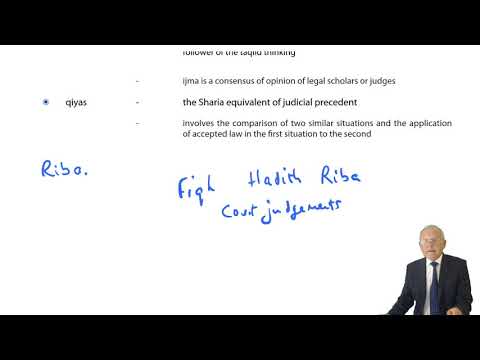
qiyas - the Sharia equivalent of judicial precedent
involves the comparison of two similar situations and the application of accepted law in the first situation to the second
8 Judicial precedent
in UK common law, judges are bound to follow decisions from earlier similar cases
this concept does not have any true equivalent in Sharia law, the nearest equivalent is qiyas
judges, in the UK, may avoid the earlier decision and therefore avoid having to follow the precedent decision:
if earlier decision was made per incuriam (without care)
if in conflict with basis principle of law
if facts are not materially similar
rules for applying a precedent
must be based on a point of law, not a point of fact
must be part of the ratio decidendi in the previous case
material facts should be sufficiently similar
prior court must have superior status in the hierarchy of the courts
9 Separation of powers and the rule of law
rule of law reflects the situation which exists when members of a society abide / obey a set of rules governing behaviour
separation of powers
the process of making laws is separated into three distinct areas:
the legislature – an elected body which decides which laws need to be passed to satisfy the nation’s wishes (for example, health, defence)
the executive – an elected body which makes the decisions which put the law into action (for example in the UK, the elected government)
the judiciary – a non-elected body which rules on disputes about law
these disputes may be between government and individuals (criminal law)
or between individual and individual (civil law)
Structure of the Legal System
6 questionsAnswer the questions one at a time. Your progress is saved so you can leave and come back.
Open chapter practice