
Employment Law

1 Employment Law
Distinguish employees, workers and the self-employed by the real relationship, including personal service, control, mutual obligations and whether the individual is genuinely in business on their own account
Courts apply 3 tests
Control test (Mersey Docks v Coggins)
Integration test (Cassidy v Ministry of Health)
Economic reality test (Readymix Concrete)
Difference is important because :-
Tax and social security contributions
Sales tax
Employment protection provisions
Vicarious liability
Liquidation
Do not stop at tax and vicarious liability — the examiner tests what actually follows from the status. Employees are preferential creditors in their employer's liquidation; independent contractors are not. And secondary Class 1 National Insurance is paid by the employer, so neither an employee nor a contractor pays it. (LW ENG S23–A24 examiner's report, Question 2, page 3.)
2 Employment Law
Indicators that a worker is self-employed
Own tools and equipment
Ability to delegate
Ability to choose which hours to work
Ability to accept or refuse work
Ability to take holidays without restrictions
Paid for the project
Work for different organisations
But no individual indicator is normally sufficient
Courts will consider all the circumstances
And it doesn’t matter what the ‘employer’ / ’worker’ have agreed between them – it’s the economic reality which is important
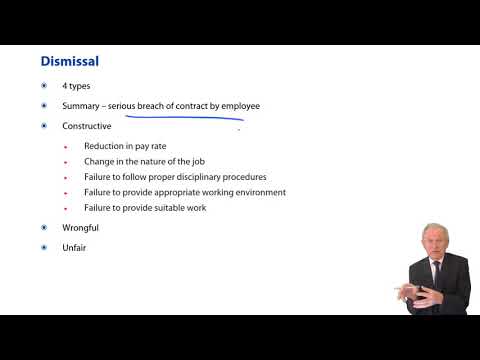
3 Dismissal
4 types
Summary – serious breach of contract by employee
Constructive
Reduction in pay rate
Change in the nature of the job
Failure to follow proper disciplinary procedures
Failure to provide appropriate working environment
Failure to provide suitable work
Wrongful
Unfair
4 Wrongful Dismissal
Not wrong if justified. If wrong, remedy is damages – lost earnings
Justified if :-
Disobedience
Dishonesty
Incompetence / negligence
Immorality
Drunkenness
Misconduct
Accepting money
Assault
Disclosure of information
5 Unfair Dismissal
Automatically unfair
Imprisonment is not automatically unfair; the employer must identify a potentially fair reason and follow a fair procedure
A transfer-related dismissal is generally automatically unfair unless there is an economic, technical or organisational reason entailing workforce changes
Exercising rights re length of working day
Insistence on minimum wage
Certain workers have statutory protection relating to Sunday working, subject to the relevant conditions
Taking steps to ensure health and safety
Trade union membership or activities
Whistle blowing
6 Unfair Dismissal
Ordinary unfair-dismissal claims generally require two years’ continuous employment; automatically unfair grounds are separate
Specific statutory exclusions or restrictions
Participation in unofficial industrial action may restrict ordinary unfair-dismissal protection under statutory rules
National-security cases are governed by specific statutory and procedural rules
Potentially fair
Incapable
Not competent to do the work for which employee is qualified
Redundancy, see later
Legal reasons eg losing driver’s licence when employed as a chauffeur
Losing qualifications – eg becoming disqualified as a doctor
7 Redundancy
A form of dismissal from employment caused by the employer needing to reduce the workforce
Reasons include:-
new technology or a new system makes your job unnecessary
the job no longer exists
the need to reduce the labour costs means staff numbers must be reduced
the business is closing down or re-locating
If fewer than 20 redundancies are proposed, individual consultation applies
this involves direct consultation and ...
... looking at any alternative to redundancy
if no consultation takes place, any redundancy may be unfair dismissal
If 20 or more redundancies are proposed within 90 days at one establishment, collective consultation applies
Collective consultation is with employee representatives and must start at least 30 days before the first dismissal for 20–99 redundancies, or 45 days for 100 or more
if no consultation takes place, a claim to an Employment Tribunal could result in compensation of up to 90 days’ pay
selection of redundant workers should be fair and objective
Unfair or non-objective redundancy selection may make the dismissal unfair; it is not automatically unfair in every case
Employment Law
9 questionsAnswer the questions one at a time. Your progress is saved so you can leave and come back.
Open chapter practice