
Contract Law


1 Invitations, offers and acceptance
A contract is an agreement, supported by consideration, made with intention to create legal relations.
An invitation must be distinguished from an offer
An invitation is not capable of acceptance
An invitation is inviting another person to make an offer
Goods in a supermarket are invitations (Pharmaceutical Society of Great Britain v Boots Cash Chemists)
Goods in a shop window are invitations (Fisher v Bell)
Adverts are normally invitations (Partridge v Crittenden)
Very occasionally, adverts may be taken to be offers (Carlill v Carbolic Smoke Ball Co)
Mail catalogues are invitations (Grainger v Gough)
The process of an auction sale constitutes the auctioneer inviting offers to be made
An advert offering a reward is an offer, not an invitation (Williams v Carwardine, R v Clark, Carlill v Carbolic)
2 Termination of Offer
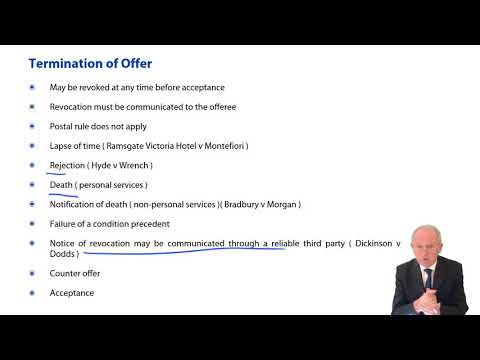
May be revoked at any time before acceptance
Revocation must be communicated to the offeree
Postal rule does not apply
Lapse of time (Ramsgate Victoria Hotel v Montefiori)
Rejection (Hyde v Wrench)
Death (personal services)
Notification of death (non-personal services)(Bradbury v Morgan)
Failure of a condition precedent
Notice of revocation may be communicated through a reliable third party (Dickinson v Dodds)
Counter offer
Acceptance
Refusal
3 Offers
Half of the ‘agreement’
An expression of willingness to be bound on specific terms
Must be certain (Gunthing v Lynn)
Must still exist when ‘accepted’
Must be distinguished from invitations
Must be distinguished from statements of intent (Harris v Nickerson)
A response to a request for information is not an offer (Harvey v Facey)
A request for information is not a counter offer (Stevenson v McLean)
Revocation must actually be communicated to the offeree (Byrne v Van Tienhoven)
May be made to the world at large (R v Clark, Williams v Carwardine, Carlill v Carbolic)
4 Acceptance

The other half of the ‘agreement’
Acceptance must be complete and unconditional
Acceptance cannot vary the original offer. That would be a counter-offer (Northland Airlines v Dennis Ferranti Meters)
The offer must still be ‘open’ at the time of acceptance (Hyde v Wrench)
Acceptance must be communicated to the offeror, but offeror may waive the right of communication (Carlill v Carbolic)
It may be communicated by a reliable third party (Powell v Lee)
Silence cannot be acceptance (Felthouse v Bindley)
Acceptance may be by conduct (Brogden v Metropolitan Railways)
Once you’ve started the acts of acceptance the offeror cannot revoke the offer (Errington v Errington)
Postal rule applies (Household Fire Insurance Co v Grant)
Acceptance must be made within a reasonable time (Ramsgate Victoria Hotel v Montefiori)
5 Consideration
Simple contracts require consideration; deeds do not
Consideration is a two-way thing in simple/parol contracts (only one way is necessary in specialty contracts/deeds)
Currie v Misa
Dunlop v Selfridges
Executed – an act in exchange for a promise
Executory – a promise in exchange for a promise (or an act)
Past consideration is no consideration (re McArdle), (Roscorla v Thomas)
Consideration must be legal and possible
Consideration must move from the promisee
privity is the separate rule governing who may enforce a contract
Courts may imply an implied promise to pay a reasonable sum (Lampleigh v Braithwait)
6 Consideration – Sufficient Not Necessarily Adequate

Courts will not look at the adequacy of agreed consideration
Consideration must have some value (sufficient)(Chappell v Nestle)
Not sufficient if in accordance with a natural duty already owed (White v Bluett)
Not sufficient if in accordance with a legal duty already owed (Collins v Godefroy)
Not sufficient if in accordance with a contractual duty already owed (Stilk v Myrick)
If over and above a natural duty, OK (Ward v Byham)
If over and above a legal duty, OK (Glasbrook v Glamorgan)
If over and above a contractual duty, OK (Hartley v Ponsonby)
Williams v Roffey
Thomas v Thomas
7 Privity of Contract

Only a party to a contract may sue to enforce it, but there are exceptions
Under the Contracts (Rights of Third Parties) Act 1999, a third party may enforce a term where the Act’s conditions are met
A principal may sue to enforce a contract entered into by his agent
A holder-in-due-course of a bill of exchange can sue all prior parties
Where a special relationship exists; for example, an executor may sue to enforce a contract entered into by the deceased (Beswick v Beswick)
A beneficiary may sue a trustee (Keech v Sandford) (Shamia v Joory)
Manufacturer liability to an ultimate consumer belongs to tort (Donoghue v Stevenson), not to the exceptions to privity
Employer vicarious liability belongs to tort (Mersey Docks v Coggins), not to the exceptions to privity
Restrictive covenants on land apply to subsequent owners (Tulk v Moxhay)
In collateral contracts, an injured party can sue even though the other party is not a party to the contract (Shanklin Pier v Detel Products)
8 Pinnell and its Exceptions
General principle – part payment of a debt does not achieve full settlement (Pinnell’s case)
Illustrated by Foakes v Beer, but there are exceptions
Receiving something different to which you were not already entitled
Goods instead of cash
Settlement before the due date
Arrangement with creditors generally that collectively they agree to accept only part payment
Payment by someone other than the debtor (Welby v Drake)
Payment at a different location than originally agreed
Doctrine of promissory estoppel
Central London Property Trust v High Trees House
Combe v Combe
D & C Builders v Rees
9 Intention to Create Legal Relations

May be express or implied
Presumed unless rebutted
Domestic arrangements, husband and wife, living together
Balfour v Balfour
Spellman v Spellman
Domestic arrangements, husband and wife, living apart
Merritt v Merritt
Domestic arrangements, other than husband and wife
Simpkin v Pays
Jones v Padavatton
Parker v Clark
Commercial agreements
Rose & Frank v Crompton
Express exclusions – binding in honour only
Jones v Vernon Pools
Appleson v Littlewoods
Presumptions – assumed until proved otherwise
Rebuttal – disproving a presumption
Carlill v Carbolic – payment of £1,000 into bank account
10 Representations
Not terms of a contract
Pre-contractual statements of some known or provable fact made with the intention of inducing another person to enter a contract
Not a statement of law
Nor or opinion, unless...
... it is clearly not a genuine opinion (Bisset v Wilkinson)
Not a statement of intent
if the representation is false, that’s a misrepresentation
11 Contractual Terms

Conditions and warranties
A term which is a condition is fundamental to the contract
Breach of a term which is a condition allows the injured party to treat the contract as discharged and sue for damages
Poussard v Spiers and Pond
A warranty is superficial to the contract
Breach of warranty allows the injured party to claim damages
But the contract is not discharged
Bettini v Gye
Innominate terms are those where it is not clear, until breached, whether they are fundamental or merely superficial
Hong Kong Fir Shipping v Kawasaki Kisen Kaisha (leading authority on innominate terms)
12 Contractual Terms
May be express or implied
Express terms are those agreed by the parties and may be written into the contract or simply agreed orally
Implied terms may be judicially or statutorily implied
Judicially implied terms -business efficacy (The Moorcock) (Express Newspapers v Silverstone)
Judicially implied terms – trade custom (Hutton v Warren)
Judicially implied terms – course of trade (Hillas v Arcos)
For business-to-consumer contracts, the Consumer Rights Act 2015 requires goods to be of satisfactory quality, fit for purpose and as described, and services to be performed with reasonable care and skill
Title
Satisfactory quality
Fit for purpose (Brown v Craiks)
Sample
Description
Limited ability to exclude statutorily implied terms
Term re title cannot be excluded in ANY contract
Sale of Goods Act rules remain relevant mainly to non-consumer sales
13 Exclusion Clauses
Used in contracts in an attempt to eliminate or limit the extent of a breaching party’s liability
Must be communicated to the other party at the time the contract is entered into (Olley v Marlborough Court Hotel) (Thornton v Shoe Lane Parking)
Should be brought to the attention of the other party (Chapelton v Barry UDC) (Thompson v LMS Railway)
Where a document apparently has a legal affect, should make sure before you sign it (L’Estrange v Graucob)
Oral statements by an employee can destroy the effectiveness of an exclusion clause (Curtis v Chemical Cleaning Co)
Where parties have a history of trade, other party may be deemed to be aware of the exclusion clause (Spurling v Bradshaw)
But this course of trade should be more than 3 or 4 occasions in the previous 5 years (Hollier v Rambler Motors)
Hardwick v Suffolk – more than 100 times in a 3 year period
Any ambiguity will be read strictly against the party seeking to rely on it (Andrews v Singer)
Possible to exclude liability for fundamental breach (PhotoProductions v Securicor)
14 Unfair Terms Legislation
Consumer Rights Act 2015 governs consumer unfair terms; UCTA 1977 applies principally to business and other non-consumer exclusions
Restrict or limit extent of liability for negligence in consumer contracts
Some are void, others are subject to a test of reasonableness
Cannot exclude liability for negligence resulting in death or personal injury
Cannot exclude liability for partial or incomplete performance by the seller
Cannot have a term which binds the consumer but allows seller to avoid the contract
Reasonable? S11 UCTA 77 takes account of :
Relative bargaining power
Any inducement offered, or normal trade custom
Special ordered goods
Fair and equitable treatment of the consumer by the seller
Extent of ability to cover by insurance
Regulations apply to terms which have not been separately negotiated
A consumer is a ‘natural person who is acting for purposes outside his business’
An unfair term is “any term which causes a significant imbalance in the parties’ rights and obligations to the detriment of the consumer”
15 Breach of Contract

May be ‘during’ or ‘anticipatory’
‘During’ – one party refuses to continue
injured party may treat the contract as discharged (if a breach of condition) and sue for damages immediately
‘Anticipatory’ - one party gives notice, before the contract start date, that they will not go ahead with their obligations
injured party may sue immediately (Hochster v De La Tour)
or ignore, go ahead with their obligations, and then sue (White and Carter Councils v MacGregor)
or wait, and hope the other party will change their minds
but if they choose to wait, they could lose their right to sue (Avery v Bowden)
to be able to achieve full compensation, the injured party must have been in a position to complete their obligation at the date the contract was due to start
The Mihalis Angelos
16 Damages
2 parts to ‘damages’- remoteness and measurement
An award of damages is the main common law remedy
Intended to be an award of monetary compensation
It is not intended as a punishment
Remoteness – only awarded if the damage suffered should have been in the reasonable contemplation of the ordinary man
Loss suffered should either arise as a natural consequence of the breach or…
…the breacher was aware of the special circumstances of the injured party
Hadley v Baxendale
Victoria Laundry v Newman Industries
Re The Heron II
17 Damages – Measurement
Courts determine how much award is necessary to put the injured party into the position they would have achieved if there had been no breach
C & P Haulage v Middleton
May take account of speculative loss (Thompson v Robinson)
….but may not (Anglia TV v Reed) (Lazenby Garages v Wright)
may consider non-financial loss
Jarvis v Swan Tours
…but may not (Alexander v Rolls Royce)
if the cost of ‘repair’ far outweighs the loss suffered, courts may make an award based on loss of amenity
Ruxley Electronics v Forsyth
The injured party has a duty to mitigate their loss
Contract Law
13 questionsAnswer the questions one at a time. Your progress is saved so you can leave and come back.
Open chapter practice