
Financial performance (profitability)



Gross profit margin
An increase in gross profit margin indicates that variable costs, raw materials, labour, power etc are not rising as quickly as selling prices, whilst a decrease will indicate the opposite.
Changes in the gross profit margin over time should be analysed further to identify the cause: has the company introduced new products? Is it cutting prices to increase market share? Was it unable to pass on inflationary price increases?
Operating profit margin
This will differ from the gross profit margin in that operating expenses, e.g. wages/salaries and depreciation are deducted. An analysis of the causes of changes in this percentage might reveal that the company's other costs are increasing/decreasing at a greater rate than sales.
Return on capital employed
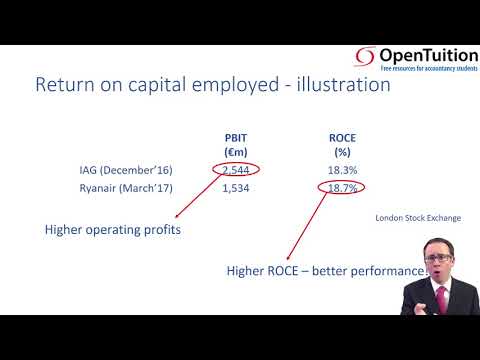
This measures the level of returns a business has made using the capital it has within it. It allows for comparison of overall performance year on year as well as allowing comparison to an entity in a similar industry of different size measuring the business’s efficiency.
Take the profit figure from the right line. Return on capital employed uses profit before financing and income taxes, as the layout above shows, and the operating profit margin uses operating profit — profit before income taxes is neither, and using it also makes the two years incomparable if borrowings have changed. Where a requirement itself states the formula for a ratio, that is the formula to use, however you learned it.
Net asset turnover
* Capital employed = shareholders’ funds + interest bearing debt.
This measures the efficiency of a business in generating revenue from its capital employed. The minimum investment in capital employed to generate revenue is another indicator of efficiency.
Some factors to consider:
Timing of Sales
Asset efficiency vs profitability
Asset valuation policies

ROCE
The following extracts are from Hassan’s financial statements:
$ | |
Profit before financing and income taxes | 10,200 |
Interest expense on borrowings and lease liabilities | (1,600) |
Income taxes | (3,300) |
Profit | 5,300 |
Share capital | 20,000 |
Reserves | 15,600 |
35,600 | |
Loan liability | 6,900 |
42,500 |
What is Hassan’s return on capital employed?
A | 15% |
B | 29% |
C | 24% |
D | 12% |
Show answerHide answer

Financial performance (1)
Archer Co is a retailer and trades through its stores on the high street, selling high quality goods. The company has recently been suffering from rising costs, that it has been unable to pass on to its customers. In response to the number of people shopping via the Internet, Archer Co has implemented a cost cutting strategy in the prior year, and in the current year asked shareholders for funds to help reduce it debt burden. The following financial information for the current year is available:
Statement of profit and loss for the year ended 31 May 2019 | |||
2019 | 2018 | ||
Revenue | 42,000 | 45,000 | |
Cost of sales | (19,000) | (17,000) | |
Gross profit | 23,000 | 28,000 | |
Operating expenses | (10,000) | (17,000) | |
Operating profit | 13,000 | 11,000 | |
Interest on borrowings and lease liabilities | (700) | (1,000) | |
Profit before income taxes | 12,600 | 10,000 | |
Income tax expense | (3,150) | (2,500) | |
Profit | 9,450 | 7,500 | |
Calculate the following ratios for the years ending 31 May 2019 and 31 May 2018:
Gross margin
Operating margin
Using the information provided and the ratios calculated above, comment on the comparative performance for the two years ended 31 May 2019 and 2018.
Show answerHide answer
Financial performance (2)
A Co and B Co both operate in the retail sector selling children’s clothes.
Extracts from the draft financial statements for the companies for the year ended 31 December 20X0 are as follows:
A Co | B Co | ||
Revenue | 180,000 | 150,000 | |
Cost of sales | (136,000) | (105,000) | |
Gross profit | 44,000 | 45,000 | |
Operating expenses | (20,000) | (18,000) | |
PBFIT | 24,000 | 27,000 | |
Interest on borrowings and lease liabilities | (4,000) | (2,000) | |
Profit before income taxes | 20,000 | 25,000 |
The following information is also relevant:
A Co manufactures and retails premium branded children’s clothes, which it sells online and in its own international chain of branded stores.
B Co sells mid-market children’s clothes in department stores. It sources its goods directly from the manufacturer and does not make international sales. B Co is looking to expand its operations to include the international market in the future.
Following an impairment review A Co suffered an impairment in the year of $10 million. The impairment expense is included within operating expenses.
Using the financial statement extracts provided, calculate the following ratios for both A Co and B Co:
(i) Gross profit margin
(ii) Operating profit margin
(iii) Interest cover
Comment on the performance of both companies for the year ended 31 December 20X0.
Show answerHide answer
Financial performance analysis (ratios)
10 questionsAnswer the questions one at a time. Your progress is saved so you can leave and come back.
Open chapter practice