
Foreign exchange risk management


1 Introduction
Globalisation has served to increase the amount of foreign trade which has in turn increased the amount of foreign currency transactions that companies have. Any dealing in foreign currency presents the problem of the risk of changes in exchange rates. The adoption in most of Europe of the single currency – the euro – has removed the problem for companies trading within Europe, but for trading with companies in other countries an important role of the financial manager is to look for ways of removing or reducing this risk.
This chapter looks at the different ways available for the removal or reduction of the risk of changes in exchange rates.
2 Types of risk
2.1 Transaction risk
This is the risk that a transaction in a foreign currency at one exchange rate is settled at another rate (because the rate has changed). It is this risk that the financial manager may attempt to manage and forms most of the work in the rest of this chapter.
2.2 Translation (or accounting) risk
This relates to the exchange profits or losses that result from converting foreign currency balances for the purposes of preparing the accounts.
These are of less relevance to the financial manager, because they are book entries as opposed to actual cash flows.
2.3 Economic risk
This refers to the change in the present value of future cash flows due to unexpected movements in foreign exchange rates. E.g. raw material imports increasing in cost.
3 The foreign exchange market
The foreign exchange market is known as FOREX. The biggest centre is the London FOREX market, although since the market is very competitive virtually no differences exist between one FOREX market and another.
4 Exchange rates
The exchange rate on a given day is known as the spot rate and two prices are quoted, depending on whether we are buying or selling the currency – the difference is known as the spread.
In the examination, the way exchange rates are quoted is always the amount of the first mentioned currency that is equal to one of the second mentioned currency.
For example, suppose we are given an exchange rate as follows:
$/£ 1.6250 – 1.6310
In this quote, the first number (1.6250) is the exchange rate if we are buying the first mentioned currency ($’s), and (1.6310) is the rate if we are selling the first mentioned currency ($’s).
(Alternatively, if you prefer, the first number is the rate at which the bank will sell us $’s and the second number the rate at which the bank will buy $’s from us. It is up to you how you choose to remember it, but it is vital that you get the arithmetic correct!)
Settle which side of the spread applies before any arithmetic. Decide which currency you are buying and which you are selling, then read the rule above — the same pair of figures gives a different answer for a payment and for a receipt. Taking the wrong one carries the error through the whole hedge.
A plc receives $100,000 from a customer in the US.
The exchange rate is $/£ 1.6250 – 1.6310.
How many £’s will A plc receive?
Usually the questions in the examination relate to real currencies (such as dollars and euros). However, occasionally the examiner invents currencies which makes the answer a little less obvious – it becomes even more important that you know the rules.
Jimjam is a company based in India, where the currency is the Indian Rupee (IR). They owe money to a supplier in Ruritania, where the currency is Ruritanian Dollars (R$). The amount owing is R$ 240,000.
The current exchange rate is IR/R$ 8.6380 – 9.2530
How many Indian Rupees will Jimjam have to pay?
5 Methods of hedging transaction exposure
In the above examples, our answers are (hopefully!) correct provided that we convert the money at the spot rate. The problem is that if the transaction is not going to take place until some time in the future, the exchange rate stands to change. We obviously have no idea what the rate will be – it may change to our advantage or to our disadvantage – and therefore there is risk.
The following methods of removing or reducing this risk are the methods of which you must be aware for the examination:
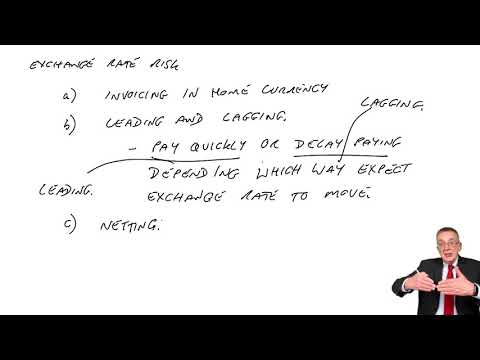
Invoicing in home currency
Leading and lagging
Netting
Matching
The above methods do not require any special techniques, but in addition you must have knowledge of the following:
forward contracts
money market hedges
currency futures
currency options
currency swaps
You can be required to perform calculations for the first two methods. For the other three you will not be required to do calculations but are required to understand the idea behind them.
6 Forward contracts

If a company wishes to buy or sell foreign currency at some date in the future, then they can obtain a quote from the bank today which will apply on a fixed date in the future. Once the quote has been accepted, that rate is then fixed (on the date, and on the amount specified) and what happens to the actual (or spot) rate on the date of the transaction is then irrelevant.
X is due to pay $200,000 in 1 months time.
Spot $/£ 1.4820 – 1.4905
1 month forward $/£ 1.4910 – 1.4970
If X contracts 1 month forward, how much will he have to pay in 1 months time (in £’s)?
Forward rates are also quoted in the financial press for certain currencies and for certain time periods. In the press the forward rates are quoted as differences from spot. The difference is expressed in the smaller units of currency (e.g. cents, in the case of the US), and is expressed as a premium or a discount depending on whether we should deduct or add the discount to the spot rate.
Y is due to receive $150,000 in 3 months time.
Spot $/£ 1.5326 – 1.5385
3m forward 0.62 – 0.51 c pm
How much will Y receive?
Example 5
Z is due to pay $200,000 in 2 months time.
Spot $/£ 1.6550 +/- 0.0018
2m forward $/£ 1.6623 +/- 0.0020
How much will Z pay?
7 Money market hedging
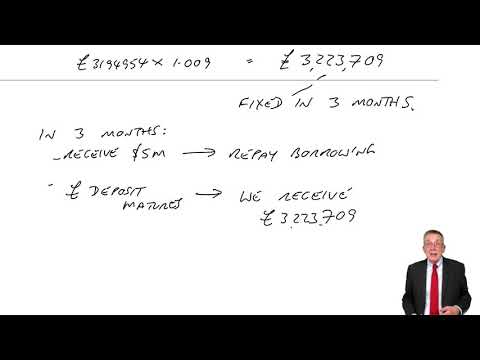
This approach involves converting the foreign currency at the current spot, which therefore makes future changes in the exchange rate irrelevant. However, if we are (for example) not going to receive the foreign currency for 3 months, then how can we convert the money today? The answer is that we borrow foreign currency now at fixed interest, on the strength of the future receipt.
P is due to receive $5M in 3 months time.
Spot: $/£ 1.5384 – 1.5426
Current 3 month interest rates: US prime 5.2% – 5.8%
UK LIBOR 3.6% – 3.9%
Show how P can use the money markets to hedge the risk.
Example 7
Q is due to pay $8M in 3 months time.
Spot: $/£ 1.6201 – 1.6283
Current 3 month interest rates: US prime 6.4% – 6.9%
UK LIBOR 9.2% – 9.9%
Show how Q can use the money markets to hedge the risk.
8 Currency futures

If we buy a sterling futures contract it is a binding contract to buy pounds at a fixed rate on a fixed date. This is similar to a forward rate, but there are two major differences:
delivery dates for futures contracts occur only on 4 dates a year – the ends of March, June, September and December.
futures contracts are traded and can be bought and sold from / to others during the period up to the delivery date.
For these two reasons, most futures contracts are sold before the delivery date – speculators use them as a way of gambling on exchange rates. They buy at one price and sell later – hopefully at a higher price. To buy futures does not involve paying the full price – the speculator gives a deposit (called the margin) and later when the future is sold the margin is returned plus any profit on the deal or less any loss. The deal must be completed by the delivery date at the latest. In this way it is possible to gamble on an increase in the exchange rate. However, it is also possible to make a profit if the exchange rate falls! To do this the speculator will sell a future at today’s price (even though he has nothing to sell) and then buy back later at a (hopefully) lower price. Again, at the start of the deal he has to put forward a margin which is returned at the end of the deal plus any profit and less any loss.
The role of the financial manager is not to speculate with the company’s cash, but he can make use of a futures deal in order to ‘cancel’ (or hedge against) the risk of a commercial transaction.
Here is a simple example just to illustrate the basic principles.
Please note that you cannot be asked for any calculations in this examination.
R is in the US and needs £800,000 on 10 August.
Spot today (12 June) is: $/£ 1.5526 – 1.5631
September $/£ futures are available. The price today (12 June) is 1.5580.
Show the outcome of using a futures hedge (assuming that the spot and the futures prices both increase by 0.02).
8.1 Note:
the futures price on any day is not the same as the spot exchange rate on that date. They are two different things and the futures prices are quoted on the futures exchanges – in London this is known as LIFFE (the London International Financial Futures Exchange). More importantly, the movement in the futures price over a period is unlikely to be exactly the same as the movement in the actual exchange rate. The futures market is efficient and prices do move very much in line with exchange rates, but the movements are not the same (unlike in the simple example above).
In practice any deal in futures must be in units of a fixed size. It is therefore not always possible to enter into a deal of precisely the same amount as the underlying transaction whose risk we are trying to hedge against.
For both the above reasons, the use of futures is unlikely to result in a perfect hedge.
9 Options
If we know that we are going to need to convert currency at a future date but we think that the exchange rate is going to move in our favour, then it would be more sensible to leave the transaction to be converted at spot on the relevant date, rather than hedge against the risk and therefore not receive the benefit of the exchange rate movements.
The above would be perfectly sensible if we were certain that the rate was going to move in our favour, but of course it is impossible to be completely certain and therefore there would still be a risk that we were wrong and that the rate moved against us.
In this situation – where we are reasonably confident that the rate will move in our favour – then it might be worthwhile considering a currency option. With a currency option we have the right (or option) to convert at a fixed rate on a future date (as with the use of a forward rate), but we do not have to exercise the right.
As a result, if the exchange rate does move in our favour then we will throw away the option and simply convert at whatever the spot rate happens to be. If, however, the exchange rate moves against us then we will use the option and convert at the fixed rate.
Since we will get the benefit of any movement in our favour, but not suffer if the exchange rate moves against us, options do not come free! We will have to pay (now) for the option whether or not we eventually decide to use it. The amount we have to pay is called the option premium.
9.1 OTC options
OTC stands for ‘over-the-counter’ and refers to the buying of an option as a private deal from a bank. The company will approach the bank stating the amount, the future date, and the exchange rate required, and the bank will quote a premium. It is then up to the company whether or not to accept the quote and purchase the option.
It is 1 April and X plc expects to receive $2 million on the 30th June.
The current spot rate is $/£ 1.5190 and X expects that this rate will move in their favour.
They have purchased from the bank an option to sell $2 million on 30 June at an exercise price of $/£ 1.5200, and the bank have charged a premium of £50,000.
Show the outcome on 30 June if the spot exchange rate on that date is:
(a) $/£ 1.5180
(b) $/£ 1.6153
9.2 Traded options
As an alternative to buying a ‘tailor-made’ OTC option from a bank, it is possible to buy and sell currency options on the currency exchanges. A benefit of this is that the premiums are driven by market forces and the company can therefore be more certain of paying a fair price. However, traded options are only available between major currencies, at various quoted exchange rates, exercisable on various quoted dates, and for fixed size units.
10 Currency swaps
Currency swaps are much less popular than interest rate swaps (which will be explained in a later chapter).
They are best explained by way of a short illustration:
A UK company is intending to invest in the US and will therefore be earning income in $’s. They need to borrow money for the investment and have decided to borrow $’s (as a way of reducing the impact of changes in exchange rate – the closer their interest payments are to their receipts the less the effect on them of exchange rate movements).
Another company in the US is intending to invest in the UK and for the same reasons as above they wish to borrow £’s.
Both companies can organise their borrowing independently, but a US company is likely to be able to borrow $’s at a lower interest rate than a UK company (and vice versa).
10.1 A solution which stands to benefit both companies is as follows:
the UK company borrows £’s and the US company borrows an equivalent amount of $’s. The two parties then swap funds at the current spot rate.
The UK company agrees to pay the US company the annual cost of the interest on the $ loan. In return the US company pays the £ interest cost of the £ borrowing by the UK company.
At the end of the period the two parties then swap back the principal amounts. This could be at the prevailing spot rates or at a predetermined amount in order to reduce foreign exchange transaction exposure.
Swaps are generally arranged by banks (who act as a ‘dating agency’ finding the parties to a swap). The bank will arrange guarantees, but they will charge commissions for their service.
More recently there has been a tendency for large companies to arrange swaps directly with each other (and not using banks, thus saving costs). The tendency is known as ‘disintermediarisation’ (!!).
Foreign exchange risk management
10 questionsAnswer the questions one at a time. Your progress is saved so you can leave and come back.
Open chapter practice