
Depreciation


1 Introduction
In this chapter we will explain what depreciation is and why it is needed. We will also look at the different methods of calculating depreciation of which you need to be aware, and the accounting entries.
2 Non-current assets
A non-current asset is an asset intended for use on a continuing basis in the business.
A tangible non-current asset is one that can be touched and refers to such items as plant, buildings and motor vehicles.
A non-tangible non-current asset is one that cannot be touched and refers to such items as goodwill and patents (we will cover these in a later chapter).
3 Depreciation
Depreciation is the charging of the cost of a non-current asset over its useful life.
The purchase of a car for $10,000 is an expense of running the business just as electricity is an expense. However, if the car is expected to last 5 years, it would be misleading to have one expense in the Statement of Profit or Loss of $10,000 every 5 years and nothing in the other years. It would be more sensible to reflect the fact that the car is being used in the business over 5 years by charging an expense each year of (say) $2,000.
The charge of $2,000 in the Statement of Profit or Loss each year is known as depreciation. At the same time, the Statement of Financial Position value of the car will be reduced by $2,000 each year to reflect the fact that it is being used up.
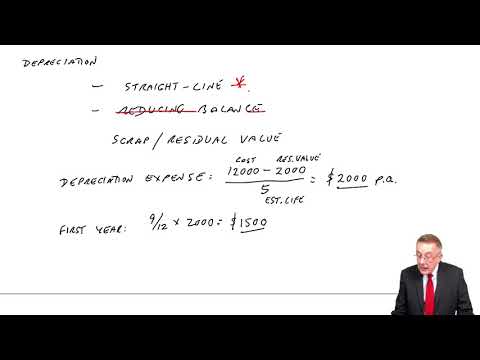
The way in which $2,000 was calculated in the above illustration is known as the straight-line method of depreciation. There are other methods and we will cover the methods that you need to know in the following sections of this chapter.
The purpose of depreciation is not to place a true value on the asset in the Statement of Financial Position. It is a method of applying the accruals, or matching, concept by charging the cost of the asset to the Statement of Profit or Loss as it is being used up.
4 Methods of calculating depreciation
There are several methods of calculating depreciation. The methods that you are expected to be aware of are the following:
straight line method
reducing balance method
These are the most common methods in practice.
Straight line method
Under this approach we charge an equal amount of depreciation each year.
The depreciation charge each year is calculated as:
Original cost – residual value |
Estimated useful life |
Sarkans has a year end of 31 December each year.
On 1 April 2002 he purchases a car for $12,000. The car is expected to last for 5 years and to have a scrap value at the end of 5 years of $2,000.
You are required to calculate the depreciation charge for each of the first three accounting periods, and to show extracts from the Statement of Financial Position and Statement of Profit or Loss for each of the three accounting periods.
Show answerHide answer
(Note, in the first accounting period we have charged a fraction of the annual depreciation because the asset was purchased during the year. A very common alternative in practice is to charge a full year in the year of purchase, regardless of when in the year it was actually purchased. In the examination, read the question carefully. If you are told to charge a full year in the year of purchase then do so. If you are not told, then charge a fraction (or time-apportion) as above.)
Reducing (or Diminishing) balance method
Under this approach we charge more depreciation in the early years of an asset’s life, with a progressively lower charge in each subsequent year.
The depreciation charge each year is a fixed percentage of the net book value (or written down value) at the end of the previous year.

Zils has a year end of 31 December each year.
On 5 April he purchased a machine for $15,000.
His depreciation policy is to charge 20% diminish balance, with a full years charge in the year of purchase.
You are required to calculate the depreciation charge for each of the first three accounting periods, and to show extracts from the Statement of Financial Position and Statement of Profit or Loss for each of the three accounting periods.
Show answerHide answer
5 Accounting for depreciation
Whichever method is used, the accounting entries are the same.
We will illustrate the required entries using an example, and will then summarise the entries afterwards.

Melns has a year end of 30 June each year.
On 1 January 2002 he purchased a car for $15,000.
The car has an expected life of 5 years, with an estimated scrap value of $1,000.
Melns depreciation policy is to use straight line depreciation.
Show the accounting entries for the first three accounting periods.
Show answerHide answer
The accounting entry for charging depreciation each year is:
Debit Depreciation Expense account
Credit Accumulated Depreciation account
The balance on the Depreciation Account will appear in the Statement of Profit or Loss as an expense.
The balance on the Accumulated Depreciation account will appear in the Statement of Financial Position as a deduction from the cost of the asset.
6 Sale of non-current assets
In practice it is unlikely that an asset will be kept for the precise useful life that was estimated for depreciation purposes – it might be kept for a longer period or for a shorter period. It is also extremely unlikely that any sale proceeds will exactly equal the value of the asset as shown in the financial statements.
On sale, we remove the asset from our books and calculate any difference between the proceeds and the value in the financial statements. This difference (which is really the effective over or under charge of depreciation) is called the profit or loss on sale and is shown in the Statement of Profit or Loss.

In example 3, Melns sells the car on 30 September 2004 for $6,500.
Write up the ledger accounts for his fourth accounting period and show extracts from his Statement of Financial Position and Statement of Profit or Loss.
Show answerHide answer
Note that in this example we have charged depreciation in the year of sale for the 3 months the car was owned. Very often you will be told that the depreciation policy is to charge no depreciation in the year of sale. The net result in the Statement of Profit or Loss will be exactly the same.
Summary of the accounting entries for the sale of a non-current asset:
DR Disposal Account
CR Asset Account
with the cost of the asset sold
DR Accumulated Depreciation Account
CR Disposal Account
with the accumulated depreciation on the asset sold
DR Cash
CR Disposal Account
with the proceeds of sale
The balance remaining on the Disposal Account is the profit or loss on sale. This should be transferred to the Statement of Profit or Loss.
7 Revaluation of non-current assets
During a period of high-inflation, the value of non-current assets may be well in excess of their carrying value (net book value).
In this situation a company may choose to show the current worth of such assets on their Statement of Financial Position.
Any profit resulting from such revaluation is an unrealised profit (in that the asset has not been sold and therefore no real profit has actually been made). As a result, the profit is shown separately from the Statement of Profit or Loss in a revaluation reserve. (For a limited company this must be the case. For a sole trader, where the owner has unlimited liability, this is not a rule even though it is good practice.)
IAS 16 Property, Plant and Equipment requires that when an item of property, plant or equipment is revalued, then the entire class of property, plant and equipment to which the asset belongs must be revalued.
When a non-current asset has been revalued, the future charge for depreciation should be based on the revalued amount and the remaining economic life of the asset.
The depreciation charge will be higher than it was before the revaluation, and the excess of the new charge over the old charge should be transferred from the revaluation reserve to retained earnings.
Purpurs has a year end of 31 December each year.
In his Statement of Financial Position as at 31 December 2002 he has buildings at a cost of $3,600,000 and accumulated depreciation of $1,080,000.
His depreciation policy is to charge 2% straight line.
On 30 June 2003, the building is to be revalued at $3,072,000. There is no change in the remaining estimated useful life of the building.
Show the relevant ledger accounts for the year to 31 December 2003.
Show answerHide answer
8 The non-current assets register
In its nominal ledge, a business will typically have accounts for the cost of each class of non-current asset e.g. buildings, plant and machinery. There will also be accounts for the accumulated depreciation for each class of non-current asset.
Every time a new item is bought, its cost will be debited to the appropriate cost account. The cost accounts therefore keep track of the total cost of each type of non-current assets and similarly the accumulated depreciation accounts keep track of the total accumulated depreciation for each type of asset.
However, more detailed information is also required. For example, when an assets is sold its depreciation to date has to be transferred to the disposals account, so records are needed of how much depreciation attaches to each individual assets. Similarly, if we are using straight-line depreciation and an asset is fully written down to zero book value, no more depreciation should be applied to it.
The more detailed information needed is recorded in a non-current asset register; this is a memorandum record and is not part of the double-entry system.
The non-current assets register has a page for each non-current asset.
Typically it will list out:
Information | Reason for the information |
Cost | Basic accounting information. Needed for depreciation calculations and on the disposal of the asset. The sum of the costs of the assets should agree to the amount in the cost account in the nominal ledger. |
Date purchased | Might be needed for depreciation calculations or the identification of old assets. |
Accumulated depreciation | Basic accounting information. Needed for depreciation calculations and on the disposal of the asset. The sum of the accumulated depreciation of the assets should agree to the amount in the accumulated depreciation account in the nominal ledger. |
Depreciation method | Needed for depreciation calculations. |
Estimated residual value | Needed for depreciation calculations if using straight-line depreciation. |
Supplier’s name, address, and the item’s serial number | Needed for maintenance and renewal of assets |
Location of the asset | Needed for physical inspection of the asset or for routine maintenance checks. |
Date asset last inspected | Needed for auditing, maintenance and safety procedures. |
Date asset scrapped or sold | Needed for auditing purposes. |
Depreciation
5 questionsAnswer the questions one at a time. Your progress is saved so you can leave and come back.
Open chapter practice