
Performance and appraisal interviews

1 Performance appraisal
We now come to look in another area of human resources management, performance appraisal.
The purpose of performance appraisal is first to improve the organisational performance and secondly to develop individuals. This should be a win-win process.
Developing individuals should motivate them. They feel that they’ve recognised, they feel their skills maybe growing how we maybe getting towards the top of the Maslow’s hierarchy of needs.
Improving organisational performance is very important. However, if you don’t let people know how they’re getting on, where they need to improve, or where they’ve done well, it is going to be relatively difficult to improve the organisation’s performance because that depends on the performance of the individuals employed.
2 Appraisal systems
It’s often said that there are three elements to an appraisal interview.
First, reward. What are we going pay these people next year?
Secondly, performance, looking back over the previous year and seeing whether people hit their targets and met their objectives.
And finally, potential, looking forward to the next period, setting objectives, listening to people’s preferences, deciding perhaps where they require training.
However some human resources professionals suggest that the reward part of the appraisal should be kept quite separate from the other two parts. They argue that there is more to reward than simply basing it on performance. For example, you have to look at the market rate and what the company can afford. It doesn’t look too good if you tell someone that they have done really well and then you immediately say, “…but we can’t give you much of a pay rise this year.” Some people therefore suggest that the reward part of the review should be about six months away from the other parts of the review.
3 Appraisal interviews
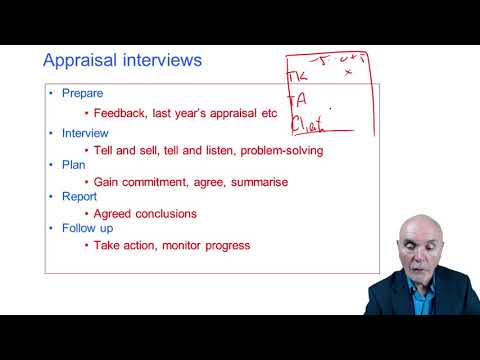
If appraisal interviews are not conducted properly they will almost certainly do more harm than good. Remember, the employee may have waited a year for their review and this is their chance to find out how they’ve been doing. If they go in and find you are not prepared and haven’t thought about their future, they are likely to be very disappointed.
S, the first thing you must to is to prepare the appraisal interview: look at what was said at last year’s appraisal interview; look at their job specification; look at any assessments which have been received from the colleagues or the superiors of that person. Make sure you know about any accomplishments such as examinations passed, and be prepared to say something about what they might be expected to be doing in the future.
If appraisals are not properly prepared and conduct the they will fall into disrepute. They might be regarded as simply a ‘box-ticking’ exercise done by managers because they are part of managers’ duties.
It is also important that there are a few barriers as possible to effective appraisal. For example, personal animosity (or perceived animosity) between the parties is likely to undermine the process. If you feel that your managers is biassed or reports from your colleagues are unfair then you are less likely to take them seriously. If the employee feels intimidated then they are less likely to listen and certainly less likely to interact with managers. It is also essential that managers are willing to constructively inform employees where improvement is needed. It can be easy for managers to avoid conflict by simply not mentioning unsatisfactory performance.
An appraisal should be primarily viewed as a way of improving employee performance by offering guidance and support rather than as an exercise in blaming employees for poor performance and only pointing out inadequacies.
There are a number of different ways of conducting the interview:
You can tell and sell. That’s more or less one-way communication. Typically, the manager presents the employee with a completed assessment sheet listing their performance across a number of areas such as technical ability, leadership, getting on with customers etc. This tells the employee what they’ve been doing well, what they’ve been doing badly, and the managers then sells those scores to the employee. In other words, convince them that the manager’s view is right. This is not regarded as a particularly useful approach.
Tell and listen. Again, the assessment sheet is already completed and the manager tells the employee what their point of view is. However, the employee is asked to respond and the manager listens. Obviously this needs and encourages two-way communication so that the employee feels more able to talk about problems and ambitions or to disagree with the manager’s assessments.
Problem-solving. The best of all, however, is the problem-solving approach. Here, manager and subordinate go through the performance together, jointly arriving at conclusions scores as to whether the various aspects of performance are satisfactory or not. Communication inevitably must be fairly comprehensive for this approach to work.
At the end of the appraisal interview, it is important for managers to gain commitment about what the employee is expected to do in the future, make sure everyone agrees on that and summarise it. There should be a report, probably two-part. The top copy can go to the employee with agreed conclusions and objectives. The other part will go on the personnel file.
A rating scale assesses performance across a range such as poor to excellent. Do not confuse it with ranking employees, a manager’s report, or feedback from colleagues.
Finally there should be follow-up. If you have arranged for training then make sure it takes place. If you have arranged for that employee to spend three months in another department make sure that takes place. If the employee has been having difficulty you may want to monitor their progress continually before waiting a whole year till their next appraisal interview.
Increasingly, companies are using 360 degree appraisals:
Managers appraise subordinates
Subordinates appraise their manager
Colleagues appraise each other
Performance and appraisal interviews
6 questionsAnswer the questions one at a time. Your progress is saved so you can leave and come back.
Open chapter practice