

ACCA Management Accounting (MA) teaches you how managers use costs, budgets, data and performance measures to make decisions. It is often described as a calculation paper, but passing requires more than memorising formulas: you must choose the right method, use data accurately and interpret what the answer means.
MA rewards steady practice. The mathematics is manageable, but small errors in units, timing, signs or rounding can turn a sound approach into a wrong objective-test answer. Your study method must therefore build both understanding and reliable calculation habits.
This is the MA exam-pass study guide. It explains what to learn, how to practise calculations and how to approach the objective tests and MTQs. For the separate resource-by-resource workflow, see How to Study for ACCA MA Using OpenTuition.
Reviewed 15 July 2026 for the ACCA MA syllabus applicable from September 2026 to June 2027.
1. Understand what MA is really examining
MA follows the management cycle. An organisation collects information, analyses it, measures costs, prepares plans, compares actual results with standards and evaluates performance. The techniques are connected, not six unrelated collections of formulas.
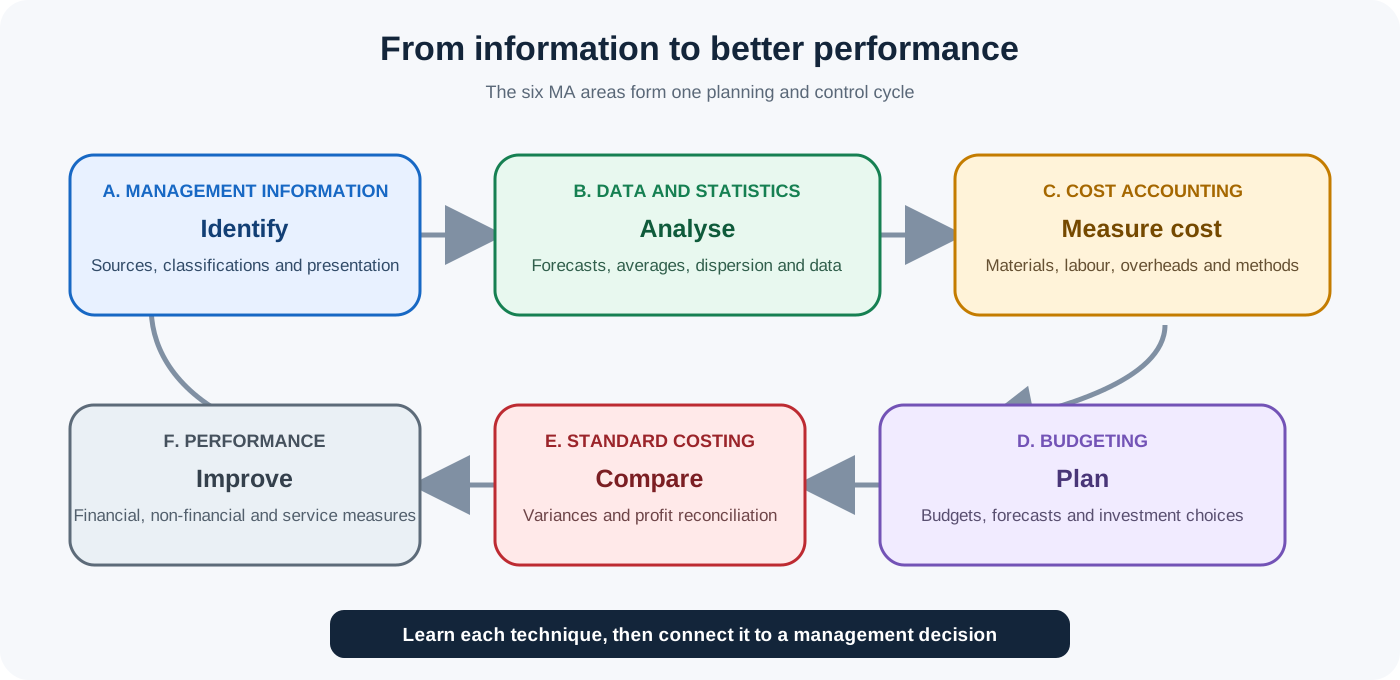
A. Management information
Know the purpose and limitations of management accounting, sources and qualities of data, cost classifications, cost behaviour, responsibility centres and suitable ways to present information.
B. Data analysis and statistical techniques
Cover sampling, high-low analysis, correlation and regression, time series, index numbers, averages and dispersion, expected values, normal distributions, big data and spreadsheets. These techniques support forecasting and budgeting rather than existing in isolation.
C. Cost accounting techniques
Learn materials, labour and overhead accounting; inventory control; absorption and marginal costing; job, batch, process and service costing; joint and by-products; and the principles of ABC, target costing and life-cycle costing.
D. Budgeting
Prepare functional, cash and master budgets, flex budgets and understand behavioural issues. Investment appraisal covers interest, discounting, payback, NPV and IRR.
E. Standard costing
Build standard costs, calculate and interpret sales, material, labour and overhead variances, and reconcile budgeted with actual profit or contribution.
F. Performance measurement
Use financial and non-financial indicators, the balanced scorecard, economy, efficiency and effectiveness, cost reduction and value analysis. Understand the special problems of measuring services, public-sector and not-for-profit organisations.
MA pass rule: for every technique, be able to state its purpose, set up the calculation, obtain a sensible answer and explain what that answer tells management.
2. Know the exam structure
MA is a two-hour on-demand computer-based exam. All questions are compulsory and the pass mark is 50%.
| Section | Structure | Marks | Study implication |
|---|---|---|---|
| A | 35 objective-test questions worth 2 marks each | 70 | Questions can come from every part of the syllabus, so broad coverage matters. |
| B | 3 multi-task questions worth 10 marks each | 30 | One MTQ each examines budgeting, standard costing and performance measurement. |
The average is 1.2 minutes per mark. A useful control is about 80 to 85 minutes for Section A and 35 to 40 minutes for Section B, adjusting slightly for easier or harder questions. ACCA reports that calculation questions make up approximately half of both sections.
3. Build a reliable calculation foundation
Before using the calculator, write the required method, then insert labelled data and units. This exposes mistakes before they become answers.
- Keep units consistent: units, batches, hours, kilometres, percentages and $000 are not interchangeable.
- Match the period: convert monthly, quarterly and annual figures before combining them.
- Keep full precision: retain calculator values and round only the final answer as instructed.
- Check the sign and direction: ask whether a variance should be favourable or adverse and whether a cost or profit should rise or fall.
- Estimate the scale: an approximate mental answer helps identify an extra zero, inverted ratio or percentage entered as a whole number.
Learn what is provided on the MA formula sheet, but practise using it. A supplied formula saves memory; it does not tell you which figures belong in it.
4. Study in a dependency order
MA topics build on one another. A productive order is:
- management information, data sources, cost classification and cost behaviour;
- materials, labour, overheads and basic cost records;
- absorption, marginal, job, batch, process and service costing;
- statistics, forecasting, spreadsheets and data analysis;
- functional, cash, flexible and investment budgets;
- standard costs, variances and profit reconciliation; and
- financial, non-financial and public-sector performance.
If an advanced question goes wrong, trace the dependency. A variance problem may really be a weak standard-cost problem; a cash budget error may come from misunderstanding payment timing; a performance ratio error may begin with incorrect cost classification.
5. Use OpenTuition as an active study system
- Read the matching chapter in the free MA notes.
- Watch the corresponding MA lecture and work every example before the tutor completes it.
- Close the solution and reproduce the method from a blank page.
- Attempt the related MA practice questions without help.
- Record the cause of every error and reattempt a fresh question later.
Add a current revision kit for the volume of exam-standard practice required. Watching a calculation is not the same as performing it, and rereading a familiar answer is not a reattempt.
6. Master calculation families, not isolated questions
| Family | Patterns to practise |
|---|---|
| Cost behaviour and data | High-low, linear equations, regression, time series, indices, averages and dispersion. |
| Resources and overheads | Inventory levels and valuation, labour costs, allocation, apportionment, reapportionment and absorption. |
| Costing methods | Marginal versus absorption profit, job and batch costs, process losses, joint products and service cost units. |
| Budgets and investment | Functional and cash budgets, flexing, relevant cash flows, compounding, discounting, NPV, IRR and payback. |
| Standards and variances | Build the standard first, calculate each variance, interpret it and reconcile profit or contribution. |
| Performance | Ratios, balanced scorecard indicators, economy, efficiency, effectiveness and non-financial measures. |
For each family, practise questions that change the wording and missing variable. Formula recognition is useful, but flexible understanding is what lets you solve an unfamiliar version.
7. Use one method for every calculation question
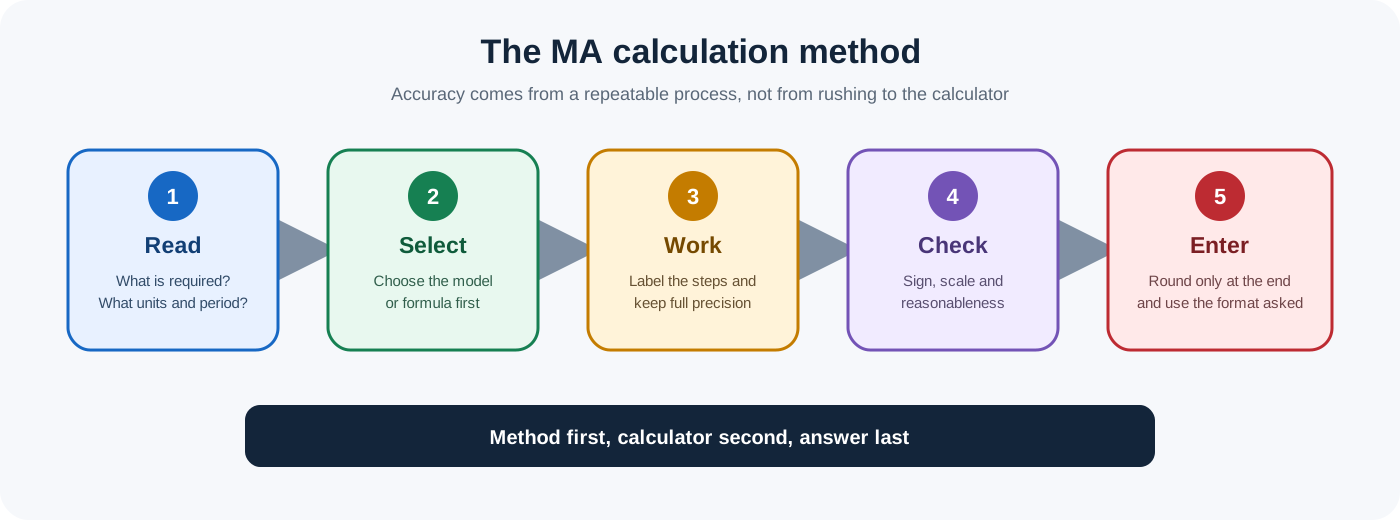
The CBE marks the response entered, so clear rough workings are for your control rather than for method marks. Use them to keep intermediate figures organised and make a final sense-check possible.
Read the required format carefully. The system may ask for dollars, units, a percentage or a value to a specified number of decimal places. Complete the whole calculation before selecting a multiple-choice answer; a plausible distractor may represent an unfinished intermediate figure.
8. Prepare for Section A breadth
Section A can test every syllabus area through multiple choice, multiple response, matching and number entry. Mix narrative and calculation questions from early in your studies. The latest examiner's report says candidates performed slightly better on narrative questions and identified number entry as a weakness.
If a question appears difficult, identify the topic and required output, eliminate impossible choices and move on before it consumes several other mark opportunities. Attempt every question: there is no negative marking.
9. Prepare deliberately for the three MTQs
Section B gives you a clear revision framework:
- Budgeting: practise linked functional and cash budgets, flexed budgets, investment appraisal and interpretation. Budgeting MTQs can also draw on analytical forecasting techniques.
- Standard costing: establish standards, calculate variances, interpret causes and reconcile budgeted with actual profit or contribution.
- Performance measurement: calculate and interpret indicators and select suitable financial or non-financial measures for commercial, service and not-for-profit contexts.
Spreadsheet information can appear in any MTQ. Read each task separately and do not assume an answer from one task is required for the next. Review all response boxes before leaving the MTQ.
10. Turn the latest examiner feedback into habits
- Cover the whole syllabus. Section A prevents safe question-spotting.
- Practise number entry. Set up, calculate, round and enter the requested value accurately.
- Read every requirement twice. Check units, time period, precision and whether the question asks for cost, profit, cash or a performance measure.
- Finish the calculation. Do not select an intermediate result merely because it appears among the options.
- Ask whether the answer is reasonable. Use business sense to detect a technical or calculator error.
- Protect your time and attempt everything. Return to difficult questions after securing accessible marks.
11. An eight-week MA study plan
| Week | Main focus | Required output |
|---|---|---|
| 1 | Information, data, cost classification and behaviour | Classify costs and information; practise high-low and presentation questions. |
| 2 | Materials, labour and overheads | Complete inventory, labour and overhead accounting sets. |
| 3 | Costing methods | Practise marginal, absorption, job, batch, process and service costing. |
| 4 | Statistics and forecasting | Complete regression, time series, index, average and dispersion questions. |
| 5 | Budgeting and investment appraisal | Prepare linked budgets and complete timed investment calculations. |
| 6 | Standard costing and variances | Calculate and interpret variances, then reconcile profit. |
| 7 | Performance measurement and mixed revision | Apply financial and non-financial measures to varied organisations. |
| 8 | MTQs and full mocks | Complete timed exams, analyse errors and reattempt weak families. |
12. Become exam-ready
Use the OpenTuition MA revision mock and ACCA's current specimen and practice materials under the two-hour limit. After each mock, classify every error as missing knowledge, wrong method, data extraction, unit or timing error, calculator error, rounding, interpretation or time pressure.
You are ready when you can complete mixed Section A sets accurately, handle all three MTQ areas, explain why each method is appropriate and achieve a safe pass in timed mocks without relying on notes.
13. MA resources to use
- OpenTuition ACCA MA home
- Free MA notes
- Free MA lectures
- MA practice questions
- MA revision lectures
- MA revision mock exam
- MA flashcards
- Ask the MA Tutor forum
- OpenTuition AI Tutor for MA
- ACCA MA/FMA syllabus and study guide: September 2026 to June 2027
- Latest ACCA MA/FMA examiner's report: September 2024 to August 2025
- ACCA MA/FMA essentials on one page
The MA pass formula: understand the purpose, select the method, calculate carefully, check the result and practise until that sequence is automatic.