

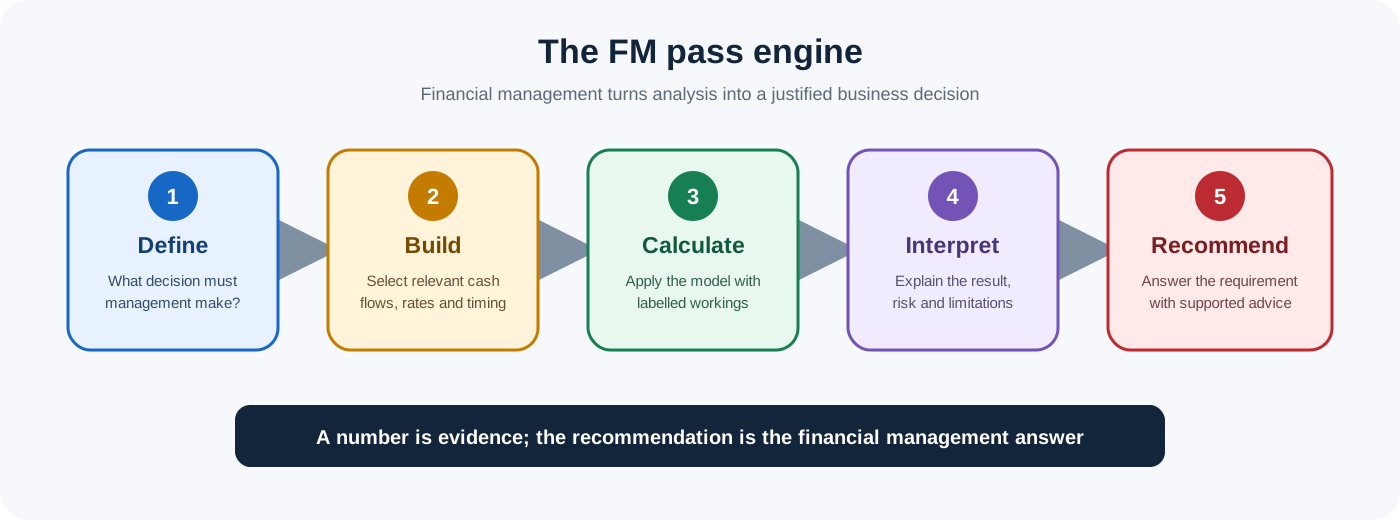
ACCA Financial Management (FM) is not mainly a formula exam. It is a decision exam in which numbers provide evidence. You must decide which cash flows, values, rates and risks matter, calculate them accurately, explain what the result means and give advice that answers the requirement.
This is why students can know many formulae and still struggle. A number without a clear basis may be wrong; a correct number without interpretation is unfinished; and a discussion that ignores the scenario is unlikely to earn enough marks. The successful FM student learns to think like the finance manager in the question.
This is the FM exam study guide. It explains how to build the technical knowledge, decision-making method and exam technique needed for a pass. For the separate resource-by-resource workflow, see How to Study for ACCA FM Using OpenTuition.
Reviewed 15 July 2026 for the ACCA FM syllabus applicable from September 2026 to June 2027.
1. Understand what FM is really examining
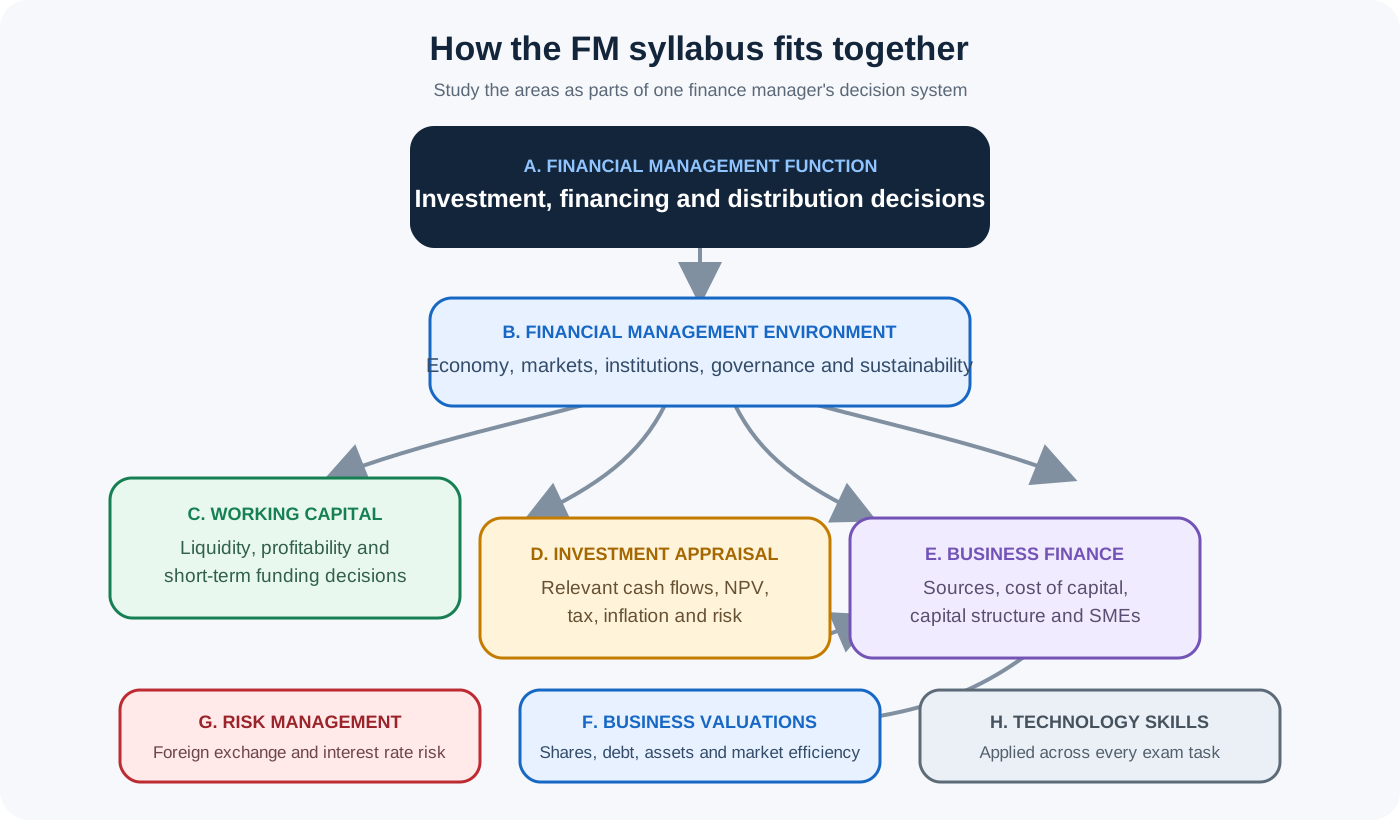
FM develops the management accounting foundation into the work of a finance manager. The central purpose is to support investment, financing and distribution decisions while considering shareholder wealth, other stakeholders, risk and the economic environment.
The current syllabus has eight connected capabilities:
A. Financial management function
This area covers the role and purpose of financial management, financial objectives, corporate strategy, stakeholders, objectives in not-for-profit organisations and the relationship between investment, financing and dividend decisions.
How to study it: use it as the framework for the rest of FM. Ask who is making the decision, what objective is being pursued and which stakeholders or constraints could change the recommendation. Do not reduce shareholder wealth maximisation to a definition; understand why timing, risk and future cash flows matter.
B. Financial management environment
You must understand the economic environment, financial markets, financial institutions and money markets in which decisions are made. The syllabus also connects financial management to governance, sustainability and environmental considerations.
How to study it: connect each institution or market to its financial purpose. For example, know why a business uses a money-market instrument, what a change in interest rates may do to financing and investment, and why governance or sustainability can affect value and risk.
C. Working capital management
This covers the nature and importance of working capital, the cash operating cycle, management of inventory, receivables, payables and cash, working capital needs and short-term funding strategies.
How to study it: treat every policy as a balance between liquidity, profitability and risk. Learn the operational reason for a change before calculating its financial effect.
D. Investment appraisal
You must apply investment appraisal techniques, deal with inflation and taxation in discounted cash flow, assess risk and uncertainty, and evaluate more specialised decisions such as lease or buy, asset replacement and capital rationing.
How to study it: master relevant cash flows and their timing before concentrating on discounting. Most serious errors begin in the cash-flow model, not in the arithmetic of a discount factor.
E. Business finance
This area includes sources of finance, raising finance, the cost of capital, capital structure and financing for small and medium-sized entities.
How to study it: compare finance by purpose, maturity, risk, cost, control and flexibility. Then learn the valuation methods that produce market-value costs and weights for WACC.
F. Business valuations
You must apply methods for valuing businesses, shares, debt and assets and understand the implications of market efficiency.
How to study it: identify what is being valued and why before selecting a model. A dividend valuation model, earnings-based value, discounted cash flow value and asset-based value make different assumptions and answer different questions.
G. Risk management
This covers the causes of foreign exchange and interest rate risk and the internal and external methods available to manage those exposures.
How to study it: identify the exposure first. Decide whether the company will receive or pay, in which currency or at which type of interest rate, and when. Only then select and evaluate a hedge.
H. Employability and technology skills
FM is a computer-based exam. You are expected to navigate exhibits, work efficiently in a spreadsheet or response area, show a professional calculation trail and communicate advice clearly. These skills are assessed through the technical requirements rather than as a separate theory topic.
Study rule: for every topic, be able to answer five questions: What decision is being made? Which inputs are relevant? Which method applies? What does the result mean? What should management do?
2. Know the FM exam before planning your study
FM is a three-hour computer-based exam. All questions are compulsory and the pass mark is 50%. Before the exam begins, candidates receive an additional 10 minutes to read the instructions. A formula sheet and discount and annuity factor tables are provided.
| Section | Structure | Marks | What this means for study |
|---|---|---|---|
| A | 15 objective test questions worth 2 marks each | 30 | You need accurate knowledge and efficient calculations across the entire syllabus. |
| B | 3 cases, each containing 5 objective test items worth 2 marks | 30 | You must apply related principles to information in a shared scenario. |
| C | 2 constructed response questions worth 20 marks each | 40 | You need visible workings, developed discussion and justified advice. |
Section C questions will mainly come from working capital management, investment appraisal and business finance. Sections A and B can examine any syllabus area, including the financial environment, valuations and risk management. The exam contains both computational and discursive elements, and some questions use a scenario or case-study approach.
A sensible time plan
With 180 minutes for 100 marks, the basic rate is 1.8 minutes per mark. A useful section control is:
- 54 minutes for Section A;
- 54 minutes for Section B; and
- 72 minutes for Section C - approximately 36 minutes for each 20-mark question.
Some objective questions will take less time and others more. The important discipline is to protect Section C, answer every objective item and avoid spending several minutes chasing two marks when you could be earning marks elsewhere.
The formula sheet saves memory, not understanding. You still need to know what each variable represents, when a formula is appropriate, whether the inputs must be market values or book values, and what the result tells management.
3. Repair the MA foundation before building FM on top
ACCA identifies Management Accounting (MA) as underpinning knowledge for FM. If basic cost behaviour, cash flows, probability or algebra are weak, an FM technique can appear more difficult than it really is.
Before the main course, check whether you can:
- distinguish cash flow from profit and relevant from irrelevant cost;
- separate fixed, variable and stepped costs;
- use contribution and understand opportunity cost;
- apply percentages, growth rates, indices and simple algebra confidently;
- calculate an expected value and interpret probability information;
- understand the time value of money at a basic level;
- calculate and interpret common performance and liquidity ratios; and
- work consistently with units such as dollars, thousands and millions.
Test the foundation with short questions from a blank page or spreadsheet. Repair a specific weakness using the relevant OpenTuition MA material, then return to FM. Do not postpone the whole course while passively revising every MA chapter.
A spreadsheet does not correct a poor financial model. If the wrong cash flow, date, rate or value enters the calculation, an elegant formula will simply produce the wrong answer faster.
4. Learn FM in an order that builds decision-making ability
The OpenTuition course provides a complete teaching sequence. The following stages explain how the knowledge should develop:
| Study stage | Main focus | Capability you are building |
|---|---|---|
| Purpose and context | Financial objectives, stakeholders, environment and markets | Understand what the finance manager is trying to achieve. |
| Short-term decisions | Working capital and short-term finance | Balance liquidity, profitability and risk. |
| Long-term investment | Relevant cash flows, NPV, tax, inflation and uncertainty | Decide whether an investment creates value. |
| Long-term finance | Sources of finance, cost of capital and capital structure | Assess how the business should fund its activities. |
| Value and risk | Business valuation, foreign exchange and interest rate risk | Connect financial choices to value and exposure. |
| Integration | Mixed objective tests and timed Section C questions | Apply the whole syllabus under CBE conditions. |
Question practice belongs inside every stage. Learn a manageable block, attempt questions without the solution, diagnose the exact weakness and reattempt later. Waiting until every lecture is complete turns revision into a race to learn how to answer questions.
5. Use OpenTuition as an active FM study system
OpenTuition gives you the teaching, notes, questions and revision support, but you must convert them into independent performance.
Prepare with the notes
Open the matching chapter in the free FM notes. Scan the learning objectives, model and examples. Identify the business decision the chapter addresses. Do not attempt to memorise every formula before understanding its purpose.
Learn with the lecture
Watch the corresponding FM lecture with the notes beside you. Pause before a key step and predict the next cash flow, formula or conclusion. Write down why the tutor includes an item or chooses a method, not only the final calculation.
Attempt from a blank page
Use the FM practice questions immediately after the topic. Close the solution. Set up the timeline, workings or answer structure independently. Looking at the first line of the answer changes a recall test into a recognition exercise and hides the real weakness.
Debrief the cause, not only the score
Classify each material loss of marks:
- knowledge: you did not know the relevant principle or relationship;
- model: you selected the wrong technique or included an irrelevant input;
- timing: a cash flow, tax effect, inflation adjustment or discount factor was placed in the wrong period;
- basis: you confused nominal with real, market with book value, or a reduction by an amount with a reduction to an amount;
- calculation: the method was sound but the arithmetic, sign, unit or spreadsheet formula was wrong;
- discussion: you stated theory without applying it to the scenario or developing the effect;
- requirement: you missed a task, instruction verb, mark allocation or conclusion; or
- CBE technique: your workings were hard to follow or the exam tools slowed you down.
Record the correction as a usable rule. "Use D1, the next dividend, in the dividend growth model" is useful. "Cost of equity weak" is not.
Reattempt after a delay
Return to the weak requirement several days later without the answer. Later, attempt a related question under strict timing. Improvement means you can rebuild the method and explain the decision independently.
6. Treat calculations as decision models
A reliable FM working begins before the calculator. Use the following model for every substantial calculation:
- Purpose: state what is being measured or compared.
- Inputs: identify the relevant cash flows, values, rates and assumptions.
- Basis: check dates, units, tax status and whether figures are nominal, real, market or book values.
- Method: use a labelled formula or structured working.
- Interpretation: explain what the result says about value, liquidity, profitability or risk.
- Decision: answer the requirement and recognise an important limitation where relevant.
Estimate the direction of the answer before calculating. If a company pays customers to settle sooner, receivables and financing cost should fall but discount cost should rise. If a project adds a large cash outflow, NPV should fall. This reasonableness check catches wrong signs and wrong bases.
Use dimensions as a control. A percentage multiplied by a value gives a value; days divided by 365 gives a fraction of a year; a cash flow divided by a cost of capital may produce a capital value. Keep thousands and full dollars consistent throughout a working.
7. Master working capital as a business system
Working capital questions connect operations to finance. Inventory, receivables, payables and cash are not isolated balances: together they affect the cash operating cycle, funding need, liquidity, profitability and risk.
Start with the operating story
Ask how the business buys, produces, sells and collects cash. A longer inventory period may result from deliberate buffer stock, weak demand or poor control. A longer receivables period may support sales growth or reveal deteriorating collection. A longer payables period may preserve cash but damage supplier relationships or lose settlement discounts.
Use ratios as evidence, not labels
Calculate inventory, receivable and payable periods consistently using the information specified. Compare the movement with policy, prior performance or the industry. Then explain the likely cause and consequence. Avoid stating that an increase is automatically good or bad.
Evaluate policy changes consistently
For an early settlement discount, stricter credit policy or factoring proposal, use either a current-versus-revised comparison or a clear incremental cost-benefit approach. Do not mix the two. Apply each percentage to the correct base: sales, receivables or the factor's advance may all be different figures.
Where the proposal changes receivables, identify the change in the investment financed and calculate the financing effect. Include relevant fees, discounts, bad-debt changes, administration savings and sales effects. Read whether a balance falls by an amount or falls to an amount. Finish with advice based on your own result.
Understand policies and models
Know the trade-off between aggressive, matching and conservative approaches to financing working capital. Learn the assumptions and meaning of inventory and cash-management models, including when they are useful and what real-world factors they omit. The formula sheet is not a substitute for knowing why a model works.
8. Build investment appraisal from relevant cash flows
Investment appraisal is a frequent Section C area because it integrates many FM skills. The safest approach is to construct the cash-flow timeline before discounting anything.
Identify relevant incremental cash flows
Include future cash flows that change because the project is accepted. Exclude sunk costs and non-cash accounting charges. Include opportunity costs, changes in working capital and relevant side effects. Separate the initial investment, operating years and terminal flows such as disposal proceeds and working-capital recovery.
Keep inflation consistent
If specific inflation rates are given, inflate the relevant cash flows from the stated price base and discount nominal cash flows at a nominal cost of capital. If working in real terms, keep both cash flows and discount rate real. Do not combine real cash flows with a nominal rate.
Place taxation in the correct period
Read whether tax is paid in the same year or in arrears. Calculate taxable cash-flow effects and capital-allowance benefits using the rules provided. A correct tax percentage in the wrong year produces an incorrect present value.
Use NPV as the main value decision
Net present value measures the increase or decrease in shareholder wealth, subject to the assumptions in the model. A positive NPV normally supports acceptance. Show the cash flow, discount factor and present value clearly by year, then state the decision.
Know the strengths and weaknesses of IRR, payback and accounting rate of return. Do not force every method to agree. For risk and uncertainty, distinguish sensitivity analysis, expected values and probability-based approaches and explain what each reveals. Also practise lease-or-buy, replacement and capital-rationing decisions as distinct models rather than small variations of one NPV table.
Build the undiscounted cash-flow model first. Discounting cannot rescue a missing working-capital flow, a sunk cost, tax in the wrong year or inconsistent inflation.
9. Understand business finance and the cost of capital
Business finance questions ask both where money can come from and what that finance costs. Begin with the company's purpose, maturity, size, risk, security, cash-flow capacity and desire to retain control.
Compare sources in context
For equity, retained earnings, debt, leasing or shorter-term sources, discuss relevant advantages and disadvantages for the scenario. Avoid generic lists. A growing private company, a listed company making an acquisition and a small entity with limited security do not face the same choices.
Calculate component costs correctly
For equity, distinguish the dividend growth model from CAPM and know what each assumes. In the dividend model, use the next dividend, D1, rather than the dividend just paid, D0. For debt, identify the instrument before calculating: irredeemable, redeemable and convertible debt require different treatment. Use after-tax debt costs where appropriate.
Use market values in WACC
WACC normally uses the market values of equity and debt because it estimates the return currently required by investors. Reserves are part of equity and are not a separate source with a separate market-value weight. Keep every value in consistent units and show the component costs and weights before the final calculation.
Learn capital structure as a developing argument
Understand the traditional view, Modigliani and Miller without tax, Modigliani and Miller with corporate tax, and the effect of market imperfections such as financial distress, agency issues and information asymmetry. A strong discussion explains how the theories connect and why an optimal gearing level cannot be selected by repeating that debt is cheaper. Finish with a scenario-based conclusion, not a memorised slogan.
10. Do not neglect valuation and risk management
Valuation and risk can be tested in Sections A and B even when Section C focuses elsewhere. Omitting them puts 60 broad-syllabus marks at risk.
Business and security valuation
For each model, know the required inputs, assumptions and appropriate use:
- asset-based valuation focuses on the value of identifiable net assets;
- earnings-based valuation applies a suitable earnings multiple;
- dividend-based valuation reflects expected dividends and investor return;
- discounted cash flow valuation focuses on future cash-generation; and
- debt valuation depends on the promised interest, redemption terms, timing and required return.
Understand weak, semi-strong and strong forms of market efficiency and their implications. Do not assume market prices are either perfectly correct or completely useless; answer within the form and scenario stated.
Foreign exchange risk
First decide whether the company will receive or pay foreign currency and on which date. Work out whether the business fears the currency strengthening or weakening. Then compare an internal technique or external hedge such as a forward contract or money-market hedge using the information provided.
Interest rate risk
Identify whether the company is borrowing or investing and whether the exposure is to rising or falling rates. Understand matching, smoothing and the main hedging instruments at the level required by the syllabus. State the financial effect being protected, rather than merely naming a product.
11. Prepare for Sections A and B: breadth, reading and speed
Sections A and B provide 60 marks and can cover the whole syllabus. They test details that are easy to neglect when revision concentrates only on large Section C calculations.
For objective test practice:
- read whether the requirement asks for the correct or incorrect statement;
- identify dates, units, tax treatment and the required basis before calculating;
- read every option in multiple-response questions because more than one may be correct;
- calculate independently rather than selecting the closest-looking answer;
- for a shared case, decide which facts apply to each separate item;
- use estimation and elimination without turning them into guessing;
- answer every item and move on when the time cost becomes unreasonable; and
- practise mixed sets so the topic is not announced before the question.
Use FM flashcards for definitions, relationships and fast retrieval. They support question practice; they do not replace application and calculation.
12. Prepare for Section C: make every mark visible
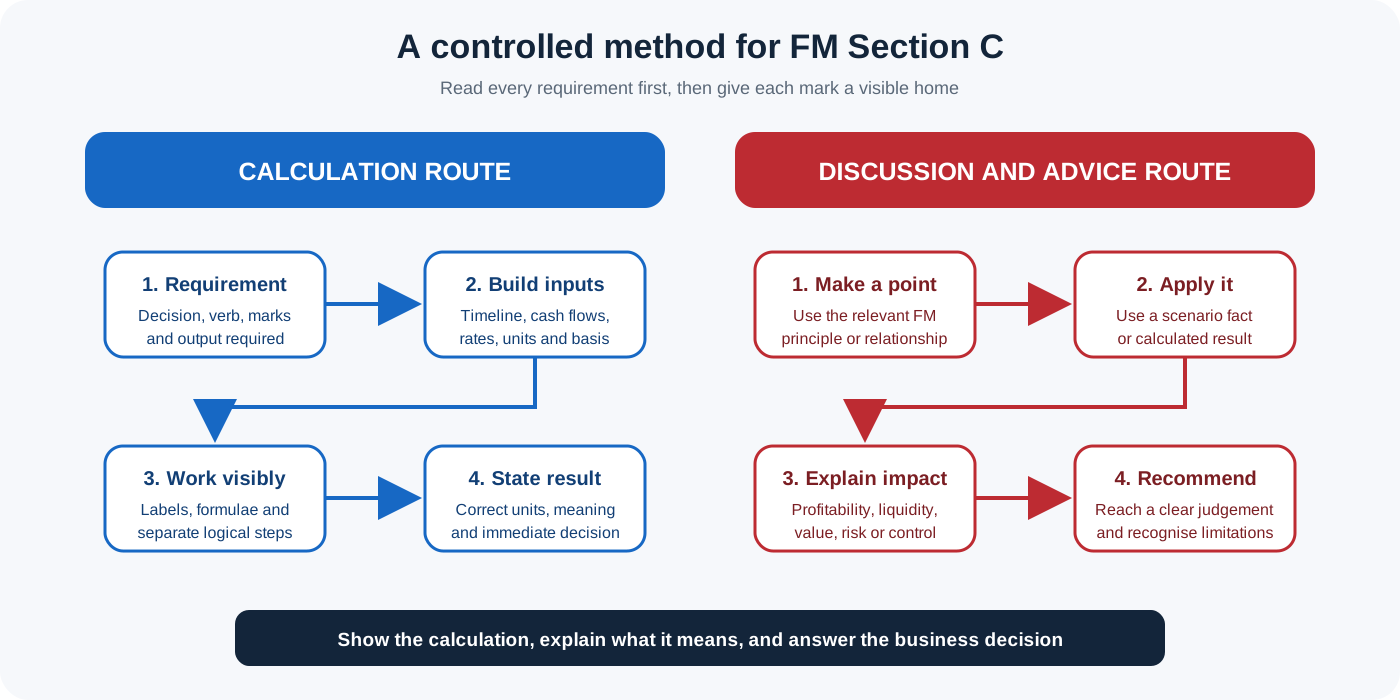
Each Section C question is worth 20 marks and should receive approximately 36 minutes. Read all requirements before reading the scenario in detail. Identify the instruction verb, decision, separate tasks and mark allocation. Set up headings or workings so every task has a visible home.
For a calculation requirement
State the purpose of the working, organise the inputs and use spreadsheet formulae with clear row labels. Break a long calculation into reviewable steps. Avoid putting a complete solution into one cell or performing important work only in the calculator. If an early figure is wrong, continue consistently: visible workings can allow method and consequential credit.
For a discussion or advice requirement
Use short paragraphs, each containing a relevant point, application to a scenario fact or result, and an explained business effect. If the verb is "discuss", develop the reason, benefit, drawback or consequence. One-word advantages and disadvantages are rarely enough. Finish with a clear recommendation when requested.
Use the CBE workspace professionally
Practise switching between exhibits, spreadsheet and response area. Label assumptions, keep units consistent and place the conclusion where the marker can see it. Your answer does not need elaborate formatting, but it must be easy to follow.
13. Turn the latest examiner feedback into study habits
The September/December 2025 examiner's report provides several lessons that should directly change your practice:
- Study the entire syllabus. Weakness in inflation, the economic environment and cash-management models showed the danger of selective study.
- Read the basis precisely. Distinguish a value falling by an amount from falling to an amount and apply percentages to the correct base.
- Use one consistent evaluation method. In a working-capital proposal, do not combine parts of an incremental approach with parts of a current-versus-revised comparison.
- Show all important workings. The marker can award method and follow-through marks only when the calculation trail is visible.
- Label spreadsheet work. Clear rows and separate steps are safer than concentrating too much work in one cell.
- Identify the instrument before valuing it. Redeemable, irredeemable and convertible debt do not use the same method.
- Use market values and consistent units in WACC. Do not treat reserves as a separate source of finance.
- Structure theory answers. Connect capital-structure theories, apply market imperfections and reach a reasoned conclusion.
- Develop discussion points. Explain the scenario-specific effect rather than naming a generic benefit.
- Give advice based on your result. State which option is preferred and why, even if you are uncertain about an earlier figure.
After attempting a relevant question in the ACCA Practice Platform, compare your response with both the solution and examiner commentary. Convert each relevant weakness into a rule for the next attempt.
14. A realistic ten-week FM study plan
This plan assumes steady weekly study. Keep one cumulative review session each week so older topics remain active while new ones are added.
| Week | Main work | Required output |
|---|---|---|
| 1 | MA diagnostic; financial management function and objectives | Repair specific foundation gaps and complete a mixed short test. |
| 2 | Economic environment, markets and institutions | Create a context map and answer scenario-based objective questions. |
| 3 | Working capital cycles, ratios and policies | Complete one full policy evaluation with a supported recommendation. |
| 4 | Inventory, receivables, payables and cash models | Complete mixed calculations and explain the assumptions of each model. |
| 5 | Investment appraisal foundations | Build NPV timelines from blank spreadsheets using relevant cash flows. |
| 6 | Tax, inflation, risk and specialised investment decisions | Complete a timed 20-mark investment appraisal question and debrief it. |
| 7 | Sources of finance and cost of capital | Calculate component costs and market-value WACC, then advise on finance. |
| 8 | Capital structure, valuations and market efficiency | Write one structured theory answer and complete a mixed valuation set. |
| 9 | Foreign exchange and interest rate risk | Identify exposures and complete mixed Section A and B cases. |
| 10 | Full integration and mock exams | Complete timed mocks, finalise the error log and target the last weak areas. |
If you have more time, spread the stages out and add question volume. If you have less time, combine teaching sessions but do not remove timed practice, whole-syllabus testing or mock debriefing.
15. Use mocks to improve decisions under pressure
A mock is a measurement exercise, not a performance. Use the OpenTuition FM mock exam and ACCA Practice Platform under realistic conditions. Use the permitted formulae and tables, obey the time limit and do not consult notes or solutions.
Debrief in four passes:
- Coverage: which topics or small details were not secure?
- Method: where did you choose the wrong input, rate, value or model?
- Communication: where were workings, application or conclusions too weak to earn available marks?
- Time: which question absorbed time and what decision should you make earlier next time?
Then reattempt the weakest requirement without the answer. A second mock is valuable only if the first one changes what you do.
16. Final readiness checklist
You are approaching exam readiness when you can:
- complete mixed objective questions without being told the topic first;
- explain the purpose and assumptions of the main formulae on the formula sheet;
- build an investment cash-flow timeline from a blank spreadsheet;
- evaluate a working-capital proposal using one consistent method;
- calculate component costs and market-value WACC with correct debt treatment;
- identify a foreign exchange or interest rate exposure before choosing a hedge;
- produce visible, labelled workings in the CBE environment;
- develop discussion points using scenario evidence and financial effects;
- complete each 20-mark Section C question in about 36 minutes; and
- finish a full mock, answer every question and explain how you will correct the main weaknesses.
17. FM resources to use
- OpenTuition ACCA FM home
- Free FM lecture notes
- Free FM lectures
- FM practice questions
- FM revision lectures
- FM revision mock exam
- FM flashcards
- Ask the FM Tutor forum
- OpenTuition AI Tutor for FM
- ACCA FM syllabus and study guide: September 2026 to June 2027
- Latest ACCA FM examiner's report: September/December 2025
- ACCA FM essentials on one page
Your aim is not to memorise a collection of calculations. Learn to build a reliable financial model, interpret its result and give advice that answers the scenario. That is the habit that turns FM knowledge into pass marks.